Metagenesis is the result of
polymorphism. Polymorphism is
the phenomenon of division of
labour, i.e. different functions
are assigned to different
individuals, rather than to the
parts of organism.
Some authors considered Metagenesis and alternation of
generation as same thing, but in strict sense both are
different. The alternation of generation is related with two
forms which are genotypically different, one is diploid
and other is haploid. The diploid form can be produced by
either sexual or asexual methods, but haploid form is
produced by asexual method only. So the alternation of
generation is a phenomena in which a diploid individual
alters with the haploid individual, both may be isomorphic
or an isomorphic, but can exist their life without the other
form, mean both form are not obligatory to complete the
life cycle.
But in case of Metagenesis the
existing individual are
genetically same, but they differ
morphologically and
functionally. Both forms are
complementary to each other to
complete their life cycle and life
activities.
METAGENESIS
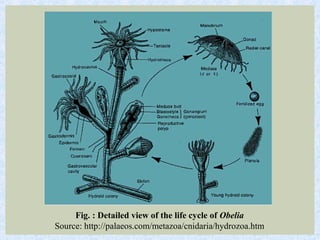
The life cycle of Obelia represents a remarkable
example of alternation of generation where the
asexual and sessile phase of Obelia reproduces
asexually by budding and gives rise to sexual and
free-swimming medusa. The medusa reproduces
sexually and forms new polyps.
Thus, a diploid asexual hydroid phase alternates
with another diploid sexual medusoid phase. This
phenomenon of alternation between two diploid
phases is termed as metagenesis.
Fig. : Detailed view of the life cycle of Obelia
Source: http://palaeos.com/metazoa/cnidaria/hydrozoa.htm
POLYMORPHISM
Thus, the life cycle of Obelia includes three distinct types of zooids;
a) Nutritive polyps – hydranths
b) Asexual reproductive polyps – blastostyles
c) Sexual reproductive polyps – medusa
This phenomenon, where Obelia is represented by structurally and
functionally different individuals, is called polymorphism. Initially
the colony of Obelia is represented by only two forms, gastrozooids
and blastozooids and is called dimorphic. Later, when gonophores
develop on the blastozooids by the process of budding, the colony is
considered trimorphic represented by three kinds of zooids.
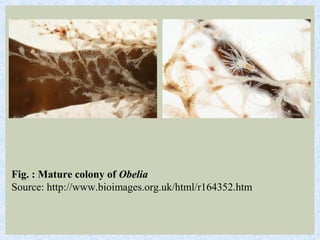
Fig. : Mature colony of Obelia
Source: http://www.bioimages.org.uk/html/r164352.htm

Coelenterates- Metagenesis

  • 2.
    Metagenesis is theresult of polymorphism. Polymorphism is the phenomenon of division of labour, i.e. different functions are assigned to different individuals, rather than to the parts of organism.
  • 3.
    Some authors consideredMetagenesis and alternation of generation as same thing, but in strict sense both are different. The alternation of generation is related with two forms which are genotypically different, one is diploid and other is haploid. The diploid form can be produced by either sexual or asexual methods, but haploid form is produced by asexual method only. So the alternation of generation is a phenomena in which a diploid individual alters with the haploid individual, both may be isomorphic or an isomorphic, but can exist their life without the other form, mean both form are not obligatory to complete the life cycle.
  • 4.
    But in caseof Metagenesis the existing individual are genetically same, but they differ morphologically and functionally. Both forms are complementary to each other to complete their life cycle and life activities.
  • 5.
    METAGENESIS The life cycleof Obelia represents a remarkable example of alternation of generation where the asexual and sessile phase of Obelia reproduces asexually by budding and gives rise to sexual and free-swimming medusa. The medusa reproduces sexually and forms new polyps. Thus, a diploid asexual hydroid phase alternates with another diploid sexual medusoid phase. This phenomenon of alternation between two diploid phases is termed as metagenesis.
  • 6.
    Fig. : Detailedview of the life cycle of Obelia Source: http://palaeos.com/metazoa/cnidaria/hydrozoa.htm
  • 7.
    POLYMORPHISM Thus, the lifecycle of Obelia includes three distinct types of zooids; a) Nutritive polyps – hydranths b) Asexual reproductive polyps – blastostyles c) Sexual reproductive polyps – medusa This phenomenon, where Obelia is represented by structurally and functionally different individuals, is called polymorphism. Initially the colony of Obelia is represented by only two forms, gastrozooids and blastozooids and is called dimorphic. Later, when gonophores develop on the blastozooids by the process of budding, the colony is considered trimorphic represented by three kinds of zooids.
  • 8.
    Fig. : Maturecolony of Obelia Source: http://www.bioimages.org.uk/html/r164352.htm