Negotiation
Skills
Kevin R. Thomas
Manager, Training & Development
x3542
Kevin.R.Thomas@williams.edu
Objectives
• You’ll learn:
– Specific steps you
can take to prepare
for any negotiation
– Best practices for
implementing a
negotiation strategy
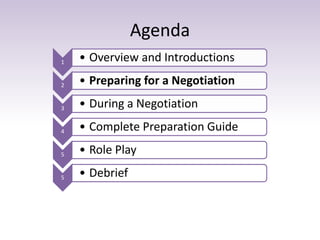
Agenda
1 • Overview and Introductions
2 • Preparing for a Negotiation
3 • During a Negotiation
4 • Complete Preparation Guide
5 • Role Play
5 • Debrief
Agenda
1 • Overview and Introductions
2 • Preparing for a Negotiation
3 • During a Negotiation
4 • Complete Preparation Guide
5 • Role Play
5 • Debrief
Norms
• Confidentiality
• Participation
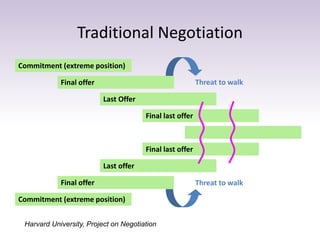
Traditional Negotiation
Commitment (extreme position)
Final offer
Last Offer
Final last offer
Commitment (extreme position)
Final offer
Last offer
Final last offer
Threat to walk
Threat to walk
Harvard University, Project on Negotiation
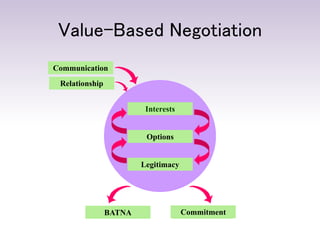
Value-Based Negotiation
Communication
Relationship
Interests
Options
Legitimacy
BATNA Commitment
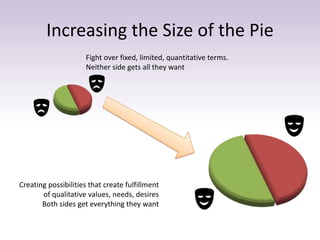
Increasing the Size of the Pie
Fight over fixed, limited, quantitative terms.
Neither side gets all they want
Creating possibilities that create fulfillment
of qualitative values, needs, desires
Both sides get everything they want
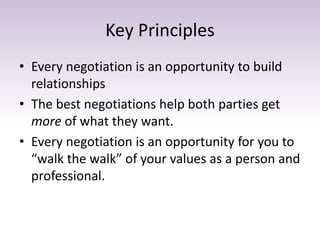
Key Principles
• Every negotiation is an opportunity to build
relationships
• The best negotiations help both parties get
more of what they want.
• Every negotiation is an opportunity for you to
“walk the walk” of your values as a person and
professional.
Agenda
1 • Overview and Introductions
2 • Preparing for a Negotiation
3 • During a Negotiation
4 • Complete Preparation Guide
5 • Role Play
5 • Debrief
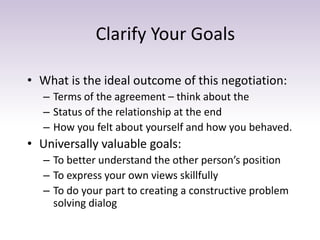
Clarify Your Goals
• What is the ideal outcome of this negotiation:
– Terms of the agreement – think about the
– Status of the relationship at the end
– How you felt about yourself and how you behaved.
• Universally valuable goals:
– To better understand the other person’s position
– To express your own views skillfully
– To do your part to creating a constructive problem
solving dialog
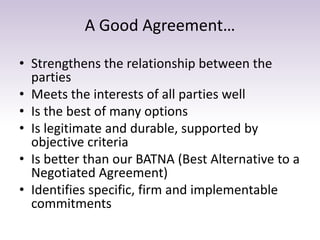
A Good Agreement…
• Strengthens the relationship between the
parties
• Meets the interests of all parties well
• Is the best of many options
• Is legitimate and durable, supported by
objective criteria
• Is better than our BATNA (Best Alternative to a
Negotiated Agreement)
• Identifies specific, firm and implementable
commitments
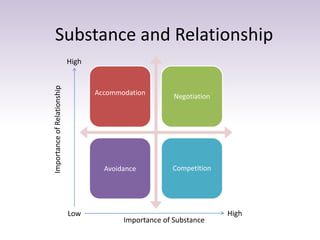
Substance and Relationship
Accommodation Negotiation
Avoidance Competition
ImportanceofRelationship
High
Low
Importance of Substance
High
Diagnose Their World
• What do you know about …
– Their hopes and fears
– Their core concerns
– Their “trading currencies”
– The influence of other stakeholders on them
– How they are likely to see you
Trading Currencies
• Any negotiation is about an exchange of value
• Value takes many forms
• Trading currencies define main categories of
value that can be exchanged.
• Understand what you have to offer
• Understand what they may have to offer
• Decide which offerings are most important for
the negotiation
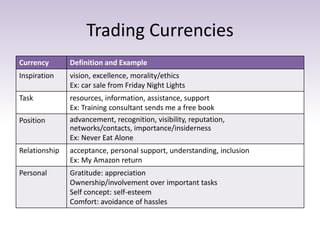
Trading Currencies
Currency Definition and Example
Inspiration vision, excellence, morality/ethics
Ex: car sale from Friday Night Lights
Task resources, information, assistance, support
Ex: Training consultant sends me a free book
Position advancement, recognition, visibility, reputation,
networks/contacts, importance/insiderness
Ex: Never Eat Alone
Relationship acceptance, personal support, understanding, inclusion
Ex: My Amazon return
Personal Gratitude: appreciation
Ownership/involvement over important tasks
Self concept: self-esteem
Comfort: avoidance of hassles
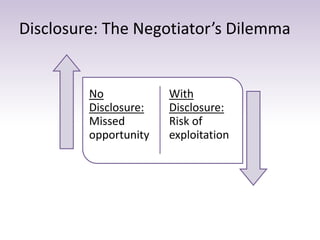
Disclosure: The Negotiator’s Dilemma
No
Disclosure:
Missed
opportunity
With
Disclosure:
Risk of
exploitation
Disclosure: Managing the Dilemma
• Prepare. Consider what you can reveal.
• Reveal the nature of your interests, but not
the intensity
• Share information reciprocally, in bite-sized
pieces
• Promote a frame of side-by-side joint
problem-solving
Objective Criteria
• Represent reasonable standards that create a
“benchmark” for what a reasonable outcome
could look like:
– Professional Standards
– Legal Precedent
– Scientific Findings
– Market Price
– Expert Opinion
BATNA
• Best Alternative to a Negotiated Agreement:
• Know Your BATNA:
– What’s next for you if you can’t come to an
agreement?
– What can you do to improve your BATNA?
• Know Their BATNA:
– What might their BATNA be?
– What could you do to find out?
Agenda
1 • Overview and Introductions
2 • Preparing for a Negotiation
3 • During a Negotiation
4 • Role Play
5 • Debrief
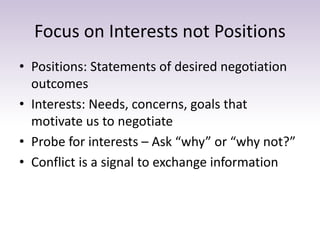
Focus on Interests not Positions
• Positions: Statements of desired negotiation
outcomes
• Interests: Needs, concerns, goals that
motivate us to negotiate
• Probe for interests – Ask “why” or “why not?”
• Conflict is a signal to exchange information
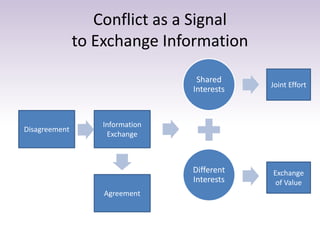
Conflict as a Signal
to Exchange Information
Disagreement
Information
Exchange
Agreement
Shared
Interests
Different
Interests
Joint Effort
Exchange
of Value
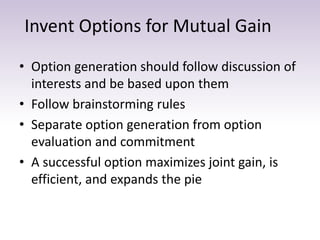
Invent Options for Mutual Gain
• Option generation should follow discussion of
interests and be based upon them
• Follow brainstorming rules
• Separate option generation from option
evaluation and commitment
• A successful option maximizes joint gain, is
efficient, and expands the pie
How to Use Objective Criteria
• Use criteria as a “sword” – “Let me show you
why this is fair.”
• Use criteria as a “shield” – “Why is that a fair
number?”
Commitments
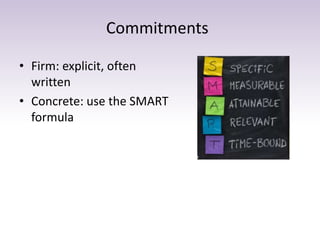
• Firm: explicit, often
written
• Concrete: use the SMART
formula
Agenda
1 • Overview and Introductions
2 • Preparing for a Negotiation
3 • During a Negotiation
4 • Complete Preparation Guide
5 • Role Play
5 • Debrief
Agenda
1 • Overview and Introductions
2 • Preparing for a Negotiation
3 • During a Negotiation
4 • Complete Preparation Guide
5 • Role Play
5 • Debrief
Agenda
1 • Overview and Introductions
2 • Preparing for a Negotiation
3 • During a Negotiation
4 • Complete Preparation Guide
5 • Role Play
5 • Debrief
Kevin R. Thomas
Manager, Training & Development
x3542
Kevin.R.Thomas@williams.edu
• Program evaluation link will be sent by email.
• You’ll get a link to a course page with all the materials.

Negotiation Skills

  • 1.
    Negotiation Skills Kevin R. Thomas Manager,Training & Development x3542 Kevin.R.Thomas@williams.edu
  • 2.
    Objectives • You’ll learn: –Specific steps you can take to prepare for any negotiation – Best practices for implementing a negotiation strategy
  • 3.
    Agenda 1 • Overviewand Introductions 2 • Preparing for a Negotiation 3 • During a Negotiation 4 • Complete Preparation Guide 5 • Role Play 5 • Debrief
  • 4.
    Agenda 1 • Overviewand Introductions 2 • Preparing for a Negotiation 3 • During a Negotiation 4 • Complete Preparation Guide 5 • Role Play 5 • Debrief
  • 5.
  • 6.
    Traditional Negotiation Commitment (extremeposition) Final offer Last Offer Final last offer Commitment (extreme position) Final offer Last offer Final last offer Threat to walk Threat to walk Harvard University, Project on Negotiation
  • 7.
  • 8.
    Increasing the Sizeof the Pie Fight over fixed, limited, quantitative terms. Neither side gets all they want Creating possibilities that create fulfillment of qualitative values, needs, desires Both sides get everything they want
  • 9.
    Key Principles • Everynegotiation is an opportunity to build relationships • The best negotiations help both parties get more of what they want. • Every negotiation is an opportunity for you to “walk the walk” of your values as a person and professional.
  • 10.
    Agenda 1 • Overviewand Introductions 2 • Preparing for a Negotiation 3 • During a Negotiation 4 • Complete Preparation Guide 5 • Role Play 5 • Debrief
  • 11.
    Clarify Your Goals •What is the ideal outcome of this negotiation: – Terms of the agreement – think about the – Status of the relationship at the end – How you felt about yourself and how you behaved. • Universally valuable goals: – To better understand the other person’s position – To express your own views skillfully – To do your part to creating a constructive problem solving dialog
  • 12.
    A Good Agreement… •Strengthens the relationship between the parties • Meets the interests of all parties well • Is the best of many options • Is legitimate and durable, supported by objective criteria • Is better than our BATNA (Best Alternative to a Negotiated Agreement) • Identifies specific, firm and implementable commitments
  • 13.
    Substance and Relationship AccommodationNegotiation Avoidance Competition ImportanceofRelationship High Low Importance of Substance High
  • 14.
    Diagnose Their World •What do you know about … – Their hopes and fears – Their core concerns – Their “trading currencies” – The influence of other stakeholders on them – How they are likely to see you
  • 15.
    Trading Currencies • Anynegotiation is about an exchange of value • Value takes many forms • Trading currencies define main categories of value that can be exchanged. • Understand what you have to offer • Understand what they may have to offer • Decide which offerings are most important for the negotiation
  • 16.
    Trading Currencies Currency Definitionand Example Inspiration vision, excellence, morality/ethics Ex: car sale from Friday Night Lights Task resources, information, assistance, support Ex: Training consultant sends me a free book Position advancement, recognition, visibility, reputation, networks/contacts, importance/insiderness Ex: Never Eat Alone Relationship acceptance, personal support, understanding, inclusion Ex: My Amazon return Personal Gratitude: appreciation Ownership/involvement over important tasks Self concept: self-esteem Comfort: avoidance of hassles
  • 17.
    Disclosure: The Negotiator’sDilemma No Disclosure: Missed opportunity With Disclosure: Risk of exploitation
  • 18.
    Disclosure: Managing theDilemma • Prepare. Consider what you can reveal. • Reveal the nature of your interests, but not the intensity • Share information reciprocally, in bite-sized pieces • Promote a frame of side-by-side joint problem-solving
  • 19.
    Objective Criteria • Representreasonable standards that create a “benchmark” for what a reasonable outcome could look like: – Professional Standards – Legal Precedent – Scientific Findings – Market Price – Expert Opinion
  • 20.
    BATNA • Best Alternativeto a Negotiated Agreement: • Know Your BATNA: – What’s next for you if you can’t come to an agreement? – What can you do to improve your BATNA? • Know Their BATNA: – What might their BATNA be? – What could you do to find out?
  • 21.
    Agenda 1 • Overviewand Introductions 2 • Preparing for a Negotiation 3 • During a Negotiation 4 • Role Play 5 • Debrief
  • 22.
    Focus on Interestsnot Positions • Positions: Statements of desired negotiation outcomes • Interests: Needs, concerns, goals that motivate us to negotiate • Probe for interests – Ask “why” or “why not?” • Conflict is a signal to exchange information
  • 23.
    Conflict as aSignal to Exchange Information Disagreement Information Exchange Agreement Shared Interests Different Interests Joint Effort Exchange of Value
  • 24.
    Invent Options forMutual Gain • Option generation should follow discussion of interests and be based upon them • Follow brainstorming rules • Separate option generation from option evaluation and commitment • A successful option maximizes joint gain, is efficient, and expands the pie
  • 25.
    How to UseObjective Criteria • Use criteria as a “sword” – “Let me show you why this is fair.” • Use criteria as a “shield” – “Why is that a fair number?”
  • 26.
    Commitments • Firm: explicit,often written • Concrete: use the SMART formula
  • 27.
    Agenda 1 • Overviewand Introductions 2 • Preparing for a Negotiation 3 • During a Negotiation 4 • Complete Preparation Guide 5 • Role Play 5 • Debrief
  • 28.
    Agenda 1 • Overviewand Introductions 2 • Preparing for a Negotiation 3 • During a Negotiation 4 • Complete Preparation Guide 5 • Role Play 5 • Debrief
  • 29.
    Agenda 1 • Overviewand Introductions 2 • Preparing for a Negotiation 3 • During a Negotiation 4 • Complete Preparation Guide 5 • Role Play 5 • Debrief
  • 30.
    Kevin R. Thomas Manager,Training & Development x3542 Kevin.R.Thomas@williams.edu • Program evaluation link will be sent by email. • You’ll get a link to a course page with all the materials.