START
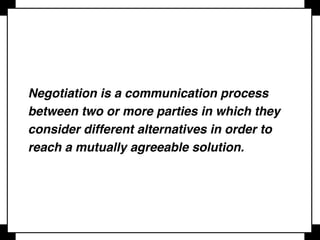
Negotiation is a communication process between
two or more parties in which they consider
different alternatives in order to reach a mutually
agreeable solution
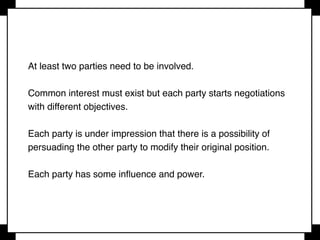
At least two parties need to be involved
Common interest must exist but each party starts negotiations with different objectives
Each party is under impression that there is a possibility of persuading the other party to modify
their original position
Each party has some influence and power
EFFECTIVE
COMMUNICATION
Be able to express your ideas and views clearly, confidently and concisely
If your message is too lengthy, disorganised, or contains errors, you can expect the message to
be misunderstood and misinterpreted
Use of poor verbal and body language can also confuse the message
Less is oftentimes more
Make sure you can deliver your message to people of different backgrounds
Source: Mindtools.com
The purpose of communication is to get your
message across and thereby convey thoughts
and ideas effectively
LISTENING
Hear what people are saying. Good listening builds a rapport and understanding with the
speaker and allows them to freely express their views.
BODY LANGUAGE
Use it and be sensitive to its use by other: eye contact, gestures,
head movements, smiling.
NEGOTIATION
The most effective way of resolving conflicts
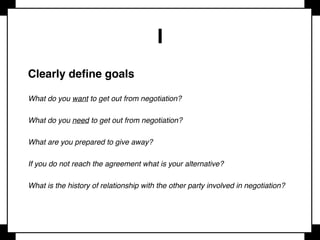
What do you want to get out from negotiation?
What do you need to get out from negotiation?
What are you prepared to give away?
If you do not reach the agreement what is your alternative?
What is the history of relationship with the other party involved in negotiation?
Clearly define goals of negotiation
It is the course of action negotiator will pursue if the current negotiation results in an impasse.
An evaluation of your best alternative to a deal is critical if you want to establish the threshold at
which you will reject an offer
The best alternative to a negotiated agreement
To determine BATNA follow these steps
1.List your alternatives
2.Evaluate your alternatives
3.Establish your BATNA
If the value of the deal proposed to you is lower than your reservation value, you are better off
rejecting the offer and pursuing your BATNA
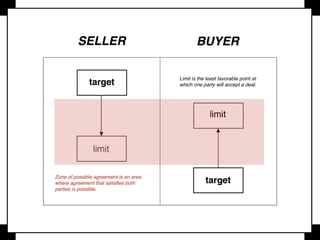
Reservation value represents the lowest valued deal you are willing to accept
Source: Harvard.edu
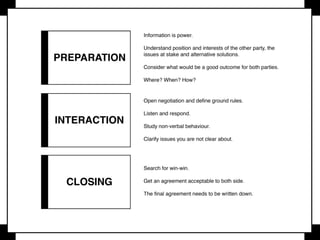
STAGES
STRATEGY
Critical elements: information, time pressure and strength
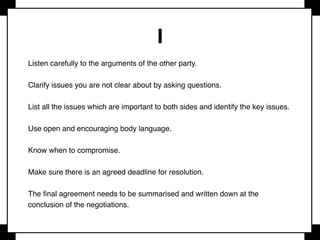
Listen carefully to the arguments of the other party
Clarify issues you are not clear about by asking questions
List all the issues which are important to both sides and identify the key issues
Use open and encouraging body language
Know when to compromise
Make sure there is an agreed deadline for resolution
The final agreement needs to be summarised and written down at the conclusion of the
negotiations
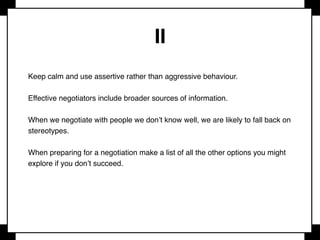
Keep calm and use assertive rather than aggressive behaviour
Effective negotiators include broader sources of information
When we negotiate with people we don’t know well, we are likely to fall back on stereotypes
When preparing for a negotiation make a list of all the other options you might explore if you
don’t succeed
SKILLED
NEGOTIATOR
Learning to be a skilled negotiator can help you make deals, solve
problems, manage conflict, and preserve relationships
You’re onstage without a script, relying on your mind and wits to come up with lines and actions
that advance the game
Should you trust your fellow players?
It seems you have no choice. You have to say something and hope you achieve the desired
reaction from your audience
Like improv performers, great negotiators have a knack for being quick on their feet. They seize
unexpected opportunities and respond swiftly to sudden threats
Source: Harvard.edu
FINAL
Don’t negotiate if not necessary
Don’t negotiate if you are not willing to walk away
Determine BATNA before the start of negotiation
Convey your thoughts and ideas effectively
The more you know about the other party, the stronger you are
Leave your ego behind
You have more power than you imagine
Know your limits
You need to master your product

Negotiation skills

  • 2.
  • 3.
    Negotiation is acommunication process between two or more parties in which they consider different alternatives in order to reach a mutually agreeable solution At least two parties need to be involved Common interest must exist but each party starts negotiations with different objectives Each party is under impression that there is a possibility of persuading the other party to modify their original position Each party has some influence and power
  • 5.
    EFFECTIVE COMMUNICATION Be able toexpress your ideas and views clearly, confidently and concisely
  • 6.
    If your messageis too lengthy, disorganised, or contains errors, you can expect the message to be misunderstood and misinterpreted Use of poor verbal and body language can also confuse the message Less is oftentimes more Make sure you can deliver your message to people of different backgrounds Source: Mindtools.com The purpose of communication is to get your message across and thereby convey thoughts and ideas effectively
  • 7.
    LISTENING Hear what peopleare saying. Good listening builds a rapport and understanding with the speaker and allows them to freely express their views.
  • 8.
    BODY LANGUAGE Use itand be sensitive to its use by other: eye contact, gestures, head movements, smiling.
  • 10.
    NEGOTIATION The most effectiveway of resolving conflicts
  • 11.
    What do youwant to get out from negotiation? What do you need to get out from negotiation? What are you prepared to give away? If you do not reach the agreement what is your alternative? What is the history of relationship with the other party involved in negotiation? Clearly define goals of negotiation
  • 12.
    It is thecourse of action negotiator will pursue if the current negotiation results in an impasse. An evaluation of your best alternative to a deal is critical if you want to establish the threshold at which you will reject an offer The best alternative to a negotiated agreement To determine BATNA follow these steps 1.List your alternatives 2.Evaluate your alternatives 3.Establish your BATNA If the value of the deal proposed to you is lower than your reservation value, you are better off rejecting the offer and pursuing your BATNA Reservation value represents the lowest valued deal you are willing to accept Source: Harvard.edu
  • 14.
  • 16.
    STRATEGY Critical elements: information,time pressure and strength
  • 17.
    Listen carefully tothe arguments of the other party Clarify issues you are not clear about by asking questions List all the issues which are important to both sides and identify the key issues Use open and encouraging body language Know when to compromise Make sure there is an agreed deadline for resolution The final agreement needs to be summarised and written down at the conclusion of the negotiations
  • 18.
    Keep calm anduse assertive rather than aggressive behaviour Effective negotiators include broader sources of information When we negotiate with people we don’t know well, we are likely to fall back on stereotypes When preparing for a negotiation make a list of all the other options you might explore if you don’t succeed
  • 19.
    SKILLED NEGOTIATOR Learning to bea skilled negotiator can help you make deals, solve problems, manage conflict, and preserve relationships
  • 20.
    You’re onstage withouta script, relying on your mind and wits to come up with lines and actions that advance the game Should you trust your fellow players? It seems you have no choice. You have to say something and hope you achieve the desired reaction from your audience Like improv performers, great negotiators have a knack for being quick on their feet. They seize unexpected opportunities and respond swiftly to sudden threats Source: Harvard.edu
  • 22.
  • 23.
    Don’t negotiate ifnot necessary Don’t negotiate if you are not willing to walk away Determine BATNA before the start of negotiation Convey your thoughts and ideas effectively The more you know about the other party, the stronger you are Leave your ego behind You have more power than you imagine Know your limits You need to master your product