
Prepared By Sumit Mehta 1
Agenda
 Introduction to Conflict
 Definition of Conflict
 Nature of Conflict
 Views on Conflict
 Types of Conflict
 Positive and Negative Conflict
 The 7 Steps to Conflict Resolution
Prepared By Sumit Mehta 2
Introduction
A conflict is a situation when the interests, needs, goals or values of
involved parties interfere with one another.
A conflict is a common phenomenon in the workplace. Different
stakeholders may have different priorities; conflicts may involve team
members, departments, projects, organization and client, boss and
subordinate, organization needs vs. personal needs. Often, a conflict is a
result of perception.
Prepared By Sumit Mehta 3
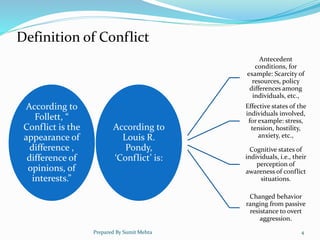
According to
Follett, “
Conflict is the
appearance of
difference ,
difference of
opinions, of
interests.”
According to
Louis R.
Pondy,
‘Conflict’ is:
Antecedent
conditions, for
example: Scarcity of
resources, policy
differences among
individuals, etc.,
Effective states of the
individuals involved,
for example: stress,
tension, hostility,
anxiety, etc.,
Cognitive states of
individuals, i.e., their
perception of
awareness of conflict
situations.
Changed behavior
ranging from passive
resistance to overt
aggression.
Definition of Conflict
Prepared By Sumit Mehta 4
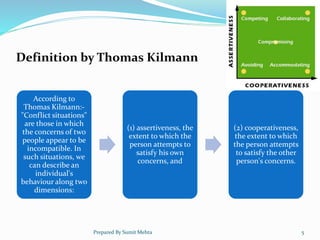
Definition by Thomas Kilmann
According to
Thomas Kilmann:-
"Conflict situations"
are those in which
the concerns of two
people appear to be
incompatible. In
such situations, we
can describe an
individual's
behaviour along two
dimensions:
(1) assertiveness, the
extent to which the
person attempts to
satisfy his own
concerns, and
(2) cooperativeness,
the extent to which
the person attempts
to satisfy the other
person's concerns.
Prepared By Sumit Mehta 5
5 different modes for responding to conflict situations by
Thomas Kilmann:
1. Competing :- assertive and uncooperative
2. Accommodating:- unassertive and cooperative
3. Avoiding :- unassertive and uncooperative
4. Collaborating :- both assertive and cooperative
5. Compromising :- moderate in both assertiveness
and cooperativeness
Prepared By Sumit Mehta 6
Competing
Competing is assertive and uncooperative—an individual
pursues his own concerns at the other person's expense.
This is a power-oriented mode in which you use whatever
power seems appropriate to win your own position—your
ability to argue, your rank, or economic sanctions.
Competing means "standing up for your rights," defending a
position which you believe is correct, or simply trying to win.
Prepared By Sumit Mehta 7
Accommodating
Accommodating is unassertive and cooperative—the complete
opposite of competing.
When accommodating, the individual neglects his own concerns to
satisfy the concerns of the other person; there is an element of self-
sacrifice in this mode.
Accommodating might take the form of selfless generosity or charity,
obeying another person's order when you would prefer not to, or
yielding to another's point of view.
Prepared By Sumit Mehta 8
Avoiding
Avoiding is unassertive and uncooperative—the person
neither pursues his own concerns nor those of the other
individual. Thus he does not deal with the conflict.
Avoiding might take the form of diplomatically
sidestepping an issue, postponing an issue until a better
time, or simply withdrawing from a threatening situation.
Prepared By Sumit Mehta 9
Compromising
Compromising is moderate in both assertiveness and cooperativeness. The objective
is to find some expedient, mutually acceptable solution that partially satisfies both
parties.
It falls intermediate between competing and accommodating. Compromising gives up
more than competing but less than accommodating. Likewise, it addresses an issue
more directly than avoiding, but does not explore it in as much depth as collaborating.
In some situations, compromising might mean splitting the difference between the
two positions, exchanging concessions, or seeking a quick middle-ground solution.
Prepared By Sumit Mehta 10
Collaborating
Collaborating is both assertive and cooperative—the complete
opposite of avoiding. Collaborating involves an attempt to work with
others to find some solution that fully satisfies their concerns.
It means digging into an issue to pinpoint the underlying needs and
wants of the two individuals.
Collaborating between two persons might take the form of exploring
a disagreement to learn from each other's insights or trying to find a
creative solution to an interpersonal problem.
Prepared By Sumit Mehta 11
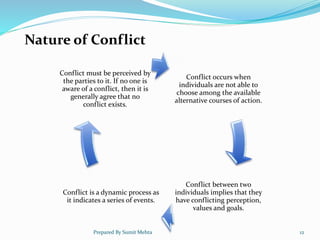
Conflict occurs when
individuals are not able to
choose among the available
alternative courses of action.
Conflict between two
individuals implies that they
have conflicting perception,
values and goals.
Conflict is a dynamic process as
it indicates a series of events.
Conflict must be perceived by
the parties to it. If no one is
aware of a conflict, then it is
generally agree that no
conflict exists.
Nature of Conflict
Prepared By Sumit Mehta 12
Who do we come into conflict with?
Prepared By Sumit Mehta 13
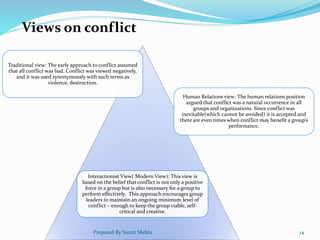
Traditional view: The early approach to conflict assumed
that all conflict was bad. Conflict was viewed negatively,
and it was used synonymously with such terms as
violence, destruction.
Human Relations view: The human relations position
argued that conflict was a natural occurrence in all
groups and organizations. Since conflict was
inevitable(which cannot be avoided) it is accepted and
there are even times when conflict may benefit a group’s
performance.
Interactionist View( Modern View): This view is
based on the belief that conflict is not only a positive
force in a group but is also necessary for a group to
perform effectively. This approach encourages group
leaders to maintain an ongoing minimum level of
conflict – enough to keep the group viable, self-
critical and creative.
Views on conflict
Prepared By Sumit Mehta 14
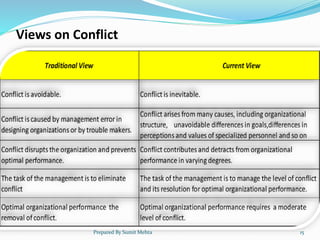
Views on Conflict
Prepared By Sumit Mehta 15
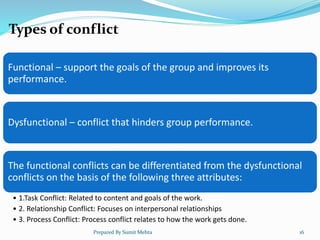
Functional – support the goals of the group and improves its
performance.
Dysfunctional – conflict that hinders group performance.
The functional conflicts can be differentiated from the dysfunctional
conflicts on the basis of the following three attributes:
• 1.Task Conflict: Related to content and goals of the work.
• 2. Relationship Conflict: Focuses on interpersonal relationships
• 3. Process Conflict: Process conflict relates to how the work gets done.
Types of conflict
Prepared By Sumit Mehta 16
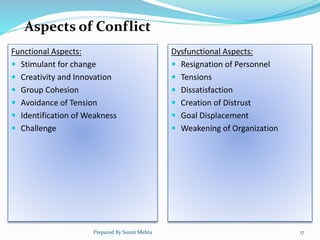
Functional Aspects:
 Stimulant for change
 Creativity and Innovation
 Group Cohesion
 Avoidance of Tension
 Identification of Weakness
 Challenge
Dysfunctional Aspects:
 Resignation of Personnel
 Tensions
 Dissatisfaction
 Creation of Distrust
 Goal Displacement
 Weakening of Organization
Aspects of Conflict
Prepared By Sumit Mehta 17
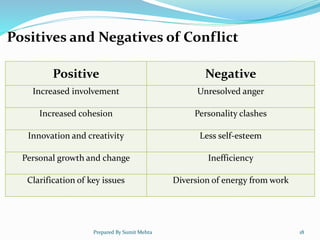
Positive Negative
Increased involvement Unresolved anger
Increased cohesion Personality clashes
Innovation and creativity Less self-esteem
Personal growth and change Inefficiency
Clarification of key issues Diversion of energy from work
Positives and Negatives of Conflict
Prepared By Sumit Mehta 18
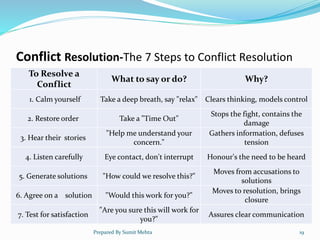
Conflict Resolution-The 7 Steps to Conflict Resolution
To Resolve a
Conflict
What to say or do? Why?
1. Calm yourself Take a deep breath, say "relax" Clears thinking, models control
2. Restore order Take a "Time Out"
Stops the fight, contains the
damage
3. Hear their stories
"Help me understand your
concern."
Gathers information, defuses
tension
4. Listen carefully Eye contact, don't interrupt Honour's the need to be heard
5. Generate solutions "How could we resolve this?"
Moves from accusations to
solutions
6. Agree on a solution "Would this work for you?"
Moves to resolution, brings
closure
7. Test for satisfaction
"Are you sure this will work for
you?"
Assures clear communication
Prepared By Sumit Mehta 19
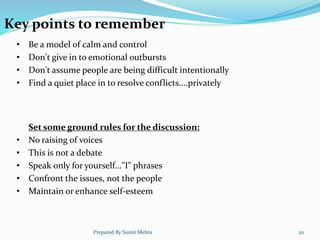
• Be a model of calm and control
• Don't give in to emotional outbursts
• Don't assume people are being difficult intentionally
• Find a quiet place in to resolve conflicts....privately
Set some ground rules for the discussion:
• No raising of voices
• This is not a debate
• Speak only for yourself..."I" phrases
• Confront the issues, not the people
• Maintain or enhance self-esteem
Key points to remember
Prepared By Sumit Mehta 20
THANK YOU
Prepared By Sumit Mehta 21

Thomas_Kilmann_Conflict_Management_SumitMehta

  • 1.
  • 2.
    Agenda  Introduction toConflict  Definition of Conflict  Nature of Conflict  Views on Conflict  Types of Conflict  Positive and Negative Conflict  The 7 Steps to Conflict Resolution Prepared By Sumit Mehta 2
  • 3.
    Introduction A conflict isa situation when the interests, needs, goals or values of involved parties interfere with one another. A conflict is a common phenomenon in the workplace. Different stakeholders may have different priorities; conflicts may involve team members, departments, projects, organization and client, boss and subordinate, organization needs vs. personal needs. Often, a conflict is a result of perception. Prepared By Sumit Mehta 3
  • 4.
    According to Follett, “ Conflictis the appearance of difference , difference of opinions, of interests.” According to Louis R. Pondy, ‘Conflict’ is: Antecedent conditions, for example: Scarcity of resources, policy differences among individuals, etc., Effective states of the individuals involved, for example: stress, tension, hostility, anxiety, etc., Cognitive states of individuals, i.e., their perception of awareness of conflict situations. Changed behavior ranging from passive resistance to overt aggression. Definition of Conflict Prepared By Sumit Mehta 4
  • 5.
    Definition by ThomasKilmann According to Thomas Kilmann:- "Conflict situations" are those in which the concerns of two people appear to be incompatible. In such situations, we can describe an individual's behaviour along two dimensions: (1) assertiveness, the extent to which the person attempts to satisfy his own concerns, and (2) cooperativeness, the extent to which the person attempts to satisfy the other person's concerns. Prepared By Sumit Mehta 5
  • 6.
    5 different modesfor responding to conflict situations by Thomas Kilmann: 1. Competing :- assertive and uncooperative 2. Accommodating:- unassertive and cooperative 3. Avoiding :- unassertive and uncooperative 4. Collaborating :- both assertive and cooperative 5. Compromising :- moderate in both assertiveness and cooperativeness Prepared By Sumit Mehta 6
  • 7.
    Competing Competing is assertiveand uncooperative—an individual pursues his own concerns at the other person's expense. This is a power-oriented mode in which you use whatever power seems appropriate to win your own position—your ability to argue, your rank, or economic sanctions. Competing means "standing up for your rights," defending a position which you believe is correct, or simply trying to win. Prepared By Sumit Mehta 7
  • 8.
    Accommodating Accommodating is unassertiveand cooperative—the complete opposite of competing. When accommodating, the individual neglects his own concerns to satisfy the concerns of the other person; there is an element of self- sacrifice in this mode. Accommodating might take the form of selfless generosity or charity, obeying another person's order when you would prefer not to, or yielding to another's point of view. Prepared By Sumit Mehta 8
  • 9.
    Avoiding Avoiding is unassertiveand uncooperative—the person neither pursues his own concerns nor those of the other individual. Thus he does not deal with the conflict. Avoiding might take the form of diplomatically sidestepping an issue, postponing an issue until a better time, or simply withdrawing from a threatening situation. Prepared By Sumit Mehta 9
  • 10.
    Compromising Compromising is moderatein both assertiveness and cooperativeness. The objective is to find some expedient, mutually acceptable solution that partially satisfies both parties. It falls intermediate between competing and accommodating. Compromising gives up more than competing but less than accommodating. Likewise, it addresses an issue more directly than avoiding, but does not explore it in as much depth as collaborating. In some situations, compromising might mean splitting the difference between the two positions, exchanging concessions, or seeking a quick middle-ground solution. Prepared By Sumit Mehta 10
  • 11.
    Collaborating Collaborating is bothassertive and cooperative—the complete opposite of avoiding. Collaborating involves an attempt to work with others to find some solution that fully satisfies their concerns. It means digging into an issue to pinpoint the underlying needs and wants of the two individuals. Collaborating between two persons might take the form of exploring a disagreement to learn from each other's insights or trying to find a creative solution to an interpersonal problem. Prepared By Sumit Mehta 11
  • 12.
    Conflict occurs when individualsare not able to choose among the available alternative courses of action. Conflict between two individuals implies that they have conflicting perception, values and goals. Conflict is a dynamic process as it indicates a series of events. Conflict must be perceived by the parties to it. If no one is aware of a conflict, then it is generally agree that no conflict exists. Nature of Conflict Prepared By Sumit Mehta 12
  • 13.
    Who do wecome into conflict with? Prepared By Sumit Mehta 13
  • 14.
    Traditional view: Theearly approach to conflict assumed that all conflict was bad. Conflict was viewed negatively, and it was used synonymously with such terms as violence, destruction. Human Relations view: The human relations position argued that conflict was a natural occurrence in all groups and organizations. Since conflict was inevitable(which cannot be avoided) it is accepted and there are even times when conflict may benefit a group’s performance. Interactionist View( Modern View): This view is based on the belief that conflict is not only a positive force in a group but is also necessary for a group to perform effectively. This approach encourages group leaders to maintain an ongoing minimum level of conflict – enough to keep the group viable, self- critical and creative. Views on conflict Prepared By Sumit Mehta 14
  • 15.
    Views on Conflict PreparedBy Sumit Mehta 15
  • 16.
    Functional – supportthe goals of the group and improves its performance. Dysfunctional – conflict that hinders group performance. The functional conflicts can be differentiated from the dysfunctional conflicts on the basis of the following three attributes: • 1.Task Conflict: Related to content and goals of the work. • 2. Relationship Conflict: Focuses on interpersonal relationships • 3. Process Conflict: Process conflict relates to how the work gets done. Types of conflict Prepared By Sumit Mehta 16
  • 17.
    Functional Aspects:  Stimulantfor change  Creativity and Innovation  Group Cohesion  Avoidance of Tension  Identification of Weakness  Challenge Dysfunctional Aspects:  Resignation of Personnel  Tensions  Dissatisfaction  Creation of Distrust  Goal Displacement  Weakening of Organization Aspects of Conflict Prepared By Sumit Mehta 17
  • 18.
    Positive Negative Increased involvementUnresolved anger Increased cohesion Personality clashes Innovation and creativity Less self-esteem Personal growth and change Inefficiency Clarification of key issues Diversion of energy from work Positives and Negatives of Conflict Prepared By Sumit Mehta 18
  • 19.
    Conflict Resolution-The 7Steps to Conflict Resolution To Resolve a Conflict What to say or do? Why? 1. Calm yourself Take a deep breath, say "relax" Clears thinking, models control 2. Restore order Take a "Time Out" Stops the fight, contains the damage 3. Hear their stories "Help me understand your concern." Gathers information, defuses tension 4. Listen carefully Eye contact, don't interrupt Honour's the need to be heard 5. Generate solutions "How could we resolve this?" Moves from accusations to solutions 6. Agree on a solution "Would this work for you?" Moves to resolution, brings closure 7. Test for satisfaction "Are you sure this will work for you?" Assures clear communication Prepared By Sumit Mehta 19
  • 20.
    • Be amodel of calm and control • Don't give in to emotional outbursts • Don't assume people are being difficult intentionally • Find a quiet place in to resolve conflicts....privately Set some ground rules for the discussion: • No raising of voices • This is not a debate • Speak only for yourself..."I" phrases • Confront the issues, not the people • Maintain or enhance self-esteem Key points to remember Prepared By Sumit Mehta 20
  • 21.
    THANK YOU Prepared BySumit Mehta 21