International Negotiation	Stephan Langdon, MBA M.Ed
Negotiation CaseWhile on vacation you go into a jewelry store and see an attractive looking watch.  You ask the store’s owner how much it costs and he replies $4.095.670  How much would you offer to pay for this watch?Should you offer anything?
When should you negotiateWhen should you never negotiate
Lewicki:When Should You Never NegotiateCuandousted no cuida. Cuandoustedpodríaperdertodo.
Cuando no hay nada ustedpodríaganar (el otrohaceque nada ustedquiera).
Cuandolasdemandas son ilegales o inmorales.
Cuandoactúan con maldad.
Cuandousted no tienetiempo.
Cuando el esperarmejoraríasuposición.
Cuando le no preparan. When you don’t care.When you could lose everything.
When there is nothing you could gain (the other has nothing you want).
When the demands are illegal or unethical.
When they act in bad faith.
When you don’t have time.
When waiting would improve your position.
When you’re not prepared.4
Distributive NegotiationGoals of one party are in fundamental, direct conflict to another party.
Resources are fixed and limited.
Maximizing the share of resources is the goal.
Distributive negotiation is all about who gets (or pays) how much. It is also where more for me means less for you.
Las metas de un partido están en el fundamental, conflicto directo a otro partido.
Los recursos son fijos y limitados.
La maximización de la parte de recursos es la meta.
La negociación distributiva está todo sobre quién consigue (o paga) cuánto. Está también donde más para mí los medios menos para usted. 5
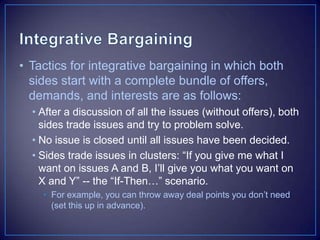
Integrative NegotiationCreate a free flow of information.
Attempt to understand the other negotiator’s real needs and objectives.
Emphasize the commonalties between the parties and minimize the differences.
Search for solutions that meet the goals and objectives of both sides.
Cree un libre flujo de información.
Intente a entender las necesidades verdaderas y los objetivos del otro negociador.
Acentúe los las cosas en campo común entre los partidos y reduzca al mínimo las diferencias.
Busque para las soluciones que logran las metas y los objetivos de ambos lados. 6
Positions and Interests
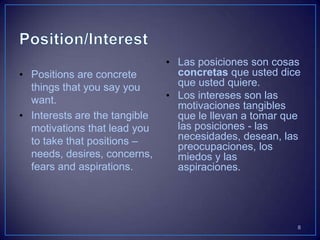
Position/InterestPositions are concrete things that you say you want.
Interests are the tangible motivations that lead you to take that positions – needs, desires, concerns, fears and aspirations.
Las posiciones son cosas concretas que usted dice que usted quiere.
Los intereses son las motivaciones tangibles que le llevan a tomar que las posiciones - las necesidades, desean, las preocupaciones, los miedos y las aspiraciones. 8
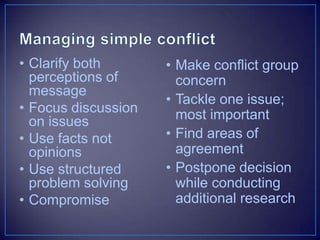
Managing simple conflictClarify both perceptions of messageFocus discussion on issuesUse facts not opinionsUse structured problem solving CompromiseMake conflict group concernTackle one issue; most importantFind areas of agreementPostpone decision while conducting additional research
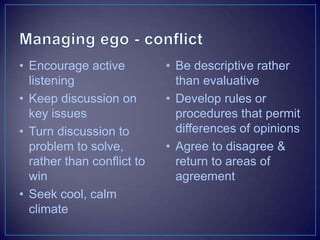
Managing ego - conflictEncourage active listeningKeep discussion on key issuesTurn discussion to problem to solve, rather than conflict to winSeek cool, calm climateBe descriptive rather than evaluativeDevelop rules or procedures that permit differences of opinionsAgree to disagree & return to areas of agreement
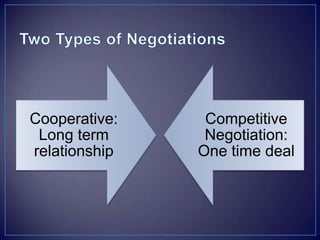
Two Types of Negotiations
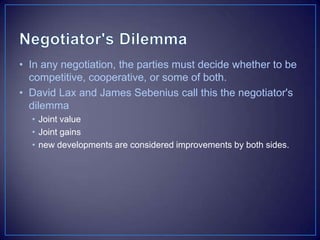
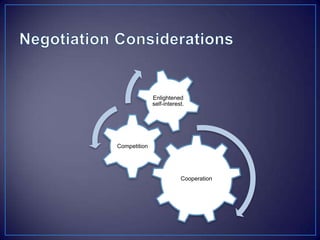
Negotiator's DilemmaIn any negotiation, the parties must decide whether to be competitive, cooperative, or some of both. David Lax and James Sebenius call this the negotiator's dilemmaJoint valueJoint gains new developments are considered improvements by both sides.
Key Concepts
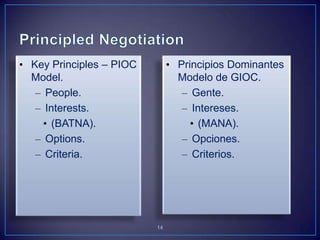
14Principled NegotiationKey Principles – PIOC Model.
People.
Interests.
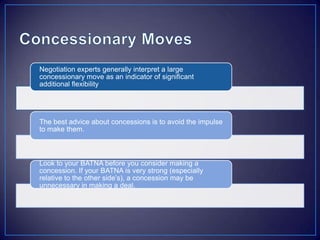
(BATNA).
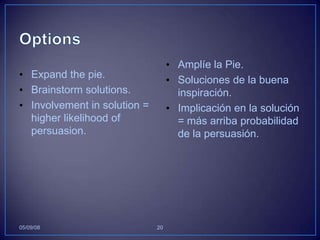
Options.
Criteria.
PrincipiosDominantesModelo de GIOC.
Gente.
Intereses.
(MANA).
Opciones.
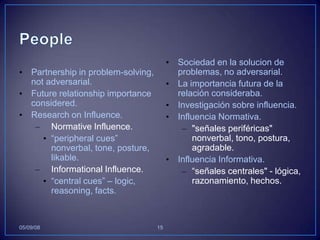
Criterios.05/09/0815PeoplePartnership in problem-solving, not adversarial.
Future relationship importance considered.
Research on Influence.
	Normative Influence.
“peripheral cues” nonverbal, tone, posture, likable.
	Informational Influence.
“central cues” – logic, reasoning, facts.
Sociedad en la solucion de problemas, no adversarial.
La importancia futura de la relación consideraba.
Investigación sobre influencia.
Influencia Normativa.
"señales periféricas" nonverbal, tono, postura, agradable.
Influencia Informativa.
“señales centrales" - lógica, razonamiento, hechos.05/09/0816InterestsWhat you need vs. what you say you want.

International Negotiation 2011 02

Editor's Notes