PATHOLOGY
GANGRENE
◦LEARNING OBJECTIVES
1. Introduction
2. Definition
3. Types
4. Causes
5. Sign and symptoms
6. Management
◦INTRODUCTION
. Gangrene is also called as Edematous myonecrosis
It is the death of tissue caused by lack of blood Flow or necrosis
. The basic type of necrosis in GANGRENE is coagulative necrosis due to ischemia onto which
bacterial infection is superimposed
. Ischemia-it is the lack of blood supply to body part
◦ Definition- Gangrene is nothing but the death of tissue caused by infection or lack of blood
supply to body part.
◦TYPES
1. Dry Gangrene
2. Wet Gangrene
3. Gas Gangrene
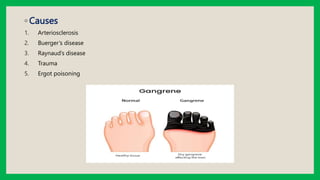
1. Dry Gangrene – it is usually seen in the distal part of limbs due to ischemia
. E.g - Dry gangrene in the toes and feet of old patient due to arteriosclerosis.
◦ Causes
1. Arteriosclerosis
2. Buerger’s disease
3. Raynaud’s disease
4. Trauma
5. Ergot poisoning
◦ One the most important thing in dry gangrene is the affected part falls continuously there is no
need to remove it and no any surgery require
◦ Affected part in dry gangrene is dark black because liberation of hemoglobin which react with
hydrogen disulfide produced by bacteria resulting in formation of black iron sulfied.
◦ Sign and symptoms
1. Affected part is dry
2. Shrunken
3. Dark black
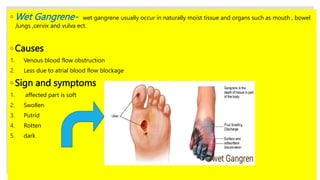
◦ Wet Gangrene- wet gangrene usually occur in naturally moist tissue and organs such as mouth , bowel
,lungs ,cervix and vulva ect.
◦ Causes
1. Venous blood flow obstruction
2. Less due to atrial blood flow blockage
◦ Sign and symptoms
1. affected part is soft
2. Swollen
3. Putrid
4. Rotten
5. dark
1. Example- Gangrene of bowel commonly due to strangulated hernia,
Volvulus or intussusceptions
2.Example - Diabetic foot
3.example-Bedsores
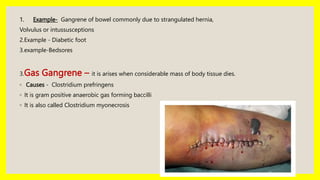
3.Gas Gangrene – it is arises when considerable mass of body tissue dies.
◦ Causes - Clostridium prefringens
◦ It is gram positive anaerobic gas forming baccilli
◦ It is also called Clostridium myonecrosis
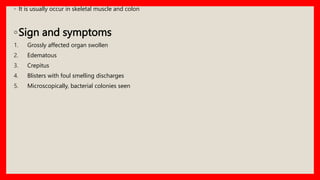
◦ It is usually occur in skeletal muscle and colon
◦Sign and symptoms
1. Grossly affected organ swollen
2. Edematous
3. Crepitus
4. Blisters with foul smelling discharges
5. Microscopically, bacterial colonies seen
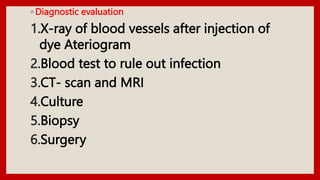
◦ Diagnostic evaluation
1.X-ray of blood vessels after injection of
dye Ateriogram
2.Blood test to rule out infection
3.CT- scan and MRI
4.Culture
5.Biopsy
6.Surgery
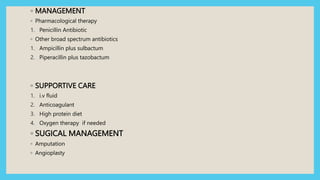
◦ MANAGEMENT
◦ Pharmacological therapy
1. Penicillin Antibiotic
◦ Other broad spectrum antibiotics
1. Ampicillin plus sulbactum
2. Piperacillin plus tazobactum
◦ SUPPORTIVE CARE
1. i.v fluid
2. Anticoagulant
3. High protein diet
4. Oxygen therapy if needed
◦ SUGICAL MANAGEMENT
◦ Amputation
◦ Angioplasty
Thank you!!

Pathology Gangrene

  • 1.
  • 2.
    ◦LEARNING OBJECTIVES 1. Introduction 2.Definition 3. Types 4. Causes 5. Sign and symptoms 6. Management
  • 3.
    ◦INTRODUCTION . Gangrene isalso called as Edematous myonecrosis It is the death of tissue caused by lack of blood Flow or necrosis . The basic type of necrosis in GANGRENE is coagulative necrosis due to ischemia onto which bacterial infection is superimposed . Ischemia-it is the lack of blood supply to body part ◦ Definition- Gangrene is nothing but the death of tissue caused by infection or lack of blood supply to body part.
  • 4.
    ◦TYPES 1. Dry Gangrene 2.Wet Gangrene 3. Gas Gangrene 1. Dry Gangrene – it is usually seen in the distal part of limbs due to ischemia . E.g - Dry gangrene in the toes and feet of old patient due to arteriosclerosis.
  • 5.
    ◦ Causes 1. Arteriosclerosis 2.Buerger’s disease 3. Raynaud’s disease 4. Trauma 5. Ergot poisoning
  • 6.
    ◦ One themost important thing in dry gangrene is the affected part falls continuously there is no need to remove it and no any surgery require ◦ Affected part in dry gangrene is dark black because liberation of hemoglobin which react with hydrogen disulfide produced by bacteria resulting in formation of black iron sulfied. ◦ Sign and symptoms 1. Affected part is dry 2. Shrunken 3. Dark black
  • 7.
    ◦ Wet Gangrene-wet gangrene usually occur in naturally moist tissue and organs such as mouth , bowel ,lungs ,cervix and vulva ect. ◦ Causes 1. Venous blood flow obstruction 2. Less due to atrial blood flow blockage ◦ Sign and symptoms 1. affected part is soft 2. Swollen 3. Putrid 4. Rotten 5. dark
  • 8.
    1. Example- Gangreneof bowel commonly due to strangulated hernia, Volvulus or intussusceptions 2.Example - Diabetic foot 3.example-Bedsores 3.Gas Gangrene – it is arises when considerable mass of body tissue dies. ◦ Causes - Clostridium prefringens ◦ It is gram positive anaerobic gas forming baccilli ◦ It is also called Clostridium myonecrosis
  • 9.
    ◦ It isusually occur in skeletal muscle and colon ◦Sign and symptoms 1. Grossly affected organ swollen 2. Edematous 3. Crepitus 4. Blisters with foul smelling discharges 5. Microscopically, bacterial colonies seen
  • 10.
    ◦ Diagnostic evaluation 1.X-rayof blood vessels after injection of dye Ateriogram 2.Blood test to rule out infection 3.CT- scan and MRI 4.Culture 5.Biopsy 6.Surgery
  • 11.
    ◦ MANAGEMENT ◦ Pharmacologicaltherapy 1. Penicillin Antibiotic ◦ Other broad spectrum antibiotics 1. Ampicillin plus sulbactum 2. Piperacillin plus tazobactum ◦ SUPPORTIVE CARE 1. i.v fluid 2. Anticoagulant 3. High protein diet 4. Oxygen therapy if needed ◦ SUGICAL MANAGEMENT ◦ Amputation ◦ Angioplasty
  • 12.