This forensic ballistics PowerPoint presentation will be helpful for 3rd-year MBBS students. it includes all the aspects of forensic ballistics and nice details of everything about ballistics.
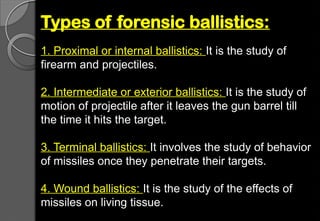
Types of forensicballistics:
1. Proximal or internal ballistics: It is the study of
firearm and projectiles.
2. Intermediate or exterior ballistics: It is the study of
motion of projectile after it leaves the gun barrel till
the time it hits the target.
3. Terminal ballistics: It involves the study of behavior
of missiles once they penetrate their targets.
4. Wound ballistics: It is the study of the effects of
missiles on living tissue.
4.
Firearm
Firearm is anyinstrument or device
which discharges a projectile (shot /
bullet / missile) by expansive force of
the gases produced by burning of an
explosive substance.
7.
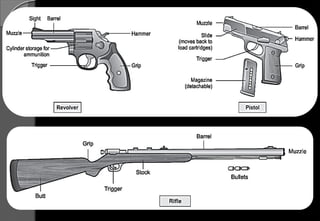
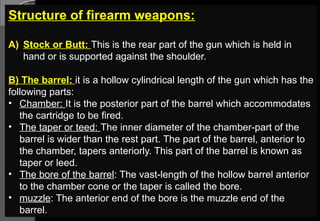
Structure of firearmweapons:
A) Stock or Butt: This is the rear part of the gun which is held in
hand or is supported against the shoulder.
B) The barrel: it is a hollow cylindrical length of the gun which has the
following parts:
• Chamber: It is the posterior part of the barrel which accommodates
the cartridge to be fired.
• The taper or teed: The inner diameter of the chamber-part of the
barrel is wider than the rest part. The part of the barrel, anterior to
the chamber, tapers anteriorly. This part of the barrel is known as
taper or leed.
• The bore of the barrel: The vast-length of the hollow barrel anterior
to the chamber cone or the taper is called the bore.
• muzzle: The anterior end of the bore is the muzzle end of the
barrel.
8.
Structure of firearmweapons:
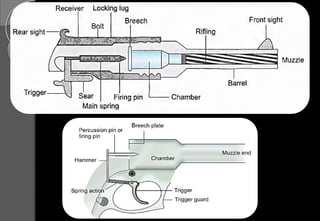
C) The breach mechanism:
It is a part of firearm weapon, which consists of the followings —
• Hammer: Behind the chamber there is a hammer with a pointed
pin at the center of the anterior surface of the hammer.
• Trigger: Below the chamber there is the trigger.
• Trigger guard: The trigger is surrounded by a metallic trigger
guard, so that the trigger will not be accidentally pulled.
• Front sight and rear sight: Aiming is done with the help of front
sight and rear sight.
• Safety catch: This is a safety device, which prevents firing even if
the trigger is accidentally pulled.
• The loading and emptying of chamber: the mechanism of loading
and emptying of chamber depends on the type of firearm used.
9.
Classification of firearms:
A.According to condition of barrel:
1. Rifled weapons: These are the guns which have spiral
groves in inner surface of their barrel.
a) Rifles:
Air and gas-operated rifles.
• 0.22 rifles.
Military and sporting rifles.
b) Single-shot target-practice pistols.
c) Revolvers.
d) Automatic pistols.
e) True automatic weapons (machine guns).
* According to velocity rifled weapons again divided into:
• Low velocity (up to 360 m/sec), example: revolver.
• Medium velocity (360 to 750 m/sec), example: pistol.
• High velocity (750 to 1260 m/sec), example :rifle.
• Very high velocity (above 1260 m/sec).
10.
Classification of firearms:
2.Smooth-bored weapons/shotgun:
• Depending on length of barrel
Short barrel
Long barrel
• Depending on number of barrel
Single barrel
Double barrel
• Depending on loading route
Muzzle loader
Breech loader
• Depending on choking
Full choke
Three quarter choke
Half choke
quarter choke
improved cylinder
True cylinder
11.
Classification of firearms:
B.According to firing action:
1. Over-bolt action.
2. Under-bolt action.
3. Lever action.
4. Pump action or auto-loading model.
12.
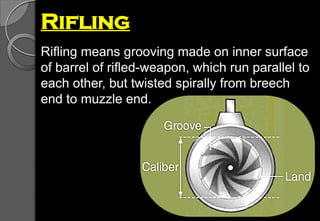
Rifling
Rifling means groovingmade on inner surface
of barrel of rifled-weapon, which run parallel to
each other, but twisted spirally from breech
end to muzzle end.
14.
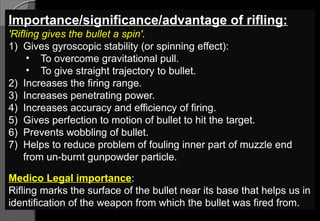
Importance/significance/advantage of rifling:
'Riflinggives the bullet a spin'.
1) Gives gyroscopic stability (or spinning effect):
• To overcome gravitational pull.
• To give straight trajectory to bullet.
2) Increases the firing range.
3) Increases penetrating power.
4) Increases accuracy and efficiency of firing.
5) Gives perfection to motion of bullet to hit the target.
6) Prevents wobbling of bullet.
7) Helps to reduce problem of fouling inner part of muzzle end
from un-burnt gunpowder particle.
Medico Legal importance:
Rifling marks the surface of the bullet near its base that helps us in
identification of the weapon from which the bullet was fired from.
15.
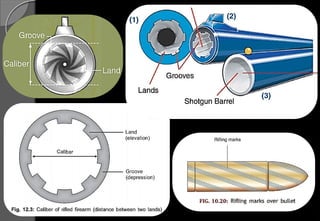
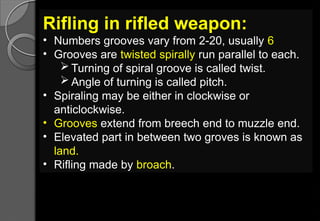
Rifling in rifledweapon:
• Numbers grooves vary from 2-20, usually 6
• Grooves are twisted spirally run parallel to each.
Turning of spiral groove is called twist.
Angle of turning is called pitch.
• Spiraling may be either in clockwise or
anticlockwise.
• Grooves extend from breech end to muzzle end.
• Elevated part in between two groves is known as
land.
• Rifling made by broach.
16.
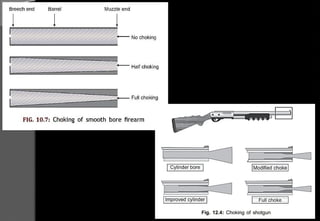
Choking
It may bedefined as narrowing or
constriction of the barrel for terminal few
centimeters (about 7.5 to 10 cm) near the
muzzle end of the shot-gun is known as
choking.
18.
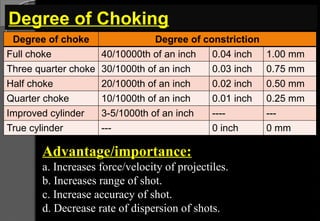
Degree of Choking
Degreeof choke Degree of constriction
Full choke 40/10000th of an inch 0.04 inch 1.00 mm
Three quarter choke 30/1000th of an inch 0.03 inch 0.75 mm
Half choke 20/1000th of an inch 0.02 inch 0.50 mm
Quarter choke 10/1000th of an inch 0.01 inch 0.25 mm
Improved cylinder 3-5/1000th of an inch ---- ---
True cylinder --- 0 inch 0 mm
Advantage/importance:
a. Increases force/velocity of projectiles.
b. Increases range of shot.
c. Increase accuracy of shot.
d. Decrease rate of dispersion of shots.
19.
Gun powder:
Gun powderis the mixture of explosive
substances which propels the bullet
forward by the enormous pressure
created as a result of expanding of gases
generated by its explosion.
Types of gun powder/ propellant powder:
1. Black powder
2. Smokeless powder
3. Semi-smokeless powder
20.
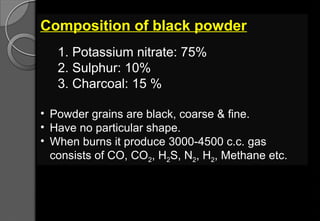
Composition of blackpowder
1. Potassium nitrate: 75%
2. Sulphur: 10%
3. Charcoal: 15 %
• Powder grains are black, coarse & fine.
• Have no particular shape.
• When burns it produce 3000-4500 c.c. gas
consists of CO, CO2, H2S, N2, H2, Methane etc.
21.
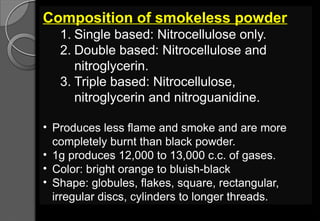
Composition of smokelesspowder
1. Single based: Nitrocellulose only.
2. Double based: Nitrocellulose and
nitroglycerin.
3. Triple based: Nitrocellulose,
nitroglycerin and nitroguanidine.
• Produces less flame and smoke and are more
completely burnt than black powder.
• 1g produces 12,000 to 13,000 c.c. of gases.
• Color: bright orange to bluish-black
• Shape: globules, flakes, square, rectangular,
irregular discs, cylinders to longer threads.
22.
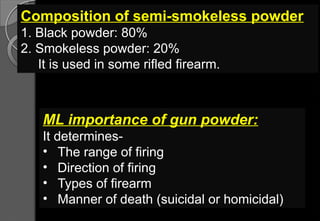
Composition of semi-smokelesspowder
1. Black powder: 80%
2. Smokeless powder: 20%
It is used in some rifled firearm.
ML importance of gun powder:
It determines-
• The range of firing
• Direction of firing
• Types of firearm
• Manner of death (suicidal or homicidal)
23.
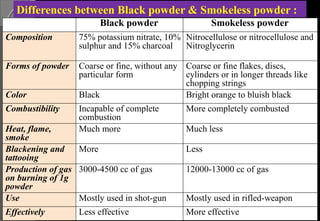
Black powder Smokelesspowder
Composition 75% potassium nitrate, 10%
sulphur and 15% charcoal
Nitrocellulose or nitrocellulose and
Nitroglycerin
Forms of powder Coarse or fine, without any
particular form
Coarse or fine flakes, discs,
cylinders or in longer threads like
chopping strings
Color Black Bright orange to bluish black
Combustibility Incapable of complete
combustion
More completely combusted
Heat, flame,
smoke
Much more Much less
Blackening and
tattooing
More Less
Production of gas
on burning of 1g
powder
3000-4500 cc of gas 12000-13000 cc of gas
Use Mostly used in shot-gun Mostly used in rifled-weapon
Effectively Less effective More effective
Differences between Black powder & Smokeless powder :
24.
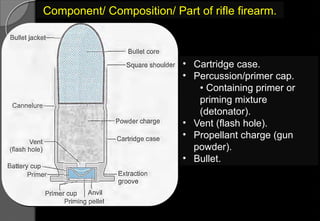
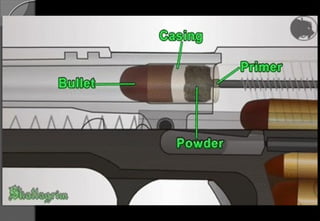
Primer / primingmixture:
Primer is the highly explosive mixture in
percussion cap at the base of the cartridge.
Composition:
• Potassium chlorate.
• Antimony sulphide.
• Lead styphnate
• Barium nitrate
Importance: Priming mixture gets ignited first by the
friction of firing pin which produces flame subsequently
flashes through the vent and ignites the propellant
charge (gun powder).
25.
Ammunition:
Ammunition means thematerial used to cause the
explosion i.e. the ingredients used such
as bullet, pellet, powder etc.
Cartridge:
Cartridge means one unit of ammunition, consists of:
1. Cartridge case with a percussion cap containing
primer at the base
2. Propellant charge
3. Projectile
4. Wads, if any.
26.
Projectile:
Projectile Means anobject propelled by force of
rapidly burning gases or other means.
a) Bullet: Bullet means projectile of rifled firearm.
b) Pellets: Pellets are spherical projectiles used in
shotguns.
If 2-20 pellets present it is called Buck shot.
If 200-400 pellets present it is called Bird shot.
If 2000-3000 pellets present it is called Dust
shot.
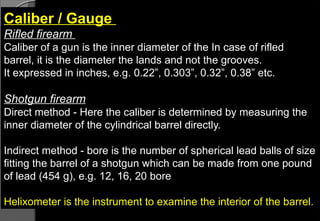
Caliber / Gauge
Rifledfirearm
Caliber of a gun is the inner diameter of the In case of rifled
barrel, it is the diameter the lands and not the grooves.
It expressed in inches, e.g. 0.22”, 0.303”, 0.32”, 0.38” etc.
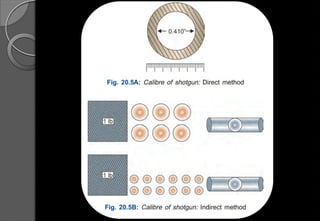
Shotgun firearm
Direct method - Here the caliber is determined by measuring the
inner diameter of the cylindrical barrel directly.
Indirect method - bore is the number of spherical lead balls of size
fitting the barrel of a shotgun which can be made from one pound
of lead (454 g), e.g. 12, 16, 20 bore
Helixometer is the instrument to examine the interior of the barrel.
31.
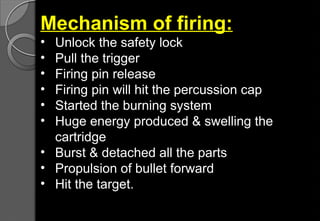
Mechanism of firing:
•Unlock the safety lock
• Pull the trigger
• Firing pin release
• Firing pin will hit the percussion cap
• Started the burning system
• Huge energy produced & swelling the
cartridge
• Burst & detached all the parts
• Propulsion of bullet forward
• Hit the target.
33.
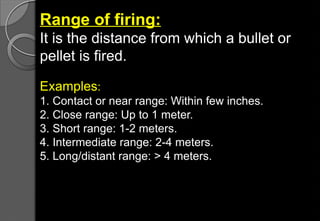
Range of firing:
Itis the distance from which a bullet or
pellet is fired.
Examples:
1. Contact or near range: Within few inches.
2. Close range: Up to 1 meter.
3. Short range: 1-2 meters.
4. Intermediate range: 2-4 meters.
5. Long/distant range: > 4 meters.
34.
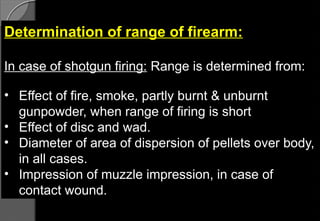
Determination of rangeof firearm:
In case of shotgun firing: Range is determined from:
• Effect of fire, smoke, partly burnt & unburnt
gunpowder, when range of firing is short
• Effect of disc and wad.
• Diameter of area of dispersion of pellets over body,
in all cases.
• Impression of muzzle impression, in case of
contact wound.
35.
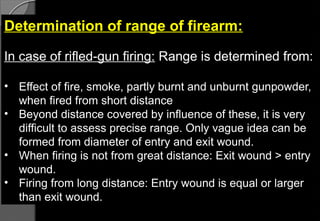
Determination of rangeof firearm:
In case of rifled-gun firing: Range is determined from:
• Effect of fire, smoke, partly burnt and unburnt gunpowder,
when fired from short distance
• Beyond distance covered by influence of these, it is very
difficult to assess precise range. Only vague idea can be
formed from diameter of entry and exit wound.
• When firing is not from great distance: Exit wound > entry
wound.
• Firing from long distance: Entry wound is equal or larger
than exit wound.
36.
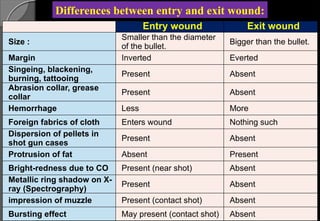
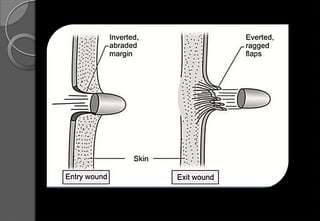
Entry wound Exitwound
Size :
Smaller than the diameter
of the bullet.
Bigger than the bullet.
Margin Inverted Everted
Singeing, blackening,
burning, tattooing
Present Absent
Abrasion collar, grease
collar
Present Absent
Hemorrhage Less More
Foreign fabrics of cloth Enters wound Nothing such
Dispersion of pellets in
shot gun cases
Present Absent
Protrusion of fat Absent Present
Bright-redness due to CO Present (near shot) Absent
Metallic ring shadow on X-
ray (Spectrography)
Present Absent
impression of muzzle Present (contact shot) Absent
Bursting effect May present (contact shot) Absent
Differences between entry and exit wound:
38.
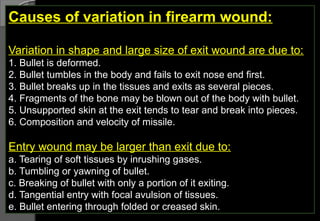
Causes of variationin firearm wound:
Variation in shape and large size of exit wound are due to:
1. Bullet is deformed.
2. Bullet tumbles in the body and fails to exit nose end first.
3. Bullet breaks up in the tissues and exits as several pieces.
4. Fragments of the bone may be blown out of the body with bullet.
5. Unsupported skin at the exit tends to tear and break into pieces.
6. Composition and velocity of missile.
Entry wound may be larger than exit due to:
a. Tearing of soft tissues by inrushing gases.
b. Tumbling or yawning of bullet.
c. Breaking of bullet with only a portion of it exiting.
d. Tangential entry with focal avulsion of tissues.
e. Bullet entering through folded or creased skin.
39.
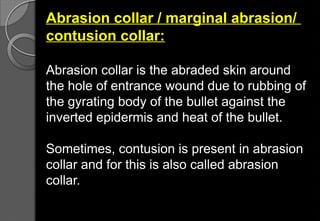
Abrasion collar /marginal abrasion/
contusion collar:
Abrasion collar is the abraded skin around
the hole of entrance wound due to rubbing of
the gyrating body of the bullet against the
inverted epidermis and heat of the bullet.
Sometimes, contusion is present in abrasion
collar and for this is also called abrasion
collar.
40.
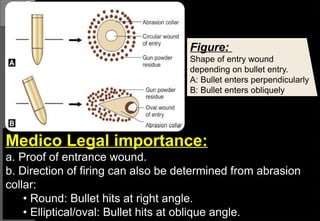
Medico Legal importance:
a.Proof of entrance wound.
b. Direction of firing can also be determined from abrasion
collar:
• Round: Bullet hits at right angle.
• Elliptical/oval: Bullet hits at oblique angle.
Figure:
Shape of entry wound
depending on bullet entry.
A: Bullet enters perpendicularly
B: Bullet enters obliquely
41.
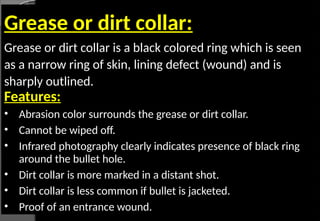
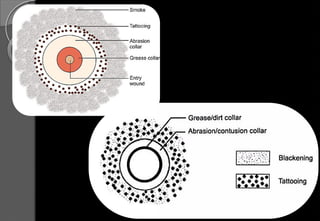
Grease or dirtcollar:
Grease or dirt collar is a black colored ring which is seen
as a narrow ring of skin, lining defect (wound) and is
sharply outlined.
Features:
• Abrasion color surrounds the grease or dirt collar.
• Cannot be wiped off.
• Infrared photography clearly indicates presence of black ring
around the bullet hole.
• Dirt collar is more marked in a distant shot.
• Dirt collar is less common if bullet is jacketed.
• Proof of an entrance wound.
43.
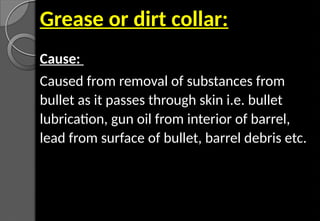
Grease or dirtcollar:
Cause:
Caused from removal of substances from
bullet as it passes through skin i.e. bullet
lubrication, gun oil from interior of barrel,
lead from surface of bullet, barrel debris etc.
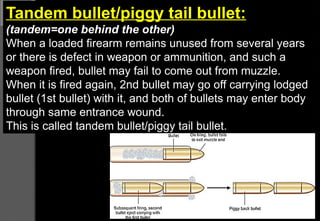
Tandem bullet/piggy tailbullet:
(tandem=one behind the other)
When a loaded firearm remains unused from several years
or there is defect in weapon or ammunition, and such a
weapon fired, bullet may fail to come out from muzzle.
When it is fired again, 2nd bullet may go off carrying lodged
bullet (1st bullet) with it, and both of bullets may enter body
through same entrance wound.
This is called tandem bullet/piggy tail bullet.
46.
Tandem bullet/piggy tailbullet:
Causes:
1. Due to defect in the weapon.
2. Due to faulty ammunition.
3. With loaded firearm unused for several years.
ML importance:
a. Two bullets are found although there may be one
entry wound.
b. Features of flame, smoke, gunpowder may be
diminished or absent.
c. Wound may appear as if caused by long -range
firing.
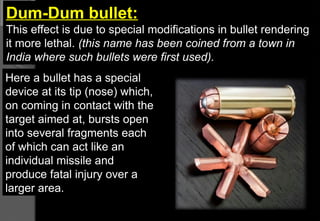
47.
Dum-Dum bullet:
This effectis due to special modifications in bullet rendering
it more lethal. (this name has been coined from a town in
India where such bullets were first used).
Here a bullet has a special
device at its tip (nose) which,
on coming in contact with the
target aimed at, bursts open
into several fragments each
of which can act like an
individual missile and
produce fatal injury over a
larger area.
48.
Rubber bullet/baton round/plastic
bullet:
Rubber bullet is a solid cylinder of polyvinylchloride (PVC),
38 mm in diameter, 10 cm long, weighing 135 g. It is fired
from a smooth bore weapon & is effective up to 50-70 meter.
It should not be fired at a person under 20-meter range.
Use: They are used in riot control.
Types of injury caused:
• Causes bruise and pain.
• Fractures of skull, fracture of ribs, limb bones.
• Damage to the eyes.
• Contusions of liver, lung and spleen.
49.
Souvenir bullet:
It refersto a bullet which is present in the body for a
long time and surrounded by a dense fibrous tissue.
Features:
• Present in body for long period.
• Surrounded by dense fibrous tissue.
• No fresh bleeding in surrounding area.
• Small scar may indicate original entry wound.
• Lead poisoning may occur from absorption of lead
from bullet remaining in body.
• Synovial fluid is capable of dissolving lead.
50.
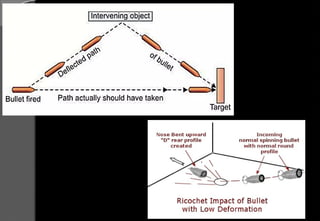
Ricochet bullet:
A ricochetbullet is one which before striking object
aimed at, strike some intervening object first, and
then after ricocheting and rebounding from these,
hits the object.
Features of ricochet bullet:
• This is a rare condition.
• Ricochet bullet gets deformed.
• Carry the paint/dirt or any such other things from
deflected object on its surface.
52.
Features of woundproduced by ricochet bullet:
a. Entry wound:
• More extensive.
• Irregularly oval or triangular or cruciate.
• with irregular abraded margin.
b. Penetration: Less.
c. Abrasion collar: Absent.
d. Burning. blackening, tattooing: Absent.
ML-importance:
It might explain the path taken by the bullet in the deceased
and cause of death.
53.
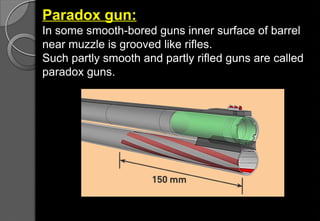
Paradox gun:
In somesmooth-bored guns inner surface of barrel
near muzzle is grooved like rifles.
Such partly smooth and partly rifled guns are called
paradox guns.
54.
Kennedy phenomenon:
(This isan artefact)
A bullet killed John F Kennedy, president of USA. A medial
man who examined him first, distorted the wound of entry to
remove the bullet surgically.
But when the medicolegal autopsy was done and wound
was described accordingly. Found not to resemble with a
typical wound of entry produced by a firearm.
This created a problem in deciding of death.
However, later the first doctor revealed his effort and clear
the ambiguity about the cause of death.
This is own as Kennedy phenomenon.
55.
Blank cartridge:
Blank cartridgeis a cartridge with primer, gunpowder
and wadding but without bullet.
Point blank:
When range is very close or in contact it is called
point blank.



![CTEV [ clubfoot] DR ARUN LAL ,DR MOHAMED ASHRAF travancore medical college k...](https://cdn.slidesharecdn.com/ss_thumbnails/ctevclubfootdrarunlaldrmohamedashraftravancoremedicalcollegekollamkeralaindia-260208063247-18fc466c-thumbnail.jpg?width=640&height=640&fit=bounds)


![PERI-PROSTHETIC FRACTURE NAIL-PLATE CONSTRUCT [NPC].pptx](https://cdn.slidesharecdn.com/ss_thumbnails/drarunkumardrmohamedashrafperiprostheticfrasturenail-plateconstructnpc-260209164459-7e9d15a1-thumbnail.jpg?width=640&height=640&fit=bounds)


