by Yohannes Tadesse (corp)
Department of Armament Engineering
DEFENSE UNIVERSITY, COLLEGE OF
ENGINEERING
BISHOFTU
2018
6/18/2024 1
INTERNAL BALLISTIC OF
GUNS
INTRODUCTION TO BALLISTICS
 Ballistics is the science of launching projectiles using propellant or
gunpowder
 The science of Ballistics involves the study of motion of projectiles
as a particular branch of applied mechanics and related fields of
physics, chemistry, mathematics, and engineering.
 Ballistics phenomenon can divided into different independent
areas.
 Interior ballistics:- the motion of the projectile or missile while
under the influence of a gun or thrust of propulsion device;
 Intermediate ballistics:- as a part of exterior ballistics; a short
period of time after the projectile leaves the muzzle and acted
upon the pressure of the emerging gas
 Exterior ballistics:- the projectile or missile in flight
 Terminal ballistics:- its effectiveness in defeating a target
INTERIOR BALLISTICS
 Interior ballistics is defined as the branch of applied mechanics
which deals with the motion and behavior characteristics of
projectiles while under the influence of the gases produced by
the propellant.
 The imparting of high velocities to projectiles requires
tremendous force. The source of the energy must be readily
manufactured, easy to transport, and capable of being safely
applied.
 At various times, proposals have been made for utilization of
energy provided by means other than explosives, such as
compressed air, electromagnetic force, and centrifugal force.
 However, no results have been attained from any of these
sources which approach those realized from chemical
explosives.
INTERIOR BALLISTICS
 Internal ballistics is the study of what happens within the barrel of a
weapon from the moment the firing pin hits the primer to the time
the bullets exits from the barrel. It is mainly concerned with
propellant pressures, acceleration of the projectile whilst it is in the
bore, muzzle velocity and recoil.
 The science of internal ballistics concerned with the propulsion of
the projectile along the tube of weapon by the gas pressure acting
on the base of projectile, or for rocket by backward exhaust of the
gas jet.
 And thus, Interior ballistics of guns comprises a study of a chemical
energy source, a working substance, and the accessory apparatus for
controlling the release of energy and for directing the activity of the
working substance.
Terminology
 Gunnery:- is the practical application of the science of ballistics to
the engagement of targets.
 Throughout this work we will be using the word ‘‘gun’’ in its
generic sense. A gun can be loosely defined as a one-stroke internal
combustion engine. In this case, the projectile is the
piston and the propellant is the air–fuel mixture.
 Gun:- a projectile-throwing device consisting essentially of a
projectile-guiding tube, with an incorporate or connected reaction
chamber in which the chemical energy of a propellant is rapidly
converted into heat and the hot gases produced expand to expel the
projectile at a high velocity.
DEFINITIONS
 Guns:- are classified according to their salient features, functions,
modes of operation, etc.
 Based on size and portability guns can be classified as small arms
and artillery.
 Small arms are in general less than 30mm in caliber and are usually portable
by foot soldiers.
 include such weapons as rifles, machine guns, pistols, etc. firing usually at
lower elevation and higher velocity,
 Artillery consists of the larger weapons usually mounted on
carriages and moved by other than human power.
Artillery weapons include guns, howitzers and mortars.
operate generally in a lower velocity range.
can be fired at high angles.
 Mortars:- operate at high angles like howitzers but operate at
still lower velocities and are generally loaded from the muzzle.
 They are simple in design and can be broken down and transported by foot
soldiers.
• A gun barrel must be able to hold in the expanding gas produced
by the propellants to ensure that optimum muzzle velocity is
attained by the projectile as it is being pushed out.
• If the barrel material cannot cope with the pressure within the
bore, the barrel itself might suffer catastrophic failure and explode,
which will not only destroy the gun but also present a life-
threatening danger to people nearby
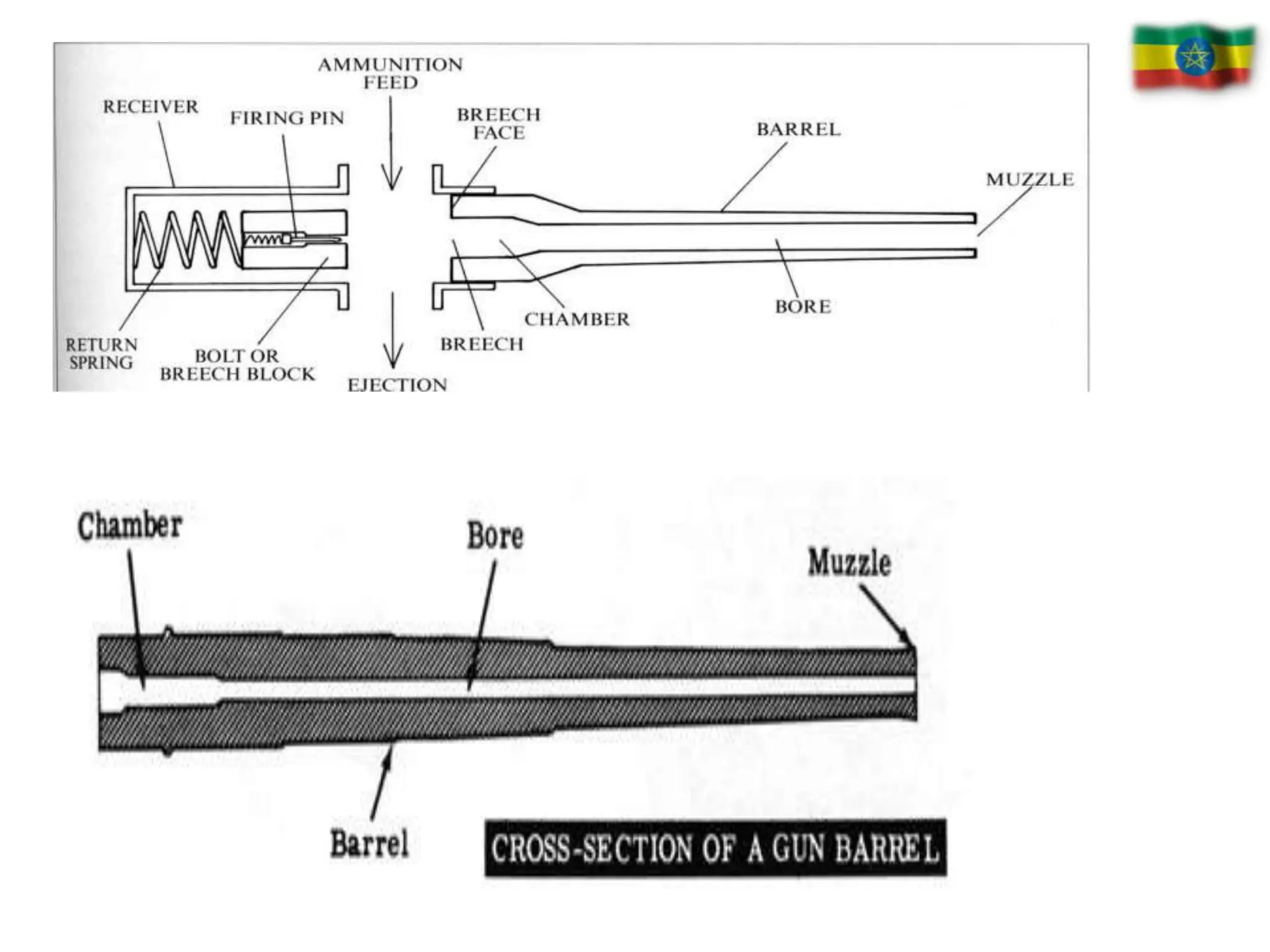
• A gun tube may be divided into four regions: the front portion or
bore through which the projectile travels when the round is fired;
the rear portion or chamber which houses the round before firing;
the rear opening or breech through which the ammunition is
loaded; and the 'front opening or muzzle from which the projectile
emerges. In recoilless guns the rear opening or nozzle provides for
recoilless.
GUN CONSTRUCTION
Components of gun barrel
1. Breech and breech assembly:- the breech end of the
chamber is closed by sliding breech block or breech screw, which
in both case is supported by a frame called a breech ring. On
firing the accelerating components of propellant gas force is
transmitted to the base of the cartridge case then to the breech
block and ultimately to breech ring . Consequently the breech
block, or screw and breech ring are heavily stressed during firing.
2. Chambers :- The chamber is the cavity at the back end of a
breech-loading gun's barrel where the cartridge is inserted in
position ready to be fired this is the smooth portion of the interior
barrel towards the breech end. The chamber dimensions are
related to the volume necessary for efficient combustion of the
propellant as also the overall length the barrel. The chamber
diameter normally larger than that of the bore . The transition
from the chamber to the bore(which is rifled or smooth) is formed
in a cone shaped ,and is called the forcing cone.
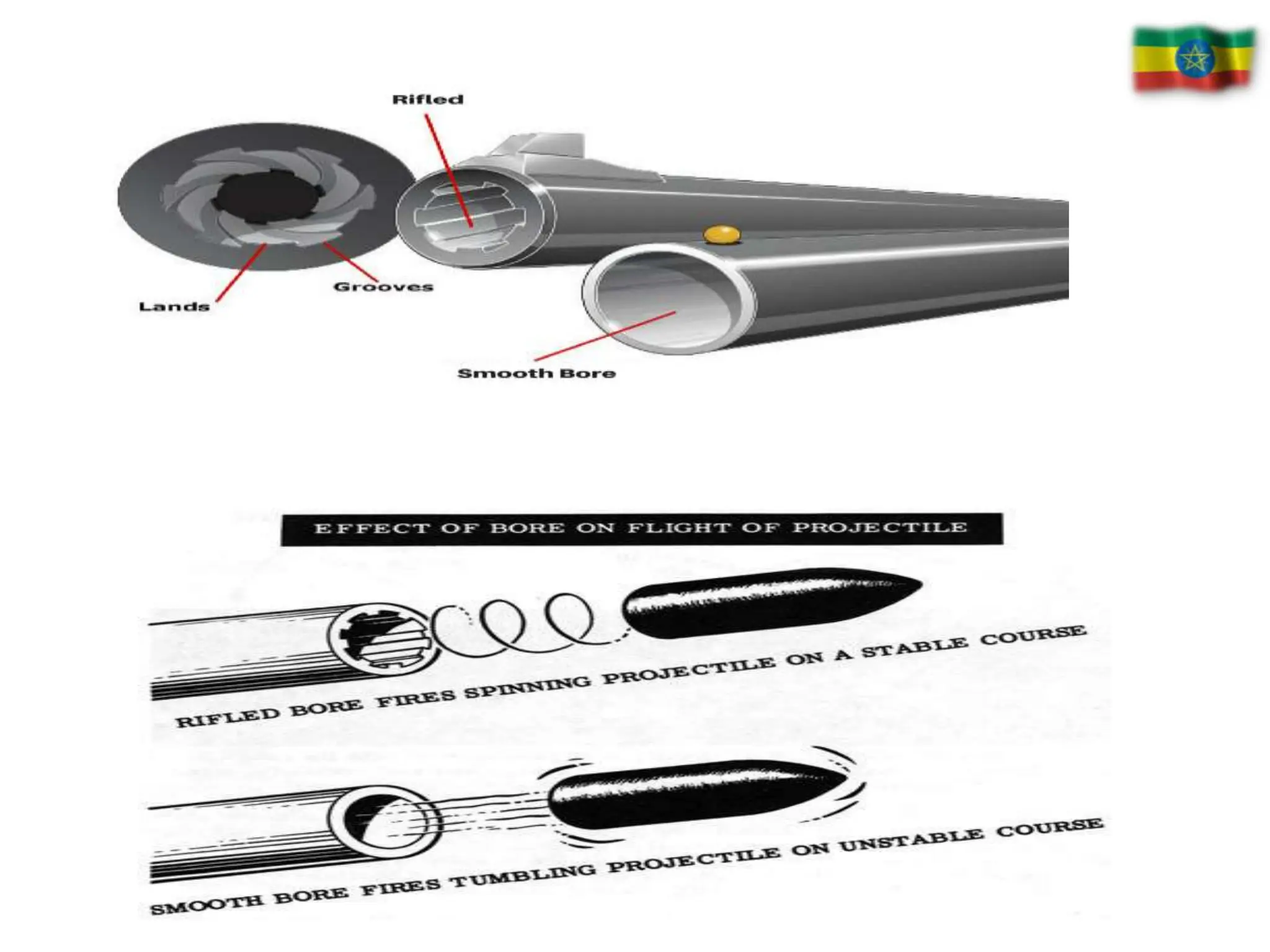
BORE
 The bore is the hollow internal lumen of the barrel, and takes up a
vast majority portion of the barrel length. It is the part of the barrel
where the projectile is located prior to firing and where it gains
speed and kinetic energy during the firing process.
 The projectile’s status of motion while travelling down the bore is
referred to as its internal ballistics.it consists of a rifled or smooth
section down which the projectile travel under the pressure of the
gas this the projectile travel the inside diameter along the
projectile travel is the caliber of the tube.
Cont.….
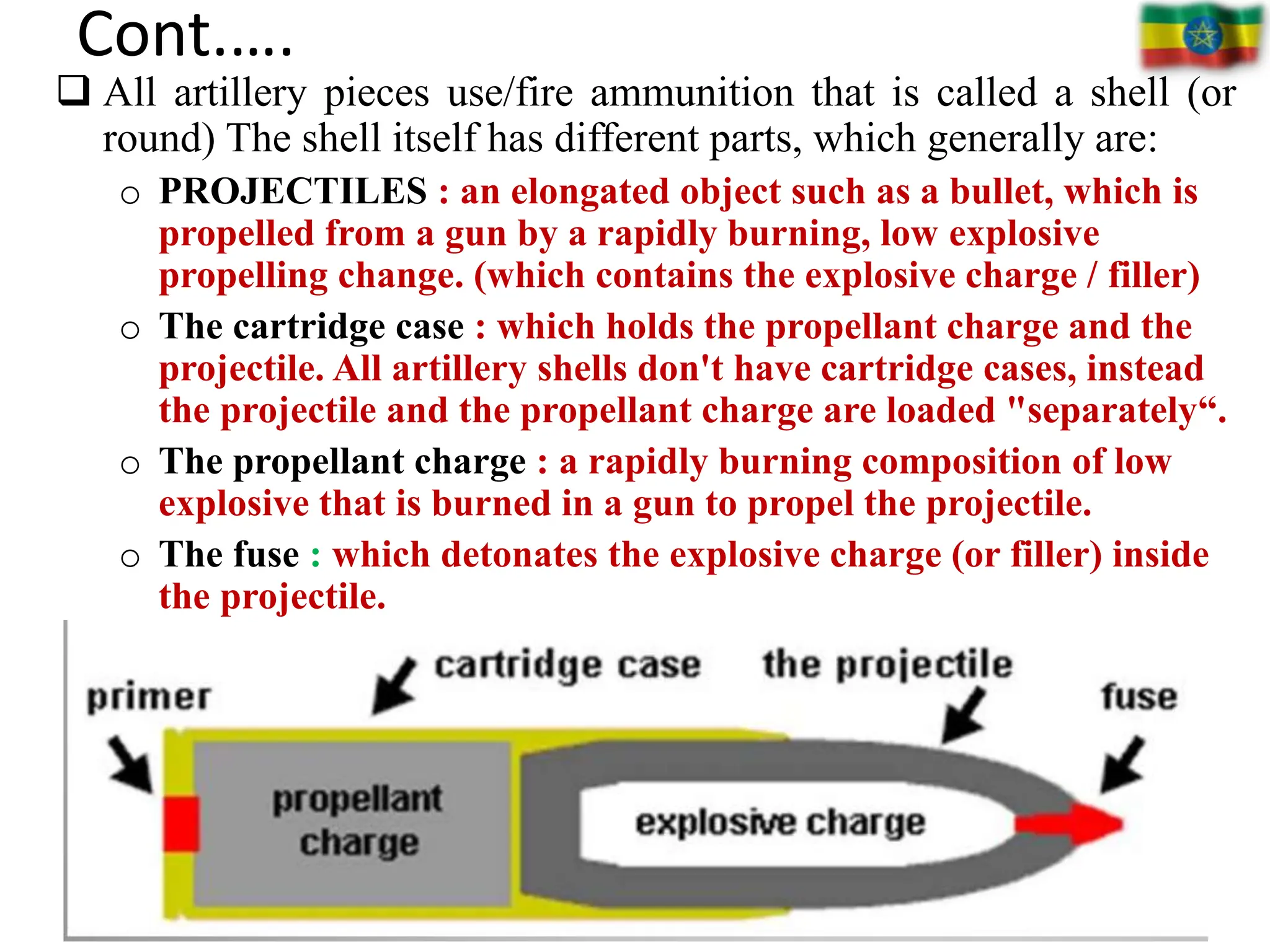
 All artillery pieces use/fire ammunition that is called a shell (or
round) The shell itself has different parts, which generally are:
o PROJECTILES : an elongated object such as a bullet, which is
propelled from a gun by a rapidly burning, low explosive
propelling change. (which contains the explosive charge / filler)
o The cartridge case : which holds the propellant charge and the
projectile. All artillery shells don't have cartridge cases, instead
the projectile and the propellant charge are loaded "separately“.
o The propellant charge : a rapidly burning composition of low
explosive that is burned in a gun to propel the projectile.
o The fuse : which detonates the explosive charge (or filler) inside
the projectile.
o The primer : which detonates the propellant charge
FIRING PROCESS
 Action inside the gun
 A gun is essentially a heat engine. Its action resembles the power stroke
of an automobile engine with the expansion of hot gases driving the
projectile instead of a piston.
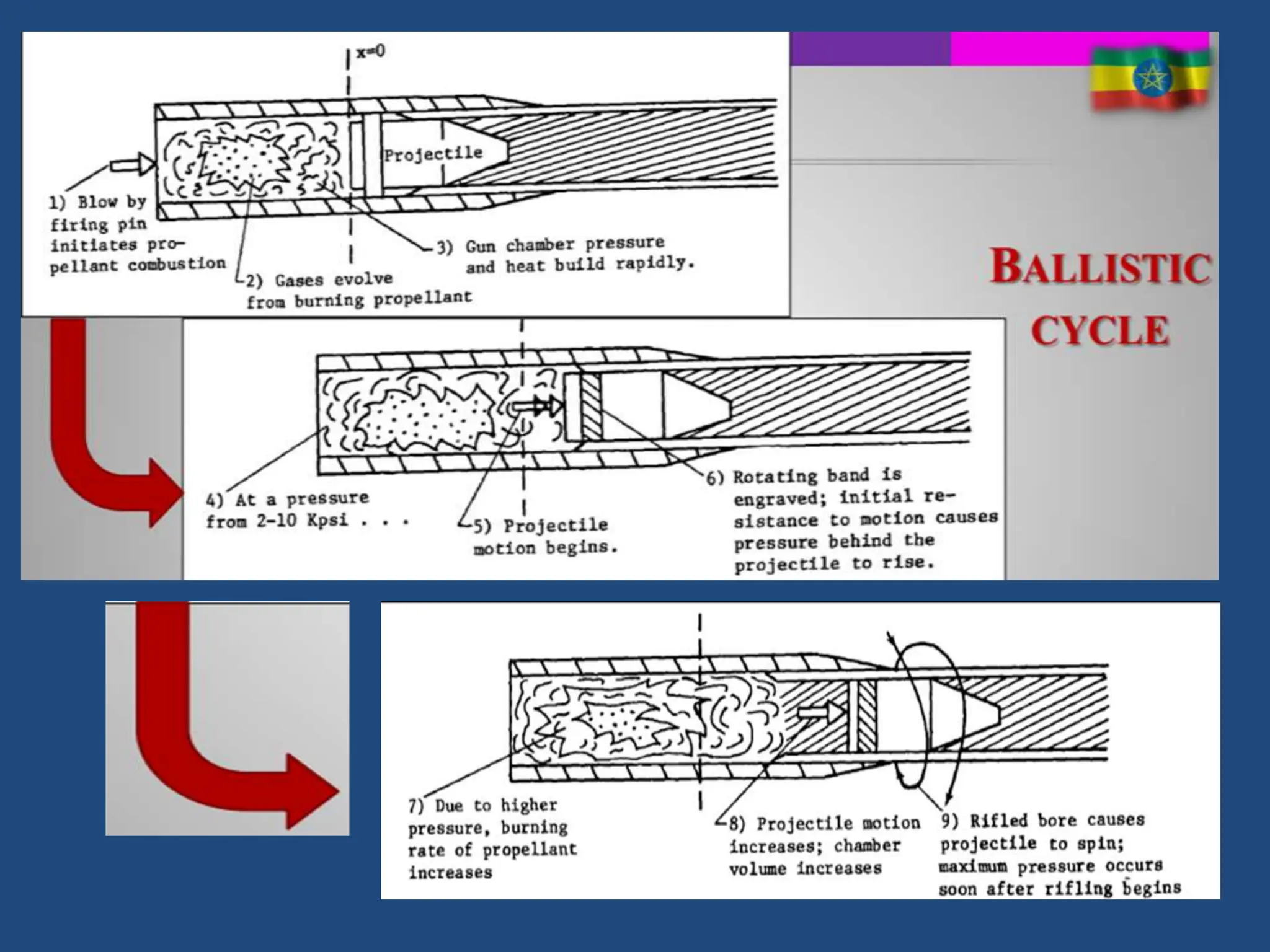
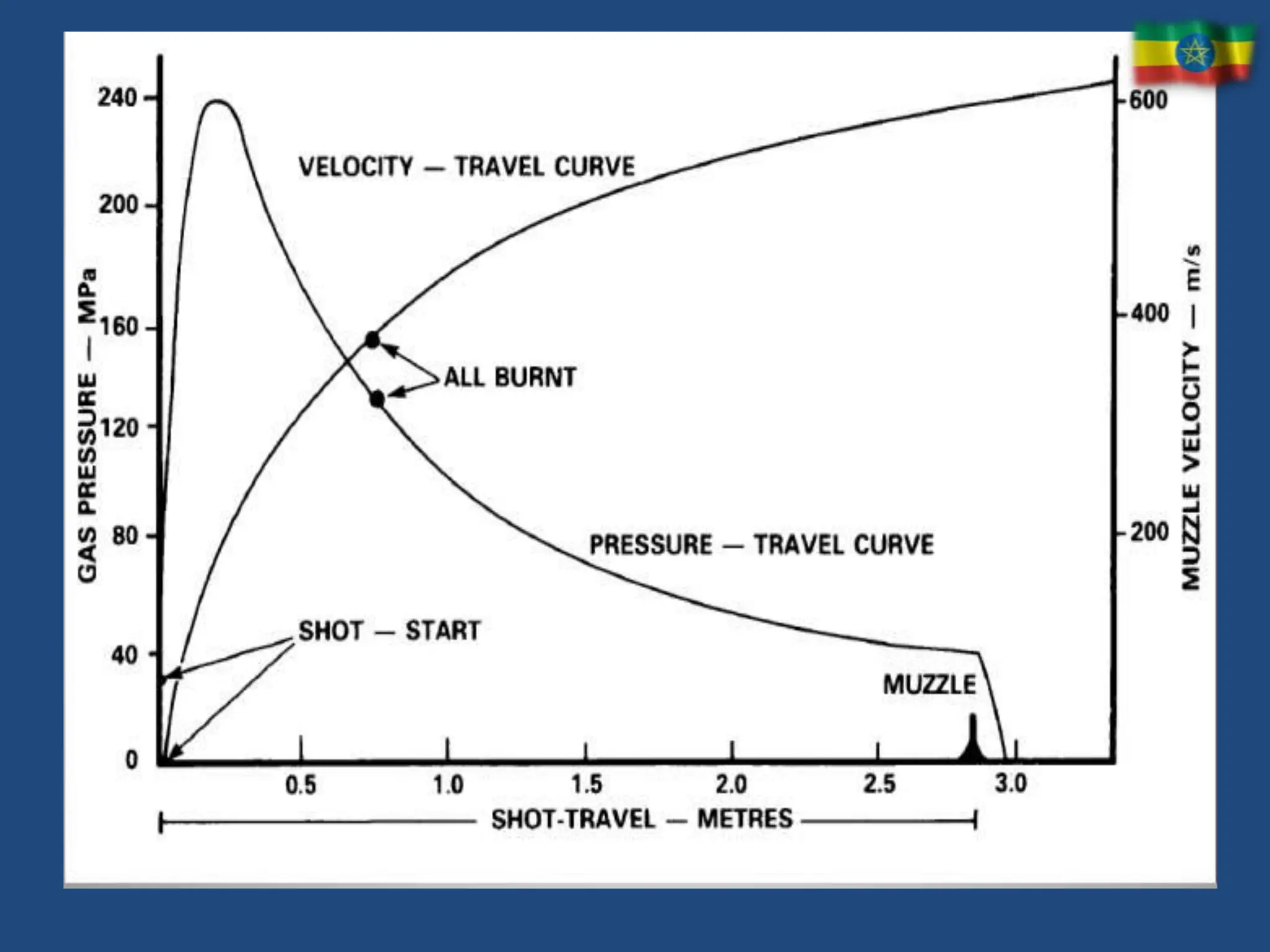
1. When the charge is ignited, gases are evolved from the surface of
each grain of propellant, and the pressure in the chamber increases rapidly.
2. The gases evolved from the surface of each separate piece of
propellant continue to build up pressure in the chamber, thereby increasing
the rate of burning such that the gases evolve more and more rapidly.
 Eventually, sufficient pressure is reached to completely overcome
driving band engravement resistance and the projectile rapidly
accelerates.
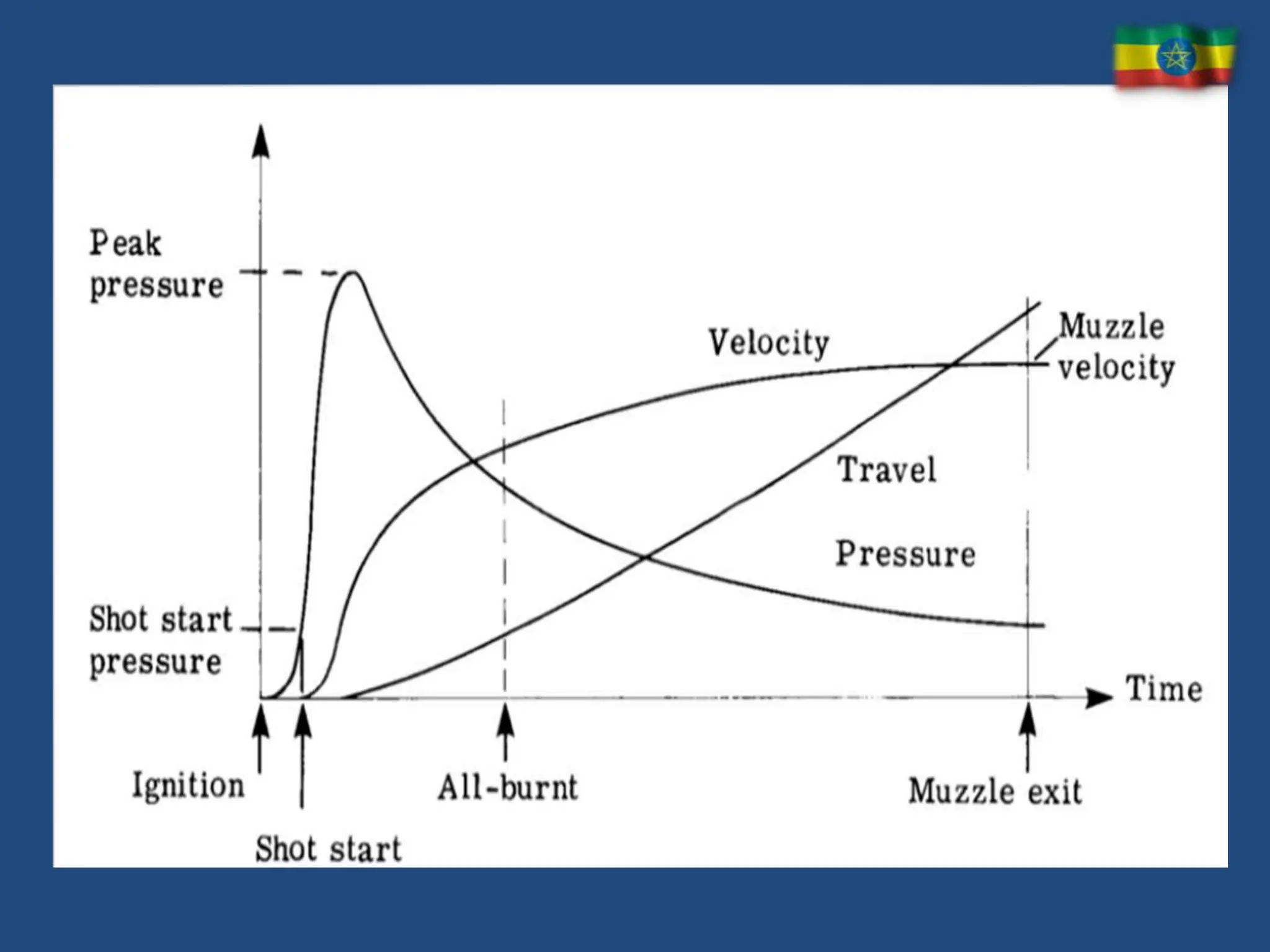
 The point at which the pressure in the chamber overcomes the resistance
of the driving band to engravement is called – shot start pressure.
FIRING PROCESS
3. The chamber volume is increased by the movement of the
projectile, which has the effect of decreasing the pressure;
however, the rate of burning of the charge increases. The net effect
is a rapid increase in the propellant pressure until the point of
maximum pressure is reached.
4. Shortly, a point is reached at which the propellant is entirely
consumed and no more gas is evolved. This point is known as the
position of all-burnt.
5. By the time the projectile reaches the muzzle, the pressure has
fallen to a fraction of its former value and acceleration is
comparatively small.
As the base of the projectile clears the muzzle, hot gases are ejected
under tremendously high pressure and high temperature.
Cont.……
Close to the muzzle, the outflowing gases have a much higher
velocity than the projectile, consequently, they overtake and pass
the projectile.
In terms of relative velocity, the projectile moves as though moving
backward.
The effect of the outflowing gases is to give the projectile an
additional thrust so that the maximum velocity is not at the muzzle
but a short distance in front of it.
The gases rapidly lose their velocity and the projectile overtakes the
outflowing gases, all within a few centimeters of the muzzle.
This is the transitional phase of ballistics (intermediate ballistics).
PRESSURE-TRAVEL CURVES
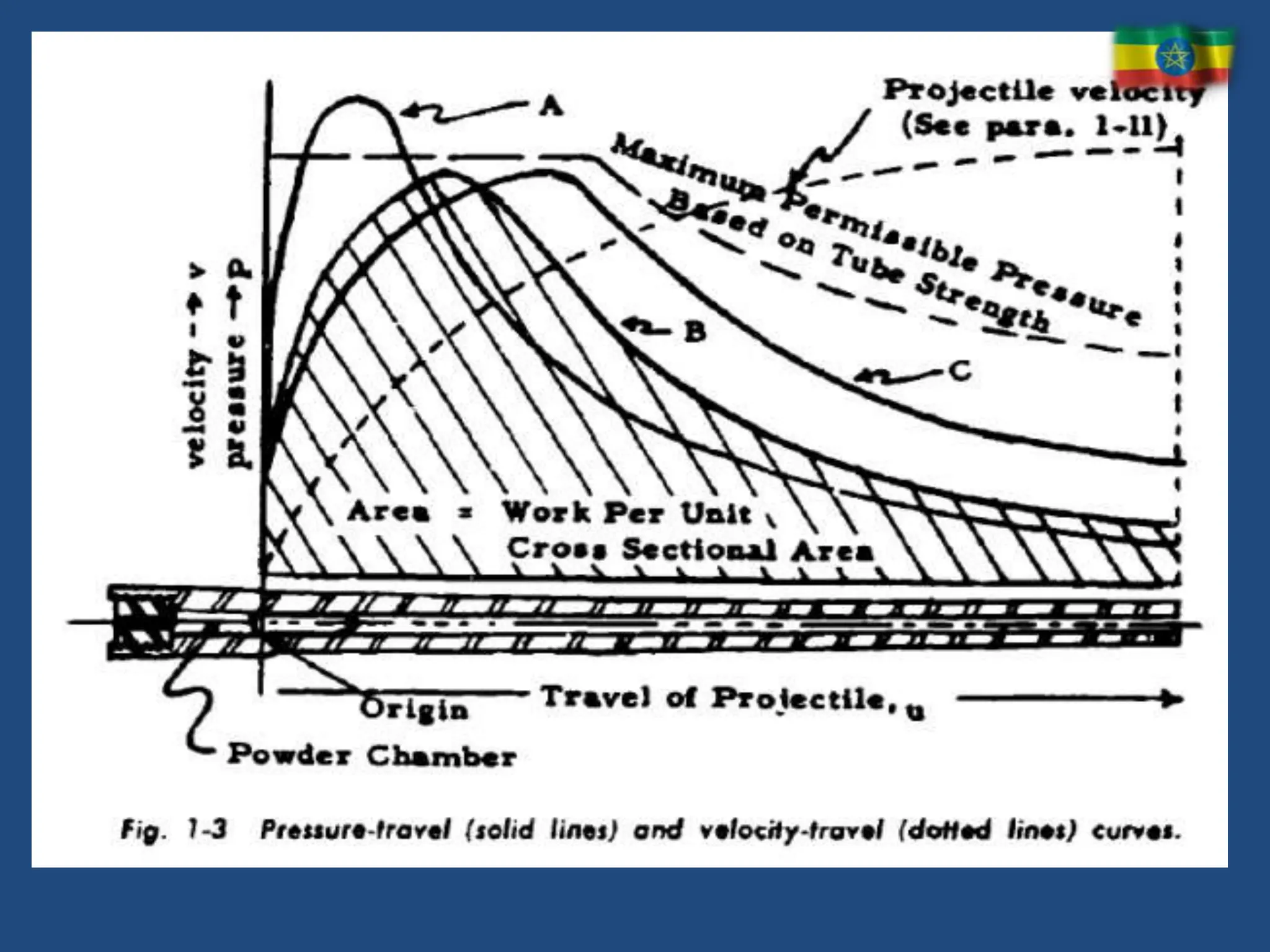
 The summary of events describes in general terms the variation in
gas pressure and projectile velocity as the projectile travels along the
bore.
 Here, gas pressure and projectile velocity are plotted against the
travel of the projectile and the resulting diagrams are known
respectively as pressure - travel and velocity - travel curves.
 All tubes are designed in accordance with a desirable pressure-travel
curve for the proposed weapon.
 The pressure-travel curves indicate the pressure (or force if pressure
is multiplied by the cross-sectional area of the bore) existing at the
base of the projectile at any point of its motion.
 Hence, the area under any of the curves represents the work done on
the projectile per unit cross-sectional area, by the expanding gases.
WORK = KE =
𝟏
𝟐
𝑴𝑽𝟐
lecture note on internal ballistics .pptx

lecture note on internal ballistics .pptx

  • 1.
    by Yohannes Tadesse(corp) Department of Armament Engineering DEFENSE UNIVERSITY, COLLEGE OF ENGINEERING BISHOFTU 2018 6/18/2024 1
  • 2.
  • 3.
    INTRODUCTION TO BALLISTICS Ballistics is the science of launching projectiles using propellant or gunpowder  The science of Ballistics involves the study of motion of projectiles as a particular branch of applied mechanics and related fields of physics, chemistry, mathematics, and engineering.  Ballistics phenomenon can divided into different independent areas.  Interior ballistics:- the motion of the projectile or missile while under the influence of a gun or thrust of propulsion device;  Intermediate ballistics:- as a part of exterior ballistics; a short period of time after the projectile leaves the muzzle and acted upon the pressure of the emerging gas  Exterior ballistics:- the projectile or missile in flight  Terminal ballistics:- its effectiveness in defeating a target
  • 4.
    INTERIOR BALLISTICS  Interiorballistics is defined as the branch of applied mechanics which deals with the motion and behavior characteristics of projectiles while under the influence of the gases produced by the propellant.  The imparting of high velocities to projectiles requires tremendous force. The source of the energy must be readily manufactured, easy to transport, and capable of being safely applied.  At various times, proposals have been made for utilization of energy provided by means other than explosives, such as compressed air, electromagnetic force, and centrifugal force.  However, no results have been attained from any of these sources which approach those realized from chemical explosives.
  • 5.
    INTERIOR BALLISTICS  Internalballistics is the study of what happens within the barrel of a weapon from the moment the firing pin hits the primer to the time the bullets exits from the barrel. It is mainly concerned with propellant pressures, acceleration of the projectile whilst it is in the bore, muzzle velocity and recoil.  The science of internal ballistics concerned with the propulsion of the projectile along the tube of weapon by the gas pressure acting on the base of projectile, or for rocket by backward exhaust of the gas jet.  And thus, Interior ballistics of guns comprises a study of a chemical energy source, a working substance, and the accessory apparatus for controlling the release of energy and for directing the activity of the working substance.
  • 6.
    Terminology  Gunnery:- isthe practical application of the science of ballistics to the engagement of targets.  Throughout this work we will be using the word ‘‘gun’’ in its generic sense. A gun can be loosely defined as a one-stroke internal combustion engine. In this case, the projectile is the piston and the propellant is the air–fuel mixture.  Gun:- a projectile-throwing device consisting essentially of a projectile-guiding tube, with an incorporate or connected reaction chamber in which the chemical energy of a propellant is rapidly converted into heat and the hot gases produced expand to expel the projectile at a high velocity.
  • 7.
    DEFINITIONS  Guns:- areclassified according to their salient features, functions, modes of operation, etc.  Based on size and portability guns can be classified as small arms and artillery.  Small arms are in general less than 30mm in caliber and are usually portable by foot soldiers.  include such weapons as rifles, machine guns, pistols, etc. firing usually at lower elevation and higher velocity,  Artillery consists of the larger weapons usually mounted on carriages and moved by other than human power. Artillery weapons include guns, howitzers and mortars. operate generally in a lower velocity range. can be fired at high angles.  Mortars:- operate at high angles like howitzers but operate at still lower velocities and are generally loaded from the muzzle.  They are simple in design and can be broken down and transported by foot soldiers.
  • 8.
    • A gunbarrel must be able to hold in the expanding gas produced by the propellants to ensure that optimum muzzle velocity is attained by the projectile as it is being pushed out. • If the barrel material cannot cope with the pressure within the bore, the barrel itself might suffer catastrophic failure and explode, which will not only destroy the gun but also present a life- threatening danger to people nearby • A gun tube may be divided into four regions: the front portion or bore through which the projectile travels when the round is fired; the rear portion or chamber which houses the round before firing; the rear opening or breech through which the ammunition is loaded; and the 'front opening or muzzle from which the projectile emerges. In recoilless guns the rear opening or nozzle provides for recoilless. GUN CONSTRUCTION
  • 10.
    Components of gunbarrel 1. Breech and breech assembly:- the breech end of the chamber is closed by sliding breech block or breech screw, which in both case is supported by a frame called a breech ring. On firing the accelerating components of propellant gas force is transmitted to the base of the cartridge case then to the breech block and ultimately to breech ring . Consequently the breech block, or screw and breech ring are heavily stressed during firing. 2. Chambers :- The chamber is the cavity at the back end of a breech-loading gun's barrel where the cartridge is inserted in position ready to be fired this is the smooth portion of the interior barrel towards the breech end. The chamber dimensions are related to the volume necessary for efficient combustion of the propellant as also the overall length the barrel. The chamber diameter normally larger than that of the bore . The transition from the chamber to the bore(which is rifled or smooth) is formed in a cone shaped ,and is called the forcing cone.
  • 12.
    BORE  The boreis the hollow internal lumen of the barrel, and takes up a vast majority portion of the barrel length. It is the part of the barrel where the projectile is located prior to firing and where it gains speed and kinetic energy during the firing process.  The projectile’s status of motion while travelling down the bore is referred to as its internal ballistics.it consists of a rifled or smooth section down which the projectile travel under the pressure of the gas this the projectile travel the inside diameter along the projectile travel is the caliber of the tube.
  • 14.
    Cont.….  All artillerypieces use/fire ammunition that is called a shell (or round) The shell itself has different parts, which generally are: o PROJECTILES : an elongated object such as a bullet, which is propelled from a gun by a rapidly burning, low explosive propelling change. (which contains the explosive charge / filler) o The cartridge case : which holds the propellant charge and the projectile. All artillery shells don't have cartridge cases, instead the projectile and the propellant charge are loaded "separately“. o The propellant charge : a rapidly burning composition of low explosive that is burned in a gun to propel the projectile. o The fuse : which detonates the explosive charge (or filler) inside the projectile. o The primer : which detonates the propellant charge
  • 15.
    FIRING PROCESS  Actioninside the gun  A gun is essentially a heat engine. Its action resembles the power stroke of an automobile engine with the expansion of hot gases driving the projectile instead of a piston. 1. When the charge is ignited, gases are evolved from the surface of each grain of propellant, and the pressure in the chamber increases rapidly. 2. The gases evolved from the surface of each separate piece of propellant continue to build up pressure in the chamber, thereby increasing the rate of burning such that the gases evolve more and more rapidly.  Eventually, sufficient pressure is reached to completely overcome driving band engravement resistance and the projectile rapidly accelerates.  The point at which the pressure in the chamber overcomes the resistance of the driving band to engravement is called – shot start pressure.
  • 16.
    FIRING PROCESS 3. Thechamber volume is increased by the movement of the projectile, which has the effect of decreasing the pressure; however, the rate of burning of the charge increases. The net effect is a rapid increase in the propellant pressure until the point of maximum pressure is reached. 4. Shortly, a point is reached at which the propellant is entirely consumed and no more gas is evolved. This point is known as the position of all-burnt. 5. By the time the projectile reaches the muzzle, the pressure has fallen to a fraction of its former value and acceleration is comparatively small. As the base of the projectile clears the muzzle, hot gases are ejected under tremendously high pressure and high temperature.
  • 17.
    Cont.…… Close to themuzzle, the outflowing gases have a much higher velocity than the projectile, consequently, they overtake and pass the projectile. In terms of relative velocity, the projectile moves as though moving backward. The effect of the outflowing gases is to give the projectile an additional thrust so that the maximum velocity is not at the muzzle but a short distance in front of it. The gases rapidly lose their velocity and the projectile overtakes the outflowing gases, all within a few centimeters of the muzzle. This is the transitional phase of ballistics (intermediate ballistics).
  • 20.
    PRESSURE-TRAVEL CURVES  Thesummary of events describes in general terms the variation in gas pressure and projectile velocity as the projectile travels along the bore.  Here, gas pressure and projectile velocity are plotted against the travel of the projectile and the resulting diagrams are known respectively as pressure - travel and velocity - travel curves.  All tubes are designed in accordance with a desirable pressure-travel curve for the proposed weapon.  The pressure-travel curves indicate the pressure (or force if pressure is multiplied by the cross-sectional area of the bore) existing at the base of the projectile at any point of its motion.  Hence, the area under any of the curves represents the work done on the projectile per unit cross-sectional area, by the expanding gases. WORK = KE = 𝟏 𝟐 𝑴𝑽𝟐