Natureview
farm
HARVARD BUSSINESS SCHOOL CASE
Natureview
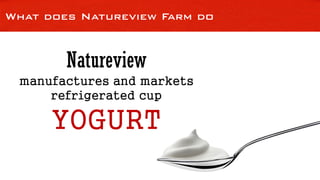
What does Natureview Farm do
Natureview
manufactures and markets
refrigerated cup
YOGURT
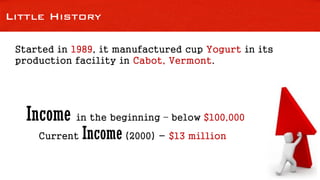
Little History
Started in 1989, it manufactured cup Yogurt in its
production facility in Cabot, Vermont.
Income in the beginning – below $100,000
Current Income (2000) - $13 million
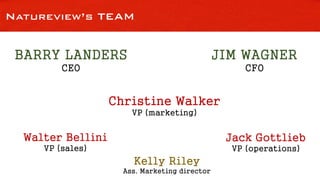
Natureview’s TEAM
BARRY LANDERS
CEO
Jack Gottlieb
VP (operations)
Walter Bellini
VP (sales)
Christine Walker
VP (marketing)
JIM WAGNER
CFO
Kelly Riley
Ass. Marketing director
Special secret recipe
The key to
Natureview yogurt’s unique
smooth, creamy texture
is the
family yogurt recipe
developed by its
Founder
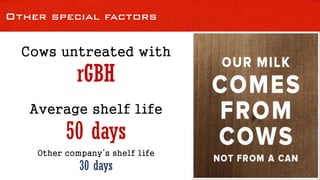
Other special factors
Cows untreated with
rGBH
Average shelf life
50 days
Other company’s shelf life
30 days
Current situation of Natureview
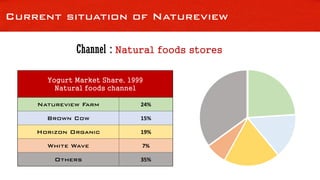
Channel : Natural foods stores
Yogurt Market Share, 1999
Natural foods channel
Natureview Farm 24%
Brown Cow 15%
Horizon Organic 19%
White Wave 7%
Others 35%
Current situation of Natureview
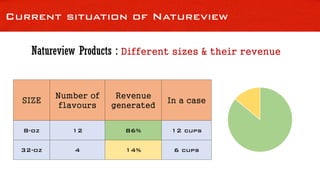
Natureview Products : Different sizes & their revenue
SIZE
Number of
flavours
Revenue
generated
In a case
8-oz 12 86% 12 cups
32-oz 4 14% 6 cups
Current situation of Natureview
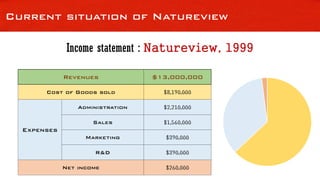
Income statement : Natureview, 1999
Revenues $13,000,000
Cost of Goods sold $8,190,000
Expenses
Administration $2,210,000
Sales $1,560,000
Marketing $390,000
R&D $390,000
Net income $260,000
Current situation of Natureview
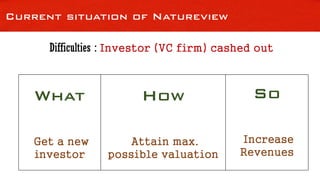
Difficulties : Investor (VC firm) cashed out
What
Get a new
investor
How
Attain max.
possible valuation
So
Increase
Revenues
$20million
revenue by
2001
GOAL
yogurt
Yogurt and its customers
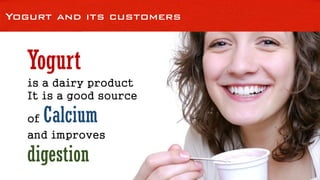
Yogurt
is a dairy product
It is a good source
of Calcium
and improves
digestion
Yogurt and its customers
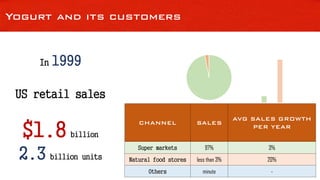
In 1999
US retail sales
$1.8 billion
2.3 billion units
CHANNEL SALES
AVG SALES GROWTH
PER YEAR
Super markets 97% 3%
Natural food stores less than 3% 20%
Others minute -
Yogurt and its customers
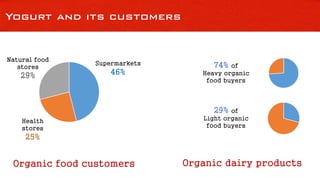
Organic food customers
Supermarkets
46%
Natural food
stores
29%
Health
stores
25%
Organic dairy products
74% of
Heavy organic
food buyers
29% of
Light organic
food buyers
Yogurt and its customers
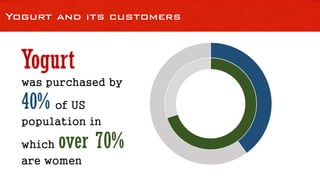
Yogurt
was purchased by
40% of US
population in
which over 70%
are women
Yogurt and its customers
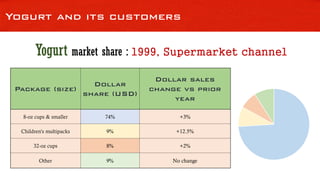
Yogurt market share : 1999, Supermarket channel
Package (size)
Dollar
share (USD)
Dollar sales
change vs prior
year
8-oz cups & smaller 74% +3%
Children's multipacks 9% +12.5%
32-oz cups 8% +2%
Other 9% No change
channels
Sales and distribution process
Yogurt
is largely distributed
through
2channels
1
Natural foods store
People’s favorite
2
Supermarket
Obviously more powerful
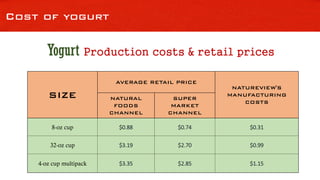
Cost of yogurt
SIZE
AVERAGE RETAIL PRICE
NATUREVIEW'S
MANUFACTURING
COSTS
NATURAL
FOODS
CHANNEL
SUPER
MARKET
CHANNEL
8-oz cup $0.88 $0.74 $0.31
32-oz cup $3.19 $2.70 $0.99
4-oz cup multipack $3.35 $2.85 $1.15
Yogurt Production costs & retail prices
Sales and distribution process
Natureview’s
expenses while passing
through these
2channels
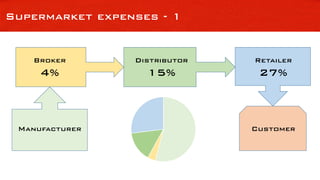
Supermarket expenses - 1
Retailer
27%
Distributor
15%
Customer
Broker
4%
Manufacturer
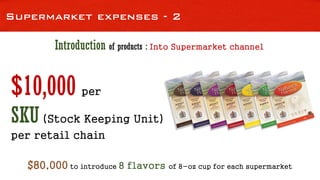
Supermarket expenses - 2
Introduction of products : Into Supermarket channel
$10,000 per
SKU (Stock Keeping Unit)
per retail chain
$80,000 to introduce 8 flavors of 8-oz cup for each supermarket
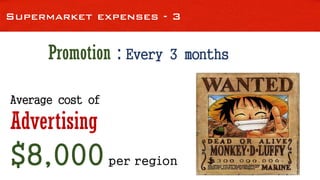
Supermarket expenses - 3
Promotion : Every 3 months
Average cost of
Advertising
$8,000per region
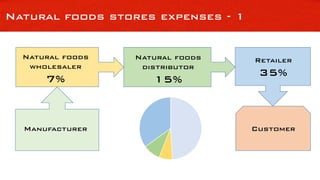
Natural foods stores expenses - 1
Retailer
35%
Natural foods
distributor
15%
Customer
Natural foods
wholesaler
7%
Manufacturer
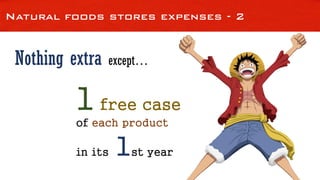
Natural foods stores expenses - 2
Nothing extra except…
1 free case
of each product
in its 1st year
solution
Solution..
A meeting with
Senior management team
gave rise to
3solutions
3
proposals
Walter Bellini
Expand into
1 or 2 selected
supermarkets with
6 SKUs of 8-oz cups
Option 1 – KEY POINTS
8-oz cups have more Dollar share
Few companies have successfully entered and
increased their revenue 200%
Supermarkets will only authorize one brand (for
yogurt). Better to enter first
1
2
3
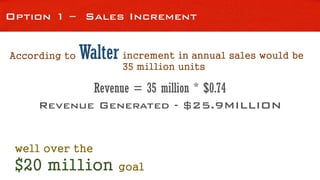
Option 1 – Sales Increment
According to Walter increment in annual sales would be
35 million units
Revenue = 35 million * $0.74
Revenue Generated - $25.9MILLION
well over the
$20 million goal
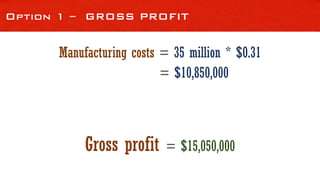
Option 1 – GROSS PROFIT
Manufacturing costs = 35 million * $0.31
= $10,850,000
Gross profit = $15,050,000
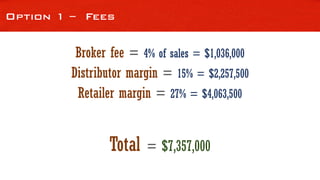
Option 1 – Fees
Broker fee = 4% of sales = $1,036,000
Total = $7,357,000
Distributor margin = 15% = $2,257,500
Retailer margin = 27% = $4,063,500
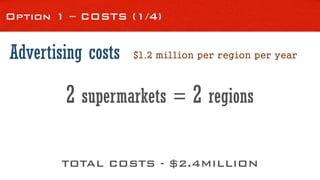
Option 1 – COSTS (1/4)
Advertising costs $1.2 million per region per year
2 supermarkets = 2 regions
TOTAL COSTS - $2.4MILLION
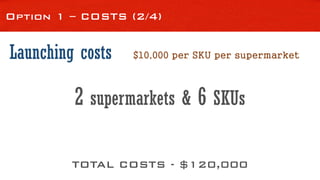
Option 1 – COSTS (2/4)
Launching costs $10,000 per SKU per supermarket
2 supermarkets & 6 SKUs
TOTAL COSTS - $120,000
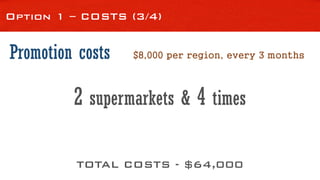
Option 1 – COSTS (3/4)
Promotion costs $8,000 per region, every 3 months
2 supermarkets & 4 times
TOTAL COSTS - $64,000
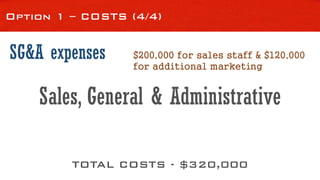
Option 1 – COSTS (4/4)
SG&A expenses $200,000 for sales staff & $120,000
for additional marketing
Sales, General & Administrative
TOTAL COSTS - $320,000
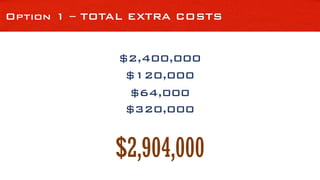
Option 1 – TOTAL EXTRA COSTS
$320,000
$2,400,000
$64,000
$120,000
$2,904,000
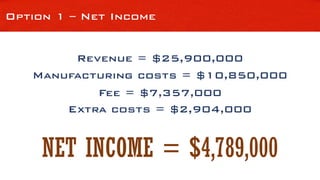
Option 1 – Net Income
Extra costs = $2,904,000
Revenue = $25,900,000
Fee = $7,357,000
Manufacturing costs = $10,850,000
NET INCOME = $4,789,000
Option 1 - Report
There is a high income and revenues, also
Greater risks (8-oz competitors)
Potential natural foods market of
Natureviewcan be lost.
Jack Gottlieb
Expand into
64 selected
supermarkets with
4 SKUs of 32-oz cups
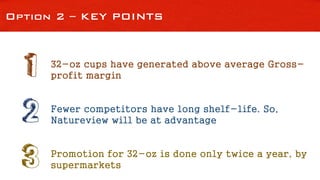
Option 2 – KEY POINTS
32-oz cups have generated above average Gross-
profit margin
Fewer competitors have long shelf-life. So,
Natureview will be at advantage
Promotion for 32-oz is done only twice a year, by
supermarkets
1
2
3
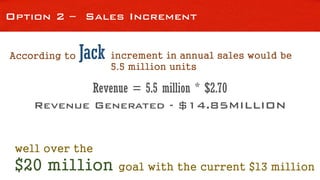
Option 2 – Sales Increment
According to Jack increment in annual sales would be
5.5 million units
Revenue = 5.5 million * $2.70
Revenue Generated - $14.85MILLION
well over the
$20 million goal with the current $13 million
Option 2 – GROSS PROFIT
Manufacturing costs = 5.5 million * $0.99
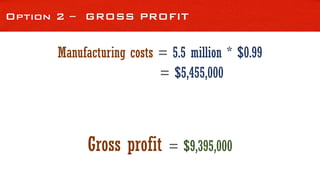
= $5,455,000
Gross profit = $9,395,000
Option 2 – Fees
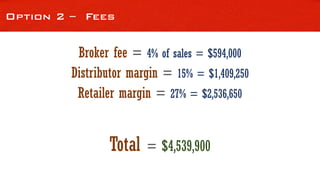
Broker fee = 4% of sales = $594,000
Total = $4,539,900
Distributor margin = 15% = $1,409,250
Retailer margin = 27% = $2,536,650
Option 2 – COSTS (1/4)
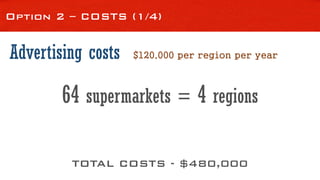
Advertising costs $120,000 per region per year
64 supermarkets = 4 regions
TOTAL COSTS - $480,000
Option 2 – COSTS (2/4)
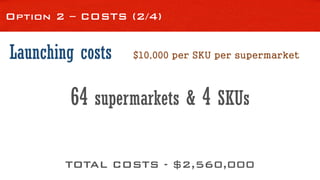
Launching costs $10,000 per SKU per supermarket
64 supermarkets & 4 SKUs
TOTAL COSTS - $2,560,000
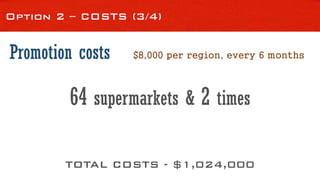
Option 2 – COSTS (3/4)
Promotion costs $8,000 per region, every 6 months
64 supermarkets & 2 times
TOTAL COSTS - $1,024,000
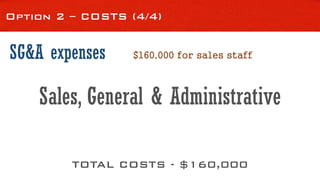
Option 2 – COSTS (4/4)
SG&A expenses $160,000 for sales staff
Sales, General & Administrative
TOTAL COSTS - $160,000
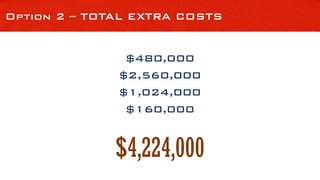
Option 2 – TOTAL EXTRA COSTS
$1,024,000
$480,000
$160,000
$2,560,000
$4,224,000
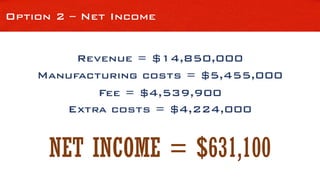
Option 2 – Net Income
Extra costs = $4,224,000
Revenue = $14,850,000
Fee = $4,539,900
Manufacturing costs = $5,455,000
NET INCOME = $631,100
Option 2 – Report
There is a high revenues, also risks
Potential natural foods market of
Natureviewcan be lost.
Also distribution
is difficult to achieve
Kelly Riley
Introduce
Natural food stores
2 SKUs of children multipacks
Option 3 – KEY POINTS
Already have a strong relationship with natural
foods stores
Natural foods channel is growing 7 times faster
than supermarket
Financial potential is very attractive. Gross
profitability of the line would be 37.6%
1
2
3
Option 3 – Sales Increment
According to Kelly increment in annual sales would be
1.8 million units
Revenue = 1.8 million * $3.35
Revenue Generated - $6,030,000
It is only above
$19 million with the current $13 million
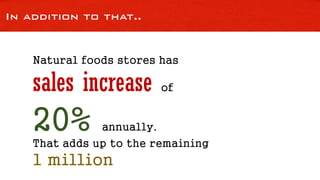
In addition to that..
Natural foods stores has
sales increase of
20% annually.
That adds up to the remaining
1 million
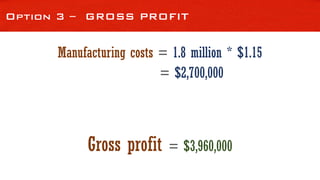
Option 3 – GROSS PROFIT
Manufacturing costs = 1.8 million * $1.15
= $2,700,000
Gross profit = $3,960,000
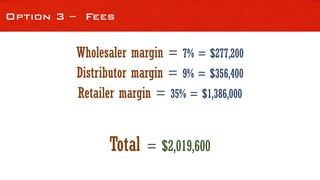
Option 3 – Fees
Wholesaler margin = 7% = $277,200
Total = $2,019,600
Distributor margin = 9% = $356,400
Retailer margin = 35% = $1,386,000
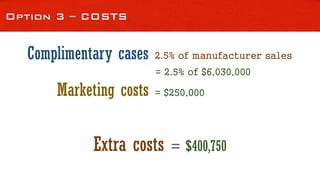
Option 3 – COSTS
Complimentary cases 2.5% of manufacturer sales
= 2.5% of $6,030,000
Extra costs = $400,750
Marketing costs = $250,000
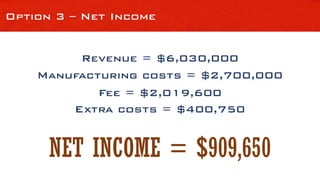
Option 3 – Net Income
Extra costs = $400,750
Revenue = $6,030,000
Fee = $2,019,600
Manufacturing costs = $2,700,000
NET INCOME = $909,650
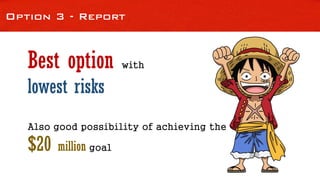
Option 3 - Report
Best option with
lowest risks
Also good possibility of achieving the
$20 million goal
conclusion
Yogurt and its customers
After this heavy analysis,
Kelly Riley’s
proposal seems to be more
profitable & healthy
Natural food stores
rules
DISCLAIMER
These slides are made by Adidala Yashwanth
during an internship under Prof Sameer
Mathur, IIM Lucknow

Natureview Harvard Business case

  • 1.
  • 2.
  • 3.
    What does NatureviewFarm do Natureview manufactures and markets refrigerated cup YOGURT
  • 4.
    Little History Started in1989, it manufactured cup Yogurt in its production facility in Cabot, Vermont. Income in the beginning – below $100,000 Current Income (2000) - $13 million
  • 5.
    Natureview’s TEAM BARRY LANDERS CEO JackGottlieb VP (operations) Walter Bellini VP (sales) Christine Walker VP (marketing) JIM WAGNER CFO Kelly Riley Ass. Marketing director
  • 6.
    Special secret recipe Thekey to Natureview yogurt’s unique smooth, creamy texture is the family yogurt recipe developed by its Founder
  • 7.
    Other special factors Cowsuntreated with rGBH Average shelf life 50 days Other company’s shelf life 30 days
  • 8.
    Current situation ofNatureview Channel : Natural foods stores Yogurt Market Share, 1999 Natural foods channel Natureview Farm 24% Brown Cow 15% Horizon Organic 19% White Wave 7% Others 35%
  • 9.
    Current situation ofNatureview Natureview Products : Different sizes & their revenue SIZE Number of flavours Revenue generated In a case 8-oz 12 86% 12 cups 32-oz 4 14% 6 cups
  • 10.
    Current situation ofNatureview Income statement : Natureview, 1999 Revenues $13,000,000 Cost of Goods sold $8,190,000 Expenses Administration $2,210,000 Sales $1,560,000 Marketing $390,000 R&D $390,000 Net income $260,000
  • 11.
    Current situation ofNatureview Difficulties : Investor (VC firm) cashed out What Get a new investor How Attain max. possible valuation So Increase Revenues
  • 12.
  • 13.
  • 14.
    Yogurt and itscustomers Yogurt is a dairy product It is a good source of Calcium and improves digestion
  • 15.
    Yogurt and itscustomers In 1999 US retail sales $1.8 billion 2.3 billion units CHANNEL SALES AVG SALES GROWTH PER YEAR Super markets 97% 3% Natural food stores less than 3% 20% Others minute -
  • 16.
    Yogurt and itscustomers Organic food customers Supermarkets 46% Natural food stores 29% Health stores 25% Organic dairy products 74% of Heavy organic food buyers 29% of Light organic food buyers
  • 17.
    Yogurt and itscustomers Yogurt was purchased by 40% of US population in which over 70% are women
  • 18.
    Yogurt and itscustomers Yogurt market share : 1999, Supermarket channel Package (size) Dollar share (USD) Dollar sales change vs prior year 8-oz cups & smaller 74% +3% Children's multipacks 9% +12.5% 32-oz cups 8% +2% Other 9% No change
  • 19.
  • 20.
    Sales and distributionprocess Yogurt is largely distributed through 2channels
  • 21.
  • 22.
  • 23.
    Cost of yogurt SIZE AVERAGERETAIL PRICE NATUREVIEW'S MANUFACTURING COSTS NATURAL FOODS CHANNEL SUPER MARKET CHANNEL 8-oz cup $0.88 $0.74 $0.31 32-oz cup $3.19 $2.70 $0.99 4-oz cup multipack $3.35 $2.85 $1.15 Yogurt Production costs & retail prices
  • 24.
    Sales and distributionprocess Natureview’s expenses while passing through these 2channels
  • 26.
    Supermarket expenses -1 Retailer 27% Distributor 15% Customer Broker 4% Manufacturer
  • 27.
    Supermarket expenses -2 Introduction of products : Into Supermarket channel $10,000 per SKU (Stock Keeping Unit) per retail chain $80,000 to introduce 8 flavors of 8-oz cup for each supermarket
  • 28.
    Supermarket expenses -3 Promotion : Every 3 months Average cost of Advertising $8,000per region
  • 30.
    Natural foods storesexpenses - 1 Retailer 35% Natural foods distributor 15% Customer Natural foods wholesaler 7% Manufacturer
  • 31.
    Natural foods storesexpenses - 2 Nothing extra except… 1 free case of each product in its 1st year
  • 32.
  • 33.
    Solution.. A meeting with Seniormanagement team gave rise to 3solutions
  • 34.
  • 35.
    Walter Bellini Expand into 1or 2 selected supermarkets with 6 SKUs of 8-oz cups
  • 36.
    Option 1 –KEY POINTS 8-oz cups have more Dollar share Few companies have successfully entered and increased their revenue 200% Supermarkets will only authorize one brand (for yogurt). Better to enter first 1 2 3
  • 37.
    Option 1 –Sales Increment According to Walter increment in annual sales would be 35 million units Revenue = 35 million * $0.74 Revenue Generated - $25.9MILLION well over the $20 million goal
  • 38.
    Option 1 –GROSS PROFIT Manufacturing costs = 35 million * $0.31 = $10,850,000 Gross profit = $15,050,000
  • 39.
    Option 1 –Fees Broker fee = 4% of sales = $1,036,000 Total = $7,357,000 Distributor margin = 15% = $2,257,500 Retailer margin = 27% = $4,063,500
  • 40.
    Option 1 –COSTS (1/4) Advertising costs $1.2 million per region per year 2 supermarkets = 2 regions TOTAL COSTS - $2.4MILLION
  • 41.
    Option 1 –COSTS (2/4) Launching costs $10,000 per SKU per supermarket 2 supermarkets & 6 SKUs TOTAL COSTS - $120,000
  • 42.
    Option 1 –COSTS (3/4) Promotion costs $8,000 per region, every 3 months 2 supermarkets & 4 times TOTAL COSTS - $64,000
  • 43.
    Option 1 –COSTS (4/4) SG&A expenses $200,000 for sales staff & $120,000 for additional marketing Sales, General & Administrative TOTAL COSTS - $320,000
  • 44.
    Option 1 –TOTAL EXTRA COSTS $320,000 $2,400,000 $64,000 $120,000 $2,904,000
  • 45.
    Option 1 –Net Income Extra costs = $2,904,000 Revenue = $25,900,000 Fee = $7,357,000 Manufacturing costs = $10,850,000 NET INCOME = $4,789,000
  • 46.
    Option 1 -Report There is a high income and revenues, also Greater risks (8-oz competitors) Potential natural foods market of Natureviewcan be lost.
  • 47.
    Jack Gottlieb Expand into 64selected supermarkets with 4 SKUs of 32-oz cups
  • 48.
    Option 2 –KEY POINTS 32-oz cups have generated above average Gross- profit margin Fewer competitors have long shelf-life. So, Natureview will be at advantage Promotion for 32-oz is done only twice a year, by supermarkets 1 2 3
  • 49.
    Option 2 –Sales Increment According to Jack increment in annual sales would be 5.5 million units Revenue = 5.5 million * $2.70 Revenue Generated - $14.85MILLION well over the $20 million goal with the current $13 million
  • 50.
    Option 2 –GROSS PROFIT Manufacturing costs = 5.5 million * $0.99 = $5,455,000 Gross profit = $9,395,000
  • 51.
    Option 2 –Fees Broker fee = 4% of sales = $594,000 Total = $4,539,900 Distributor margin = 15% = $1,409,250 Retailer margin = 27% = $2,536,650
  • 52.
    Option 2 –COSTS (1/4) Advertising costs $120,000 per region per year 64 supermarkets = 4 regions TOTAL COSTS - $480,000
  • 53.
    Option 2 –COSTS (2/4) Launching costs $10,000 per SKU per supermarket 64 supermarkets & 4 SKUs TOTAL COSTS - $2,560,000
  • 54.
    Option 2 –COSTS (3/4) Promotion costs $8,000 per region, every 6 months 64 supermarkets & 2 times TOTAL COSTS - $1,024,000
  • 55.
    Option 2 –COSTS (4/4) SG&A expenses $160,000 for sales staff Sales, General & Administrative TOTAL COSTS - $160,000
  • 56.
    Option 2 –TOTAL EXTRA COSTS $1,024,000 $480,000 $160,000 $2,560,000 $4,224,000
  • 57.
    Option 2 –Net Income Extra costs = $4,224,000 Revenue = $14,850,000 Fee = $4,539,900 Manufacturing costs = $5,455,000 NET INCOME = $631,100
  • 58.
    Option 2 –Report There is a high revenues, also risks Potential natural foods market of Natureviewcan be lost. Also distribution is difficult to achieve
  • 59.
    Kelly Riley Introduce Natural foodstores 2 SKUs of children multipacks
  • 60.
    Option 3 –KEY POINTS Already have a strong relationship with natural foods stores Natural foods channel is growing 7 times faster than supermarket Financial potential is very attractive. Gross profitability of the line would be 37.6% 1 2 3
  • 61.
    Option 3 –Sales Increment According to Kelly increment in annual sales would be 1.8 million units Revenue = 1.8 million * $3.35 Revenue Generated - $6,030,000 It is only above $19 million with the current $13 million
  • 62.
    In addition tothat.. Natural foods stores has sales increase of 20% annually. That adds up to the remaining 1 million
  • 63.
    Option 3 –GROSS PROFIT Manufacturing costs = 1.8 million * $1.15 = $2,700,000 Gross profit = $3,960,000
  • 64.
    Option 3 –Fees Wholesaler margin = 7% = $277,200 Total = $2,019,600 Distributor margin = 9% = $356,400 Retailer margin = 35% = $1,386,000
  • 65.
    Option 3 –COSTS Complimentary cases 2.5% of manufacturer sales = 2.5% of $6,030,000 Extra costs = $400,750 Marketing costs = $250,000
  • 66.
    Option 3 –Net Income Extra costs = $400,750 Revenue = $6,030,000 Fee = $2,019,600 Manufacturing costs = $2,700,000 NET INCOME = $909,650
  • 67.
    Option 3 -Report Best option with lowest risks Also good possibility of achieving the $20 million goal
  • 68.
  • 69.
    Yogurt and itscustomers After this heavy analysis, Kelly Riley’s proposal seems to be more profitable & healthy
  • 70.
  • 71.
    DISCLAIMER These slides aremade by Adidala Yashwanth during an internship under Prof Sameer Mathur, IIM Lucknow