+
Harrington
Collection


             Case Analysis

             Trent Halverson, Aaron Kinning, Erin Moller,
             Alyssa Nelson
+
    Internal Analysis

     Overall
            Objective: To provide preeminent brands
     for women desiring elegant, high-end fashions.

     Overall   Strategy: Differentiation
+
    Internal Analysis

     Target
           Market: Affluent, fashionable, college-
     educated, professional women ages 25-60.
        Each division focused more narrowly on a specific TM.

     Positioning: Lifestyle branding strategy, wearing
     the label is a sign of status
+
    Product

     Objective: To  provide the highest quality clothing
     that offers a lifestyle of prestige and status

     Strategy: Product   Differentiation

     Tactics:
             All 4 divisions include: Harrington Limited,
     Sopra, Christina Cole, and Vigor. No private label
     brands.
+
    Price

     Objective: To    increase market share and profit
     margins

     Strategy: Skimming

     Tactics: Offer   premium prices to support status of
     brand.
        Harrington Limited: $500-$1,000
        Sopra: $400-$800
        Christina Cole: $300-$700
        Vigor: $150-500
+
    Promotion

     Objective: To
                 provide convenience to retailers, and
     help them obtain and sell the brand

     Strategy: Push

     Tactics:
            Retail sales force well trained; Offer
     channel partners more support and incentives than
     most manufacturers; Offer retailers valuable
     inventory and sales advice.
+
    Channel

     Objective: Toprovide convenience to both retailers
     and final consumers by offering the Harrington
     collection at only the best retailers or directly
     through e-commerce

     Strategy: Dual   channel strategy

     Tactics: Company  owned retail stores (20% sales);
     upscale department stores (60% sales) and
     specialty stores (40% sales); e-commerce
+
    Performance

    Sales

     $2,433,900,000    in retail sales

     Total   revenue: $1,344 million
        Manufacturing Group: $538 million
        Retail Group: $806 million

     Total   Profit before tax: $118 million
+
    Performance

     Market   Share:
        2007 women’s apparel industry = $133 billion in retail sales
        Harrington Collection held approximately 1.83% share of
         total women’s apparel market in 2007

     Trends   (CAGR):
        Average Growth Rate in U.S. retail sales of women’s apparel
         2002-2007: 4.66% (ex 1, p 240)
+
    External Analysis

     Political/Legal/Regulatory: Textile   import quotas
     from China eliminated in 2004.

     Economic: The economic downturn that began in
     the early 2000s significantly impacted the industry
     for U.S. women’s apparel. Consumers had become
     very price sensitive- half of all apparel purchases
     were sold ―on sale.‖
+
    External Analysis

     Technological: E-commerce.

     Social/Cultural: Women  were buying more casual
     clothing. More dollars were being spent on
     technology products, home design, and leisure-
     activities. Fast changing fashion product life
     cycles—consumers’ tastes constantly changing.
+
    Competitive Analysis – Porter’s
    Five Forces
    Macro (5 forces)

     Threat
           of New Entrants: High- Due to the ease of
     outsourcing production, low barriers to entry

     Bargaining
               Power of Buyers: Moderate-
     Manufacturers integrating forward with company-
     owned stores; but department store mergers gave
     more bargaining power to suppliers
+
    Porter’s Five Forces (cont.)

     Bargaining Power of Suppliers: Moderate- willing
     and cheap labor overseas. More retail outlets
     integrating backwards (providing margins of about
     10-20% higher).

     Threatof Substitutes: High- easy to imitate designs
     at lower costs

     Intensityof Rivalry: High- many brands competing
     for shelf space and market share. The industry was
     moderately concentrated.
+
    Competitive Analysis

    Micro
       Leading brands: Jones Apparel Group, Liz Claiborne
        due to their diverse portfolios
         Both outsource production of apparel overseas
         Both involved in design, marketing, wholesaling, and
          retailing of women’s apparel
         Jones: 396 specialty retail stores
           Brands include: Jones New York, Nine West, Anne
            Klein, Gloria Vanderbilt, Kasper, Bandolino, Evan-
            Picone, Energie, EnzoAngiolini
         Claiborne: 338 retail stores around the globe (201 in
          US)
           Brands include: Liz Claiborne, Mexx, Juicy Couture,
            Lucky Brand Jeans, Ellen Tracy
+
    Market Segments

    Women’s apparel products could be divided into six
     general categories based on quality and price:
    1)   Haute couture
    2)   Designer
    3)   Bridge
    4)   Better
    5)   Moderate
    6)   Budget
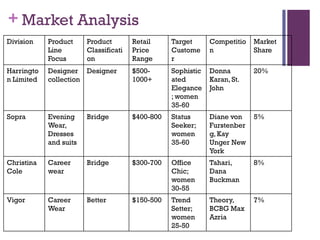
+ Market Analysis
Division    Product     Product        Retail     Target      Competitio   Market
            Line        Classificati   Price      Custome     n            Share
            Focus       on             Range      r
Harringto   Designer Designer          $500-      Sophistic   Donna        20%
n Limited   collection                 1000+      ated        Karan, St.
                                                  Elegance    John
                                                  ; women
                                                  35-60
Sopra       Evening     Bridge         $400-800   Status      Diane von    5%
            Wear,                                 Seeker;     Furstenber
            Dresses                               women       g, Kay
            and suits                             35-60       Unger New
                                                              York
Christina   Career      Bridge         $300-700   Office      Tahari,      8%
Cole        wear                                  Chic;       Dana
                                                  women       Buckman
                                                  30-55
Vigor       Career      Better         $150-500   Trend       Theory,      7%
            Wear                                  Setter;     BCBG Max
                                                  women       Azria
                                                  25-50
+
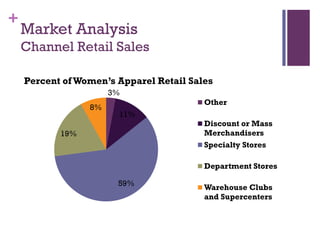
    Market Analysis
    Channel Retail Sales

    Percent of Women’s Apparel Retail Sales
                      3%
                                         Other
                 8%
                       11%
                                         Discount or Mass
           19%                           Merchandisers
                                         Specialty Stores

                                         Department Stores

                       59%
                                         Warehouse Clubs
                                         and Supercenters
+
    Case Brief


    Problem: How should Harrington Collection
     put forth their new active wear line?
+
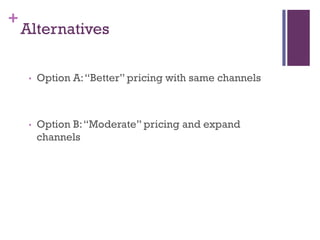
    Alternatives

     •   Option A: ―Better‖ pricing with same channels


     •   Option B: ―Moderate‖ pricing and expand
         channels
+
    Criteria

     Maintain   sophisticated, high-class status

     Increase   margins

     Break   even in first year
+
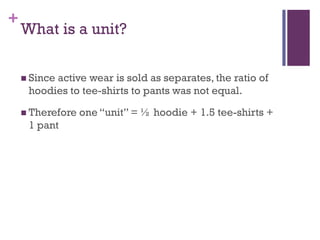
    What is a unit?

     Since
          active wear is sold as separates, the ratio of
     hoodies to tee-shirts to pants was not equal.

     Therefore   one ―unit‖ = ½ hoodie + 1.5 tee-shirts +
     1 pant
+
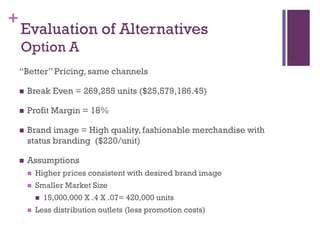
    Evaluation of Alternatives
    Option A
    ―Better‖ Pricing, same channels

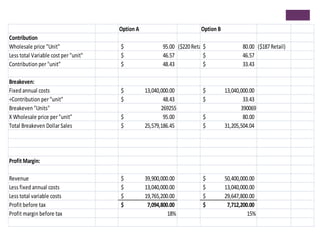
       Break Even = 269,255 units ($25,579,186.45)

       Profit Margin = 18%

       Brand image = High quality, fashionable merchandise with
        status branding ($220/unit)

       Assumptions
           Higher prices consistent with desired brand image
           Smaller Market Size
               15,000,000 X .4 X .07= 420,000 units
           Less distribution outlets (less promotion costs)
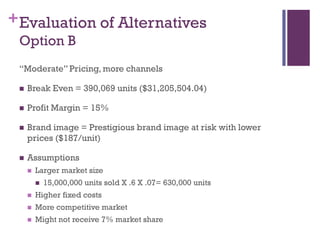
+ Evaluation of Alternatives
 Option B
 ―Moderate‖ Pricing, more channels

    Break Even = 390,069 units ($31,205,504.04)

    Profit Margin = 15%

    Brand image = Prestigious brand image at risk with lower
     prices ($187/unit)

    Assumptions
        Larger market size
            15,000,000 units sold X .6 X .07= 630,000 units
        Higher fixed costs
        More competitive market
        Might not receive 7% market share
Option A                          Option B
Contribution
Wholesale price "Unit"                $                 95.00 ($220 Retail)
                                                                         $                80.00 ($187 Retail)
Less total Variable cost per "unit"   $                 46.57            $                46.57
Contribution per "unit"               $                 48.43            $                33.43

Breakeven:
Fixed annual costs                    $          13,040,000.00           $         13,040,000.00
÷Contribution per "unit"              $                  48.43           $                 33.43
Breakeven "Units"                                       269255                            390069
X Wholesale price per "unit"          $                  95.00           $                 80.00
Total Breakeven Dollar Sales          $          25,579,186.45           $         31,205,504.04


Profit Margin:

Revenue                               $          39,900,000.00           $         50,400,000.00
Less fixed annual costs               $          13,040,000.00           $         13,040,000.00
Less total variable costs             $          19,765,200.00           $         29,647,800.00
Profit before tax                     $           7,094,800.00           $          7,712,200.00
Profit margin before tax                                   18%                               15%
+
    Recommendations

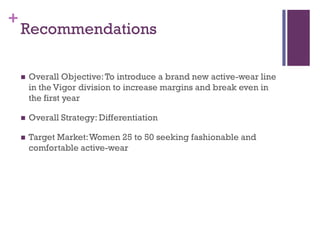
       Overall Objective: To introduce a brand new active-wear line
        in the Vigor division to increase margins and break even in
        the first year

       Overall Strategy: Differentiation

       Target Market: Women 25 to 50 seeking fashionable and
        comfortable active-wear
+
    Product

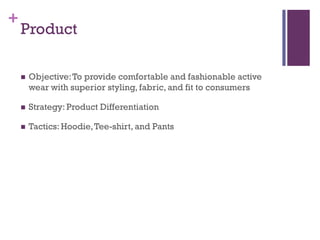
       Objective: To provide comfortable and fashionable active
        wear with superior styling, fabric, and fit to consumers

       Strategy: Product Differentiation

       Tactics: Hoodie, Tee-shirt, and Pants
+
    Price

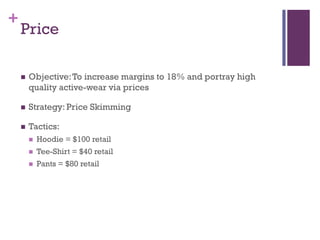
       Objective: To increase margins to 18% and portray high
        quality active-wear via prices

       Strategy: Price Skimming

       Tactics:
           Hoodie = $100 retail
           Tee-Shirt = $40 retail
           Pants = $80 retail
+
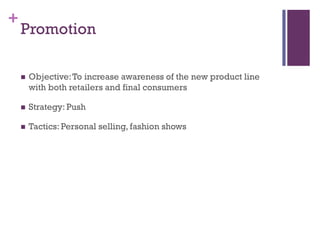
    Promotion

       Objective: To increase awareness of the new product line
        with both retailers and final consumers

       Strategy: Push

       Tactics: Personal selling, fashion shows
+
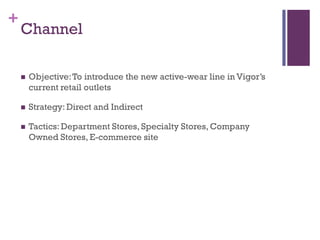
    Channel

       Objective: To introduce the new active-wear line in Vigor’s
        current retail outlets

       Strategy: Direct and Indirect

       Tactics: Department Stores, Specialty Stores, Company
        Owned Stores, E-commerce site
+
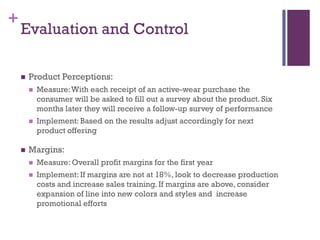
    Evaluation and Control

       Product Perceptions:
           Measure: With each receipt of an active-wear purchase the
            consumer will be asked to fill out a survey about the product. Six
            months later they will receive a follow-up survey of performance
           Implement: Based on the results adjust accordingly for next
            product offering

       Margins:
           Measure: Overall profit margins for the first year
           Implement: If margins are not at 18%, look to decrease production
            costs and increase sales training. If margins are above, consider
            expansion of line into new colors and styles and increase
            promotional efforts
+
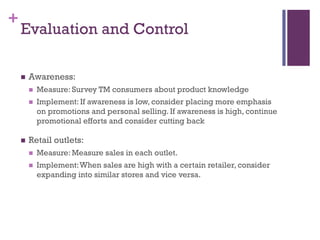
    Evaluation and Control

       Awareness:
           Measure: Survey TM consumers about product knowledge
           Implement: If awareness is low, consider placing more emphasis
            on promotions and personal selling. If awareness is high, continue
            promotional efforts and consider cutting back

       Retail outlets:
           Measure: Measure sales in each outlet.
           Implement: When sales are high with a certain retailer, consider
            expanding into similar stores and vice versa.
+
    THANK YOU

harrington collection

  • 1.
    + Harrington Collection Case Analysis Trent Halverson, Aaron Kinning, Erin Moller, Alyssa Nelson
  • 2.
    + Internal Analysis  Overall Objective: To provide preeminent brands for women desiring elegant, high-end fashions.  Overall Strategy: Differentiation
  • 3.
    + Internal Analysis  Target Market: Affluent, fashionable, college- educated, professional women ages 25-60.  Each division focused more narrowly on a specific TM.  Positioning: Lifestyle branding strategy, wearing the label is a sign of status
  • 4.
    + Product  Objective: To provide the highest quality clothing that offers a lifestyle of prestige and status  Strategy: Product Differentiation  Tactics: All 4 divisions include: Harrington Limited, Sopra, Christina Cole, and Vigor. No private label brands.
  • 5.
    + Price  Objective: To increase market share and profit margins  Strategy: Skimming  Tactics: Offer premium prices to support status of brand.  Harrington Limited: $500-$1,000  Sopra: $400-$800  Christina Cole: $300-$700  Vigor: $150-500
  • 6.
    + Promotion  Objective: To provide convenience to retailers, and help them obtain and sell the brand  Strategy: Push  Tactics: Retail sales force well trained; Offer channel partners more support and incentives than most manufacturers; Offer retailers valuable inventory and sales advice.
  • 7.
    + Channel  Objective: Toprovide convenience to both retailers and final consumers by offering the Harrington collection at only the best retailers or directly through e-commerce  Strategy: Dual channel strategy  Tactics: Company owned retail stores (20% sales); upscale department stores (60% sales) and specialty stores (40% sales); e-commerce
  • 8.
    + Performance Sales  $2,433,900,000 in retail sales  Total revenue: $1,344 million  Manufacturing Group: $538 million  Retail Group: $806 million  Total Profit before tax: $118 million
  • 9.
    + Performance  Market Share:  2007 women’s apparel industry = $133 billion in retail sales  Harrington Collection held approximately 1.83% share of total women’s apparel market in 2007  Trends (CAGR):  Average Growth Rate in U.S. retail sales of women’s apparel 2002-2007: 4.66% (ex 1, p 240)
  • 10.
    + External Analysis  Political/Legal/Regulatory: Textile import quotas from China eliminated in 2004.  Economic: The economic downturn that began in the early 2000s significantly impacted the industry for U.S. women’s apparel. Consumers had become very price sensitive- half of all apparel purchases were sold ―on sale.‖
  • 11.
    + External Analysis  Technological: E-commerce.  Social/Cultural: Women were buying more casual clothing. More dollars were being spent on technology products, home design, and leisure- activities. Fast changing fashion product life cycles—consumers’ tastes constantly changing.
  • 12.
    + Competitive Analysis – Porter’s Five Forces Macro (5 forces)  Threat of New Entrants: High- Due to the ease of outsourcing production, low barriers to entry  Bargaining Power of Buyers: Moderate- Manufacturers integrating forward with company- owned stores; but department store mergers gave more bargaining power to suppliers
  • 13.
    + Porter’s Five Forces (cont.)  Bargaining Power of Suppliers: Moderate- willing and cheap labor overseas. More retail outlets integrating backwards (providing margins of about 10-20% higher).  Threatof Substitutes: High- easy to imitate designs at lower costs  Intensityof Rivalry: High- many brands competing for shelf space and market share. The industry was moderately concentrated.
  • 14.
    + Competitive Analysis Micro  Leading brands: Jones Apparel Group, Liz Claiborne due to their diverse portfolios  Both outsource production of apparel overseas  Both involved in design, marketing, wholesaling, and retailing of women’s apparel  Jones: 396 specialty retail stores  Brands include: Jones New York, Nine West, Anne Klein, Gloria Vanderbilt, Kasper, Bandolino, Evan- Picone, Energie, EnzoAngiolini  Claiborne: 338 retail stores around the globe (201 in US)  Brands include: Liz Claiborne, Mexx, Juicy Couture, Lucky Brand Jeans, Ellen Tracy
  • 15.
    + Market Segments Women’s apparel products could be divided into six general categories based on quality and price: 1) Haute couture 2) Designer 3) Bridge 4) Better 5) Moderate 6) Budget
  • 16.
    + Market Analysis Division Product Product Retail Target Competitio Market Line Classificati Price Custome n Share Focus on Range r Harringto Designer Designer $500- Sophistic Donna 20% n Limited collection 1000+ ated Karan, St. Elegance John ; women 35-60 Sopra Evening Bridge $400-800 Status Diane von 5% Wear, Seeker; Furstenber Dresses women g, Kay and suits 35-60 Unger New York Christina Career Bridge $300-700 Office Tahari, 8% Cole wear Chic; Dana women Buckman 30-55 Vigor Career Better $150-500 Trend Theory, 7% Wear Setter; BCBG Max women Azria 25-50
  • 17.
    + Market Analysis Channel Retail Sales Percent of Women’s Apparel Retail Sales 3% Other 8% 11% Discount or Mass 19% Merchandisers Specialty Stores Department Stores 59% Warehouse Clubs and Supercenters
  • 18.
    + Case Brief Problem: How should Harrington Collection put forth their new active wear line?
  • 19.
    + Alternatives • Option A: ―Better‖ pricing with same channels • Option B: ―Moderate‖ pricing and expand channels
  • 20.
    + Criteria  Maintain sophisticated, high-class status  Increase margins  Break even in first year
  • 21.
    + What is a unit?  Since active wear is sold as separates, the ratio of hoodies to tee-shirts to pants was not equal.  Therefore one ―unit‖ = ½ hoodie + 1.5 tee-shirts + 1 pant
  • 22.
    + Evaluation of Alternatives Option A ―Better‖ Pricing, same channels  Break Even = 269,255 units ($25,579,186.45)  Profit Margin = 18%  Brand image = High quality, fashionable merchandise with status branding ($220/unit)  Assumptions  Higher prices consistent with desired brand image  Smaller Market Size  15,000,000 X .4 X .07= 420,000 units  Less distribution outlets (less promotion costs)
  • 23.
    + Evaluation ofAlternatives Option B ―Moderate‖ Pricing, more channels  Break Even = 390,069 units ($31,205,504.04)  Profit Margin = 15%  Brand image = Prestigious brand image at risk with lower prices ($187/unit)  Assumptions  Larger market size  15,000,000 units sold X .6 X .07= 630,000 units  Higher fixed costs  More competitive market  Might not receive 7% market share
  • 24.
    Option A Option B Contribution Wholesale price "Unit" $ 95.00 ($220 Retail) $ 80.00 ($187 Retail) Less total Variable cost per "unit" $ 46.57 $ 46.57 Contribution per "unit" $ 48.43 $ 33.43 Breakeven: Fixed annual costs $ 13,040,000.00 $ 13,040,000.00 ÷Contribution per "unit" $ 48.43 $ 33.43 Breakeven "Units" 269255 390069 X Wholesale price per "unit" $ 95.00 $ 80.00 Total Breakeven Dollar Sales $ 25,579,186.45 $ 31,205,504.04 Profit Margin: Revenue $ 39,900,000.00 $ 50,400,000.00 Less fixed annual costs $ 13,040,000.00 $ 13,040,000.00 Less total variable costs $ 19,765,200.00 $ 29,647,800.00 Profit before tax $ 7,094,800.00 $ 7,712,200.00 Profit margin before tax 18% 15%
  • 25.
    + Recommendations  Overall Objective: To introduce a brand new active-wear line in the Vigor division to increase margins and break even in the first year  Overall Strategy: Differentiation  Target Market: Women 25 to 50 seeking fashionable and comfortable active-wear
  • 26.
    + Product  Objective: To provide comfortable and fashionable active wear with superior styling, fabric, and fit to consumers  Strategy: Product Differentiation  Tactics: Hoodie, Tee-shirt, and Pants
  • 27.
    + Price  Objective: To increase margins to 18% and portray high quality active-wear via prices  Strategy: Price Skimming  Tactics:  Hoodie = $100 retail  Tee-Shirt = $40 retail  Pants = $80 retail
  • 28.
    + Promotion  Objective: To increase awareness of the new product line with both retailers and final consumers  Strategy: Push  Tactics: Personal selling, fashion shows
  • 29.
    + Channel  Objective: To introduce the new active-wear line in Vigor’s current retail outlets  Strategy: Direct and Indirect  Tactics: Department Stores, Specialty Stores, Company Owned Stores, E-commerce site
  • 30.
    + Evaluation and Control  Product Perceptions:  Measure: With each receipt of an active-wear purchase the consumer will be asked to fill out a survey about the product. Six months later they will receive a follow-up survey of performance  Implement: Based on the results adjust accordingly for next product offering  Margins:  Measure: Overall profit margins for the first year  Implement: If margins are not at 18%, look to decrease production costs and increase sales training. If margins are above, consider expansion of line into new colors and styles and increase promotional efforts
  • 31.
    + Evaluation and Control  Awareness:  Measure: Survey TM consumers about product knowledge  Implement: If awareness is low, consider placing more emphasis on promotions and personal selling. If awareness is high, continue promotional efforts and consider cutting back  Retail outlets:  Measure: Measure sales in each outlet.  Implement: When sales are high with a certain retailer, consider expanding into similar stores and vice versa.
  • 32.
    + THANK YOU

Editor's Notes

  • #9 The manufacturing group is dedicated to designing, producing, and marketing upscale women’s apparel. The retail group focused on retail based operations for company owned stores.
  • #10 END ALYSSA
  • #11 START TRENT
  • #16 Haute couture = tens of thousands of dollars; ex includes Chanel, Dior*Designer = more than $1,000; ex Gucci*Bridge = near, but less than, $1,000; ex Tahari*Better = $500; ex Liz ClaiborneModerate = $100; ex Gap and Nine WestBudget = $50; Old Navy
  • #17 Harrington Limited: Designer Collection- dresses, skirts, blouses, pants, suits, and coats Target Customer- avg household income $200,000+; college educated professional seeking conservative designer clothingSopra: Target Customer- avg household income $150,000+; college educated professional seeking status brandsChristina Cole: Career wear- dresses, skirts, blouses, pants, suits, and coats Target Customer- avg household income $100,000+; college educated professional seeking stylish refined clothing for workVigor: Career wear- dresses, skirts, blouses, pants and coats Target Customer- avg household income of $75,000+; college educated professional seeking fashionable yet comfortable clothing for work
  • #18 END TRENT
  • #19 KINNING
  • #23 **QUALITATIVE analysis especially for margins because higher prices always lead to higher marginsLower prices are in a larger market for more purchase possibilities, however more promotion will be required because more stores will be required, can tarnish brand image with lower prices
  • #26 ERINObjective- Increase Margins, which I will further explain in pricing strategy, Break Even, which Aaron explained in the evaluation of alternatives Tremendous growth in the active-wear segmentStrategy- Differentiation from higher end designer activewear, and from lower end budget activewear short-lived fashion product life styles TM: keep target market the same as our original line of clothing
  • #27 Product Differentiation- appeal to the same market, but a more relaxed side than the traditional dress clothes offered by HarringtonTactics- Offer a line of hoodies, t-shirts, and pants in a variety of colors that is consistent with our current customers’ style
  • #28 Objective – “Better” product category could give us an 18% margin, compared to the (13%?) margin with the “moderate” pricingStrategy- Skimming to maintain sophisticated, high class status
  • #29 Objective – Strategy – Push, retailers will have to be enticed to carry the new product line before we can market to consumersTactics: fashion shows to attract retail outlets, as well as consistent training for personal selling staff in company owned stores
  • #30 Strategy – Direct to company owned stores and e-comm site Indirect to department stores and specialty stores where our other product is offered
  • #31 PP – Online surveys, give email in online survey to do a follow up surveyM – make sure margins are consistent with the 18% for the “better” product segment
  • #32 Awareness – Implement – low awareness=increased training for personal selling high awareness=if enough people know about the product line, focus money on expanding product lineRetail – If sales are low, keep active-wear line in the company owned stores until awareness and sales increase