
PHARMACOGNOSY


 Presented by ,
Mr. SHINDE N.G.
     (M. Pharm.)
CARMINATIVE DRUGS


                          Definition:
   These are soothing medicaments act by relieving pain in the
 stomach and intestine and expel gas from GI tract by peristalsis.

Examples-
              Coriander
              Fennel
              Ginger
              Black paper
              Cinnamon
              Nutmeg
              Clove
              Asafoetia
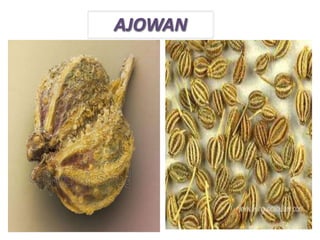
AJOWAN
AJOWAN
SYNONAME- Bishop’s weed
BIOLOGICAL SOURCE- It is dried ripe seed of Trychyspermum ammi belongs to
Umbelliferae family.(2% volatile oil)
GEOGRAPHICL DISTRIBUTION- native to Egypt,
cultivated in Iran ,Iraq, Afghanistan , Pakistan and India.

CULTIVATION & COLLECTION- cultivated as rabbi crop in oct./nov. Harvesting
done in Feb../ March. (yield-300-350 KG fruits /hectare)
CHEMICAL CONSTITUENTS- 2-4 % volatile oil- thymol, p-
cymene, terpinene, pinene, dipentenes.
21% fat, 17% proteins, 25% carbohydrates.
USES- Antispasmodic, stimulant, carminative. Also in sore throat and bronchitis.
        Ajowan oil used as antiseptic, antifungal, insecticide.
         Also used as deodorant in mouth washes, tooth paste and flavoring agent
in disinfectant soaps.
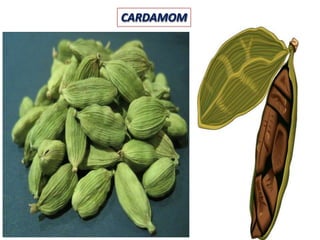
CARDAMOM
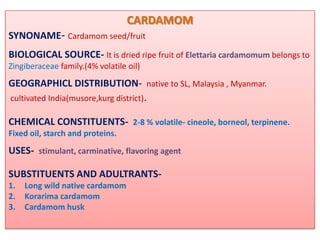
CARDAMOM
SYNONAME- Cardamom seed/fruit
BIOLOGICAL SOURCE- It is dried ripe fruit of Elettaria cardamomum belongs to
Zingiberaceae family.(4% volatile oil)
GEOGRAPHICL DISTRIBUTION- native to SL, Malaysia , Myanmar.
cultivated India(musore,kurg district).

CHEMICAL CONSTITUENTS- 2-8 % volatile- cineole, borneol, terpinene.
Fixed oil, starch and proteins.
USES- stimulant, carminative, flavoring agent

SUBSTITUENTS AND ADULTRANTS-
1.   Long wild native cardamom
2.   Korarima cardamom
3.   Cardamom husk
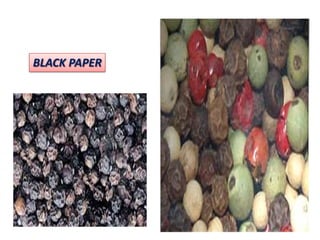
BLACK PAPER
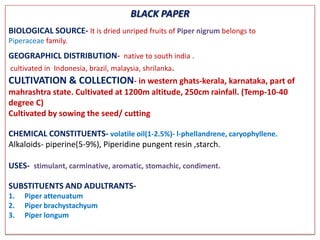
BLACK PAPER
BIOLOGICAL SOURCE- It is dried unriped fruits of Piper nigrum belongs to
Piperaceae family.
GEOGRAPHICL DISTRIBUTION- native to south india .
cultivated in Indonesia, brazil, malaysia, shrilanka.
CULTIVATION & COLLECTION- in western ghats-kerala, karnataka, part of
mahrashtra state. Cultivated at 1200m altitude, 250cm rainfall. (Temp-10-40
degree C)
Cultivated by sowing the seed/ cutting

CHEMICAL CONSTITUENTS- volatile oil(1-2.5%)- l-phellandrene, caryophyllene.
Alkaloids- piperine(5-9%), Piperidine pungent resin ,starch.

USES- stimulant, carminative, aromatic, stomachic, condiment.

SUBSTITUENTS AND ADULTRANTS-
1.   Piper attenuatum
2.   Piper brachystachyum
3.   Piper longum
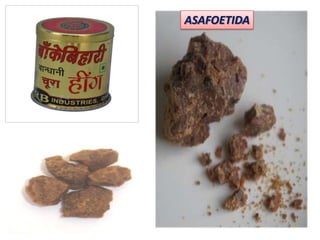
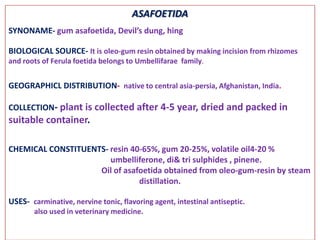
ASAFOETIDA
ASAFOETIDA
SYNONAME- gum asafoetida, Devil’s dung, hing

BIOLOGICAL SOURCE- It is oleo-gum resin obtained by making incision from rhizomes
and roots of Ferula foetida belongs to Umbellifarae family.


GEOGRAPHICL DISTRIBUTION- native to central asia-persia, Afghanistan, India.

COLLECTION- plant is collected after 4-5 year, dried and packed in
suitable container.

CHEMICAL CONSTITUENTS- resin 40-65%, gum 20-25%, volatile oil4-20 %
                       umbelliferone, di& tri sulphides , pinene.
                    Oil of asafoetida obtained from oleo-gum-resin by steam
                               distillation.

USES- carminative, nervine tonic, flavoring agent, intestinal antiseptic.
       also used in veterinary medicine.
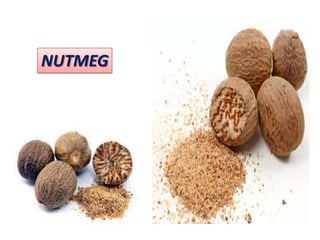
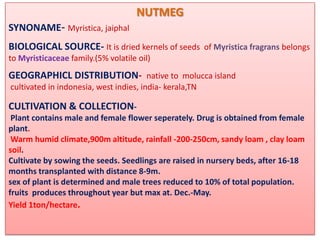
NUTMEG
NUTMEG
SYNONAME- Myristica, jaiphal
BIOLOGICAL SOURCE- It is dried kernels of seeds of Myristica fragrans belongs
to Myristicaceae family.(5% volatile oil)
GEOGRAPHICL DISTRIBUTION- native to molucca island
cultivated in indonesia, west indies, india- kerala,TN

CULTIVATION & COLLECTION-
 Plant contains male and female flower seperately. Drug is obtained from female
plant.
 Warm humid climate,900m altitude, rainfall -200-250cm, sandy loam , clay loam
soil.
Cultivate by sowing the seeds. Seedlings are raised in nursery beds, after 16-18
months transplanted with distance 8-9m.
sex of plant is determined and male trees reduced to 10% of total population.
fruits produces throughout year but max at. Dec.-May.
Yield 1ton/hectare.
NUTMEG

CHEMICAL CONSTITUENTS-
 5-15% volatile oil-myristicin, elemicin,saffrole.
30% fat,
fatty acids-myristic, palmitic, oleic, lauric acids.
 Protein and starch.

USES- stimulant, carminative, flavoring agent, aromatic.
         In rheumatism and in soap industry.

SUBSTITUENTS AND ADULTRANTS-

1.   Myristica malbarica
2.   Myristica argentea
3.   Myristica beddomei
ANTISEPTIC AND DISINFECTANTS


     Antiseptics are the agent that sterilize the living surface.

                                while

   Disinfectants kills bacteria and spores from nonliving surface.


Examples-
                   BENZOIN
                   MYRRH
                   NEEM
                   CURCUMA
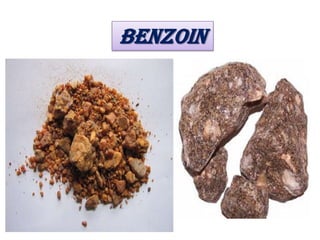
BENZOIN
BENZOIN

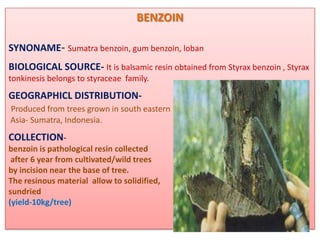
SYNONAME- Sumatra benzoin, gum benzoin, loban
BIOLOGICAL SOURCE- It is balsamic resin obtained from Styrax benzoin , Styrax
tonkinesis belongs to styraceae family.
GEOGRAPHICL DISTRIBUTION-
Produced from trees grown in south eastern
Asia- Sumatra, Indonesia.
COLLECTION-
benzoin is pathological resin collected
 after 6 year from cultivated/wild trees
by incision near the base of tree.
The resinous material allow to solidified,
sundried
(yield-10kg/tree)
BENZOIN
CHEMICAL CONSTITUENTS-
Sumatra benzoin- free balsamic acids(benzoic and cinnamic acids).
also triterpenoid acids like suma-resinolic acid & siaresinolic acid
Slam benzoin- ester coniferyl benzoate(75%)
Styrol , vanillin, phenyl propyl cinnamate.
USES-
1. irritating expectorant
2. carminative
3. diuretic
4.Antiseptic
5.Protective
6. Treatment of URT infection (as inhalation)

.
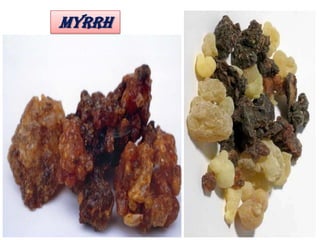
MYRRH
MYRRH
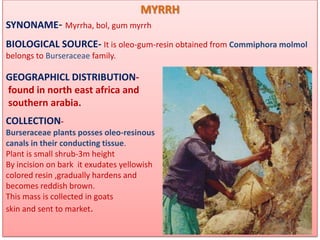
SYNONAME- Myrrha, bol, gum myrrh
BIOLOGICAL SOURCE- It is oleo-gum-resin obtained from Commiphora molmol
belongs to Burseraceae family.

GEOGRAPHICL DISTRIBUTION-
found in north east africa and
southern arabia.
COLLECTION-
Burseraceae plants posses oleo-resinous
canals in their conducting tissue.
Plant is small shrub-3m height
By incision on bark it exudates yellowish
colored resin ,gradually hardens and
becomes reddish brown.
This mass is collected in goats
skin and sent to market.
MYRRH
CHEMICAL CONSTITUENTS-

10% thick VOLATILE OIL-
Terpenes, cuminic aldehyde, eugenol.
25-40% resins –
 alpha, beta and gamma commiphoric acid
3-4% bitter principles

USES-
        - stimulant,
        - used as antiseptic,
        - protective,
        - used in mouthwashes.

ADULTRATION-
Arabian myrrh
Yamen myrrh
Indian bdellium(balsamoendron mukul)
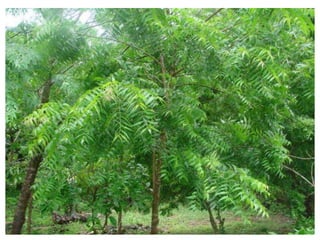
NEEM
SYNONAME- LIMB

BIOLOGICAL SOURCE- It consist of leaves and other aerial parts of Azadiracta indica
belongs to Meliaceae family.
GEOGRAPHICL DISTRIBUTION- it is indigenous and widely grown in India.

CULTIVATION- The plant is propagated by seeds. it survive at high
temp. little rainfall , nutrient deficient soil. The plant bears fruit
after 5 years.
CHEMICAL CONSTITUENTS-
Azadiractin, salanin, meliantriol
Leaves- nimbosterol, quercetin
Seeds- azadirtactin, salanin , meliantrol, meliacin
Bark- nimbin, nimbinin, nimbidin, nimbosterol, margosine.

USES- Antiseptic, insecticide, antiviral,treatement of AIDS
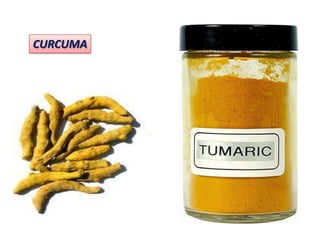
CURCUMA
CURCUMA
SYNONAME- turmeric, haldi, Indian saffron

BIOLOGICAL SOURCE- It consist of dried or fresh rhizomes of Curcuma longa belongs to
Zinzibrraceae family.
GEOGRAPHICL DISTRIBUTION- it is cultivated in pak ., Malaysia, china.
                                  india-MH, TN, WB, UP, PJ


CHEMICAL CONSTITUENTS-

5% VOLATILE OIL, RESIN, yellow coloring sub. Curcuminoids
Curcumin, turmerone, zingiberine, borneol, caprylic acid.

USES-
Antiseptic,
Expectorant,
In condiment
Coloring agent- ointment, creams
Antimicrobial
antiinflammatory
THANK YOU

CARMINATIVE DRUGS PPT.

  • 1.
    PHARMACOGNOSY Presented by, Mr. SHINDE N.G. (M. Pharm.)
  • 2.
    CARMINATIVE DRUGS Definition: These are soothing medicaments act by relieving pain in the stomach and intestine and expel gas from GI tract by peristalsis. Examples- Coriander Fennel Ginger Black paper Cinnamon Nutmeg Clove Asafoetia
  • 3.
  • 4.
    AJOWAN SYNONAME- Bishop’s weed BIOLOGICALSOURCE- It is dried ripe seed of Trychyspermum ammi belongs to Umbelliferae family.(2% volatile oil) GEOGRAPHICL DISTRIBUTION- native to Egypt, cultivated in Iran ,Iraq, Afghanistan , Pakistan and India. CULTIVATION & COLLECTION- cultivated as rabbi crop in oct./nov. Harvesting done in Feb../ March. (yield-300-350 KG fruits /hectare) CHEMICAL CONSTITUENTS- 2-4 % volatile oil- thymol, p- cymene, terpinene, pinene, dipentenes. 21% fat, 17% proteins, 25% carbohydrates. USES- Antispasmodic, stimulant, carminative. Also in sore throat and bronchitis. Ajowan oil used as antiseptic, antifungal, insecticide. Also used as deodorant in mouth washes, tooth paste and flavoring agent in disinfectant soaps.
  • 5.
  • 6.
    CARDAMOM SYNONAME- Cardamom seed/fruit BIOLOGICALSOURCE- It is dried ripe fruit of Elettaria cardamomum belongs to Zingiberaceae family.(4% volatile oil) GEOGRAPHICL DISTRIBUTION- native to SL, Malaysia , Myanmar. cultivated India(musore,kurg district). CHEMICAL CONSTITUENTS- 2-8 % volatile- cineole, borneol, terpinene. Fixed oil, starch and proteins. USES- stimulant, carminative, flavoring agent SUBSTITUENTS AND ADULTRANTS- 1. Long wild native cardamom 2. Korarima cardamom 3. Cardamom husk
  • 7.
  • 8.
    BLACK PAPER BIOLOGICAL SOURCE-It is dried unriped fruits of Piper nigrum belongs to Piperaceae family. GEOGRAPHICL DISTRIBUTION- native to south india . cultivated in Indonesia, brazil, malaysia, shrilanka. CULTIVATION & COLLECTION- in western ghats-kerala, karnataka, part of mahrashtra state. Cultivated at 1200m altitude, 250cm rainfall. (Temp-10-40 degree C) Cultivated by sowing the seed/ cutting CHEMICAL CONSTITUENTS- volatile oil(1-2.5%)- l-phellandrene, caryophyllene. Alkaloids- piperine(5-9%), Piperidine pungent resin ,starch. USES- stimulant, carminative, aromatic, stomachic, condiment. SUBSTITUENTS AND ADULTRANTS- 1. Piper attenuatum 2. Piper brachystachyum 3. Piper longum
  • 9.
  • 10.
    ASAFOETIDA SYNONAME- gum asafoetida,Devil’s dung, hing BIOLOGICAL SOURCE- It is oleo-gum resin obtained by making incision from rhizomes and roots of Ferula foetida belongs to Umbellifarae family. GEOGRAPHICL DISTRIBUTION- native to central asia-persia, Afghanistan, India. COLLECTION- plant is collected after 4-5 year, dried and packed in suitable container. CHEMICAL CONSTITUENTS- resin 40-65%, gum 20-25%, volatile oil4-20 % umbelliferone, di& tri sulphides , pinene. Oil of asafoetida obtained from oleo-gum-resin by steam distillation. USES- carminative, nervine tonic, flavoring agent, intestinal antiseptic. also used in veterinary medicine.
  • 11.
  • 12.
    NUTMEG SYNONAME- Myristica, jaiphal BIOLOGICALSOURCE- It is dried kernels of seeds of Myristica fragrans belongs to Myristicaceae family.(5% volatile oil) GEOGRAPHICL DISTRIBUTION- native to molucca island cultivated in indonesia, west indies, india- kerala,TN CULTIVATION & COLLECTION- Plant contains male and female flower seperately. Drug is obtained from female plant. Warm humid climate,900m altitude, rainfall -200-250cm, sandy loam , clay loam soil. Cultivate by sowing the seeds. Seedlings are raised in nursery beds, after 16-18 months transplanted with distance 8-9m. sex of plant is determined and male trees reduced to 10% of total population. fruits produces throughout year but max at. Dec.-May. Yield 1ton/hectare.
  • 13.
    NUTMEG CHEMICAL CONSTITUENTS- 5-15%volatile oil-myristicin, elemicin,saffrole. 30% fat, fatty acids-myristic, palmitic, oleic, lauric acids. Protein and starch. USES- stimulant, carminative, flavoring agent, aromatic. In rheumatism and in soap industry. SUBSTITUENTS AND ADULTRANTS- 1. Myristica malbarica 2. Myristica argentea 3. Myristica beddomei
  • 14.
    ANTISEPTIC AND DISINFECTANTS Antiseptics are the agent that sterilize the living surface. while Disinfectants kills bacteria and spores from nonliving surface. Examples- BENZOIN MYRRH NEEM CURCUMA
  • 15.
  • 16.
    BENZOIN SYNONAME- Sumatra benzoin,gum benzoin, loban BIOLOGICAL SOURCE- It is balsamic resin obtained from Styrax benzoin , Styrax tonkinesis belongs to styraceae family. GEOGRAPHICL DISTRIBUTION- Produced from trees grown in south eastern Asia- Sumatra, Indonesia. COLLECTION- benzoin is pathological resin collected after 6 year from cultivated/wild trees by incision near the base of tree. The resinous material allow to solidified, sundried (yield-10kg/tree)
  • 17.
    BENZOIN CHEMICAL CONSTITUENTS- Sumatra benzoin-free balsamic acids(benzoic and cinnamic acids). also triterpenoid acids like suma-resinolic acid & siaresinolic acid Slam benzoin- ester coniferyl benzoate(75%) Styrol , vanillin, phenyl propyl cinnamate. USES- 1. irritating expectorant 2. carminative 3. diuretic 4.Antiseptic 5.Protective 6. Treatment of URT infection (as inhalation) .
  • 18.
  • 19.
    MYRRH SYNONAME- Myrrha, bol,gum myrrh BIOLOGICAL SOURCE- It is oleo-gum-resin obtained from Commiphora molmol belongs to Burseraceae family. GEOGRAPHICL DISTRIBUTION- found in north east africa and southern arabia. COLLECTION- Burseraceae plants posses oleo-resinous canals in their conducting tissue. Plant is small shrub-3m height By incision on bark it exudates yellowish colored resin ,gradually hardens and becomes reddish brown. This mass is collected in goats skin and sent to market.
  • 20.
    MYRRH CHEMICAL CONSTITUENTS- 10% thickVOLATILE OIL- Terpenes, cuminic aldehyde, eugenol. 25-40% resins – alpha, beta and gamma commiphoric acid 3-4% bitter principles USES- - stimulant, - used as antiseptic, - protective, - used in mouthwashes. ADULTRATION- Arabian myrrh Yamen myrrh Indian bdellium(balsamoendron mukul)
  • 22.
    NEEM SYNONAME- LIMB BIOLOGICAL SOURCE-It consist of leaves and other aerial parts of Azadiracta indica belongs to Meliaceae family. GEOGRAPHICL DISTRIBUTION- it is indigenous and widely grown in India. CULTIVATION- The plant is propagated by seeds. it survive at high temp. little rainfall , nutrient deficient soil. The plant bears fruit after 5 years. CHEMICAL CONSTITUENTS- Azadiractin, salanin, meliantriol Leaves- nimbosterol, quercetin Seeds- azadirtactin, salanin , meliantrol, meliacin Bark- nimbin, nimbinin, nimbidin, nimbosterol, margosine. USES- Antiseptic, insecticide, antiviral,treatement of AIDS
  • 23.
  • 24.
    CURCUMA SYNONAME- turmeric, haldi,Indian saffron BIOLOGICAL SOURCE- It consist of dried or fresh rhizomes of Curcuma longa belongs to Zinzibrraceae family. GEOGRAPHICL DISTRIBUTION- it is cultivated in pak ., Malaysia, china. india-MH, TN, WB, UP, PJ CHEMICAL CONSTITUENTS- 5% VOLATILE OIL, RESIN, yellow coloring sub. Curcuminoids Curcumin, turmerone, zingiberine, borneol, caprylic acid. USES- Antiseptic, Expectorant, In condiment Coloring agent- ointment, creams Antimicrobial antiinflammatory
  • 25.