Biological source, chemical constituents and
therapeutic
Efficacy of the following categories of crude drugs.
• Definitions – Depending upon intensities of drug effects are categorized as –
• 01.Aperient – Are mild laxatives.
• 02.Laxatives – Are the drugs which loosens the bowels (intestine). e.g. senna, isapgol.
• 03.Purgatives – Are the drugs which evacuates the bowels. e.g. Aloe, Rhubarb, Castor
oil,
• Senna.
• 04.Drastics / Cathartics – Are the drugs which are active purgative usually producing
• evacuation,may or may not accompanied with pain. Ex. Castor oil, aloe , Rhubarb.
• 05.Hydrogogues – Are the drugs produces fluid motions. Ex. Colocynth, Jalap,
Podophylum.
• Mechanism of action of laxatives – They act either bulk forming, irritant or emollient
depending upon the chemical nature of active constituents.
• Laxatives are mainly given in constipation and in evacuation of bowel, prior to
diagnostic procedure or surgery.
• 01.Aloe -
• Synonyms – Korpad, Musabber, Ghrutkumari.
• Biological Source – Aloe is dried juice obtained after incision to thick
fleshy leaves of Aloe perryi, Aloe vera, Aloe Africana, Aloe spicata,
Aloe barbadensis, Aloeferox belonging to family Liliaceae
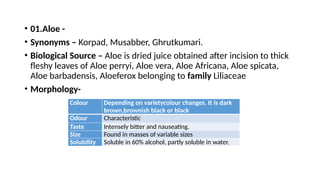
• Morphology-
Colour Depending on varietycolour changes. It is dark
brown,brownish black or black
Odour Characteristic
Taste Intensely bitter and nauseating.
Size Found in masses of variable sizes
Solubility Soluble in 60% alcohol, partly soluble in water.
• Chemical constituents – Contains Anthraquinone glycosides. Main glycosides are
Aloins (Barbaloin, Isobarbaloin, Beta barbaloin), Aloe emodin, aloinoside A and B,
Capaloresinotannol with p-coumaric acid, Barbaloresinotannol with cinnamic acid.
• Chemical tests – Prepare 1% solution of aloe by boiling with water and
kieselguhr ,filter. And with filtrate perform following tests –
• 1.Schoentetens test -Take above filtrate add borax in it, we observe green
fluorescence of aloe-emodin.
• 2.Take above filtrate add equal quantity of bromine water, a pale yellow
precipitate of tetrabrommalion is observed.
• 3.To above filtrate add nitric acid, different varieties of aloe gives different colours
as,
• a) Cape aloe – Yellow brown to green.
• b) Curacao aloe – Reddish-orange.
• .Castor oil -
• Synonyms –Oleum Ricini, Erand tel.
• Biological source – Castor oil is the fixed oil obtained by cold
expression of seeds of RicinusCommunis. Family – Euphorbiaceae
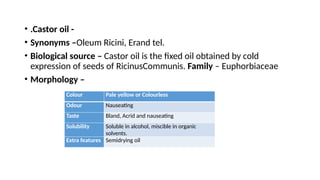
• Morphology –
Colour Pale yellow or Colourless
Odour Nauseating
Taste Bland, Acrid and nauseating
Solubility Soluble in alcohol, miscible in organic
solvents.
Extra features Semidrying oil
• Chemical Constituents – It contains Fixed oil mainly triglycerides of
Ricinoleic acid
• ( Vitamin – F ), isorecinoleic acid, linoleic acid, stearic acid, isostearic
acid.
• Chemical tests – 1. Equal volume of castor oil and alcohol is clearly
soluble on cooling at 0oc
and on storage for three hours, liquid remains
clear.
• 2.It mixes with half its volume of light petroleum ether and partly
soluble in its two volumes.
• Uses – Cathartic. It is also used in paints, enamel, varnishes, greases,
polishes, printing ink, hydrolics.
• Due to irritant action is used in abortificient paste and contraceptive
creams and jellies. Also used in hair oil and hair fixers
• . Ispaghula–
• Synonyms –Isapgol, Isabgol.
• Biological Source – Isapgol consists of dried seeds of the plant
Plantago ovata, Family – Plantaginaceae.
• Morphology
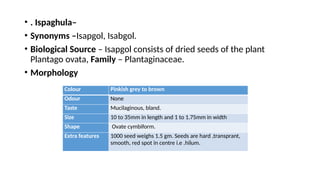
Colour Pinkish grey to brown
Odour None
Taste Mucilaginous, bland.
Size 10 to 35mm in length and 1 to 1.75mm in width
Shape Ovate cymbiform.
Extra features 1000 seed weighs 1.5 gm. Seeds are hard ,transprant,
smooth, red spot in centre i.e .hilum.
• Isapgol husk i.e. covering of seed contains more percentage of mucilages in it as
compared to seeds.
• Chemical Constituents – It contains Carbohydrates mainly Pentosan and Aldobionic
acid. Otherproductsof hydrolysis are xylose, arabinose, galactouronic acid and
rhmnose.
• Husk and seeds contains mainly Mucilage.
• Chemical Tests – 1.Isapgol give pink colour with ruthenium red due to Mucilage.
• 2.Swelling factor test – Is determined by putting 1 gm. Of seeds in 25ml. capacity of
measuring cylinder containing 20 ml. of water, with occasional shaking. The volume
occupied by seeds after 24 hours of swelling is measured. Swelling factor of seed is
10 to 14.
• Uses – Demulcent, laxative, emollient, in treatment of chronic constipation, amoebic
and bacillary dysentery.Mucilage of isapgol is used in preparation of tablets,
stabilizer in Ice-cream industry, used in poultice in rheumatic pains.
• Adulterants – Plantagolanceolata.
• Substitutes – 1.Plantagoasiatica 2. PlantagoPsyillum
• 04. Senna Leaves –
• Synonyms – Indian senna, Tinnevellysenna,Alexendriansenna,
Europiansenna, Sonamukhi.
• Biological Source –It consists of dried leaflets of Cassia angustifolia,
Cassia acutifolia belong to family – Leguminosae It contains not less
than 2% of hydroxyl anthracene derivatives i.e. sennoside B
• Morphology
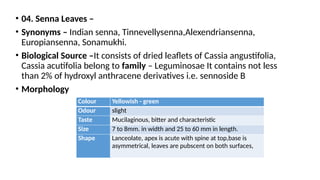
Colour Yellowish - green
Odour slight
Taste Mucilaginous, bitter and characteristic
Size 7 to 8mm. in width and 25 to 60 mm in length.
Shape Lanceolate, apex is acute with spine at top,base is
asymmetrical, leaves are pubscent on both surfaces,
• Microscopy – Refer practical manual for this.
• Chemical Constituents –Senna contains Anthraquinone glycosides mainly –
Sennoside A, Sennoside B, Sennoside C, Sennoside D, Kaempferol,aloe-
emodin, isorhamnetin,Myricylalcohol,Phytosterol,Salicylic acid, Mucilage,
Resin etc.
• Aglycone of senna is Sennidin. It contains Mucilage.
• Chemical Tests -Borntragers test –To drug add dilute HCL heat on boiling
water bath, filter ,cool and shake with organic solvent like benzene. Separate
benzene layer add in it dilute ammonia solution. A pink – red colour is
obtained.
• Uses –Laxative, Irritant Purgative.As it causes gripping in pelvis is overcome
by mixing drug with carminative.
• Adulterants – Ailanthus glandulosa.
• Substitutes – 1.Dog senna, 2. Palthesenna, 3.Arabian Senna
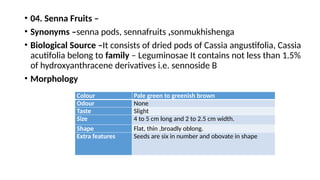
• 04. Senna Fruits –
• Synonyms –senna pods, sennafruits ,sonmukhishenga
• Biological Source –It consists of dried pods of Cassia angustifolia, Cassia
acutifolia belong to family – Leguminosae It contains not less than 1.5%
of hydroxyanthracene derivatives i.e. sennoside B
• Morphology
Colour Pale green to greenish brown
Odour None
Taste Slight
Size 4 to 5 cm long and 2 to 2.5 cm width.
Shape Flat, thin ,broadly oblong.
Extra features Seeds are six in number and obovate in shape
• Chemical constituents – It contains Sennoside A and Sennoside B. The
pods are superior over leaves because they do not contain mucilage
so easy to handle.
• Uses - Purgative
•
• Cardiotonics
• Definition: These are the drugs which gives strength or energy to the activity of the
heart. OR
• Cardio tonics are the drugs which gives strength or energy to the cardiac muscles.
• Cardio tonics increase the force of contraction of cardiac muscles and stimulates the
overall activity of the heart.
• Examples – Digitalis, Strophanthus, Sqill, Thevetia, Arjuna.
• Digitalis:
• Synonyms- Fox gloves leaves, Rhudhapatri
• Biological source: Digitalis consists of dried leaves of Digitalis purpurea, family-
Scrophulariaceae. Leaves immediately after collection are dried below temperature
600c
And should contains not less than 5% of moisture.
• Geology –It is cultivated and collected in England and other parts of Europe, USA and
India.
• In India it is cultivated in Kashmir mainly in Tannary, Kishtawar, Mungapoo and Nilgiri
hills.
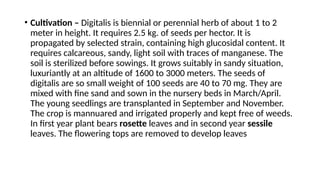
• Cultivation – Digitalis is biennial or perennial herb of about 1 to 2
meter in height. It requires 2.5 kg. of seeds per hector. It is
propagated by selected strain, containing high glucosidal content. It
requires calcareous, sandy, light soil with traces of manganese. The
soil is sterilized before sowings. It grows suitably in sandy situation,
luxuriantly at an altitude of 1600 to 3000 meters. The seeds of
digitalis are so small weight of 100 seeds are 40 to 70 mg. They are
mixed with fine sand and sown in the nursery beds in March/April.
The young seedlings are transplanted in September and November.
The crop is mannuared and irrigated properly and kept free of weeds.
In first year plant bears rosette leaves and in second year sessile
leaves. The flowering tops are removed to develop leaves
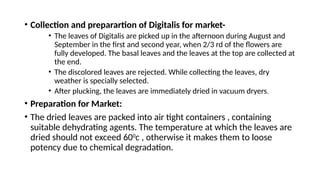
• Collection and preparartion of Digitalis for market-
• The leaves of Digitalis are picked up in the afternoon during August and
September in the first and second year, when 2/3 rd of the flowers are
fully developed. The basal leaves and the leaves at the top are collected at
the end.
• The discolored leaves are rejected. While collecting the leaves, dry
weather is specially selected.
• After plucking, the leaves are immediately dried in vacuum dryers.
• Preparation for Market:
• The dried leaves are packed into air tight containers , containing
suitable dehydrating agents. The temperature at which the leaves are
dried should not exceed 600
c , otherwise it makes them to loose
potency due to chemical degradation.
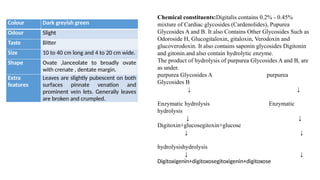
Colour Dark greyish green
Odour Slight
Taste Bitter
Size 10 to 40 cm long and 4 to 20 cm wide.
Shape Ovate ,lanceolate to broadly ovate
with crenate , dentate margin.
Extra
features
Leaves are slightly pubescent on both
surfaces pinnate venation and
prominent vein lets. Generally leaves
are broken and crumpled.
Chemical constituents:Digitalis contains 0.2% - 0.45%
mixture of Cardiac glycosides (Cardenolides), Pupurea
Glycosides A and B. It also Contains Other Glycosides Such as
Odoroside H, Glucogitaloxin, gitaloxin, Verodoxin and
glucoverodoxin. It also contains saponin glycosides Digitonin
and gitonin.and also contain hydrolytic enzyme.
The product of hydrolysis of purpurea Glycosides A and B, are
as under.
purpurea Glycosides A purpurea
Glycosides B
↓ ↓
Enzymatic hydrolysis Enzymatic
hydrolysis
↓ ↓
Digitoxin+glucosegitoxin+glucose
↓ ↓
hydrolysishydrolysis
↓ ↓
Digitoxigenin+digitoxosegitoxigenin+digitoxose
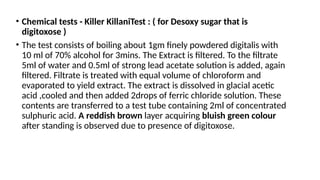
• Chemical tests - Killer KillaniTest : ( for Desoxy sugar that is
digitoxose )
• The test consists of boiling about 1gm finely powdered digitalis with
10 ml of 70% alcohol for 3mins. The Extract is filtered. To the filtrate
5ml of water and 0.5ml of strong lead acetate solution is added, again
filtered. Filtrate is treated with equal volume of chloroform and
evaporated to yield extract. The extract is dissolved in glacial acetic
acid ,cooled and then added 2drops of ferric chloride solution. These
contents are transferred to a test tube containing 2ml of concentrated
sulphuric acid. A reddish brown layer acquiring bluish green colour
after standing is observed due to presence of digitoxose.
• Uses:
• It increases excitability of cardiac muscles and produces more
powerful contractions. It is effective in congestive cardiac failure. It is
used as cardio tonic drug.
• Adulterants: 1)Verbascum Thapsus 2) The Primrose leaves 3) Comfrey
leaves
• Substituents: 1) Digitalis lanata 2) Digitalis lutea or straw foxglove 3)
Digitalis thapsi or Spanish foxglove
• Storage – It should be stored in well closed, well filled container in
cool place away from light. While storing care must be taken to
ensure that, leaves do not contain more than 5% moisture
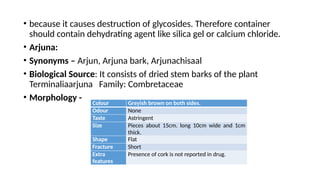
• because it causes destruction of glycosides. Therefore container
should contain dehydrating agent like silica gel or calcium chloride.
• Arjuna:
• Synonyms – Arjun, Arjuna bark, Arjunachisaal
• Biological Source: It consists of dried stem barks of the plant
Terminaliaarjuna Family: Combretaceae
• Morphology - Colour Greyish brown on both sides.
Odour None
Taste Astringent
Size Pieces about 15cm. long 10cm wide and 1cm
thick.
Shape Flat
Fracture Short
Extra
features
Presence of cork is not reported in drug.
• Chemical constituents:Arjuna contains about 15% of tannins. It also
contains triterpenoidssaponins, arjunolic acid, arjunic acid, arjunogenin. It
also contains β-sitosterol,ellagic acid and arjunic acid, arjunine, arjunitine.
Calcium, aluminium and magnesium salts along with colouring matter
and sugar.
• Chemical test – The ethereal extract of arjuna shows Pinkish fluorescence
under ultra-violet light. ( WhileTerminaliatomentosa gives pale blue)
• Uses: It is used as cardiotonic. It is also styptic, febrifugal and
antidysentric. It possesses diuretic and tonic properties.
• Adulterant –Terminaliatomentosa.
•
• Umbelliferous Fruits –They belongs to family Umbellifere. Various umbelliferous fruits
are Fennel, Coriander, Ajowan, Caraway, Dill, Cumin.
• Characteristics features of Umbelliferous fruits -
• 1. Schizocarp (splliting fruits)- Dry fruits from syncarpus ovary that splits at maturity into 2
portions
• 2. Mericarp- Each portion of Schizocarp (cremocarp) is called as mericarp.
• 3. Two mericarp join together by a thread like structure called as carpophore
• 4. Primary ridges are 5 or more runs from apex to base.
• 5. Each mericarp has a disc like structure at the apex called as stylopod.
• 6. Each mericarp has 2 surfaces
• a) Outer dorsal or curved surface
• b) Inner ventral or commissural surface.
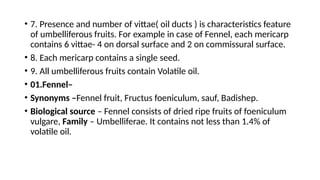
• 7. Presence and number of vittae( oil ducts ) is characteristics feature
of umbelliferous fruits. For example in case of Fennel, each mericarp
contains 6 vittae- 4 on dorsal surface and 2 on commissural surface.
• 8. Each mericarp contains a single seed.
• 9. All umbelliferous fruits contain Volatile oil.
• 01.Fennel–
• Synonyms –Fennel fruit, Fructus foeniculum, sauf, Badishep.
• Biological source – Fennel consists of dried ripe fruits of foeniculum
vulgare, Family – Umbelliferae. It contains not less than 1.4% of
volatile oil.
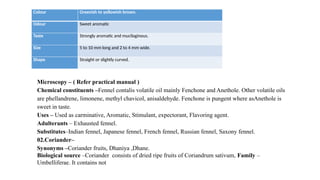
Colour Greenish to yellowish brown.
Odour Sweet aromatic
Taste Strongly aromatic and mucilaginous.
Size 5 to 10 mm long and 2 to 4 mm wide.
Shape Straight or slightly curved.
Microscopy – ( Refer practical manual )
Chemical constituents –Fennel contalis volatile oil mainly Fenchone and Anethole. Other volatile oils
are phellandrene, limonene, methyl chavicol, anisaldehyde. Fenchone is pungent where asAnethole is
sweet in taste.
Uses – Used as carminative, Aromatic, Stimulant, expectorant, Flavoring agent.
Adulterants – Exhausted fennel.
Substitutes–Indian fennel, Japanese fennel, French fennel, Russian fennel, Saxony fennel.
02.Coriander–
Synonyms –Coriander fruits, Dhaniya ,Dhane.
Biological source –Coriander consists of dried ripe fruits of Coriandrum sativum, Family –
Umbelliferae. It contains not
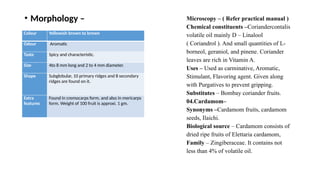
• Morphology –
Colour Yellowish brown to brown
Odour Aromatic
Taste Spicy and characteristic.
Size 4to 8 mm long and 2 to 4 mm diameter.
Shape Subglobular, 10 primary ridges and 8 secondary
ridges are found on it.
Extra
features
Found in cremocarps form, and also in mericarps
form. Weight of 100 fruit is approxi. 1 gm.
Microscopy – ( Refer practical manual )
Chemical constituents –Coriandercontalis
volatile oil mainly D – Linalool
( Coriandrol ). And small quantities of L-
borneol, geraniol, and pinene. Coriander
leaves are rich in Vitamin A.
Uses – Used as carminative, Aromatic,
Stimulant, Flavoring agent. Given along
with Purgatives to prevent gripping.
Substitutes – Bombay coriander fruits.
04.Cardamom–
Synonyms –Cardamom fruits, cardamom
seeds, Ilaichi.
Biological source – Cardamom consists of
dried ripe fruits of Elettaria cardamom,
Family – Zingiberaceae. It contains not
less than 4% of volatile oil.
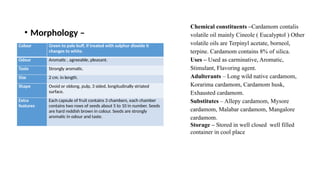
• Morphology –
Colour Green to pale buff, if treated with sulphur dioxide it
changes to white.
Odour Aromatic , agreeable, pleasant.
Taste Strongly aromatic.
Size 2 cm. in length.
Shape Ovoid or oblong, pulp, 3 sided, longitudinally striated
surface.
Extra
features
Each capsule of fruit contains 3 chambers, each chamber
contains two rows of seeds about 5 to 10 in number. Seeds
are hard reddish brown in colour. Seeds are strongly
aromatic in odour and taste.
Chemical constituents –Cardamom contalis
volatile oil mainly Cineole ( Eucalyptol ) Other
volatile oils are Terpinyl acetate, borneol,
terpine. Cardamom contains 8% of silica.
Uses – Used as carminative, Aromatic,
Stimulant, Flavoring agent.
Adulterants – Long wild native cardamom,
Korarima cardamom, Cardamom husk,
Exhausted cardamom.
Substitutes – Allepy cardamom, Mysore
cardamom, Malabar cardamom, Mangalore
cardamom.
Storage – Stored in well closed well filled
container in cool place
• Chemical constituents –Cardamom contalis volatile oil mainly Cineole
( Eucalyptol ) Other volatile oils are Terpinyl acetate, borneol, terpine.
Cardamom contains 8% of silica.
• Uses – Used as carminative, Aromatic, Stimulant, Flavoring agent.
• Adulterants – Long wild native cardamom, Korarima cardamom,
Cardamom husk, Exhausted cardamom.
• Substitutes – Allepy cardamom, Mysore cardamom, Malabar cardamom,
Mangalore cardamom.
• Storage – Stored in well closed well filled container in cool place.
• 05.Black Pepper–
• Synonyms – Kali miri, mire.
• Biological source – Black pepper consists of dried unripe fruits of Piper
nigrum, Family – Piparaceae
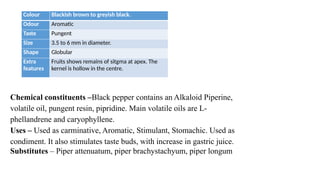
Colour Blackish brown to greyish black.
Odour Aromatic
Taste Pungent
Size 3.5 to 6 mm in diameter.
Shape Globular
Extra
features
Fruits shows remains of sitgma at apex. The
kernel is hollow in the centre.
Chemical constituents –Black pepper contains an Alkaloid Piperine,
volatile oil, pungent resin, pipridine. Main volatile oils are L-
phellandrene and caryophyllene.
Uses – Used as carminative, Aromatic, Stimulant, Stomachic. Used as
condiment. It also stimulates taste buds, with increase in gastric juice.
Substitutes – Piper attenuatum, piper brachystachyum, piper longum
• 06.Ginger–
• Synonyms –Zingiber, Sonth, Ale.
• Biological source – Ginger consists of dried and fresh rhizomes of
Zingiber officinale, Family –Zingiberaceae
Colour Externally it is buff colored.
Odour Agreeable and aromatic.
Taste Agreeable and pungent
Size 5 to 15 cm. in length and 1.5 to 6.5 cm wide.
Shape Laterally compressed, flat, ovate, branches with bud at
apex.
Fracture Short and fibrous.
• Microscopy – ( Refer practical manual )
• Chemical constituents –Ginger contains volatile oil and resin and
starch. Zingiberene is main constituent, Pungent constituent is
gingerol, it also contains shogaol.
• Chemical Test – If ginger is boiled with 2 % of potassium hydroxide its
pungency is dertroyed.
• Uses – Used as Stomachic, carminative, Aromatic, Stimulant,
expectorant, Flavoring agent. It is used in mouth washes , gargles,
beverages and liquors.Used in spices and as a condiments.
• Adulterants – Exhausted ginger.
• Storage – Ginger is coated with lime to improve its colour and quality
hence it is also known as limed ginger.
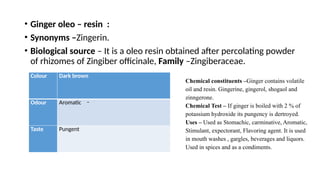
• Ginger oleo – resin :
• Synonyms –Zingerin.
• Biological source – It is a oleo resin obtained after percolating powder
of rhizomes of Zingiber officinale, Family –Zingiberaceae.
Colour Dark brown
Odour Aromatic
Taste Pungent
-
Chemical constituents –Ginger contains volatile
oil and resin. Gingerine, gingerol, shogaol and
zinngerone.
Chemical Test – If ginger is boiled with 2 % of
potassium hydroxide its pungency is dertroyed.
Uses – Used as Stomachic, carminative, Aromatic,
Stimulant, expectorant, Flavoring agent. It is used
in mouth washes , gargles, beverages and liquors.
Used in spices and as a condiments.
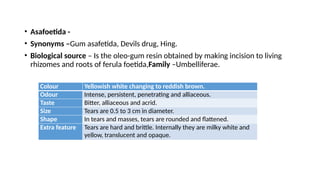
• Asafoetida -
• Synonyms –Gum asafetida, Devils drug, Hing.
• Biological source – Is the oleo-gum resin obtained by making incision to living
rhizomes and roots of ferula foetida,Family –Umbelliferae.
Colour Yellowish white changing to reddish brown.
Odour Intense, persistent, penetrating and alliaceous.
Taste Bitter, alliaceous and acrid.
Size Tears are 0.5 to 3 cm in diameter.
Shape In tears and masses, tears are rounded and flattened.
Extra feature Tears are hard and brittle. Internally they are milky white and
yellow, translucent and opaque.
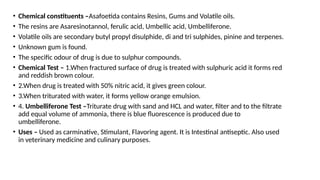
• Chemical constituents –Asafoetida contains Resins, Gums and Volatile oils.
• The resins are Asaresinotannol, ferulic acid, Umbellic acid, Umbelliferone.
• Volatile oils are secondary butyl propyl disulphide, di and tri sulphides, pinine and terpenes.
• Unknown gum is found.
• The specific odour of drug is due to sulphur compounds.
• Chemical Test – 1.When fractured surface of drug is treated with sulphuric acid it forms red
and reddish brown colour.
• 2.When drug is treated with 50% nitric acid, it gives green colour.
• 3.When triturated with water, it forms yellow orange emulsion.
• 4. Umbelliferone Test –Triturate drug with sand and HCL and water, filter and to the filtrate
add equal volume of ammonia, there is blue fluorescence is produced due to
umbelliferone.
• Uses – Used as carminative, Stimulant, Flavoring agent. It is Intestinal antiseptic. Also used
in veterinary medicine and culinary purposes.
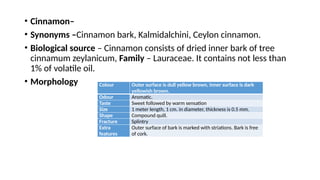
• Cinnamon–
• Synonyms –Cinnamon bark, Kalmidalchini, Ceylon cinnamon.
• Biological source – Cinnamon consists of dried inner bark of tree
cinnamum zeylanicum, Family – Lauraceae. It contains not less than
1% of volatile oil.
• Morphology Colour Outer surface is dull yellow brown, Inner surface is dark
yellowish brown.
Odour Aromatic.
Taste Sweet followed by warm sensation
Size 1 meter length, 1 cm. in diameter, thickness is 0.5 mm.
Shape Compound quill.
Fracture Splintry
Extra
features
Outer surface of bark is marked with striations. Bark is free
of cork.
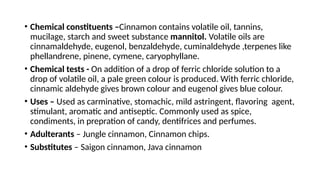
• Chemical constituents –Cinnamon contains volatile oil, tannins,
mucilage, starch and sweet substance mannitol. Volatile oils are
cinnamaldehyde, eugenol, benzaldehyde, cuminaldehyde ,terpenes like
phellandrene, pinene, cymene, caryophyllane.
• Chemical tests - On addition of a drop of ferric chloride solution to a
drop of volatile oil, a pale green colour is produced. With ferric chloride,
cinnamic aldehyde gives brown colour and eugenol gives blue colour.
• Uses – Used as carminative, stomachic, mild astringent, flavoring agent,
stimulant, aromatic and antiseptic. Commonly used as spice,
condiments, in prepration of candy, dentifrices and perfumes.
• Adulterants – Jungle cinnamon, Cinnamon chips.
• Substitutes – Saigon cinnamon, Java cinnamon
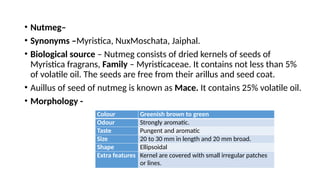
• Nutmeg–
• Synonyms –Myristica, NuxMoschata, Jaiphal.
• Biological source – Nutmeg consists of dried kernels of seeds of
Myristica fragrans, Family – Myristicaceae. It contains not less than 5%
of volatile oil. The seeds are free from their arillus and seed coat.
• Auillus of seed of nutmeg is known as Mace. It contains 25% volatile oil.
• Morphology -
Colour Greenish brown to green
Odour Strongly aromatic.
Taste Pungent and aromatic
Size 20 to 30 mm in length and 20 mm broad.
Shape Ellipsoidal
Extra features Kernel are covered with small irregular patches
or lines.
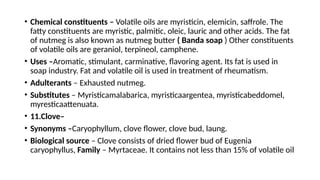
• Chemical constituents – Volatile oils are myristicin, elemicin, saffrole. The
fatty constituents are myristic, palmitic, oleic, lauric and other acids. The fat
of nutmeg is also known as nutmeg butter ( Banda soap ) Other constituents
of volatile oils are geraniol, terpineol, camphene.
• Uses –Aromatic, stimulant, carminative, flavoring agent. Its fat is used in
soap industry. Fat and volatile oil is used in treatment of rheumatism.
• Adulterants – Exhausted nutmeg.
• Substitutes – Myristicamalabarica, myristicaargentea, myristicabeddomel,
myresticaattenuata.
• 11.Clove–
• Synonyms –Caryophyllum, clove flower, clove bud, laung.
• Biological source – Clove consists of dried flower bud of Eugenia
caryophyllus, Family – Myrtaceae. It contains not less than 15% of volatile oil
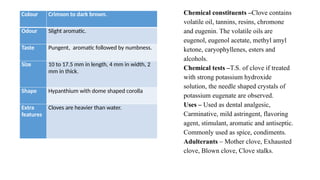
Colour Crimson to dark brown.
Odour Slight aromatic.
Taste Pungent, aromatic followed by numbness.
Size 10 to 17.5 mm in length, 4 mm in width, 2
mm in thick.
Shape Hypanthium with dome shaped corolla
Extra
features
Cloves are heavier than water.
Chemical constituents –Clove contains
volatile oil, tannins, resins, chromone
and eugenin. The volatile oils are
eugenol, eugenol acetate, methyl amyl
ketone, caryophyllenes, esters and
alcohols.
Chemical tests –T.S. of clove if treated
with strong potassium hydroxide
solution, the needle shaped crystals of
potassium eugenate are observed.
Uses – Used as dental analgesic,
Carminative, mild astringent, flavoring
agent, stimulant, aromatic and antiseptic.
Commonly used as spice, condiments.
Adulterants – Mother clove, Exhausted
clove, Blown clove, Clove stalks.
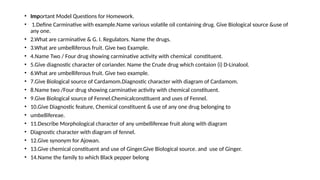
• Important Model Questions for Homework.
• 1.Define Carminative with example.Name various volatile oil containing drug. Give Biological source &use of
any one.
• 2.What are carminative & G. I. Regulators. Name the drugs.
• 3.What are umbelliferous fruit. Give two Example.
• 4.Name Two / Four drug showing carminative activity with chemical constituent.
• 5.Give diagnostic character of coriander. Name the Crude drug which contaion (i) D-Linalool.
• 6.What are umbelliferous fruit. Give two example.
• 7.Give Biological source of Cardamom.Diagnostic character with diagram of Cardamom.
• 8.Name two /Four drug showing carminative activity with chemical constituent.
• 9.Give Biological source of Fennel.Chemicalconstituent and uses of Fennel.
• 10.Give Diagnostic feature, Chemical constituent & use of any one drug belonging to
• umbellifereae.
• 11.Describe Morphological character of any umbellifereae fruit along with diagram
• Diagnostic character with diagram of fennel.
• 12.Give synonym for Ajowan.
• 13.Give chemical constituent and use of Ginger.Give Biological source. and use of Ginger.
• 14.Name the family to which Black pepper belong
• 15.Chemical Constituent of Asafoetida.Chemical test of Asafoetida.
• Chemical constituent of Nutmeg.Biological source & use of Nutmeg.
• 16.Diagnostic character with diagram of Nutmeg.Write note on Mace.
• 17.Biological Source & use of Nutmeg.Write note on Mace.
• 18.Chemical test of Cinnamon.
• 19. Give Biological source & use of drug containing cinnamic aldehyde.
• 20.Name various volatile oil containing drug. Give Biological source & use of
any one.
• 21.Give synonym, Diagnostic character, chemical constituent and uses of Clove.
• 22.Name the drug which contain Eugenol.Give Chemical test of Clove.
• 23.Give official source, chemical constituent, chemical test & uses of clove
Which part of plant use in case of clove.
• 24.Why Indian dill is not suitable for human use.?
• 4.Astringents.
• Definition – Astringents are those crude drugs which combines with
proteins and precipitates them. For example.Black catechu, Pale
catechu, Bahera, Hirda, Myrobalan.
• Astringents are obtained from vegetable source and mineral source.
• Vegetable source -Black catechu, Pale catechu, Bah era, Hirda,
Myrobalan.
• Mineral source – salts of aluminum, bismuth, barium, copper and zinc.
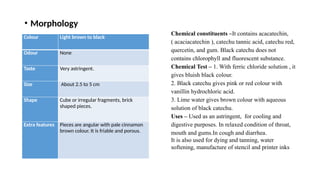
• 01.Black Catechu -
• Synonyms -Cutch, Kattha, Khadir, Khair.
• Biological source – It consists of dried aqueous extract of the
heartwood of the plant acacia catechu, Family – Leguminose.
• Morphology
Colour Light brown to black
Odour None
Taste Very astringent.
Size About 2.5 to 5 cm
Shape Cube or irregular fragments, brick
shaped pieces.
Extra features Pieces are angular with pale cinnamon
brown colour. It is friable and porous.
Chemical constituents –It contains acacatechin,
( acaciacatechin ), catechu tannic acid, catechu red,
quercetin, and gum. Black catechu does not
contains chlorophyll and fluorescent substance.
Chemical Test – 1. With ferric chloride solution , it
gives bluish black colour.
2. Black catechu gives pink or red colour with
vanillin hydrochloric acid.
3. Lime water gives brown colour with aqueous
solution of black catechu.
Uses – Used as an astringent, for cooling and
digestive purposes. In relaxed condition of throat,
mouth and gums.In cough and diarrhea.
It is also used for dying and tanning, water
softening, manufacture of stencil and printer inks
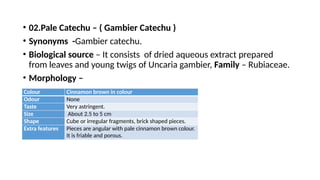
• 02.Pale Catechu – ( Gambier Catechu )
• Synonyms -Gambier catechu.
• Biological source – It consists of dried aqueous extract prepared
from leaves and young twigs of Uncaria gambier, Family – Rubiaceae.
• Morphology –
Colour Cinnamon brown in colour
Odour None
Taste Very astringent.
Size About 2.5 to 5 cm
Shape Cube or irregular fragments, brick shaped pieces.
Extra features Pieces are angular with pale cinnamon brown colour.
It is friable and porous.
• ) Socotrine aloe – Pale brownish yellow.
• d) Zanzibar aloe – Yellowish brown.
• 4.Klunges test –To above filtrate add drop of saturate copper sulphatesolution,followed
by sodium chloride and 90% alcohol,
• Curacao aloe gives – wine red colour.
• Cape aloe gives – a faint wine colour.
• Zanzibar and Socotrine aloe does not respond to the test.
• 5.ModifiedBorntragers test –To above filtrate add ferric chloride and dilute HCL heat on
boiling water bath, filter ,cool and shake with organic solvent like benzene. Separate
benzene layer add in it dilute ammonia solution. A pink – red colour is obtained.
• Uses – Irritant purgative. It acts on colon causes gripping in pelvis which is overcome by
giving carminative along drug.
• Aloe gel is also used in cosmetics as a protective. It prevents effect of ageing, used to
treat radiation burns, clears the skin blemishes and grows new and healthy tissues, it
stimulates growth of hairs, Externally is applied for painful inflammations
• Chemical constituents –It contains acacatechin, ( acaciacatechin ), catechu tannic acid,
catechu red, quercetin, and gum. It also contains chlorophyll and fluorescent substance
known as gambirfluorescin.
• Chemical Test – 1. With ferric chloride solution , it gives bluish black colour.
• 2. Black catechu gives pink or red colour with vanillin hydrochloric acid.
• 3. Lime water gives brown colour with aqueous solution of black catechu.
• 4. For catechin –It is modification test for lignin. Phloroglucinol formed from catechin, turns
the match-stick red with hydrochloric acid.
• 5. For Gambier Fluorescin – Extract powder drug with alcohol, to yhe filtrate add solution of
sodium hydroxide, shake, add few drops of light petroleum, shake again and allow to stand.
The petroleum layer acquires green fluorescence.( This test is negative with black catechu )
• 6. For Chlorophyll – The chloroform extract of the drug in white porcelain dish shows
greenish yellow colour due to chlorophyll.( This test is negative with black catechu )
• Uses – Used as an astringent, for cooling and digestive purposes. In relaxed condition of
throat, mouth and gums.In cough and diarrhea.
• It is also used for dying and tanning, water softening, manufacture of stencil and printer
inks.
• 03. MYROBALAN
Synonym: Myristalan, Harde, Himaj, Hantaki, Chebulic myrobatan.
• Biological Source: it consists of dried ripe and fully matured fruits of Terminalia chebula, belonging to
family, Combretaceae. Matured fruits are known as ‘Harde’ while small fruits are know as 'Himaji'.
Morphology -
• Calor: Pale brownish to black color.
Odor : Slight and characteristics Taste : Bitter, astringent taste and sweetish at the end.
Size : 2-3 cm long, 1.3-2.5 cm broad. Shape: Ovate and wrinkled longitudinally
Chemical Constituents:
• It consists of hydrolysable tannins which upon hydrolysis gives chebulic acid and D-galloyl glucose. It
contains free tannic acid, gallic acid, ellagic acid. The resin of myrobalan is known as myrobalanin. It
also contains chebulinic acid, chebulagic acid, glucose and sorbitol. Sennoside and anthraquinone
glycoside shows purgative action.
Uses:
Antiseptic, as a stomachic,It is used in wound healing, The fine powder of myrobatan is used in dental
preparation, Purgative,It is the one of the ingredient of Triphala Churna (Amla+ Harda+Behada) ,
Anthelminitic, It is also used in the treatment of piles and external ulcers.
• 5.Drugs Acting On Nervous System.
• Classification -
• Drugs Acting On CNS can be classified as –
• 01.Analeptics – e.g. Lobeline from Lobelia leaves, Strychnine from
seeds of Nux vomica.
• 02.Drugs affecting mental activity –
• e.g. a)Stimulants – Caffine from tea, coffee.
• b)Depressants – Reserpine from Rauwolfia root.
• c)Hallucinogenics – Tetrahydrocannabinol from leaves of Cannabis.
• 03.Analgesics – Morphine and Codeine from papaversomniferum
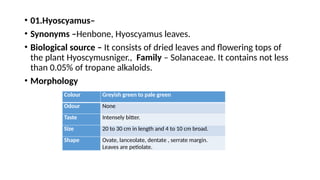
• 01.Hyoscyamus–
• Synonyms –Henbone, Hyoscyamus leaves.
• Biological source – It consists of dried leaves and flowering tops of
the plant Hyoscymusniger., Family – Solanaceae. It contains not less
than 0.05% of tropane alkaloids.
• Morphology
Colour Greyish green to pale green
Odour None
Taste Intensely bitter.
Size 20 to 30 cm in length and 4 to 10 cm broad.
Shape Ovate, lanceolate, dentate , serrate margin.
Leaves are petiolate.
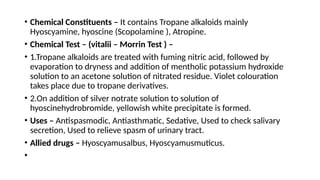
• Chemical Constituents – It contains Tropane alkaloids mainly
Hyoscyamine, hyoscine (Scopolamine ), Atropine.
• Chemical Test – (vitalii – Morrin Test ) –
• 1.Tropane alkaloids are treated with fuming nitric acid, followed by
evaporation to dryness and addition of mentholic potassium hydroxide
solution to an acetone solution of nitrated residue. Violet colouration
takes place due to tropane derivatives.
• 2.On addition of silver notrate solution to solution of
hyoscinehydrobromide, yellowish white precipitate is formed.
• Uses – Antispasmodic, Antiasthmatic, Sedative, Used to check salivary
secretion, Used to relieve spasm of urinary tract.
• Allied drugs – Hyoscyamusalbus, Hyoscyamusmuticus.
•
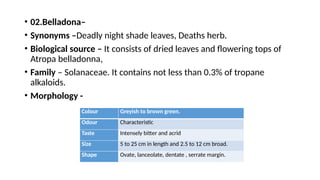
• 02.Belladona–
• Synonyms –Deadly night shade leaves, Deaths herb.
• Biological source – It consists of dried leaves and flowering tops of
Atropa belladonna,
• Family – Solanaceae. It contains not less than 0.3% of tropane
alkaloids.
• Morphology -
Colour Greyish to brown green.
Odour Characteristic
Taste Intensely bitter and acrid
Size 5 to 25 cm in length and 2.5 to 12 cm broad.
Shape Ovate, lanceolate, dentate , serrate margin.
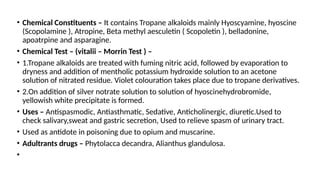
• Chemical Constituents – It contains Tropane alkaloids mainly Hyoscyamine, hyoscine
(Scopolamine ), Atropine, Beta methyl aesculetin ( Scopoletin ), belladonine,
apoatrpine and asparagine.
• Chemical Test – (vitalii – Morrin Test ) –
• 1.Tropane alkaloids are treated with fuming nitric acid, followed by evaporation to
dryness and addition of mentholic potassium hydroxide solution to an acetone
solution of nitrated residue. Violet colouration takes place due to tropane derivatives.
• 2.On addition of silver notrate solution to solution of hyoscinehydrobromide,
yellowish white precipitate is formed.
• Uses – Antispasmodic, Antiasthmatic, Sedative, Anticholinergic, diuretic.Used to
check salivary,sweat and gastric secretion, Used to relieve spasm of urinary tract.
• Used as antidote in poisoning due to opium and muscarine.
• Adultrants drugs – Phytolacca decandra, Alianthus glandulosa.
•
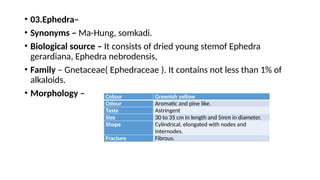
• 03.Ephedra–
• Synonyms – Ma-Hung, somkadi.
• Biological source – It consists of dried young stemof Ephedra
gerardiana, Ephedra nebrodensis,
• Family – Gnetaceae( Ephedraceae ). It contains not less than 1% of
alkaloids.
• Morphology – Colour Greenish yellow
Odour Aromatic and pine like.
Taste Astringent
Size 30 to 35 cm in length and 5mm in diameter.
Shape Cylindrical, elongated with nodes and
internodes.
Fracture Fibrous.
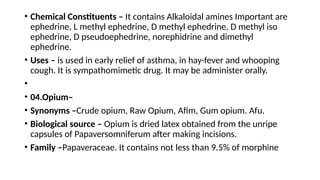
• Chemical Constituents – It contains Alkaloidal amines Important are
ephedrine, L methyl ephedrine, D methyl ephedrine, D methyl iso
ephedrine, D pseudoephedrine, norephidrine and dimethyl
ephedrine.
• Uses – is used in early relief of asthma, in hay-fever and whooping
cough. It is sympathomimetic drug. It may be administer orally.
•
• 04.Opium–
• Synonyms –Crude opium, Raw Opium, Afim, Gum opium. Afu.
• Biological source – Opium is dried latex obtained from the unripe
capsules of Papaversomniferum after making incisions.
• Family –Papaveraceae. It contains not less than 9.5% of morphine
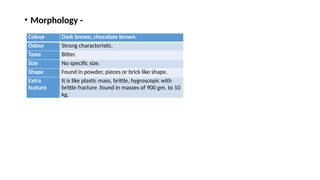
• Morphology -
Colour Dark brown, chocolate brown.
Odour Strong characteristic.
Taste Bitter.
Size No specific size.
Shape Found in powder, pieces or brick like shape.
Extra
feature
It is like plastic mass, brittle, hygroscopic with
brittle fracture .found in masses of 900 gm. to 10
kg.
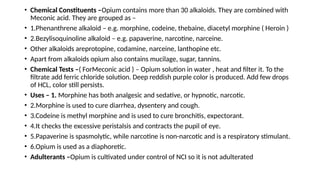
• Chemical Constituents –Opium contains more than 30 alkaloids. They are combined with
Meconic acid. They are grouped as –
• 1.Phenanthrene alkaloid – e.g. morphine, codeine, thebaine, diacetyl morphine ( Heroin )
• 2.Bezylisoquinoline alkaloid – e.g. papaverine, narcotine, narceine.
• Other alkaloids areprotopine, codamine, narceine, lanthopine etc.
• Apart from alkaloids opium also contains mucilage, sugar, tannins.
• Chemical Tests –( ForMeconic acid ) – Opium solution in water , heat and filter it. To the
filtrate add ferric chloride solution. Deep reddish purple color is produced. Add few drops
of HCL, color still persists.
• Uses – 1. Morphine has both analgesic and sedative, or hypnotic, narcotic.
• 2.Morphine is used to cure diarrhea, dysentery and cough.
• 3.Codeine is methyl morphine and is used to cure bronchitis, expectorant.
• 4.It checks the excessive peristalsis and contracts the pupil of eye.
• 5.Papaverine is spasmolytic, while narcotine is non-narcotic and is a respiratory stimulant.
• 6.Opium is used as a diaphoretic.
• Adulterants –Opium is cultivated under control of NCI so it is not adulterated
• 05. Tea Leaves
• Biological source - It contains the prepared leaves and leaf buds of Thea sinesis
belonging to family - Theaceae.
• Chemical constituent -
The leaves are a rich source of caffine (1-5%), It also contains theobromine and
thophylline in minor quantities.
The colour of tea leaves is due to tannin (10-27% gallotannic acid)
The agreeable odour is due to presence of a yellow volatile oil
Tea leaves also contain protein, wax, resin and an enzymatic mixture called thease.
Therapeutic Efficacy –
• 1. It is used as CNS stimulant, astringent and also as diuretic.
2. It is rich in catechins polyphenols, particularly epigallocatechin gallate (EGCG)
powerful anti-oxidant, reduces the risk of all cancers and inhibits the growth of
cancer cells without harming healthy tissue.
• 3. Green tea is used for weight loss.
• 06. COFFEE SEED
Biological source – It is the dried ripe seeds of Coffea Arabica, belonging to
family Rubiaceae.
Chemical constituent -
The main contituents of coffee are caffine, tannin, fixed oil and proteins.
• It contains 2-3% caffeine, 5% tannins.
• Also contains oil,coffeol and wax.
• Uses –
• 1. Coffee is widely used as a flavouring agent.
• 2. As a source of caffine,dried seeds are used as a stimulant,nervine and
diuretic.
• 3. Very valuable in cases of snake bite, helping to ward off the terrible coma.
• 07. COCA LEAVES
Biological source - Coca consists of the dried leaves of various species of Erythmxylon, that is,
Erythroxylon coca,Erythroxylon truxillence(From Bolivan coca,Peruvian,Truxillo or java coca) belonging
to family – Erythroxylaceae.
Chemical constituent –
• The major chemical constituent of coca is Alkaloids.
It is consist of cocaine,cinnamyl cocaine and alpha-truxilline or cocamine.
• It also contains Hygrine,hygroline,cuscohygrine,dihydrocuscohygrine and tropacocaine.
• They also contains cocatannica acid,essential oil .
Uses –
• 1. Coca, cocaine has stimulant action on CNS.
• 2. Leaves are used to relieve from hunger and fatigue.
• 3. Coca leaves are used as a stimulant of cerebral area and muscle stimulant.
• 4. It is especially used during convalescence, to get rid from nausea, vomiting and pain of stomach
without upsetting the digestion.
• 5. Local anesthetic action on skin and mucous membrane.
• 6. It is use as dental anesthesia and minor local surgery.
•
• Definition – The medicaments given in treatment of high blood
pressure are known as antihypertensive drugs.
• The systolic blood pressure in the range of 160-200-280 mm of Hg is
known as high blood pressure. Which may lead to cardiac arrest.
Antihypertensive agents are Methyldopa, Clonidine, Propranolol,
Reserpine.
• RAUWOLFIA -
• Synonyms –Chhotachand, Sarpagandha, Snake-root.
• Biological source – It consists of dried roots of the Rauwolfia
serpentine, Family – Apocynaceae. It is collected in autumn from 3 to
4 years old plant. It contains not less than 0.14% of alkaloids.
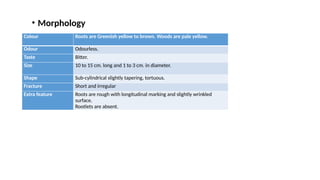
• Morphology
Colour Roots are Greenish yellow to brown. Woods are pale yellow.
Odour Odourless.
Taste Bitter.
Size 10 to 15 cm. long and 1 to 3 cm. in diameter.
Shape Sub-cylindrical slightly tapering, tortuous.
Fracture Short and irregular
Extra feature Roots are rough with longitudinal marking and slightly wrinkled
surface.
Rootlets are absent.
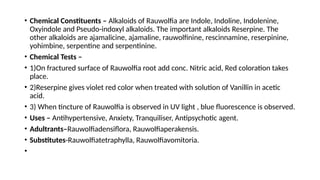
• Chemical Constituents – Alkaloids of Rauwolfia are Indole, Indoline, Indolenine,
Oxyindole and Pseudo-indoxyl alkaloids. The important alkaloids Reserpine. The
other alkaloids are ajamalicine, ajamaline, rauwolfinine, rescinnamine, reserpinine,
yohimbine, serpentine and serpentinine.
• Chemical Tests –
• 1)On fractured surface of Rauwolfia root add conc. Nitric acid, Red coloration takes
place.
• 2)Reserpine gives violet red color when treated with solution of Vanillin in acetic
acid.
• 3) When tincture of Rauwolfia is observed in UV light , blue fluorescence is observed.
• Uses – Antihypertensive, Anxiety, Tranquiliser, Antipsychotic agent.
• Adultrants–Rauwolfiadensiflora, Rauwolfiaperakensis.
• Substitutes-Rauwolfiatetraphylla, Rauwolfiavomitoria.
•
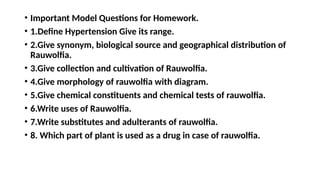
• Important Model Questions for Homework.
• 1.Define Hypertension Give its range.
• 2.Give synonym, biological source and geographical distribution of
Rauwolfia.
• 3.Give collection and cultivation of Rauwolfia.
• 4.Give morphology of rauwolfia with diagram.
• 5.Give chemical constituents and chemical tests of rauwolfia.
• 6.Write uses of Rauwolfia.
• 7.Write substitutes and adulterants of rauwolfia.
• 8. Which part of plant is used as a drug in case of rauwolfia.
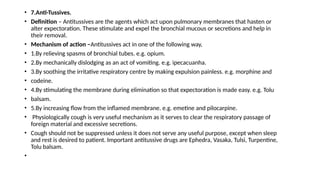
• 7.Anti-Tussives.
• Definition – Antitussives are the agents which act upon pulmonary membranes that hasten or
alter expectoration. These stimulate and expel the bronchial mucous or secretions and help in
their removal.
• Mechanism of action –Antitussives act in one of the following way,
• 1.By relieving spasms of bronchial tubes. e.g. opium.
• 2.By mechanically dislodging as an act of vomiting. e.g. ipecacuanha.
• 3.By soothing the irritative respiratory centre by making expulsion painless. e.g. morphine and
• codeine.
• 4.By stimulating the membrane during elimination so that expectoration is made easy. e.g. Tolu
• balsam.
• 5.By increasing flow from the inflamed membrane. e.g. emetine and pilocarpine.
• Physiologically cough is very useful mechanism as it serves to clear the respiratory passage of
foreign material and excessive secretions.
• Cough should not be suppressed unless it does not serve any useful purpose, except when sleep
and rest is desired to patient. Important antitussive drugs are Ephedra, Vasaka, Tulsi, Turpentine,
Tolu balsam.
•
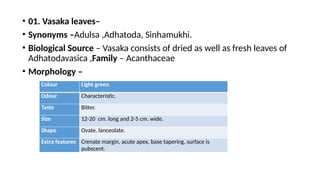
• 01. Vasaka leaves–
• Synonyms –Adulsa ,Adhatoda, Sinhamukhi.
• Biological Source – Vasaka consists of dried as well as fresh leaves of
Adhatodavasica ,Family – Acanthaceae
• Morphology –
Colour Light green.
Odour Characteristic.
Taste Bitter.
Size 12-20 cm. long and 2-5 cm. wide.
Shape Ovate, lanceolate.
Extra features Crenate margin, acute apex, base tapering, surface is
pubscent.
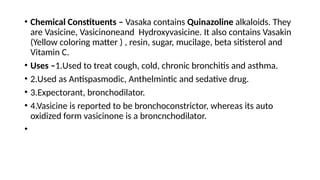
• Chemical Constituents – Vasaka contains Quinazoline alkaloids. They
are Vasicine, Vasicinoneand Hydroxyvasicine. It also contains Vasakin
(Yellow coloring matter ) , resin, sugar, mucilage, beta sitisterol and
Vitamin C.
• Uses –1.Used to treat cough, cold, chronic bronchitis and asthma.
• 2.Used as Antispasmodic, Anthelmintic and sedative drug.
• 3.Expectorant, bronchodilator.
• 4.Vasicine is reported to be bronchoconstrictor, whereas its auto
oxidized form vasicinone is a broncnchodilator.
•
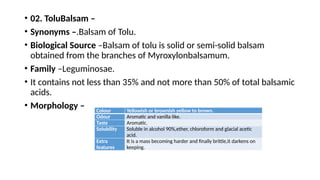
• 02. ToluBalsam –
• Synonyms –.Balsam of Tolu.
• Biological Source –Balsam of tolu is solid or semi-solid balsam
obtained from the branches of Myroxylonbalsamum.
• Family –Leguminosae.
• It contains not less than 35% and not more than 50% of total balsamic
acids.
• Morphology – Colour Yellowish or brownish yellow to brown.
Odour Aromatic and vanilla like.
Taste Aromatic.
Solubility Soluble in alcohol 90%,ether, chloroform and glacial acetic
acid.
Extra
features
It is a mass becoming harder and finally brittle,it darkens on
keeping.
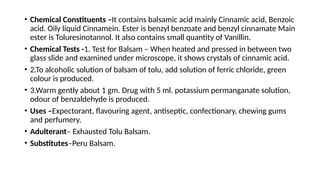
• Chemical Constituents –It contains balsamic acid mainly Cinnamic acid, Benzoic
acid. Oily liquid Cinnamein. Ester is benzyl benzoate and benzyl cinnamate Main
ester is Toluresinotannol. It also contains small quantity of Vanillin.
• Chemical Tests -1. Test for Balsam – When heated and pressed in between two
glass slide and examined under microscope, it shows crystals of cinnamic acid.
• 2.To alcoholic solution of balsam of tolu, add solution of ferric chloride, green
colour is produced.
• 3.Warm gently about 1 gm. Drug with 5 ml. potassium permanganate solution,
odour of benzaldehyde is produced.
• Uses –Expectorant, flavouring agent, antiseptic, confectionary, chewing gums
and perfumery.
• Adulterant– Exhausted Tolu Balsam.
• Substitutes–Peru Balsam.
• Important Model Questions for Homework.
•
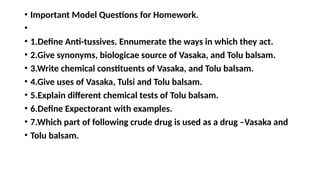
• 1.Define Anti-tussives. Ennumerate the ways in which they act.
• 2.Give synonyms, biologicae source of Vasaka, and Tolu balsam.
• 3.Write chemical constituents of Vasaka, and Tolu balsam.
• 4.Give uses of Vasaka, Tulsi and Tolu balsam.
• 5.Explain different chemical tests of Tolu balsam.
• 6.Define Expectorant with examples.
• 7.Which part of following crude drug is used as a drug –Vasaka and
• Tolu balsam.
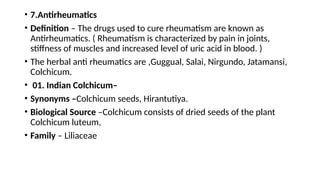
• 7.Antirheumatics
• Definition – The drugs used to cure rheumatism are known as
Antirheumatics. ( Rheumatism is characterized by pain in joints,
stiffness of muscles and increased level of uric acid in blood. )
• The herbal anti rheumatics are ,Guggual, Salai, Nirgundo, Jatamansi,
Colchicum.
• 01. Indian Colchicum–
• Synonyms –Colchicum seeds, Hirantutiya.
• Biological Source –Colchicum consists of dried seeds of the plant
Colchicum luteum,
• Family – Liliaceae
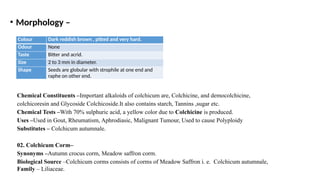
• Morphology –
Colour Dark reddish brown , pitted and very hard.
Odour None
Taste Bitter and acrid.
Size 2 to 3 mm in diameter.
Shape Seeds are globular with strophile at one end and
raphe on other end.
Chemical Constituents –Important alkaloids of colchicum are, Colchicine, and democolchicine,
colchicoresin and Glycoside Colchicoside.It also contains starch, Tannins ,sugar etc.
Chemical Tests –With 70% sulphuric acid, a yellow color due to Colchicine is produced.
Uses –Used in Gout, Rheumatism, Aphrodiasic, Malignant Tumour, Used to cause Polyploidy
Substitutes – Colchicum autumnale.
02. Colchicum Corm–
Synonyms –Autumn crocus corm, Meadow saffron corm.
Biological Source –Colchicum corms consists of corms of Meadow Saffron i. e. Colchicum autumnale,
Family – Liliaceae.
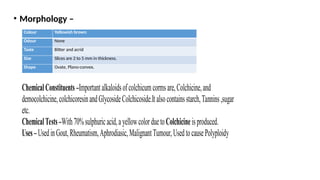
• Morphology –
Colour Yellowish brown
Odour None
Taste Bitter and acrid
Size Slices are 2 to 5 mm in thickness.
Shape Ovate, Plano-convex.
ChemicalConstituents–Importantalkaloidsofcolchicumcormsare,Colchicine,and
democolchicine,colchicoresinandGlycosideColchicoside.Italsocontainsstarch,Tannins,sugar
etc.
ChemicalTests–With70%sulphuricacid,ayellowcolorduetoColchicineisproduced.
Uses–UsedinGout,Rheumatism,Aphrodiasic,MalignantTumour,UsedtocausePolyploidy
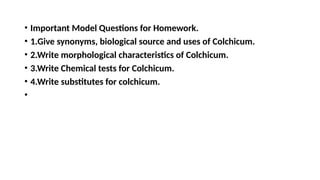
• Important Model Questions for Homework.
• 1.Give synonyms, biological source and uses of Colchicum.
• 2.Write morphological characteristics of Colchicum.
• 3.Write Chemical tests for Colchicum.
• 4.Write substitutes for colchicum.
•
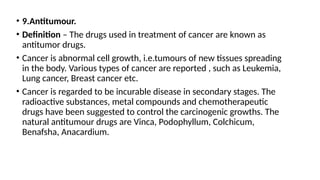
• 9.Antitumour.
• Definition – The drugs used in treatment of cancer are known as
antitumor drugs.
• Cancer is abnormal cell growth, i.e.tumours of new tissues spreading
in the body. Various types of cancer are reported , such as Leukemia,
Lung cancer, Breast cancer etc.
• Cancer is regarded to be incurable disease in secondary stages. The
radioactive substances, metal compounds and chemotherapeutic
drugs have been suggested to control the carcinogenic growths. The
natural antitumour drugs are Vinca, Podophyllum, Colchicum,
Benafsha, Anacardium.
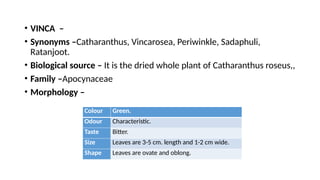
• VINCA –
• Synonyms –Catharanthus, Vincarosea, Periwinkle, Sadaphuli,
Ratanjoot.
• Biological source – It is the dried whole plant of Catharanthus roseus,,
• Family –Apocynaceae
• Morphology –
Colour Green.
Odour Characteristic.
Taste Bitter.
Size Leaves are 3-5 cm. length and 1-2 cm wide.
Shape Leaves are ovate and oblong.
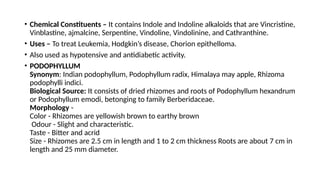
• Chemical Constituents – It contains Indole and Indoline alkaloids that are Vincristine,
Vinblastine, ajmalcine, Serpentine, Vindoline, Vindolinine, and Cathranthine.
• Uses – To treat Leukemia, Hodgkin’s disease, Chorion epithelloma.
• Also used as hypotensive and antidiabetic activity.
• PODOPHYLLUM
Synonym: Indian podophyllum, Podophyllum radix, Himalaya may apple, Rhizoma
podophylli indici.
Biological Source: It consists of dried rhizomes and roots of Podophyllum hexandrum
or Podophyllum emodi, betonging to family Berberidaceae.
Morphology -
Color - Rhizomes are yellowish brown to earthy brown
Odour - Slight and characteristic.
Taste - Bitter and acrid
Size - Rhizomes are 2.5 cm in length and 1 to 2 cm thickness Roots are about 7 cm in
length and 25 mm diameter.
• Chemical Constituents:
• Indian Podophyllum contains 7 to 15% of resin known as podophylline. Active constituent
of podophylline resin is the podophyllotoxin. It also contains flavonoids such a astragatin.
Also contains quercetin, kaempferol, asiragalin, essential oil, etc.
Uses:
1.Because of cytotoxic action it is used as an Anticancer.
2. Also used as purgative, cholagauge bitter tonic .
• 3. Active constituent i.e. podophylline resin is successively used to control some forms of
cancer.
4. It is used in semi-synthetic production of etoposide.
• 5. Roots are antirheumatics.
• 6. In treatment of genital warts.
• 6. Plant is used in gonorrhea and syphilis.
Chemical Tests -
Test for Tannins: Macerate 0.5 gm of drug with 10 ml of alcohol and filter it, to the
filtrate, add strong copper acetate solution, brown precipitate is produced.
• 10.Antidiabetics.
• Definition –The drugs used to cure diabetes are known as anti-
diabetic drugs.
• In diabetes pancreas fail to secrete insulin in sufficient quantity and
due to this, the body is not able to utilize glucose. Due to this there is
increased concentration of sugar in blood
• ( Hyperglycemia ) and excretion of sugar in urine ( Glycosuria )
• Apart from several synthetic antidiabetics like Tolubutamide,
Chlorpropamide, the natural oral antidiabetic drugs are
• Gymnema, Bitter gourd, Jambhul and Indian kino.
•
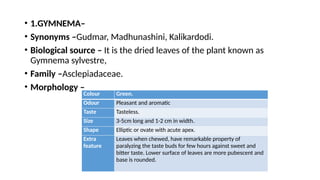
• 1.GYMNEMA–
• Synonyms –Gudmar, Madhunashini, Kalikardodi.
• Biological source – It is the dried leaves of the plant known as
Gymnema sylvestre,
• Family –Asclepiadaceae.
• Morphology –
Colour Green.
Odour Pleasant and aromatic
Taste Tasteless.
Size 3-5cm long and 1-2 cm in width.
Shape Elliptic or ovate with acute apex.
Extra
feature
Leaves when chewed, have remarkable property of
paralyzing the taste buds for few hours against sweet and
bitter taste. Lower surface of leaves are more pubescent and
base is rounded.
• Chemical Constituents – The leaves contains Hentriactone, Pentriactone,
Ptyline, alpha and beta chlorophylls, Resin, Tartaric acid, Formic acid, Butyric
acid, Mucilage, inositol, D-quircitol, Gymnemic acid and Anthraquinone
derivatives.
• Gymnemic acid is antisaccharin principle occurring as potassium salt. Which
also paralyze the taste buds.
• Uses –Antidiabetic, Stomachic, Stimulant, Laxative and Diuretic.
• Substitute –Gymnema hirsutum.
• PETROCARPUS–
• Synonyms –Bijasal, Indian kino tree, Malbarkino, Asana, Raktachandan.
• Biological source – It consists of the dried juice of the plant Petrocarpus
marsupium,
• Family –Leguminosae
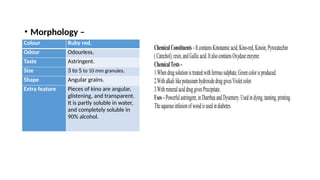
• Morphology –
Colour Ruby red.
Odour Odourless.
Taste Astringent.
Size 3 to 5 to 10 mm granules.
Shape Angular grains.
Extra feature Pieces of kino are angular,
glistening, and transparent.
It is partly soluble in water,
and completely soluble in
90% alcohol.
ChemicalConstituents–ItcontainsKinotannicacid,Kino-red,Kinoin,Pyrocatechin
(Catechol),resin,andGallicacid.ItalsocontainsOxydaseenzyme.
ChemicalTests–
1.Whendrugsolutionistreatedwithferroussulphate,Greencolorisproduced.
2.WithalkalilikepotassiumhydroxidedruggivesVioletcolor.
3.WithmineralaciddruggivesPrecipitate.
Uses–Powerfulastringent,inDiarrheaandDysentery. Usedindying,tanning,printing.
Theaqueousinfusionofwoodisusedindiabetes.
• Important Model Questions for Homework.
•
• 1.Give synonyms, biological source and uses of Gymnema and
Petrocarpus.
• 2.Write morphological characteristics of Gymnema and Petrocarpus.
• 3.Write Chemical constituents of Gymnema and Petrocarpus.
• 5.Write a note on Diabetes mellitus.
• 6. Give chemical tests of Petrocarpus
• 11.Diuretics.
• Definition – Diuretics are the drugs which increase the flow of urine.
• Diuretics are generally used for treatment of all types if edema, Acute
renal failure, regulation of osmotic pressure of plasma, treatment of
glaucoma etc.
• They can be grouped as follows,
• 1.Cardiac diuretics – e.g. digitalis.
• 2.Purine diuretics – e.g. caffeine, theophylline.
• Other diuretics are Osmotic diuretics, Alkaline diuretics, Acidifying
diuretics, Mercury diuretics, and Volatile oil diuretics.
• Important diuretic drugs are gokhru, punarnava, tea, coffee, digitalis.
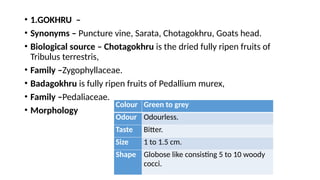
• 1.GOKHRU –
• Synonyms – Puncture vine, Sarata, Chotagokhru, Goats head.
• Biological source – Chotagokhru is the dried fully ripen fruits of
Tribulus terrestris,
• Family –Zygophyllaceae.
• Badagokhru is fully ripen fruits of Pedallium murex,
• Family –Pedaliaceae.
• Morphology
Colour Green to grey
Odour Odourless.
Taste Bitter.
Size 1 to 1.5 cm.
Shape Globose like consisting 5 to 10 woody
cocci.
• Chemical Constituents – It contains alkaloids that are harmine and
Harman. Additionally they containssaponins which on hydrolysis gives
steroidal sapogenins like diosgenin, gitogenin, chlorogenin and
ruscogenin. It also contains flavonoids, kaemferol, tribuloside.
• Uses – Diuretic, tonic, in treatment of calculous affection and painful
micturition. Also used as Aphrodiasic, Gout. Is used in ayurvedic
preparation ‘Dashamoolarishta’ and ‘Chyavanprash’.
• Badagokhru is used in Dysuria and Gonorrhoea.
• 2.PUNARNAVA –
• Synonyms – Hog weed, RaktaPunarnava,
• Biological source – It consists of fresh as well as, dried herb known as
Boerhaavia difussa, Boerhaavia repens, Boerhaavia procumbens,
• Family –Nyctaginaceae.
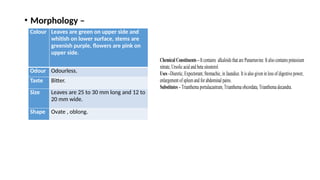
• Morphology –
Colour Leaves are green on upper side and
whitish on lower surface, stems are
greenish purple, flowers are pink on
upper side.
Odour Odourless.
Taste Bitter.
Size Leaves are 25 to 30 mm long and 12 to
20 mm wide.
Shape Ovate , oblong.
Chemical Constituents – It contains alkaloids that are Punarnavine. It also contains potassium
nitrate, Ursolic acid and beta sitosterol.
Uses –Diuretic, Expectorant, Stomachic, in Jaundice. It is also given in loss of digestive power,
enlargement of spleen and for abdominal pains.
Substitutes – Trianthema portulacastrum, Trianthema obcordata, Trianthema decandra.
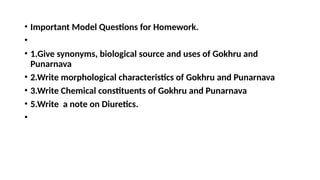
• Important Model Questions for Homework.
•
• 1.Give synonyms, biological source and uses of Gokhru and
Punarnava
• 2.Write morphological characteristics of Gokhru and Punarnava
• 3.Write Chemical constituents of Gokhru and Punarnava
• 5.Write a note on Diuretics.
•
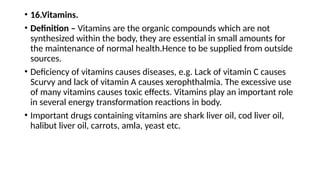
• 16.Vitamins.
• Definition – Vitamins are the organic compounds which are not
synthesized within the body, they are essential in small amounts for
the maintenance of normal health.Hence to be supplied from outside
sources.
• Deficiency of vitamins causes diseases, e.g. Lack of vitamin C causes
Scurvy and lack of vitamin A causes xerophthalmia. The excessive use
of many vitamins causes toxic effects. Vitamins play an important role
in several energy transformation reactions in body.
• Important drugs containing vitamins are shark liver oil, cod liver oil,
halibut liver oil, carrots, amla, yeast etc.
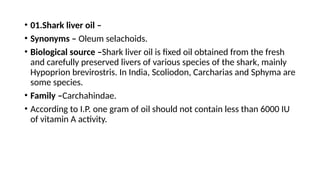
• 01.Shark liver oil –
• Synonyms – Oleum selachoids.
• Biological source –Shark liver oil is fixed oil obtained from the fresh
and carefully preserved livers of various species of the shark, mainly
Hypoprion brevirostris. In India, Scoliodon, Carcharias and Sphyma are
some species.
• Family –Carchahindae.
• According to I.P. one gram of oil should not contain less than 6000 IU
of vitamin A activity.
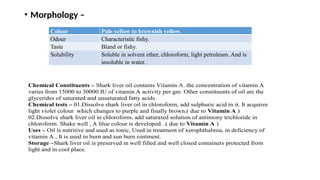
• Morphology –
Colour Pale yellow to brownish yellow.
Odour Characteristic fishy.
Taste Bland or fishy.
Solubility Soluble in solvent ether, chloroform, light petroleum. And is
insoluble in water.
Chemical Constituents – Shark liver oil contains Vitamin A. the concentration of vitamin A
varies from 15000 to 30000 IU of vitamin A activity per gm. Other constituents of oil are the
glycerides of saturated and unsaturated fatty acids.
Chemical tests – 01.Dissolve shark liver oil in chloroform, add sulphuric acid in it. It acquires
light violet colour which changes to purple and finally brown.( due to Vitamin A )
02.Dissolve shark liver oil in chloroform, add saturated solution of antimony trichloride in
chloroform. Shake well , A blue colour is developed. .( due to Vitamin A )
Uses – Oil is nutritive and used as tonic, Used in treatment of xerophthalmia, in deficiency of
vitamin A , It is used in burn and sun burn ointment.
Storage –Shark liver oil is preserved in well filled and well closed containers protected from
light and in cool place.
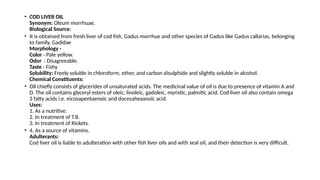
• COD LIVER OIL
Synonym: Oleum morrhuae.
Biological Source:
• It is obtained from fresh liver of cod fish, Gadus morrhue and other species of Gadus like Gadus callarias, belonging
to family, Gadidae
Morphology -
Color - Pale yellow.
Odor : Disagreeable.
Taste - Fishy
Solubility: Freely soluble in chloroform, ether, and carbon disulphide and slightly soluble in alcohol.
Chemical Constituents:
• Oil chiefly consists of glycerides of unsaturated acids. The medicinal value of oil is due to presence of vitamin A and
D. The oil contains glyceryl esters of oleic, linoleic, gadoleic, myristic, palmitic acid. Cod liver oil also contain omega
3 fatty acids i.e. eicosapentaenoic and docesahexanoic acid.
Uses:
1. As a nutritive.
2. In treatment of T.B.
3. In treatment of Rickets.
• 4. As a source of vitamins.
Adulterants:
Cod liver oil is liable to adulteration with other fish liver oils and with seal oil, and their detection is very difficult.
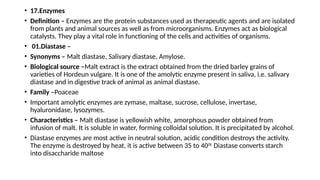
• 17.Enzymes
• Definition – Enzymes are the protein substances used as therapeutic agents and are isolated
from plants and animal sources as well as from microorganisms. Enzymes act as biological
catalysts. They play a vital role in functioning of the cells and activities of organisms.
• 01.Diastase –
• Synonyms – Malt diastase, Salivary diastase, Amylose.
• Biological source –Malt extract is the extract obtained from the dried barley grains of
varieties of Hordeun vulgare. It is one of the amolytic enzyme present in saliva, i.e. salivary
diastase and in digestive track of animal as animal diastase.
• Family –Poaceae
• Important amolytic enzymes are zymase, maltase, sucrose, cellulose, invertase,
hyaluronidase, lysozymes.
• Characteristics – Malt diastase is yellowish white, amorphous powder obtained from
infusion of malt. It is soluble in water, forming colloidal solution. It is precipitated by alcohol.
• Diastase enzymes are most active in neutral solution, acidic condition destroys the activity.
The enzyme is destroyed by heat, it is active between 35 to 400c
Diastase converts starch
into disaccharide maltose
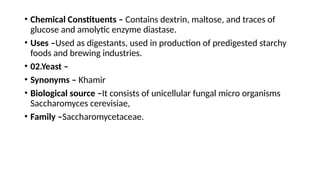
• Chemical Constituents – Contains dextrin, maltose, and traces of
glucose and amolytic enzyme diastase.
• Uses –Used as digestants, used in production of predigested starchy
foods and brewing industries.
• 02.Yeast –
• Synonyms – Khamir
• Biological source –It consists of unicellular fungal micro organisms
Saccharomyces cerevisiae,
• Family –Saccharomycetaceae.
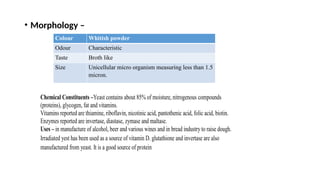
• Morphology –
Colour Whitish powder
Odour Characteristic
Taste Broth like
Size Unicellular micro organism measuring less than 1.5
micron.
Chemical Constituents –Yeast contains about 85% of moisture, nitrogenous compounds
(proteins), glycogen, fat and vitamins.
Vitamins reported are thiamine, riboflavin, nicotinic acid, pantothenic acid, folic acid, biotin.
Enzymes reported are invertase, diastase, zymase and maltase.
Uses – in manufacture of alcohol, beer and various wines and in bread industry to raise dough.
Irradiated yest has been used as a source of vitamin D. glutathione and invertase are also
manufactured from yeast. It is a good source of protein
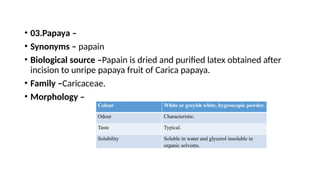
• 03.Papaya –
• Synonyms – papain
• Biological source –Papain is dried and purified latex obtained after
incision to unripe papaya fruit of Carica papaya.
• Family –Caricaceae.
• Morphology –
Colour White or greyish white, hygroscopic powder.
Odour Characteristic.
Taste Typical.
Solubility Soluble in water and glycerol insoluble in
organic solvents.
• Chemical Constituents –It contains papain and chymopapain.
• Chemical Test -01. In papaya latex add water and shake well add
solution of potassium permanganate, Decolorisation takes place.
• 02.To 20ml of milk add 0.5gm. papaya latex. The milk curdles.
• Uses –Digestant, anti inflammatory agent, used in clarification of
beverages and as meat tenderizer, cheese manufacture, as substitute
of renin. Used in relieving symptoms of episiotomy.
• Storage –It is very sensitive to air, light, moisture and high
temperature. It undergoes auto oxidation very fast and hence should
be stored in well closed and filled containers away from light and in
cool place
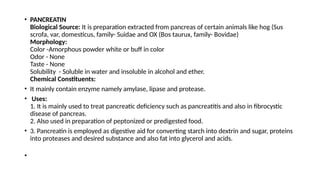
• PANCREATIN
Biological Source: It is preparation extracted from pancreas of certain animals like hog (Sus
scrofa, var, domesticus, family- Suidae and OX (Bos taurux, family- Bovidae)
Morphology:
Color -Amorphous powder white or buff in color
Odor - None
Taste - None
Solubility - Soluble in water and insoluble in alcohol and ether.
Chemical Constituents:
• It mainly contain enzyme namely amylase, lipase and protease.
• Uses:
1. It is mainly used to treat pancreatic deficiency such as pancreatitis and also in fibrocystic
disease of pancreas.
2. Also used in preparation of peptonized or predigested food.
• 3. Pancreatin is employed as digestive aid for converting starch into dextrin and sugar, proteins
into proteases and desired substance and also fat into glycerol and acids.
•
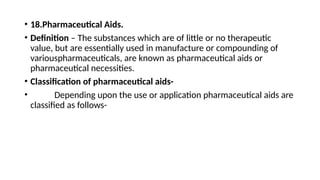
• 18.Pharmaceutical Aids.
• Definition – The substances which are of little or no therapeutic
value, but are essentially used in manufacture or compounding of
variouspharmaceuticals, are known as pharmaceutical aids or
pharmaceutical necessities.
• Classification of pharmaceutical aids-
• Depending upon the use or application pharmaceutical aids are
classified as follows-
Sr.
no.
Use /Application Examples of crude drugs
1. Acidulants Tamarind, lemon juice
2. Colouring agents Carmel, cochineal, turmeric saffron, indigo, chlorophyll.
3. Disintegrating agents Starch, CMC, Psyllumhusk
4. Diluents Cinnamon water, peppermint water peanut oil, sesame oil,
glucose lactose.
5. Emulsifying & suspending
agents
Acacia, agar, alginic acid, gelatin, tragacanth, guar gum
6. Filter aids Talc, betonies, kieselguhr.
7. Flavoring agents Cardamom, cinnamon, rose, lemon oil, orange oil, nutmeg.
8. Harding agents Bees wax, hard paraffin
9. lubricants Talc, coca butter, magnesium stearate
10. Ointment bases Beeswax, lanolin, PEG, paraffin, wool fat.
11. Solvents Alcohol, glycerin, propyleneglycol.
12. sweating agents Honey, glycyrrhizin, sorbitol saccharin
13. Thickening agents Pectin, tragacanth, methyl cellulose.
14 Vehicles Arachis oil, honey, sesame oil.
• 01.Acacia ( Indian gum ) –
• Synonyms –Gum acacia, Gum Arabic, Acacia senegal, Indian gum,
Bhabul dink.
• Biological source – Indian gum is the dried gummy exudation
obtained from the stem and branches of Acacia arebica,
• Family – Leguminosae.
• Morphology Colour Tears are cream brown to red,
powder is light brown.
Odour Odourless.
Taste Bland and mucilaginous.
Solubility Soluble in water but insoluble in
alcohol.
• Chemical Constituents –It contains hetropolysaccharide compound arabin. Arebin is calcium,
magnesium and potassium salt of arabic acid. Arebic acid on hydrolysis gives L-rhamnose, D-
galactose, and D-glucuronic acid. It also contains an enzyme oxidase.
• Chemical Tests -(A) In solution of gum add Borax ,Stiff transluscent mass is formed .
• (B) In solution of gum add lead subacetatesolution ,gelatinisationtakes place.
• (C) In solution of gum add Ruthenium red ,No pinkcolour .
• (D) In solution of gum add hydrogen peroxide solution & 1% benzidine in alcohol solution ,
• shake it well Blue colour due to Oxydase enzyme.
• (E) Hydrolise the solution of gum with dilute HCL by boiling , To it add Fehling solution A &
• Fehling solution B , heat again , Red ppt. is observed.
• (F) In solution of gum add 10 ml. of water , keep aside for few hrs. No sedimentation .
• (G) In Solution of gum add Iodine ,No brown or blue colour as Dextrin & Starch is absent.
• (H) In solution of gum add FeCL3 ,NO blue or black colour.as Tannins are absent.
• Uses –Demulcent, emollient, emulsifying agent, suspending agent, adhesive, Binder.It is also
administered intravenously in haemolysis.
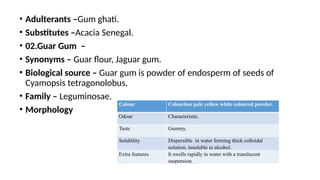
• Adulterants –Gum ghati.
• Substitutes –Acacia Senegal.
• 02.Guar Gum –
• Synonyms – Guar flour, Jaguar gum.
• Biological source – Guar gum is powder of endosperm of seeds of
Cyamopsis tetragonolobus,
• Family – Leguminosae.
• Morphology
Colour Colourless pale yellow white coloured powder.
Odour Characteristic.
Taste Gummy.
Solubility Dispersible in water forming thick colloidal
solution, insoluble in alcohol.
Extra features It swells rapidly in water with a translucent
suspension.