
ISPAGHULA/ ISHABGULA
BY
Dr. Jitendra Patel
Associate Professor
AIPS, Hyderabad, India.
Synonyms
1. Ispaghula,
2. Ispagol,
3. Ishabgula,
4. Spongel seeds.
Biological Source
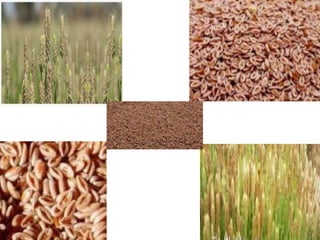
• Ispaghula consists of dried seeds of Plantago
ovata Forskal, belonging to family
Plantaginaece.
Geographical Source
• Ispaghula is an annual herb cultivated in India
in Gujarat, Maharastra, Punjab and in some
parts of Rajasthan and Sindh Province of
Pakistan. It is cultivated extensively around
Sidhpur in north Gujarat.
Cultivation and Collection
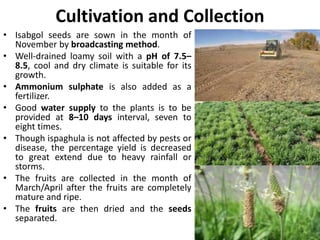
• Isabgol seeds are sown in the month of
November by broadcasting method.
• Well-drained loamy soil with a pH of 7.5–
8.5, cool and dry climate is suitable for its
growth.
• Ammonium sulphate is also added as a
fertilizer.
• Good water supply to the plants is to be
provided at 8–10 days interval, seven to
eight times.
• Though ispaghula is not affected by pests or
disease, the percentage yield is decreased
to great extend due to heavy rainfall or
storms.
• The fruits are collected in the month of
March/April after the fruits are completely
mature and ripe.
• The fruits are then dried and the seeds
separated.
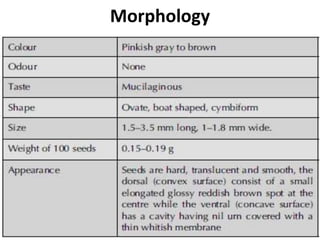
Morphology
Chemical constituents
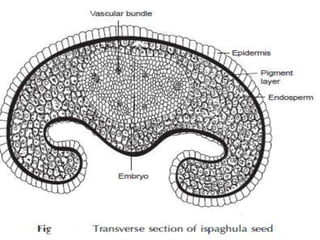
• Ispaghula seeds contain about 10% mucilage
which is present in the epidermis of testa.
• Mucilage consists of two complex
polysaccharides, of which one is soluble in cold
water and the other soluble in hot water.
• Chemically it is pentosan and aldobionic acid.
Pentosan on hydrolysis yields xylose and
arabinose and aldobionic acid yields
galactouronic acid and rhamnose.
• Protein and fixed oil are present in endosperm
and embryo.
Chemical Tests
1. Ispaghula seeds when treated with ruthenium red
give red colour due to the presence of mucilage.
2. Add water to few seeds on a slide, mucilage comes
out and forms zone surrounding the seeds.
3. Swelling factor: Swelling factor is the parameter to
determine the purity of seeds. Swelling can be
determined quantitatively by swelling factor. 1 g of
the drug is put in a measuring cylinder of 25 ml
capacity and 20 ml water is added. It is shaken
periodically for first 23 h and kept for one more
hour. The volume occupied by the drug is called
swelling factor. Swelling factor of ispaghula seeds is
10–13.
Uses
• Ispaghula seeds are used as an excellent
demulcent and bulk laxative in chronic
constipation.
• The laxative activity of ispaghula mucilage is
purely mechanical.
• It is also useful in dysentery, chronic
diarrhoea, in cases of duodenal ulcers and
piles.
• It works effectively as a soothing agent.
• Ispaghula husk is also used for similar
purpose.
Thank You

ISPAGHULA/ ISHABGULA- Plantago ovata

  • 1.
    ISPAGHULA/ ISHABGULA BY Dr. JitendraPatel Associate Professor AIPS, Hyderabad, India.
  • 3.
    Synonyms 1. Ispaghula, 2. Ispagol, 3.Ishabgula, 4. Spongel seeds.
  • 4.
    Biological Source • Ispaghulaconsists of dried seeds of Plantago ovata Forskal, belonging to family Plantaginaece.
  • 5.
    Geographical Source • Ispaghulais an annual herb cultivated in India in Gujarat, Maharastra, Punjab and in some parts of Rajasthan and Sindh Province of Pakistan. It is cultivated extensively around Sidhpur in north Gujarat.
  • 6.
    Cultivation and Collection •Isabgol seeds are sown in the month of November by broadcasting method. • Well-drained loamy soil with a pH of 7.5– 8.5, cool and dry climate is suitable for its growth. • Ammonium sulphate is also added as a fertilizer. • Good water supply to the plants is to be provided at 8–10 days interval, seven to eight times. • Though ispaghula is not affected by pests or disease, the percentage yield is decreased to great extend due to heavy rainfall or storms. • The fruits are collected in the month of March/April after the fruits are completely mature and ripe. • The fruits are then dried and the seeds separated.
  • 7.
  • 8.
    Chemical constituents • Ispaghulaseeds contain about 10% mucilage which is present in the epidermis of testa. • Mucilage consists of two complex polysaccharides, of which one is soluble in cold water and the other soluble in hot water. • Chemically it is pentosan and aldobionic acid. Pentosan on hydrolysis yields xylose and arabinose and aldobionic acid yields galactouronic acid and rhamnose. • Protein and fixed oil are present in endosperm and embryo.
  • 10.
    Chemical Tests 1. Ispaghulaseeds when treated with ruthenium red give red colour due to the presence of mucilage. 2. Add water to few seeds on a slide, mucilage comes out and forms zone surrounding the seeds. 3. Swelling factor: Swelling factor is the parameter to determine the purity of seeds. Swelling can be determined quantitatively by swelling factor. 1 g of the drug is put in a measuring cylinder of 25 ml capacity and 20 ml water is added. It is shaken periodically for first 23 h and kept for one more hour. The volume occupied by the drug is called swelling factor. Swelling factor of ispaghula seeds is 10–13.
  • 11.
    Uses • Ispaghula seedsare used as an excellent demulcent and bulk laxative in chronic constipation. • The laxative activity of ispaghula mucilage is purely mechanical. • It is also useful in dysentery, chronic diarrhoea, in cases of duodenal ulcers and piles. • It works effectively as a soothing agent. • Ispaghula husk is also used for similar purpose.
  • 12.