TsunamiTsunami
D Gift Pon Lazarus
Assistant Professor
Department of civil engineering
MRIIRS, Faridabad.
DefinitionDefinition
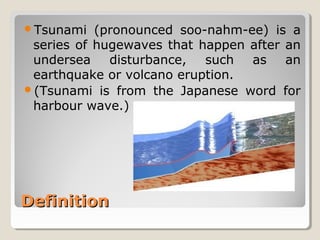
Tsunami (pronounced soo-nahm-ee) is a
series of hugewaves that happen after an
undersea disturbance, such as an
earthquake or volcano eruption.
(Tsunami is from the Japanese word for
harbour wave.)
CausesCauses
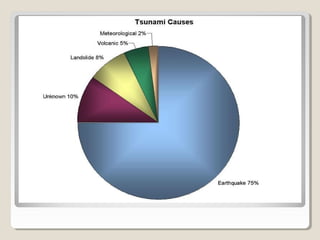
By an earthquake
The phenomenon we call “TSUNAMI” (soo-
NAhmee) is a series of travelling ocean waves of
extremely long length generated primarily by
earthquakes occurring below or near the ocean
floor.
Tsunami waves are distinguished from ordinary
ocean waves by their great length.
In the deep ocean ,the tsunami waves propagate
at a speed exceeding 800 kmph.
Tsunami is a kind of Coastal Hazard
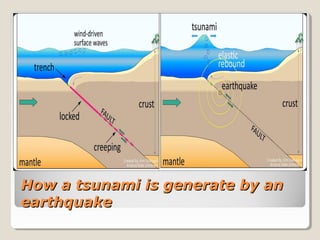
How a tsunami is generate by anHow a tsunami is generate by an
earthquakeearthquake
By an earthquakeBy an earthquake
On the Earth, these tectonic plates are
constantly in motion, moving along each
other at a speed of 1 to 2 inches (2.5 to 5
centimeters) per year.
The movement occurs most dramatically
along fault lines (where the pie is cut).
 These motions can produce earthquakes
and volcanism, which, when they occur at
the bottom of the ocean, are two possible
sources of tsunamis.
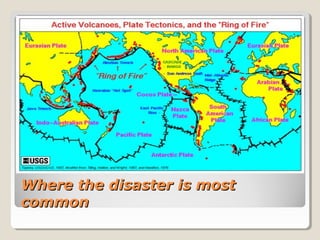
Where the disaster is mostWhere the disaster is most
commoncommon
By a volcanic explosionBy a volcanic explosion
Although relatively infrequent, violent volcanic
eruptions represent also impulsive disturbances,
which can displace a great volume of water &
generate extremely destructive tsunami waves in
the immediate source area.
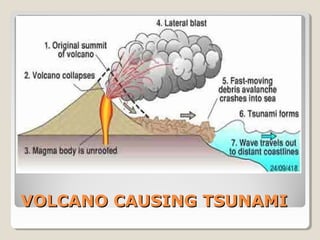
According to this mechanism, waves may be
generated by the sudden displacement of water
caused by a volcanic explosion.
One of the largest & most destructive tsunamis
ever recode was generated in August 26,1883
after the explosion & collapse of the volcano of
Krakatau(Indonesia).This explosion generated
waves that reached 135ft,destroyed towns
&villages, and killing 36,417 people.
VOLCANO CAUSING TSUNAMIVOLCANO CAUSING TSUNAMI
By landslidesBy landslides
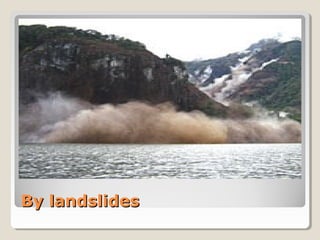
Tsunami waves can be generated from
displacements of water resulting from rock-falls,
icefalls & sudden submarine landslides or slumps.
Major earthquakes are suspected to cause many
underwater landslides, which may contribute
significantly to tsunami generation.
In the 1980’seath moving & construction work of
an airport runway along the coast of Southern
France, trrigered an underwater landslide, which
generated tsunami waves in the harbor of
Thebes.
By landslidesBy landslides
FACTORS OF DESTRUCTION ORFACTORS OF DESTRUCTION OR
EFFECTS”EFFECTS”
 Mainly there are three “FACTORS OF DESTRUCTION
OR EFFECTS” of tsunami-
◦ Inundation
◦ Wave impact on structures
◦ Erosion.
 Strong tsunami-induced currents lead to erosion of
foundations and the collapse of bridges & seawalls.
 Floatation & drag forces move houses &overturned
railroad cars.
 Floating debris, including boats & cars become
dangerous projectiles that may crash into buildings,
break power line &may start fire
FACTORS OF DESTRUCTION ORFACTORS OF DESTRUCTION OR
EFFECTSEFFECTS
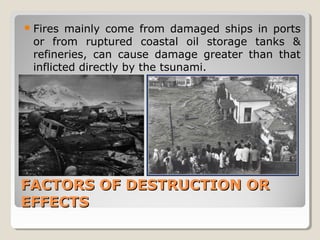
Fires mainly come from damaged ships in ports
or from ruptured coastal oil storage tanks &
refineries, can cause damage greater than that
inflicted directly by the tsunami.
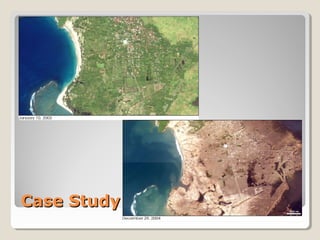
Case StudyCase Study
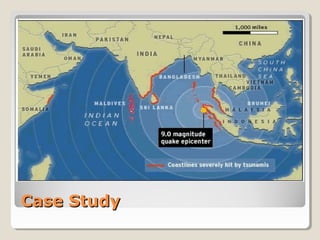
On Dec.26th 2004,a magnitude 9.0 undersea
earthquake off the west coast of Northern
Sumatra(Indonesia),unleashed a tsunami
that affected more than 12 countries
throughout south & southeast Asia &
stretched as far as the northeastern African
coast.
Within 6 hrs. the deadly waves travelled
more than 3,000 miles & carved a trail of
death & destruction as they arrived on land.
Case StudyCase Study
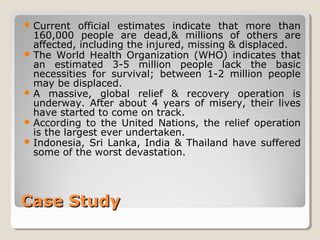
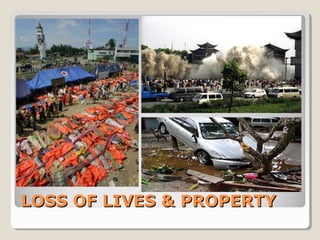
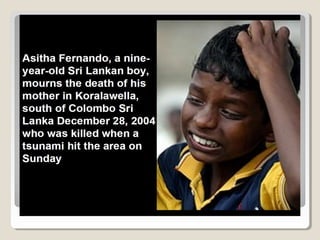
 Current official estimates indicate that more than
160,000 people are dead,& millions of others are
affected, including the injured, missing & displaced.
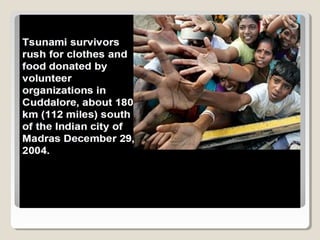
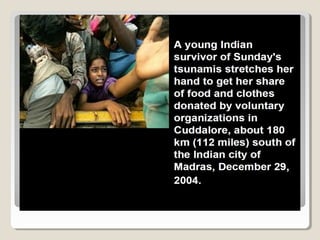
 The World Health Organization (WHO) indicates that
an estimated 3-5 million people lack the basic
necessities for survival; between 1-2 million people
may be displaced.
 A massive, global relief & recovery operation is
underway. After about 4 years of misery, their lives
have started to come on track.
 According to the United Nations, the relief operation
is the largest ever undertaken.
 Indonesia, Sri Lanka, India & Thailand have suffered
some of the worst devastation.
Case StudyCase Study
LOSS OF LIVES & PROPERTYLOSS OF LIVES & PROPERTY
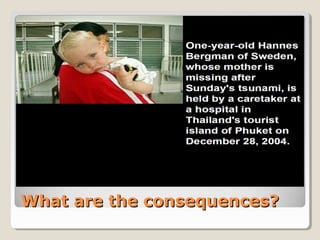
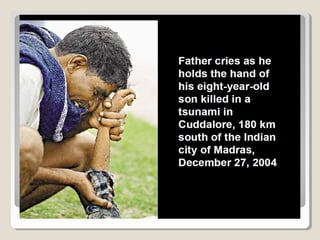
What are the consequences?What are the consequences?
Tsunami
Tsunami
Tsunami
Tsunami

Tsunami

  • 1.
    TsunamiTsunami D Gift PonLazarus Assistant Professor Department of civil engineering MRIIRS, Faridabad.
  • 2.
    DefinitionDefinition Tsunami (pronounced soo-nahm-ee)is a series of hugewaves that happen after an undersea disturbance, such as an earthquake or volcano eruption. (Tsunami is from the Japanese word for harbour wave.)
  • 3.
    CausesCauses By an earthquake Thephenomenon we call “TSUNAMI” (soo- NAhmee) is a series of travelling ocean waves of extremely long length generated primarily by earthquakes occurring below or near the ocean floor. Tsunami waves are distinguished from ordinary ocean waves by their great length. In the deep ocean ,the tsunami waves propagate at a speed exceeding 800 kmph. Tsunami is a kind of Coastal Hazard
  • 4.
    How a tsunamiis generate by anHow a tsunami is generate by an earthquakeearthquake
  • 5.
    By an earthquakeByan earthquake On the Earth, these tectonic plates are constantly in motion, moving along each other at a speed of 1 to 2 inches (2.5 to 5 centimeters) per year. The movement occurs most dramatically along fault lines (where the pie is cut).  These motions can produce earthquakes and volcanism, which, when they occur at the bottom of the ocean, are two possible sources of tsunamis.
  • 6.
    Where the disasteris mostWhere the disaster is most commoncommon
  • 7.
    By a volcanicexplosionBy a volcanic explosion Although relatively infrequent, violent volcanic eruptions represent also impulsive disturbances, which can displace a great volume of water & generate extremely destructive tsunami waves in the immediate source area. According to this mechanism, waves may be generated by the sudden displacement of water caused by a volcanic explosion. One of the largest & most destructive tsunamis ever recode was generated in August 26,1883 after the explosion & collapse of the volcano of Krakatau(Indonesia).This explosion generated waves that reached 135ft,destroyed towns &villages, and killing 36,417 people.
  • 8.
  • 9.
    By landslidesBy landslides Tsunamiwaves can be generated from displacements of water resulting from rock-falls, icefalls & sudden submarine landslides or slumps. Major earthquakes are suspected to cause many underwater landslides, which may contribute significantly to tsunami generation. In the 1980’seath moving & construction work of an airport runway along the coast of Southern France, trrigered an underwater landslide, which generated tsunami waves in the harbor of Thebes.
  • 10.
  • 12.
    FACTORS OF DESTRUCTIONORFACTORS OF DESTRUCTION OR EFFECTS”EFFECTS”  Mainly there are three “FACTORS OF DESTRUCTION OR EFFECTS” of tsunami- ◦ Inundation ◦ Wave impact on structures ◦ Erosion.  Strong tsunami-induced currents lead to erosion of foundations and the collapse of bridges & seawalls.  Floatation & drag forces move houses &overturned railroad cars.  Floating debris, including boats & cars become dangerous projectiles that may crash into buildings, break power line &may start fire
  • 13.
    FACTORS OF DESTRUCTIONORFACTORS OF DESTRUCTION OR EFFECTSEFFECTS Fires mainly come from damaged ships in ports or from ruptured coastal oil storage tanks & refineries, can cause damage greater than that inflicted directly by the tsunami.
  • 14.
    Case StudyCase Study OnDec.26th 2004,a magnitude 9.0 undersea earthquake off the west coast of Northern Sumatra(Indonesia),unleashed a tsunami that affected more than 12 countries throughout south & southeast Asia & stretched as far as the northeastern African coast. Within 6 hrs. the deadly waves travelled more than 3,000 miles & carved a trail of death & destruction as they arrived on land.
  • 15.
  • 16.
    Case StudyCase Study Current official estimates indicate that more than 160,000 people are dead,& millions of others are affected, including the injured, missing & displaced.  The World Health Organization (WHO) indicates that an estimated 3-5 million people lack the basic necessities for survival; between 1-2 million people may be displaced.  A massive, global relief & recovery operation is underway. After about 4 years of misery, their lives have started to come on track.  According to the United Nations, the relief operation is the largest ever undertaken.  Indonesia, Sri Lanka, India & Thailand have suffered some of the worst devastation.
  • 17.
  • 18.
    LOSS OF LIVES& PROPERTYLOSS OF LIVES & PROPERTY
  • 19.
    LOSS OF LIVES& PROPERTYLOSS OF LIVES & PROPERTY
  • 20.
    What are theconsequences?What are the consequences?