What is an Earthquake?
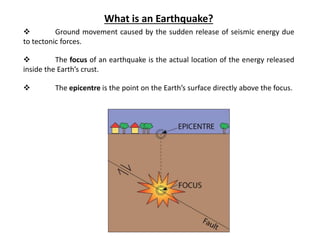
 Ground movement caused by the sudden release of seismic energy due
to tectonic forces.
 The focus of an earthquake is the actual location of the energy released
inside the Earth’s crust.
 The epicentre is the point on the Earth’s surface directly above the focus.
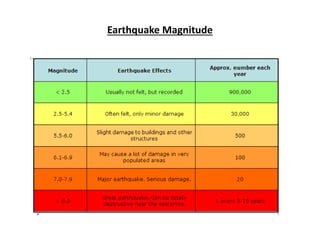
Earthquake Magnitude
Why do earthquakes occur?
 Seismic energy is usually caused by the brittle failure (fracturing) of rocks
under stress.
 This commonly occurs due to movement along tectonic plate boundaries
 The conditions required to put rocks under the amount of stress needed
to fracture them mainly occurs around the boundaries of tectonic plates.
As plates push together or slide past each other they stick due to friction
and then suddenly break and earthquakes are produced.
Earthquake Hazards
 These are important hazards to understand:
 the natural hazard that on average kills the highest number of people per year (> 1
million during the past century)
 no time for evacuation
 not a predictable trend to earthquake numbers, magnitude or location
 1000's of large earthquakes every year
 Earthquakes are important hazards to
 understand as they are responsible for the deaths of the highest number of people
per event for any natural hazard.
 They commonly strike without warning, therefore people can not evacuate to safer
areas.
Example
San Francisco - Great Earthquake
Magnitude 7.7 - 8.3
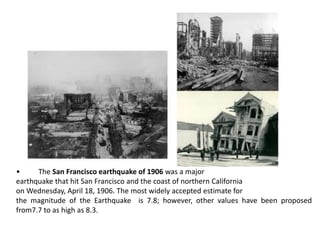
• The San Francisco earthquake of 1906 was a major
earthquake that hit San Francisco and the coast of northern California
on Wednesday, April 18, 1906. The most widely accepted estimate for
the magnitude of the Earthquake is 7.8; however, other values have been proposed
from7.7 to as high as 8.3.
How do we mitigate the hazard from earthquakes?
 Reinforce buildings
 Education
 Disaster plan
Earthquakes and Tsunami’s
An earthquake under the ocean has the potential to form a tsunami.
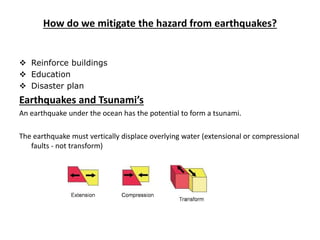
The earthquake must vertically displace overlying water (extensional or compressional
faults - not transform)
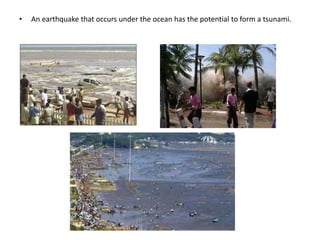
• An earthquake that occurs under the ocean has the potential to form a tsunami.
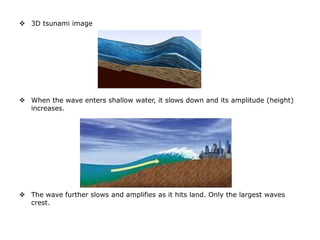
 3D tsunami image
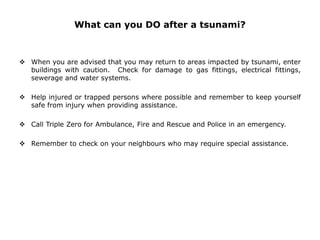
 When the wave enters shallow water, it slows down and its amplitude (height)
increases.
 The wave further slows and amplifies as it hits land. Only the largest waves
crest.
What can you DO after a tsunami?
 When you are advised that you may return to areas impacted by tsunami, enter
buildings with caution. Check for damage to gas fittings, electrical fittings,
sewerage and water systems.
 Help injured or trapped persons where possible and remember to keep yourself
safe from injury when providing assistance.
 Call Triple Zero for Ambulance, Fire and Rescue and Police in an emergency.
 Remember to check on your neighbours who may require special assistance.
Before the arrival of the cyclone
 Check that your home is in a sound condition, especially the roof.
 Trim any tree branches hanging over your roof.
 Clear your property of any loose items that could become missiles during extreme winds.
 Prepare an emergency kit containing:
 A portable radio, torch and spare batteries.
 Stocks of fresh water and canned food.
 Matches, fuel lamp, portable stove, cooking gear, utensils, can opener
 A first aid kit
 Keep a list of emergency phone numbers handy
 Find out how and where to turn off power, and water supplies.
 Store your important documents (eg. wills, passports, photos, birth certificates) in a fire/water-
proof container What causes tornadoes to form?
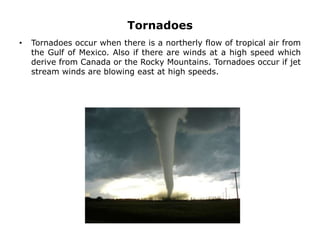
Tornadoes
• Tornadoes occur when there is a northerly flow of tropical air from
the Gulf of Mexico. Also if there are winds at a high speed which
derive from Canada or the Rocky Mountains. Tornadoes occur if jet
stream winds are blowing east at high speeds.
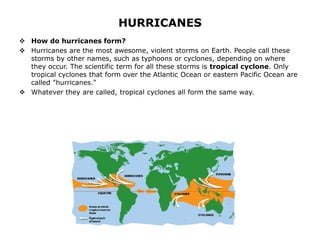
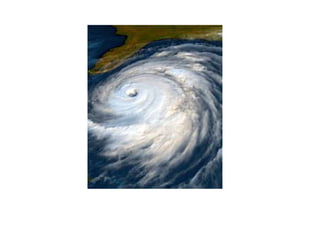
HURRICANES
 How do hurricanes form?
 Hurricanes are the most awesome, violent storms on Earth. People call these
storms by other names, such as typhoons or cyclones, depending on where
they occur. The scientific term for all these storms is tropical cyclone. Only
tropical cyclones that form over the Atlantic Ocean or eastern Pacific Ocean are
called "hurricanes."
 Whatever they are called, tropical cyclones all form the same way.
Frequency and Severity of Hurricanes Likely to Increase
 While the scientific community debates the root cause of the temperature
changes that are contributing to the current increase in destructive hurricanes,
three things are apparent:
 Air and water temperatures are rising worldwide.
 Human activities such as deforestation and greenhouse gas emissions from a
wide range of industrial and agricultural processes are contributing to those
temperature changes at a greater rate today than in the past.
 Increase levels of greenhouse gases is likely to lead to more frequent and
severe hurricanes in the future.
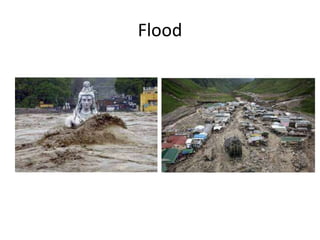
Flood
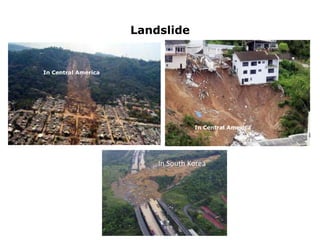
Landslide
In South Korea
In Central America
In Central America
Natural disaster

Natural disaster

  • 1.
    What is anEarthquake?  Ground movement caused by the sudden release of seismic energy due to tectonic forces.  The focus of an earthquake is the actual location of the energy released inside the Earth’s crust.  The epicentre is the point on the Earth’s surface directly above the focus.
  • 2.
  • 3.
    Why do earthquakesoccur?  Seismic energy is usually caused by the brittle failure (fracturing) of rocks under stress.  This commonly occurs due to movement along tectonic plate boundaries  The conditions required to put rocks under the amount of stress needed to fracture them mainly occurs around the boundaries of tectonic plates. As plates push together or slide past each other they stick due to friction and then suddenly break and earthquakes are produced.
  • 4.
    Earthquake Hazards  Theseare important hazards to understand:  the natural hazard that on average kills the highest number of people per year (> 1 million during the past century)  no time for evacuation  not a predictable trend to earthquake numbers, magnitude or location  1000's of large earthquakes every year  Earthquakes are important hazards to  understand as they are responsible for the deaths of the highest number of people per event for any natural hazard.  They commonly strike without warning, therefore people can not evacuate to safer areas. Example San Francisco - Great Earthquake Magnitude 7.7 - 8.3
  • 5.
    • The SanFrancisco earthquake of 1906 was a major earthquake that hit San Francisco and the coast of northern California on Wednesday, April 18, 1906. The most widely accepted estimate for the magnitude of the Earthquake is 7.8; however, other values have been proposed from7.7 to as high as 8.3.
  • 7.
    How do wemitigate the hazard from earthquakes?  Reinforce buildings  Education  Disaster plan Earthquakes and Tsunami’s An earthquake under the ocean has the potential to form a tsunami. The earthquake must vertically displace overlying water (extensional or compressional faults - not transform)
  • 8.
    • An earthquakethat occurs under the ocean has the potential to form a tsunami.
  • 9.
     3D tsunamiimage  When the wave enters shallow water, it slows down and its amplitude (height) increases.  The wave further slows and amplifies as it hits land. Only the largest waves crest.
  • 10.
    What can youDO after a tsunami?  When you are advised that you may return to areas impacted by tsunami, enter buildings with caution. Check for damage to gas fittings, electrical fittings, sewerage and water systems.  Help injured or trapped persons where possible and remember to keep yourself safe from injury when providing assistance.  Call Triple Zero for Ambulance, Fire and Rescue and Police in an emergency.  Remember to check on your neighbours who may require special assistance.
  • 11.
    Before the arrivalof the cyclone  Check that your home is in a sound condition, especially the roof.  Trim any tree branches hanging over your roof.  Clear your property of any loose items that could become missiles during extreme winds.  Prepare an emergency kit containing:  A portable radio, torch and spare batteries.  Stocks of fresh water and canned food.  Matches, fuel lamp, portable stove, cooking gear, utensils, can opener  A first aid kit  Keep a list of emergency phone numbers handy  Find out how and where to turn off power, and water supplies.  Store your important documents (eg. wills, passports, photos, birth certificates) in a fire/water- proof container What causes tornadoes to form?
  • 12.
    Tornadoes • Tornadoes occurwhen there is a northerly flow of tropical air from the Gulf of Mexico. Also if there are winds at a high speed which derive from Canada or the Rocky Mountains. Tornadoes occur if jet stream winds are blowing east at high speeds.
  • 13.
    HURRICANES  How dohurricanes form?  Hurricanes are the most awesome, violent storms on Earth. People call these storms by other names, such as typhoons or cyclones, depending on where they occur. The scientific term for all these storms is tropical cyclone. Only tropical cyclones that form over the Atlantic Ocean or eastern Pacific Ocean are called "hurricanes."  Whatever they are called, tropical cyclones all form the same way.
  • 14.
    Frequency and Severityof Hurricanes Likely to Increase  While the scientific community debates the root cause of the temperature changes that are contributing to the current increase in destructive hurricanes, three things are apparent:  Air and water temperatures are rising worldwide.  Human activities such as deforestation and greenhouse gas emissions from a wide range of industrial and agricultural processes are contributing to those temperature changes at a greater rate today than in the past.  Increase levels of greenhouse gases is likely to lead to more frequent and severe hurricanes in the future.
  • 16.
  • 17.
    Landslide In South Korea InCentral America In Central America