Geography For  A/L
N A T U R A  L  H A Z A R D S
 
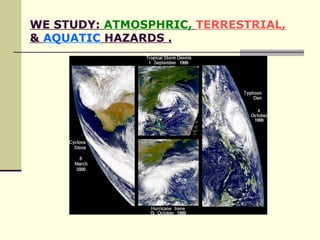
WE STUDY:  ATMOSPHRIC,   TERRESTRIAL,  &  AQUATIC  HAZARDS .
As element or circumstance in the natural environment which has the potential to cause harm to person or property . Natural hazards may be extreme physical event such as  earthquakes  and  tornados  or they may involve less violent biological phenomena. Such events are the result or natural biophysical processes in the earth/ atmosphere system . They only become hazardous when human are involved. What’s Natural Hazard?
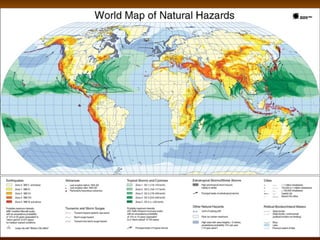
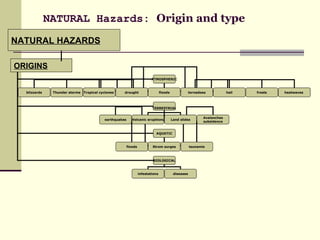
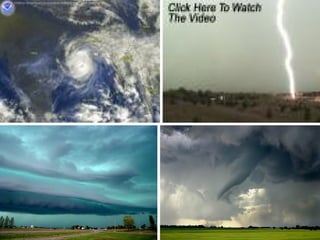
NATURAL Hazards:  Origin and type NATURAL HAZARDS ORIGINS ATMOSPHERIC TERRESTRIAL AQUATIC BIOLOGICAL blizzards Thunder storms Tropical cyclones drought floods tornadoes hail frosts heatwaves  earthquakes Volcanic eruptions Land slides Avalanches subsidence floods Strom surges tsunamis infestations diseases
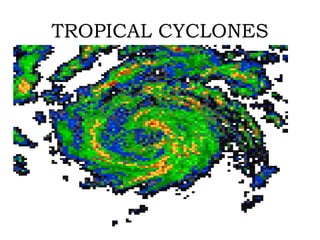
TROPICAL CYCLONES
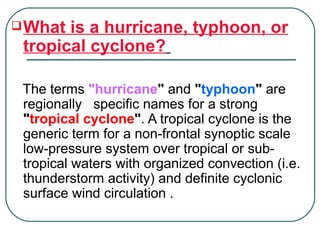
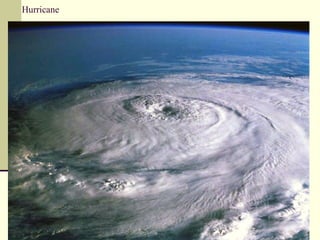
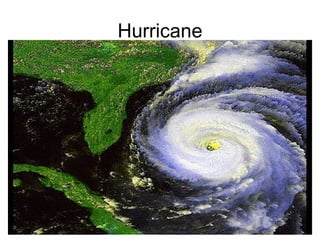
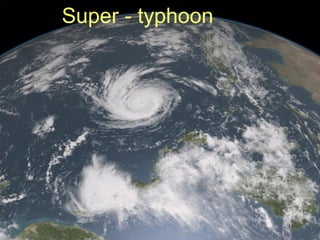
What is a hurricane, typhoon, or tropical cyclone?   The terms  "hurricane "  and  " typhoon "  are regionally  specific names for a strong  " tropical cyclone " . A tropical cyclone is the generic term for a non-frontal synoptic scale low-pressure system over tropical or sub-tropical waters with organized convection (i.e. thunderstorm activity) and definite cyclonic surface wind circulation .
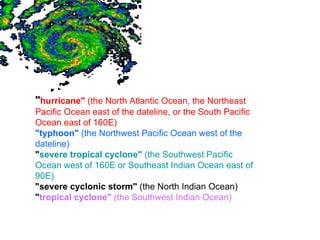
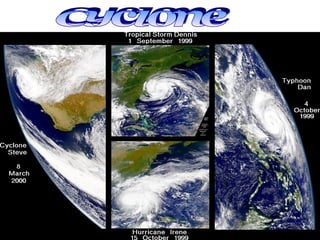
" hurricane"  (the North Atlantic Ocean, the Northeast Pacific Ocean east of the dateline, or the South Pacific Ocean east of 160E)  "typhoon"  (the Northwest Pacific Ocean west of the dateline)   " severe tropical cyclone"  (the Southwest Pacific Ocean west of 160E or Southeast Indian Ocean east of 90E)  "severe cyclonic storm"  (the North Indian Ocean)  " tropical cyclone"  (the Southwest Indian Ocean)
Hurricane
Cyclone
Hurricane
Super - typhoon
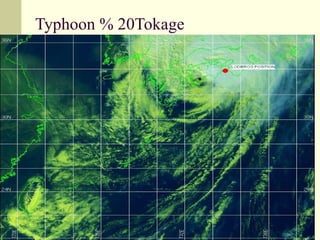
Typhoon % 20Tokage
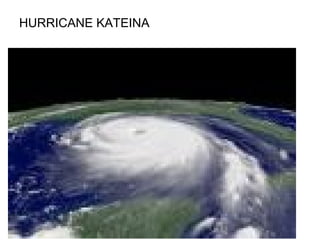
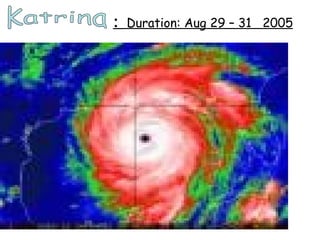
HURRICANE KATEINA
:  Duration: Aug 29 – 31  2005 Katrina
 
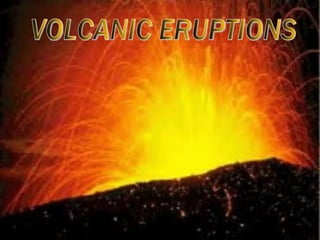
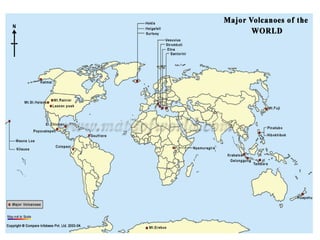
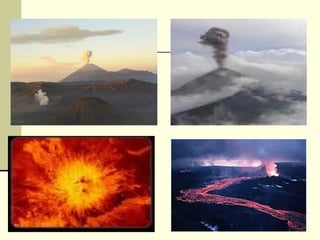
VOLCANIC ERUPTIONS
 
 
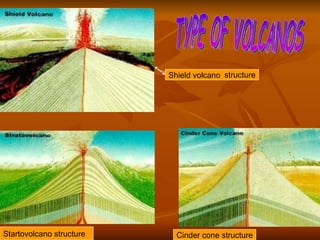
Shield volcano structure Startovolcano structure Cinder cone structure TYPE OF VOLCANOS
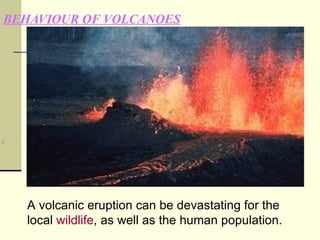
BEHAVIOUR   OF VOLCANOES                                                                             A volcanic eruption can be devastating for the local  wildlife , as well as the human population.
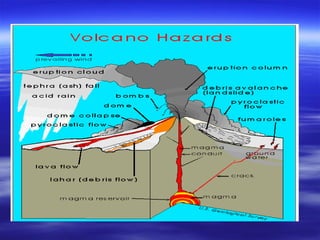
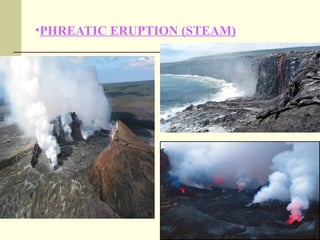
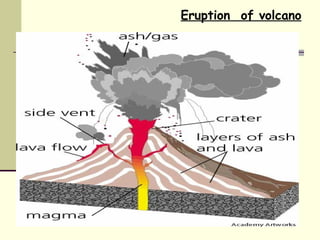
There are many different kinds of volcanic activity and eruptions: phreatic eruptions  (steam)  explosive eruption of high- silica   lava  (e.g.,  rhyolite )  effusive eruption of low-silica lava  ( e.g.,  basalt )   pyroclastic flows   lahars  (debris flow)  carbon dioxide  emission  All of these activities can pose a hazard to humans. Volcanic activity is often accompanied by  earthquakes ,  hot springs ,  fumaroles ,  mud pots  and  geysers . Low-magnitude earthquakes often precede eruptions.
 
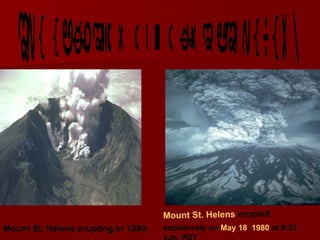
Mount St. Helens erupting in 1980   Mount St. Helens  erupted   explosively on  May 18 ,  1980  at 8:32 a.m. PDT   THE ERUPTION OFMOUNT ST. HELENA
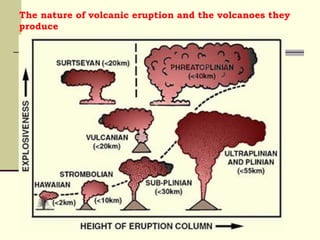
The nature of volcanic eruption and the volcanoes they produce
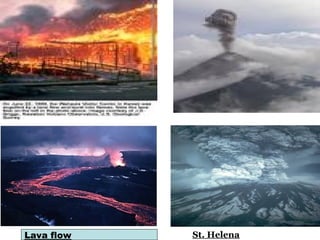
St. Helena Lava flow
PHREATIC ERUPTION (STEAM)
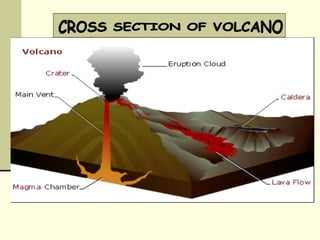
CROSS SECTION OF VOLCANO
Eruption  of volcano
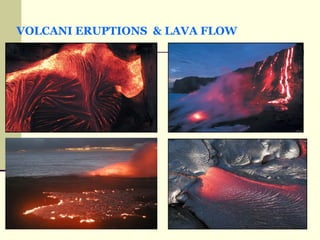
VOLCANI ERUPTIONS  & LAVA FLOW
 
 
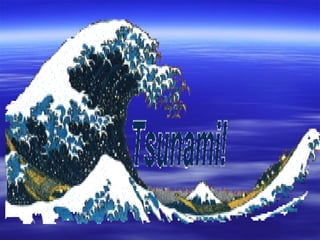
WHAT DOES TSUNAMI MEAN    Tsunami is a Japanese word with the English translation, "harbor   wave ."  Represented by two characters, the top character, "tsu," means harbor, while the bottom character, "nami," means "wave." In the past, tsunamis were sometimes referred to as "tidal waves" by the general public, and as "seismic sea waves" by the scientific   community .  The term "tidal wave" is a misnomer; although a tsunami's impact upon a coastline is dependent upon the tidal level at the time a tsunami strikes, tsunamis are unrelated to the tides.  Tides result from the imbalanced, extraterrestrial, gravitational influences of the moon, sun, and planets.  The term "seismic sea wave" is also misleading. "Seismic" implies an earthquake-related generation mechanism, but a tsunami can also be caused by a nonseismic event, such as a landslide or meteorite impact.
A tsunami (pronounced  tsoo-nah-mee ) is a wave train, or series of waves, generated in a body of water by an impulsive disturbance that vertically displaces the water column.   Earthquakes, landslides, volcanic eruptions, explosions, and even the impact of cosmic bodies, such as meteorites, can generate tsunamis.  Tsunamis can savagely attack coastlines, causing devastating property damage and loss of life.  What is a tsunami?
How do tsunamis differ from other water waves? Tsunamis are unlike wind-generated waves, which many of us may have observed on a local lake or at a coastal beach, in that they are characterized as shallow-water waves, with long periods and wave lengths . The wind-generated swell one sees at a California beach, for example, spawned by a storm out in the Pacific and rhythmically rolling in, one wave after another, might have a period of about 10 seconds and a wave length of 150 m.  A tsunami, on the other hand, can have a wavelength in excess of 100 km and period on the order of one hour.
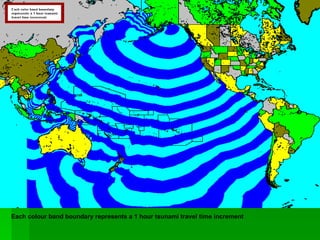
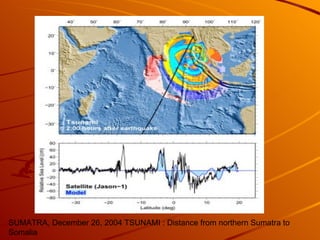
Each colour band boundary represents a 1 hour tsunami travel time increment
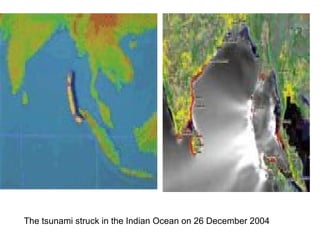
SUMATRA, December 26, 2004 TSUNAMI : Distance from northern Sumatra to Somalia
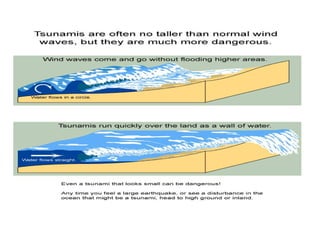
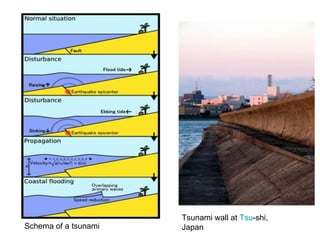
Sumatra  Feature:   Pictures and video from the 2004 tsunami highlighted the vast difference between tsunamis and wind generated waves . Because tsunamis have very long wavelengths they come ashore more like a long lasting flood wave rather than the breaking surf usually seen at the beach.  This diagram illustrates the difference between tsunamis and wind waves when they come ashore.   Next
 
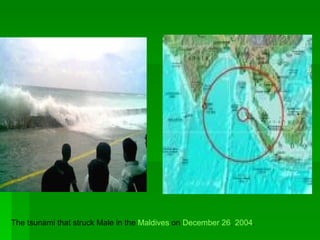
The tsunami that struck Male in the  Maldives  on  December 26 ,  2004 .
Schema of a tsunami  Tsunami wall at  Tsu -shi, Japan
The tsunami struck in the Indian Ocean on 26 December 2004
 
 
ASSESSMENT Using newspapers and recent magazines, make a list of any extreme geophysical events (Tropical Cyclones, Volcanic eruptions, Tsunamis ) reported. How would you explain such patterns ? Review your understand of the following terms: Hurricanes Tornadoes  Silica Lava Basalt
Presentation by  MISS. K.D.R.P.PERERA C/Ratnawali Balika, Colombo 08.
THANK YOU!
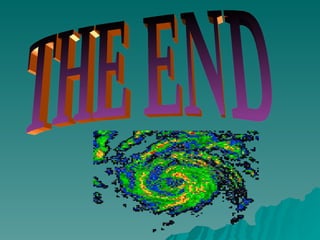
THE END

Geography / natural Hazards

  • 1.
  • 2.
    N A TU R A L H A Z A R D S
  • 3.
  • 4.
    WE STUDY: ATMOSPHRIC, TERRESTRIAL, & AQUATIC HAZARDS .
  • 5.
    As element orcircumstance in the natural environment which has the potential to cause harm to person or property . Natural hazards may be extreme physical event such as earthquakes and tornados or they may involve less violent biological phenomena. Such events are the result or natural biophysical processes in the earth/ atmosphere system . They only become hazardous when human are involved. What’s Natural Hazard?
  • 6.
    NATURAL Hazards: Origin and type NATURAL HAZARDS ORIGINS ATMOSPHERIC TERRESTRIAL AQUATIC BIOLOGICAL blizzards Thunder storms Tropical cyclones drought floods tornadoes hail frosts heatwaves earthquakes Volcanic eruptions Land slides Avalanches subsidence floods Strom surges tsunamis infestations diseases
  • 7.
  • 8.
    What is ahurricane, typhoon, or tropical cyclone? The terms "hurricane " and " typhoon " are regionally specific names for a strong " tropical cyclone " . A tropical cyclone is the generic term for a non-frontal synoptic scale low-pressure system over tropical or sub-tropical waters with organized convection (i.e. thunderstorm activity) and definite cyclonic surface wind circulation .
  • 9.
    " hurricane" (the North Atlantic Ocean, the Northeast Pacific Ocean east of the dateline, or the South Pacific Ocean east of 160E) "typhoon" (the Northwest Pacific Ocean west of the dateline) " severe tropical cyclone" (the Southwest Pacific Ocean west of 160E or Southeast Indian Ocean east of 90E) "severe cyclonic storm" (the North Indian Ocean) " tropical cyclone" (the Southwest Indian Ocean)
  • 10.
  • 11.
  • 12.
  • 13.
  • 14.
  • 15.
  • 16.
    : Duration:Aug 29 – 31 2005 Katrina
  • 17.
  • 18.
  • 19.
  • 20.
  • 21.
    Shield volcano structureStartovolcano structure Cinder cone structure TYPE OF VOLCANOS
  • 22.
    BEHAVIOUR OF VOLCANOES                                                                     A volcanic eruption can be devastating for the local wildlife , as well as the human population.
  • 23.
    There are manydifferent kinds of volcanic activity and eruptions: phreatic eruptions (steam) explosive eruption of high- silica lava (e.g., rhyolite ) effusive eruption of low-silica lava ( e.g., basalt ) pyroclastic flows lahars (debris flow) carbon dioxide emission All of these activities can pose a hazard to humans. Volcanic activity is often accompanied by earthquakes , hot springs , fumaroles , mud pots and geysers . Low-magnitude earthquakes often precede eruptions.
  • 24.
  • 25.
    Mount St. Helenserupting in 1980 Mount St. Helens erupted explosively on May 18 , 1980 at 8:32 a.m. PDT THE ERUPTION OFMOUNT ST. HELENA
  • 26.
    The nature ofvolcanic eruption and the volcanoes they produce
  • 27.
  • 28.
  • 29.
  • 30.
    Eruption ofvolcano
  • 31.
    VOLCANI ERUPTIONS & LAVA FLOW
  • 32.
  • 33.
  • 34.
    WHAT DOES TSUNAMIMEAN   Tsunami is a Japanese word with the English translation, "harbor wave ." Represented by two characters, the top character, "tsu," means harbor, while the bottom character, "nami," means "wave." In the past, tsunamis were sometimes referred to as "tidal waves" by the general public, and as "seismic sea waves" by the scientific community . The term "tidal wave" is a misnomer; although a tsunami's impact upon a coastline is dependent upon the tidal level at the time a tsunami strikes, tsunamis are unrelated to the tides. Tides result from the imbalanced, extraterrestrial, gravitational influences of the moon, sun, and planets. The term "seismic sea wave" is also misleading. "Seismic" implies an earthquake-related generation mechanism, but a tsunami can also be caused by a nonseismic event, such as a landslide or meteorite impact.
  • 35.
    A tsunami (pronounced tsoo-nah-mee ) is a wave train, or series of waves, generated in a body of water by an impulsive disturbance that vertically displaces the water column. Earthquakes, landslides, volcanic eruptions, explosions, and even the impact of cosmic bodies, such as meteorites, can generate tsunamis. Tsunamis can savagely attack coastlines, causing devastating property damage and loss of life. What is a tsunami?
  • 36.
    How do tsunamisdiffer from other water waves? Tsunamis are unlike wind-generated waves, which many of us may have observed on a local lake or at a coastal beach, in that they are characterized as shallow-water waves, with long periods and wave lengths . The wind-generated swell one sees at a California beach, for example, spawned by a storm out in the Pacific and rhythmically rolling in, one wave after another, might have a period of about 10 seconds and a wave length of 150 m. A tsunami, on the other hand, can have a wavelength in excess of 100 km and period on the order of one hour.
  • 37.
    Each colour bandboundary represents a 1 hour tsunami travel time increment
  • 38.
    SUMATRA, December 26,2004 TSUNAMI : Distance from northern Sumatra to Somalia
  • 39.
    Sumatra Feature: Pictures and video from the 2004 tsunami highlighted the vast difference between tsunamis and wind generated waves . Because tsunamis have very long wavelengths they come ashore more like a long lasting flood wave rather than the breaking surf usually seen at the beach. This diagram illustrates the difference between tsunamis and wind waves when they come ashore. Next
  • 40.
  • 41.
    The tsunami thatstruck Male in the Maldives on December 26 , 2004 .
  • 42.
    Schema of atsunami Tsunami wall at Tsu -shi, Japan
  • 43.
    The tsunami struckin the Indian Ocean on 26 December 2004
  • 44.
  • 45.
  • 46.
    ASSESSMENT Using newspapersand recent magazines, make a list of any extreme geophysical events (Tropical Cyclones, Volcanic eruptions, Tsunamis ) reported. How would you explain such patterns ? Review your understand of the following terms: Hurricanes Tornadoes Silica Lava Basalt
  • 47.
    Presentation by MISS. K.D.R.P.PERERA C/Ratnawali Balika, Colombo 08.
  • 48.
  • 49.