Done by-suhaib
 What is a “Geohazard”?
• Earth processes (involving the lithosphere, hydrosphere
& atmosphere) that, upon interaction with human activity,
cause loss of life and property
It is important to understand the human element
 without it, there would be no hazard
 because of it, the science of geohazards becomes
more important every year
 mitigation: reduction/prevention
 The Earth’s population is increasing
 more people living in hazard-prone areas
 populations are becoming hyper-concentrated
 consumption of resources
 examples:
 today there are 6 billion people on Earth ( ~ 50% live in
cities)
 by 2025, there will be ~8 billion people (~ 66% in cities)
 of these cities, 40% are coastal
 prone to severe storm and tsunami damage
 and a large majority lie in areas subject to other
geohazards (for example volcanoes and earthquakes)
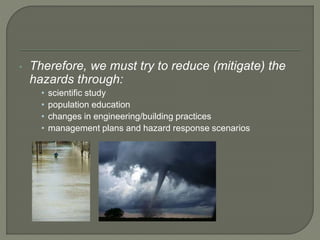
• Therefore, we must try to reduce (mitigate) the
hazards through:
• scientific study
• population education
• changes in engineering/building practices
• management plans and hazard response scenarios
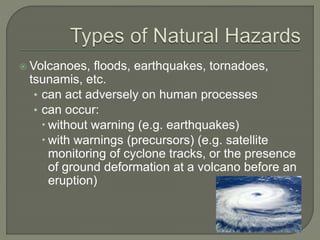
 Volcanoes, floods, earthquakes, tornadoes,
tsunamis, etc.
• can act adversely on human processes
• can occur:
 without warning (e.g. earthquakes)
 with warnings (precursors) (e.g. satellite
monitoring of cyclone tracks, or the presence
of ground deformation at a volcano before an
eruption)
 To help mitigate the hazard we need to know:
 Frequency vs. Magnitude
• F: how often a given event occurs in a certain region
• M: how powerful (amount of energy released) an event
is
 for example, high M hazards happen with low F, but
are much more destructive
 Scope
• S: area affected by a given hazard
 local: landslides, floods, earthquakes, fire …
 regional: tsunamis, volcanoes, larger earthquakes,
cyclones …
 global: large volcanoes, global warming, meteorite
impacts …
 Monitoring
• process is very technology-intensive
 high costs for many poorer countries
• often no technology available to monitor local
tsunamis
 for example,
 Papua New Guinea has no monitoring stations
 reliant on the Pacific Tsunami Warning Center
 tsunami in 1998 was not detected
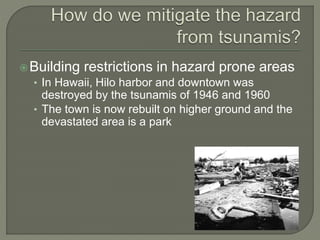
Building restrictions in hazard prone areas
• In Hawaii, Hilo harbor and downtown was
destroyed by the tsunamis of 1946 and 1960
• The town is now rebuilt on higher ground and the
devastated area is a park
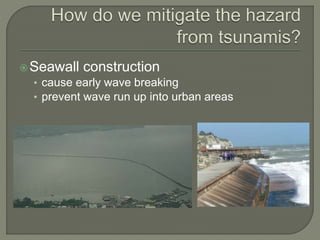
Seawall construction
• cause early wave breaking
• prevent wave run up into urban areas
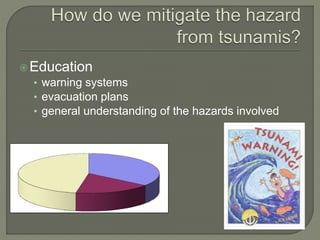
Education
• warning systems
• evacuation plans
• general understanding of the hazards involved
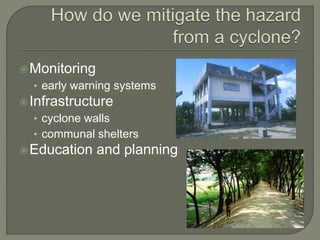
Monitoring
• early warning systems
Infrastructure
• cyclone walls
• communal shelters
Education and planning
Thanks for watching

Specific hazards and mitigation

  • 1.
  • 2.
     What isa “Geohazard”? • Earth processes (involving the lithosphere, hydrosphere & atmosphere) that, upon interaction with human activity, cause loss of life and property It is important to understand the human element  without it, there would be no hazard  because of it, the science of geohazards becomes more important every year  mitigation: reduction/prevention
  • 3.
     The Earth’spopulation is increasing  more people living in hazard-prone areas  populations are becoming hyper-concentrated  consumption of resources  examples:  today there are 6 billion people on Earth ( ~ 50% live in cities)  by 2025, there will be ~8 billion people (~ 66% in cities)  of these cities, 40% are coastal  prone to severe storm and tsunami damage  and a large majority lie in areas subject to other geohazards (for example volcanoes and earthquakes)
  • 4.
    • Therefore, wemust try to reduce (mitigate) the hazards through: • scientific study • population education • changes in engineering/building practices • management plans and hazard response scenarios
  • 5.
     Volcanoes, floods,earthquakes, tornadoes, tsunamis, etc. • can act adversely on human processes • can occur:  without warning (e.g. earthquakes)  with warnings (precursors) (e.g. satellite monitoring of cyclone tracks, or the presence of ground deformation at a volcano before an eruption)
  • 6.
     To helpmitigate the hazard we need to know:  Frequency vs. Magnitude • F: how often a given event occurs in a certain region • M: how powerful (amount of energy released) an event is  for example, high M hazards happen with low F, but are much more destructive  Scope • S: area affected by a given hazard  local: landslides, floods, earthquakes, fire …  regional: tsunamis, volcanoes, larger earthquakes, cyclones …  global: large volcanoes, global warming, meteorite impacts …
  • 7.
     Monitoring • processis very technology-intensive  high costs for many poorer countries • often no technology available to monitor local tsunamis  for example,  Papua New Guinea has no monitoring stations  reliant on the Pacific Tsunami Warning Center  tsunami in 1998 was not detected
  • 8.
    Building restrictions inhazard prone areas • In Hawaii, Hilo harbor and downtown was destroyed by the tsunamis of 1946 and 1960 • The town is now rebuilt on higher ground and the devastated area is a park
  • 9.
    Seawall construction • causeearly wave breaking • prevent wave run up into urban areas
  • 10.
    Education • warning systems •evacuation plans • general understanding of the hazards involved
  • 11.
    Monitoring • early warningsystems Infrastructure • cyclone walls • communal shelters Education and planning
  • 12.