Presented By-
S.Bhaktiswarupa
Msc (N) 1st Year
Sum Nursing College
 National Anti Malaria Programme
 National Filaria Control Programme
 Kala–azar Control Programme
 JE Control programme
 Dengue fever control programme
 Launched in India -1953
 ACTION- Indoor residual spray of DDT in endemic
areas.
 RESULT- 80% of reduction in Malaria cases.
 Launched in India -1958
 ACTION- Programme in various phases.
(Preparatory, Attack , Maintenance)
 RESULT- Early beginning successful very high, late set back.
 Modified plan of action (1977)
OBJECTIVE :
 Prevent death
 Reduce morbidity
 Maintain Industrial and Agricultural production.
OUTCOMES:
 Brought down then 2.18 million in 1984 and
remain stable in 2 million up to 1993.
Again number of death increased.
 Government of India adopted in 1994
OBJECTIVES:
 Management of critical complicated cases of
Malaria.
 Check death in high risk groups.
 Reduce morbidity rate.
 Checking malaria endemic.
 Limiting cases of drug resistance.
WORK POLICY:
 Finding and treating.
 Controlling of parasite.
 Indentifying primary areas.
 Launched in 1971
OBJECTIVES:
 Adopting recurrent antilarval measure in
urban areas.
 Indentifying malaria cases with help of
available system and health workers.
 Controlling malaria through treatment.
 Launched in 1997
COMPONENTS:
 Early diagnosis and prompt treatment.
 Selective vector control and indivisual
protection.
 Information, Education, Communication.
 Developing capacity against infection.
 Epidemic planning and rapid response
 In 2010, India is on 18th position in total
reported cases in the world and 21st position in
total world death of Malaria.
 85% cases from Odisha, Rajasthan, Chhattisgarh,
Madhya pradesh, Tripura, Andhra pradesh,
Gujurat, Maharastra, West Bengal, Assam.
 Launched in 1955
MEASURES:
 Assessing the extend of problem of filaria.
 Treating and Diagnosed cases with DEC.
 Continuing the disease control through
antilarval and anti parasitic programme in
urban areas.
 Launched in 1990-91
Goals:
 To eradicate 2010;
Actions:
 Reduce number of vector and the transmission
by sprinkling of chemical twice /year.
 Primary diagnosis and treatment.
 Providing health education for protection
against disease.
JE
o Started1958
o ACTION
Treatment
Finding
Monitoring
Implementation
In 2005
23 affected
5 deaths reported
DENGUE
 1996 1st case detected
 It has reduced upto ,0.4%
in 2011.
 ACTION
Identifying
Vector control
Case management
IEC
 In year 1990 ARD control programme had
launched
 During 1992-93 it is implemented as a part of
CSSM prog.
OBJECTIVES
 To reduce mortality in children due to ARD
STRATERGIES
 To ensure standard care management
 To trained peripheral health staff
 To promote timely referral
 To improve maternal knowledge
 To promote immunisation
 Started in 1962
OBJECTIVES:
 Long term objective
 Short term objective
ORGANISATION:
 District TB centre on average 50 peripheral
health centre
 PHC, CHC, General Hospital
 Reviewed NTP and launched RNTCP on 1992.
Strategies:
 Achievement of at least 85% cure rate of infections
cases through short term Chemotherapy.
 Case findings through Sputum Microscopy.
 Strengthening health care centre.
 Ensure the supply of Antituberculosis medication .
 Being improvement of all NGO staffs and all
categories of health worker.
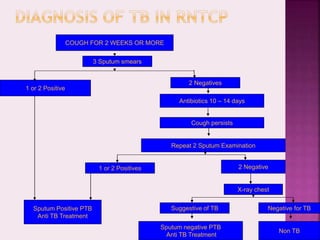
COUGH FOR 2 WEEKS OR MORE
3 Sputum smears
1 or 2 Positive
2 Negatives
Antibiotics 10 – 14 days
Cough persists
Repeat 2 Sputum Examination
1 or 2 Positives 2 Negative
X-ray chest
Suggestive of TB Negative for TB
Sputum negative PTB
Anti TB Treatment
Non TB
Sputum Positive PTB
Anti TB Treatment
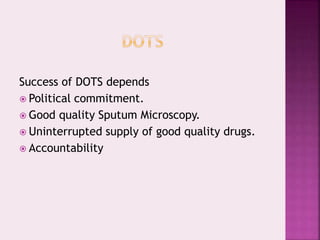
Success of DOTS depends
 Political commitment.
 Good quality Sputum Microscopy.
 Uninterrupted supply of good quality drugs.
 Accountability
 India is 2nd largest country in world in terms
coverage of DOTS.
 By October 2004, 83% of population covered
under RNTCP.
 About 9000 lab established.
 More than 85% success rate till 2006.
 Death reduced from 24% - 4%.
OBJECTIVE:
 To remove leprosy from the country.
In 2002; India has 5/10,000 population Leprosy ratio.
OBJECTIVE:
 To treat Leprosy at home by DAPSONE
MONOTHERAPY
In 2007 onwards;
OBJECTIVE:
 Early detection cases
 Treating with MDT
 Home visit
 Providing service by health worker.
 Solving problem of ugliness and
Rehabilitation.
 Between 2010-2011 -> 1,26,800 fresh cases
of Leprosy around 4000 among them
disabilities.
 Launched in 1987;
OBJECTIVES:
 Reducing the Morbidity and Mortality of AIDS.
 Minimizing the HIV infection.
ACTIVITIES:
 Strengthening the Management Potentials
 Rectifying IEC System
 Control of STD
 Safe Blood
 Monitoring
 Strengthening the diagnosis, Management, Capability.
 Launched in India 1978.
OBJECTIVE:
 Reducing the Morbidity and Mortality resulting from
six vaccine preventable disease of childhood.
 To achieve self sufficiency in vaccine.
 Launched in 1985.
 100% vaccination of children and pregnant women.
ACHIEVEMENT:
 By 2009 coverage level 90% in TT, 88% BCG, 80% DPT,
78.2% OPV
OBJECTIVE:
 To build capacity at district and state level.
ACTIVITIES:
 Training of Paramedical and Medical staffs.
 Publicity of technical information and
direction.
 Setting up a development Lab.
 Encouraging Participation of community.
 Modernization of Communication.
 Started in1975;
OBJECTIVES:
 Primary Prevention
 Secondary Prevention
 Tertiary Prevention
SCHEMES (2004-05):
 Regional cancer centre scheme.
 Oncology wing development scheme.
 District cancer control programme.
 IEC at central level.
 Started in (1985-90) 7th five year plan.
OBJECTIVES:
 Identifying high risk group at early stage.
 Early diagnosis and management.
 Prevention and complication management.
 Rehabilitation.
 Launched in 7th (Five Year plan)
OBJECTIVES:
 Mental health care service for all.
 Identify high risk group in communities.
 Started in 1976
ACTIVITIES:
 Establishing Regional institute of Ophthalmology.
 Improving level of Ophthalmic Services.
 Development of Mobile Ophthalmic Units.
 Training and appointing Ophthalmic personnel.
 Vision 2020: RIGHT TO SIGHT
 School Level Programme:
 ICDS
 MIDDAY MEAL PROGRAMME
 SPECIAL NUTRITION PROGRAMME
 NATIONAL NUTRITIONAL ANAEMIA
PROPHYLAXIS PROGRAMMME
 NATIONAL IODINE DEFICIENCY DISORDER
CONTROL PROGRAMME
o To improve the nutrition and health status of
children 0-6 yrs.
o To lay out the foundation between all aspect
of the child
o To reduce mortality morbidity and school
drop out, of the children
o To enhance the capability of mother to
provide the child nutritional need
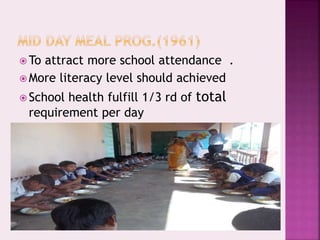
 To attract more school attendance .
 More literacy level should achieved
 School health fulfill 1/3 rd of total
requirement per day
 To improve the nutritional status of a target
group , For children below 6 yrs ,pregnant
woman,nursing mother.
 Provides 300Kcalorie,10-12 gm of protien per
child per day
 Mother get 500 kcalorie and 25 gms of
protien
 Launched in 1962 as national goitre control
programme
GOALS
 Surveying deficiency
 Distribution
 Evaluation of iodine salt.
 Health education
 Lab monitoring of iodine
2011 Strategies: of malaria
 Accessible cost diagnosis services.
 Treatment in identified high risk groups.
 Newer diagnostic techniques like Rapid
Diagnostic Test.
 Long lasting insecticidal nets to improve
quality must provide.
 In 2011, the success rate was > 87% Quality
Sputum smear exam is available .
 12th five year plan (2012-2017) = TB FREE
INDIA
OPEN DISCUSSION
national health programmes
national health programmes
  • 2.
    Presented By- S.Bhaktiswarupa Msc (N)1st Year Sum Nursing College
  • 4.
     National AntiMalaria Programme  National Filaria Control Programme  Kala–azar Control Programme  JE Control programme  Dengue fever control programme
  • 5.
     Launched inIndia -1953  ACTION- Indoor residual spray of DDT in endemic areas.  RESULT- 80% of reduction in Malaria cases.  Launched in India -1958  ACTION- Programme in various phases. (Preparatory, Attack , Maintenance)  RESULT- Early beginning successful very high, late set back.
  • 6.
     Modified planof action (1977) OBJECTIVE :  Prevent death  Reduce morbidity  Maintain Industrial and Agricultural production. OUTCOMES:  Brought down then 2.18 million in 1984 and remain stable in 2 million up to 1993. Again number of death increased.
  • 7.
     Government ofIndia adopted in 1994 OBJECTIVES:  Management of critical complicated cases of Malaria.  Check death in high risk groups.  Reduce morbidity rate.  Checking malaria endemic.  Limiting cases of drug resistance. WORK POLICY:  Finding and treating.  Controlling of parasite.  Indentifying primary areas.
  • 8.
     Launched in1971 OBJECTIVES:  Adopting recurrent antilarval measure in urban areas.  Indentifying malaria cases with help of available system and health workers.  Controlling malaria through treatment.
  • 9.
     Launched in1997 COMPONENTS:  Early diagnosis and prompt treatment.  Selective vector control and indivisual protection.  Information, Education, Communication.  Developing capacity against infection.  Epidemic planning and rapid response
  • 10.
     In 2010,India is on 18th position in total reported cases in the world and 21st position in total world death of Malaria.  85% cases from Odisha, Rajasthan, Chhattisgarh, Madhya pradesh, Tripura, Andhra pradesh, Gujurat, Maharastra, West Bengal, Assam.
  • 11.
     Launched in1955 MEASURES:  Assessing the extend of problem of filaria.  Treating and Diagnosed cases with DEC.  Continuing the disease control through antilarval and anti parasitic programme in urban areas.
  • 12.
     Launched in1990-91 Goals:  To eradicate 2010; Actions:  Reduce number of vector and the transmission by sprinkling of chemical twice /year.  Primary diagnosis and treatment.  Providing health education for protection against disease.
  • 13.
    JE o Started1958 o ACTION Treatment Finding Monitoring Implementation In2005 23 affected 5 deaths reported DENGUE  1996 1st case detected  It has reduced upto ,0.4% in 2011.  ACTION Identifying Vector control Case management IEC
  • 14.
     In year1990 ARD control programme had launched  During 1992-93 it is implemented as a part of CSSM prog. OBJECTIVES  To reduce mortality in children due to ARD STRATERGIES  To ensure standard care management  To trained peripheral health staff  To promote timely referral  To improve maternal knowledge  To promote immunisation
  • 16.
     Started in1962 OBJECTIVES:  Long term objective  Short term objective ORGANISATION:  District TB centre on average 50 peripheral health centre  PHC, CHC, General Hospital
  • 17.
     Reviewed NTPand launched RNTCP on 1992. Strategies:  Achievement of at least 85% cure rate of infections cases through short term Chemotherapy.  Case findings through Sputum Microscopy.  Strengthening health care centre.  Ensure the supply of Antituberculosis medication .  Being improvement of all NGO staffs and all categories of health worker.
  • 18.
    COUGH FOR 2WEEKS OR MORE 3 Sputum smears 1 or 2 Positive 2 Negatives Antibiotics 10 – 14 days Cough persists Repeat 2 Sputum Examination 1 or 2 Positives 2 Negative X-ray chest Suggestive of TB Negative for TB Sputum negative PTB Anti TB Treatment Non TB Sputum Positive PTB Anti TB Treatment
  • 19.
    Success of DOTSdepends  Political commitment.  Good quality Sputum Microscopy.  Uninterrupted supply of good quality drugs.  Accountability
  • 20.
     India is2nd largest country in world in terms coverage of DOTS.  By October 2004, 83% of population covered under RNTCP.  About 9000 lab established.  More than 85% success rate till 2006.  Death reduced from 24% - 4%.
  • 22.
    OBJECTIVE:  To removeleprosy from the country. In 2002; India has 5/10,000 population Leprosy ratio. OBJECTIVE:  To treat Leprosy at home by DAPSONE MONOTHERAPY In 2007 onwards; OBJECTIVE:  Early detection cases  Treating with MDT
  • 23.
     Home visit Providing service by health worker.  Solving problem of ugliness and Rehabilitation.  Between 2010-2011 -> 1,26,800 fresh cases of Leprosy around 4000 among them disabilities.
  • 24.
     Launched in1987; OBJECTIVES:  Reducing the Morbidity and Mortality of AIDS.  Minimizing the HIV infection. ACTIVITIES:  Strengthening the Management Potentials  Rectifying IEC System  Control of STD  Safe Blood  Monitoring  Strengthening the diagnosis, Management, Capability.
  • 25.
     Launched inIndia 1978. OBJECTIVE:  Reducing the Morbidity and Mortality resulting from six vaccine preventable disease of childhood.  To achieve self sufficiency in vaccine.  Launched in 1985.  100% vaccination of children and pregnant women. ACHIEVEMENT:  By 2009 coverage level 90% in TT, 88% BCG, 80% DPT, 78.2% OPV
  • 27.
    OBJECTIVE:  To buildcapacity at district and state level. ACTIVITIES:  Training of Paramedical and Medical staffs.  Publicity of technical information and direction.  Setting up a development Lab.  Encouraging Participation of community.  Modernization of Communication.
  • 29.
     Started in1975; OBJECTIVES: Primary Prevention  Secondary Prevention  Tertiary Prevention SCHEMES (2004-05):  Regional cancer centre scheme.  Oncology wing development scheme.  District cancer control programme.  IEC at central level.
  • 30.
     Started in(1985-90) 7th five year plan. OBJECTIVES:  Identifying high risk group at early stage.  Early diagnosis and management.  Prevention and complication management.  Rehabilitation.
  • 32.
     Launched in7th (Five Year plan) OBJECTIVES:  Mental health care service for all.  Identify high risk group in communities.
  • 33.
     Started in1976 ACTIVITIES:  Establishing Regional institute of Ophthalmology.  Improving level of Ophthalmic Services.  Development of Mobile Ophthalmic Units.  Training and appointing Ophthalmic personnel.  Vision 2020: RIGHT TO SIGHT  School Level Programme:
  • 34.
     ICDS  MIDDAYMEAL PROGRAMME  SPECIAL NUTRITION PROGRAMME  NATIONAL NUTRITIONAL ANAEMIA PROPHYLAXIS PROGRAMMME  NATIONAL IODINE DEFICIENCY DISORDER CONTROL PROGRAMME
  • 35.
    o To improvethe nutrition and health status of children 0-6 yrs. o To lay out the foundation between all aspect of the child o To reduce mortality morbidity and school drop out, of the children o To enhance the capability of mother to provide the child nutritional need
  • 36.
     To attractmore school attendance .  More literacy level should achieved  School health fulfill 1/3 rd of total requirement per day
  • 37.
     To improvethe nutritional status of a target group , For children below 6 yrs ,pregnant woman,nursing mother.  Provides 300Kcalorie,10-12 gm of protien per child per day  Mother get 500 kcalorie and 25 gms of protien
  • 38.
     Launched in1962 as national goitre control programme GOALS  Surveying deficiency  Distribution  Evaluation of iodine salt.  Health education  Lab monitoring of iodine
  • 39.
    2011 Strategies: ofmalaria  Accessible cost diagnosis services.  Treatment in identified high risk groups.  Newer diagnostic techniques like Rapid Diagnostic Test.  Long lasting insecticidal nets to improve quality must provide.
  • 40.
     In 2011,the success rate was > 87% Quality Sputum smear exam is available .  12th five year plan (2012-2017) = TB FREE INDIA
  • 41.