National Health Programme
Prepared by :-
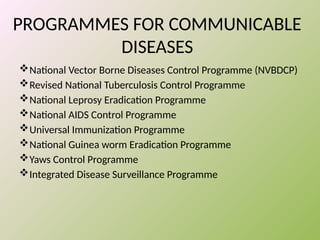
PROGRAMMES FOR COMMUNICABLE
DISEASES
National Vector Borne Diseases Control Programme (NVBDCP)
Revised National Tuberculosis Control Programme
National Leprosy Eradication Programme
National AIDS Control Programme
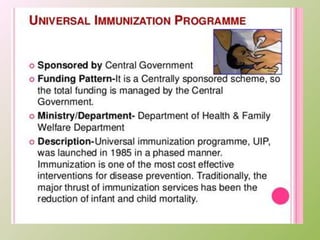
Universal Immunization Programme
National Guinea worm Eradication Programme
Yaws Control Programme
Integrated Disease Surveillance Programme
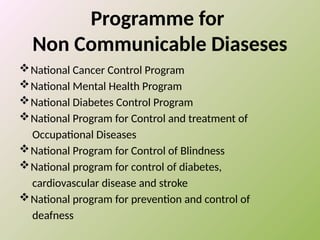
Programme for
Non Communicable Diaseses
National Cancer Control Program
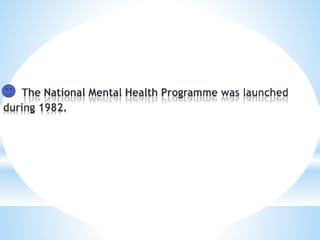
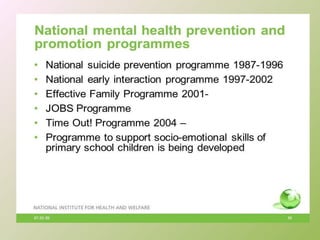
National Mental Health Program
National Diabetes Control Program
National Program for Control and treatment of
Occupational Diseases
National Program for Control of Blindness
National program for control of diabetes,
cardiovascular disease and stroke
National program for prevention and control of
deafness
National Nutritional
Programme.
Integrated Child Development Services Scheme
 Midday Meal Programme
 Special Nutrition Programme (SNP)
 National Nutritional Anemia Prophylaxis
Programme
 National Iodine Deficiency Disorders Control
Programme
 Balvadi nutrition programme.
Programs related to System
Strengthening/Welfare
 National Reproductive and Child Health
Programme
 Rural Health Mission
 National Water supply & Sanitation Programme
 20 Points Programme
NATIONAL VECTOR
BORNE DISEASE
CONTROL
PROGRAMME
National Malaria Control
Programme
This Programme lunched in 1953
 During the first five year plan [1951-1955].
 This programme started with the help of international
organization.
 The good results of this programme encouraged
Government of India to adopt malaria eradication
programme.
ↆ Strategic Action Plan For Malaria
Control in India [2007-2012]:-
 Malaria control is now incorporated into the health service
delivery programmes under the umbrella of NRHM.
 All available methods and means are begins used to deliver
these interventions at entry-level facilities.
 Malaria Action Plan (MAP)
 An expert committee formed by Government of India in
1994.
Enhanced Malaria Control Project:-
 Launched in 1997 with the financial support of world bank.
 Intensified Malaria Control Project-IMCP:-
 IMCP is a 5 year scheme starting from July 05, to June 2010.
 Urban Malaria Scheme:-
 Launched in 1971.
NATIONAL FILARIA CONTROLL
PROGRAMME
NFCP was launched in 1955.
The target year for Global elimination of Filaria
is by the year 2020.
In India, the National Health Policy [2002]
envisages elimination of Filaria by 2015.
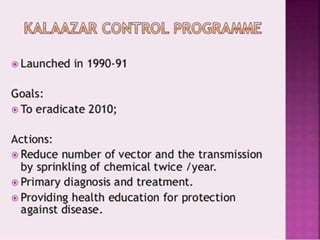
KALAZAR CONTROLL
PROGRAMME
lAUNCHED IN 1990
GOALS:-
To Eradicate 2010
Actions:-
JAPANESE ENCAPHLITIES CONTROLL
PROGRAMME
• This disease is caused by a small virus, which is spread by
mosquitoes.
• Death rate is very high in this disease, and the survivors have
to fight many neurological complication.
 Strategy to control JE:-
• Early Diagnosis and complete treatment [ EDCT].
• Integrated vector control including personal protection.
• Capacity building
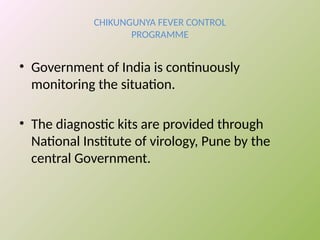
CHIKUNGUNYA FEVER CONTROL
PROGRAMME
• Government of India is continuously
monitoring the situation.
• The diagnostic kits are provided through
National Institute of virology, Pune by the
central Government.
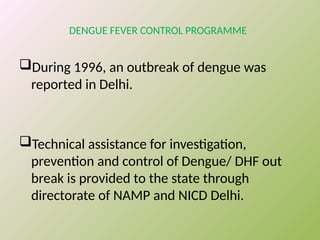
DENGUE FEVER CONTROL PROGRAMME
During 1996, an outbreak of dengue was
reported in Delhi.
Technical assistance for investigation,
prevention and control of Dengue/ DHF out
break is provided to the state through
directorate of NAMP and NICD Delhi.
The National Leprosy Control Programme has been
in operation since 1955, as a centrally aided
programme.
The programme gained momentum during
the fourth five year plan after it was made a
centrally- sponsored programme.
 In 1983 the government of India declared its
resolve to “eradicate” Leprosy by the year 2000 and
constituted a working group to advise accordingly.
 Modified Leprosy Elimination Camping
[MLEC]
A mid term appraisal of the programme in April 1997
Indicated that while the progress of the programme is
satisfactory at national level.
The first round was conducted during 1997-1998.
Special action project for Elimination of Leprosy
During the year 2004-2005 and 2005-2006 focus of
attention under National Leprosy Eradication
Programme was shifted from endemic states to high
priority districts.
Activities under NLEP:-
ↆ Diagnosis and treatment of leprosy:
ↆ Service's for diagnosis and treatment are provided
by all primary health centres and Government
dispensaries throughout the country free of cost.
ↆ ASHA under NRHM are begin involved to bring out
leprosy cases from villages for diagnosis at PHC
and follow- up of confirmed cases for treatment
completion.
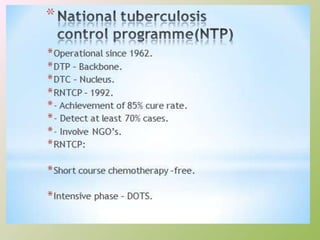
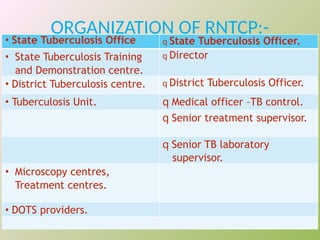
ORGANIZATION OF RNTCP:-
• State Tuberculosis Office q State Tuberculosis Officer.
• State Tuberculosis Training
and Demonstration centre.
q Director
• District Tuberculosis centre. q District Tuberculosis Officer.
• Tuberculosis Unit. q Medical officer –TB control.
q Senior treatment supervisor.
q Senior TB laboratory
supervisor.
• Microscopy centres,
Treatment centres.
• DOTS providers.
National AIDS Control Programme was
launched in India in the year 1987.
 The Ministry of Health & Family welfare has set
up National AIDS Control Organization as a
separate wing to implement and closely monitor
the various component of the Programme.
NACP-1[1992-1999]
NACP-2[1999-2006]
NACP-3[2007-2012]
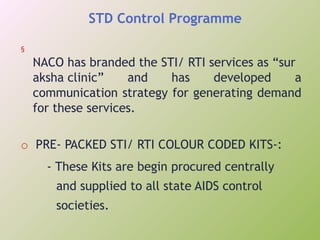
STD Control Programme
§
NACO has branded the STI/ RTI services as “sur
aksha clinic” and has developed a
communication strategy for generating demand
for these services.
o PRE- PACKED STI/ RTI COLOUR CODED KITS-:
- These Kits are begin procured centrally
and supplied to all state AIDS control
societies.
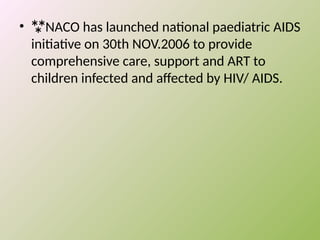
• NACO has launched national paediatric AIDS
initiative on 30th NOV.2006 to provide
comprehensive care, support and ART to
children infected and affected by HIV/ AIDS.
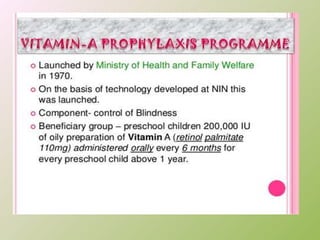
 NATIONAL PROGRAMME FOR
PREVENTION OF BLINDNESS:
The Government of India launched

a mass programme for the prevention
of blindness in November 1976.
 Under this programme children
between 1-5 years are begin given an
oral dose of 2 lakh IU of vitamin A
once in 6 months.
• OBJECTIVES:-
• To reduce the backlog of blindness through
identification and treatment of blind.
• To develop eye care facilities in every district.
• To develop human resources for providing eye
care services.
• To improve quality of service delivery.
• To secure participation of voluntary
organizations in eye care.
• To enhance community awareness on eye care.
NATIONAL PEDIATRIC AIDS
INITIATIVES
• NACO has launched national paediatric AIDS
initiative on 30th NOV.2006 to provide
comprehensive care, support and ART to
children infected and affected by HIV/ AIDS.
NATIONAL PROGRAMME FOR PREVIENTION
OF BLINDNESS
• The Government of India launched a mass
programme for the prevention of blindness in
November 1976.
• Under this programme children between
1-5 years are begin given an oral dose of 2
lakh IU of vitamin A once in 6 months.
OBJECTIVES -
• To reduce the backlog of blindness through
identification and treatment of blind.
• To develop eye care facilities in every district.
• To develop human resources for providing eye
care services.
• To improve quality of service delivery.
• To secure participation of voluntary
organizations in eye care.
• To enhance community awareness on eye care.
REPRODUCTIVE
CHILDHEALTH
PROGRAMME IN INDIA
THANK YOU

National Health Programme.PPPPPPPPPPpptx

  • 1.
  • 3.
    PROGRAMMES FOR COMMUNICABLE DISEASES NationalVector Borne Diseases Control Programme (NVBDCP) Revised National Tuberculosis Control Programme National Leprosy Eradication Programme National AIDS Control Programme Universal Immunization Programme National Guinea worm Eradication Programme Yaws Control Programme Integrated Disease Surveillance Programme
  • 4.
    Programme for Non CommunicableDiaseses National Cancer Control Program National Mental Health Program National Diabetes Control Program National Program for Control and treatment of Occupational Diseases National Program for Control of Blindness National program for control of diabetes, cardiovascular disease and stroke National program for prevention and control of deafness
  • 5.
    National Nutritional Programme. Integrated ChildDevelopment Services Scheme  Midday Meal Programme  Special Nutrition Programme (SNP)  National Nutritional Anemia Prophylaxis Programme  National Iodine Deficiency Disorders Control Programme  Balvadi nutrition programme.
  • 6.
    Programs related toSystem Strengthening/Welfare  National Reproductive and Child Health Programme  Rural Health Mission  National Water supply & Sanitation Programme  20 Points Programme
  • 7.
  • 8.
    National Malaria Control Programme ThisProgramme lunched in 1953  During the first five year plan [1951-1955].  This programme started with the help of international organization.  The good results of this programme encouraged Government of India to adopt malaria eradication programme.
  • 9.
    ↆ Strategic ActionPlan For Malaria Control in India [2007-2012]:-  Malaria control is now incorporated into the health service delivery programmes under the umbrella of NRHM.  All available methods and means are begins used to deliver these interventions at entry-level facilities.  Malaria Action Plan (MAP)  An expert committee formed by Government of India in 1994.
  • 10.
    Enhanced Malaria ControlProject:-  Launched in 1997 with the financial support of world bank.  Intensified Malaria Control Project-IMCP:-  IMCP is a 5 year scheme starting from July 05, to June 2010.  Urban Malaria Scheme:-  Launched in 1971.
  • 11.
    NATIONAL FILARIA CONTROLL PROGRAMME NFCPwas launched in 1955. The target year for Global elimination of Filaria is by the year 2020. In India, the National Health Policy [2002] envisages elimination of Filaria by 2015.
  • 12.
    KALAZAR CONTROLL PROGRAMME lAUNCHED IN1990 GOALS:- To Eradicate 2010 Actions:-
  • 13.
    JAPANESE ENCAPHLITIES CONTROLL PROGRAMME •This disease is caused by a small virus, which is spread by mosquitoes. • Death rate is very high in this disease, and the survivors have to fight many neurological complication.  Strategy to control JE:- • Early Diagnosis and complete treatment [ EDCT]. • Integrated vector control including personal protection. • Capacity building
  • 14.
    CHIKUNGUNYA FEVER CONTROL PROGRAMME •Government of India is continuously monitoring the situation. • The diagnostic kits are provided through National Institute of virology, Pune by the central Government.
  • 15.
    DENGUE FEVER CONTROLPROGRAMME During 1996, an outbreak of dengue was reported in Delhi. Technical assistance for investigation, prevention and control of Dengue/ DHF out break is provided to the state through directorate of NAMP and NICD Delhi.
  • 17.
    The National LeprosyControl Programme has been in operation since 1955, as a centrally aided programme. The programme gained momentum during the fourth five year plan after it was made a centrally- sponsored programme.  In 1983 the government of India declared its resolve to “eradicate” Leprosy by the year 2000 and constituted a working group to advise accordingly.
  • 18.
     Modified LeprosyElimination Camping [MLEC] A mid term appraisal of the programme in April 1997 Indicated that while the progress of the programme is satisfactory at national level. The first round was conducted during 1997-1998. Special action project for Elimination of Leprosy During the year 2004-2005 and 2005-2006 focus of attention under National Leprosy Eradication Programme was shifted from endemic states to high priority districts.
  • 19.
    Activities under NLEP:- ↆDiagnosis and treatment of leprosy: ↆ Service's for diagnosis and treatment are provided by all primary health centres and Government dispensaries throughout the country free of cost. ↆ ASHA under NRHM are begin involved to bring out leprosy cases from villages for diagnosis at PHC and follow- up of confirmed cases for treatment completion.
  • 22.
    ORGANIZATION OF RNTCP:- •State Tuberculosis Office q State Tuberculosis Officer. • State Tuberculosis Training and Demonstration centre. q Director • District Tuberculosis centre. q District Tuberculosis Officer. • Tuberculosis Unit. q Medical officer –TB control. q Senior treatment supervisor. q Senior TB laboratory supervisor. • Microscopy centres, Treatment centres. • DOTS providers.
  • 24.
    National AIDS ControlProgramme was launched in India in the year 1987.  The Ministry of Health & Family welfare has set up National AIDS Control Organization as a separate wing to implement and closely monitor the various component of the Programme. NACP-1[1992-1999] NACP-2[1999-2006] NACP-3[2007-2012]
  • 25.
    STD Control Programme § NACOhas branded the STI/ RTI services as “sur aksha clinic” and has developed a communication strategy for generating demand for these services. o PRE- PACKED STI/ RTI COLOUR CODED KITS-: - These Kits are begin procured centrally and supplied to all state AIDS control societies.
  • 26.
    • NACO haslaunched national paediatric AIDS initiative on 30th NOV.2006 to provide comprehensive care, support and ART to children infected and affected by HIV/ AIDS.
  • 27.
     NATIONAL PROGRAMMEFOR PREVENTION OF BLINDNESS: The Government of India launched  a mass programme for the prevention of blindness in November 1976.  Under this programme children between 1-5 years are begin given an oral dose of 2 lakh IU of vitamin A once in 6 months.
  • 28.
    • OBJECTIVES:- • Toreduce the backlog of blindness through identification and treatment of blind. • To develop eye care facilities in every district. • To develop human resources for providing eye care services. • To improve quality of service delivery. • To secure participation of voluntary organizations in eye care. • To enhance community awareness on eye care.
  • 30.
    NATIONAL PEDIATRIC AIDS INITIATIVES •NACO has launched national paediatric AIDS initiative on 30th NOV.2006 to provide comprehensive care, support and ART to children infected and affected by HIV/ AIDS.
  • 31.
    NATIONAL PROGRAMME FORPREVIENTION OF BLINDNESS • The Government of India launched a mass programme for the prevention of blindness in November 1976. • Under this programme children between 1-5 years are begin given an oral dose of 2 lakh IU of vitamin A once in 6 months.
  • 32.
    OBJECTIVES - • Toreduce the backlog of blindness through identification and treatment of blind. • To develop eye care facilities in every district. • To develop human resources for providing eye care services. • To improve quality of service delivery. • To secure participation of voluntary organizations in eye care. • To enhance community awareness on eye care.
  • 34.
  • 41.