

NATIONAL HEALTH PROGRAMS
OF INDIA
1
Dr. E Srikaanth Reddy
•Associate Professor in
Community Medicine
•Ex-National Medical Consultant
in N.T.EP, World Health
Organization , INDIA, posted at
Odisha 2019-2020
4
5
6
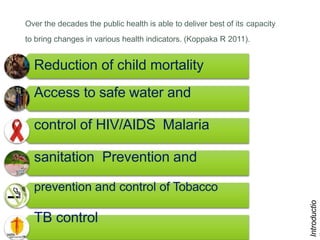
Over the decades the public health is able to deliver best of its capacity
to bring changes in various health indicators. (Koppaka R 2011).
Introductio
Reduction of child mortality
Access to safe water and
control of HIV/AIDS Malaria
sanitation Prevention and
prevention and control of Tobacco
TB control
7
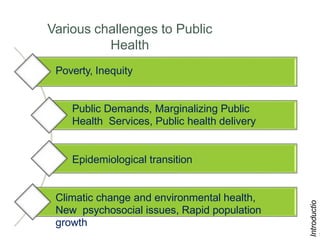
Poverty, Inequity
Public Demands, Marginalizing Public
Health Services, Public health delivery
Epidemiological transition
Climatic change and environmental health,
New psychosocial issues, Rapid population
growth
Various challenges to Public
Health
Introductio
8
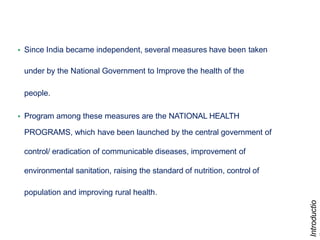
• Since India became independent, several measures have been taken
under by the National Government to Improve the health of the
people.
• Program among these measures are the NATIONAL HEALTH
PROGRAMS, which have been launched by the central government of
control/ eradication of communicable diseases, improvement of
environmental sanitation, raising the standard of nutrition, control of
population and improving rural health.
Introductio
9
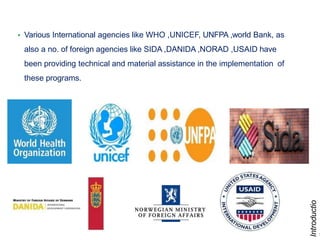
• Various International agencies like WHO ,UNICEF, UNFPA ,world Bank, as
also a no. of foreign agencies like SIDA ,DANIDA ,NORAD ,USAID have
been providing technical and material assistance in the implementation of
these programs.
Introductio
*
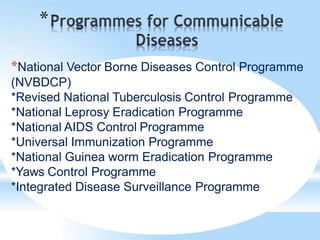
*National Vector Borne Diseases Control Programme
(NVBDCP)
*Revised National Tuberculosis Control Programme
*National Leprosy Eradication Programme
*National AIDS Control Programme
*Universal Immunization Programme
*National Guinea worm Eradication Programme
*Yaws Control Programme
*Integrated Disease Surveillance Programme
*
• *National Cancer Control Program
• *National Mental Health Program
• *National Diabetes Control Program
• *National Program for Control and
treatment of Occupational Diseases
• *National Program for Control of Blindness
• *National program for control of diabetes,
cardiovascular disease and stroke
• *National program for prevention and control of
deafness
*
Integrated Child Development Services
Scheme
*Midday Meal Programme
*Special Nutrition Programme (SNP)
*National Nutritional Anemia Prophylaxis
Programme
*National Iodine Deficiency Disorders Control
Programme
* Balvadi nutrition programme.
*
*National Reproductive and Child Health
Programme
*Rural Health Mission
*National Water supply & Sanitation Programme
*20 Points Programme
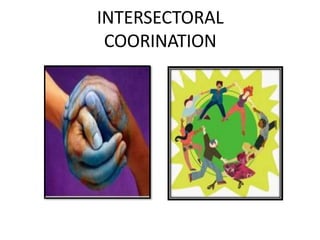
INTERSECTORAL
COORINATION
ADVANTAGES OF INTERSECTORAL COORDINATION
• To provide sustainable basic health service to the
community and to integrate these services with other
health services provided by other health sectors.
• Early detection, treatment of patients within the
community itself.
• To promote corporation and mutual understanding
among various sectors.
• To take pressure off the one sector alone.
• To make the services available to people with early and
easy access.
NON-
GOVERNMENTAL
AGENCIES & ITS
ROLES
This agencies arose because
there was an unmet health
need.
They are the organizations that
are formed by groups of people
because of their interest in a
particular health concern.
These are funded by
donations.
VOLUNTARY
AGENCIES
Voluntary agencies play an important role in
research and education, although they may
provide a few direct health services.
2 types, i.e. national & international.
PROFESSIONAL HEALTH ORGANIZATION
Professional agencies are
made of health professionals who
have completed specialized
education and have met the
standards of registration, licensure
for their respective fields. E.g. INC,
ANA.
ROLE OF PROFESSIONAL AGENCIES
•Promoting high standards of
professional practice for their specific
profession, thus improving health of
society.
•Certification of continuing education
programme for professional renewal.
•Lobbying for example INC has a
powerful lobby nationally.
PHILANTHROPIC FOUNDATIONS
These foundation supports community
health throughout the world by funding
programmes and research on the
prevention, control and treatment of many
diseases.
SERVICE, SOCIAL AND RELIGIOUS
ORGANIZATIONS
•These play an important role in community
health. E.g.:- Rotary clubs, lion clubs.
•Members enjoy social interactions with
people of similar interests in addition to
fulfilling the needs of community.
•Though their specific mission is not health but they
make important contribution in that direction by
raising money and funding health related problems.
CONT…
• Religious group donated money for
mission. It is should be noted that
some religious groups have hindered
the work of community health
workers.
• Almost every community in the
country can provide an example
where a religious organization has
protected the offering of a school
district’s sex education programme.
CORPORATE AGENCIES
•These agencies support health related
programme both at and away from the
worksite.
RECENT TRENDS
 World’s 1st malaria vaccine (mosquirix) approved
after 30yrs of trials.
 NRHM included some new programs like
RMNCH+A, JSSK, Rashtria Kishor Swasthaya
Karyakram, Rashtriya Bal Swasthaya Karyakram.
 India launched massive health campaign (Filaria
Free India/ Hathipaon Mukt Bharat) to eliminate
lymphatic filariasis.
 A mobile app “TrackTheBite” was launched to
track the mosquito infestation in India.
LISTS OF VARIOUS
NATIONAL HEALTH
PROGRAMS
NATIONAL VECTOR BORNE DISEASE
CONTROL PROGRAM
MISSION STATEMENT
Integrated accelerated action
towards:-
 Reducing mortality on account of Malaria,
Dengue and JE by half.
 Elimination of Kala-azar by 2025.
 Elimination of lymphatic
filariasis by year 2025.
STRATEGY UNDER NVBDCP
A)Disease management
B) Integrated vector
management
C)Supportive interventions
D) Environment
management
NATIONAL ANTI-MALARIA
PROGRAMME (NAMP)
 1953- NMCP
Objectives- to reduce the morbidity rate of
malaria.
 1958- NMEP
Objectives:- ending transmission of malaria by
killing entire vectors & elimination of reservoir of
infections.
 1999- NAMP
NATIONAL FILARIA CONTROL
PROGRAMME (NFCP)
- Launched in 1955.
- Control measures:-
• Assessing the extent of problem of filaria.
• Treating & diagnosed cases with DEC.
• Controlling the disease through anti-larva & anti-
parasite measures in urban areas.
• IEC activities for community awareness.
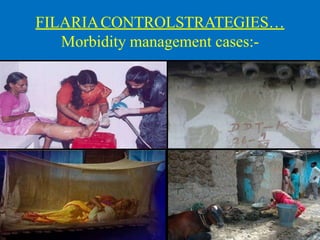
FILARIACONTROLSTRATEGIES…
Morbidity management cases:-
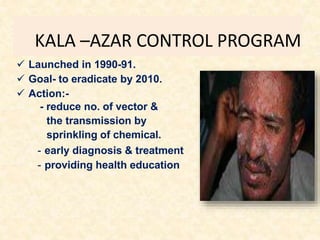
KALA –AZAR CONTROL PROGRAM
 Launched in 1990-91.
 Goal- to eradicate by 2010.
 Action:-
- reduce no. of vector &
the transmission by
sprinkling of chemical.
- early diagnosis & treatment
- providing health education
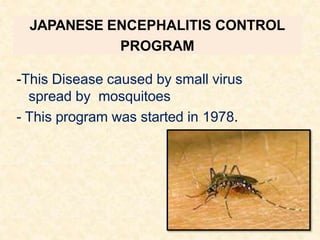
JAPANESE ENCEPHALITIS CONTROL
PROGRAM
-This Disease caused by small virus
spread by mosquitoes
- This program was started in 1978.
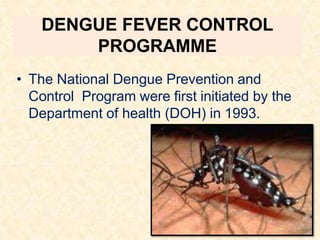
DENGUE FEVER CONTROL
PROGRAMME
• The National Dengue Prevention and
Control Program were first initiated by the
Department of health (DOH) in 1993.
CHIKUNGUNYA CONTROL
PROGRAMME
Chikungunya is a viral disease.
During 2006 there was huge outbreak
of Chikungunya in India. There is no
specific treatment. Only symptomatic &
supportive treatment is provided to
patients.
Launched in 1955 with the objective to
remove leprosy from our country.
Control measures:-
1) Decentralization and Institutional
Development
2) Strengthening Delivery sysem
3) Disability Prevention ,Care and
Rehabilitation
4) IEC activities
5) Training of staff of General Health
Services
India achieved elimination of leprosy in Dec.
2005.
Cont….
Launched in
1962.
renamed in
1992.
Cont…
-NTCP was launched in 1962, with the
objective to detect the TB cases &
provide domiciliary treatment to TB
patients.
-In 1992, revised strategy of TB was
launched & renamed as RNTCP.
WORLD TB DAY:- 24TH MARCH
Cont…
Control measures:-
Strengthen Intersectoral coordination
and involving Medical colleges
 IEC activities.
Improving laboratory facilities for
sputum culture and drug sensitivity
Implementation of DOTS –Plus strategy
for Multi Drug Resistant Tuberculosis
(MDR-TB)
NACP Phase- I was launched in 1987 &
phase-II in 1999-2001 & phase-III in 2006-
2011.
AIMS:-
-To prevent further transmission of HIV.
-To decrease morbidity and mortality.
CONTROL MEASURES:-
 establishment of surveillance centers
 Identification of high risk groups
 Clinical management of detected cases
 Control of STDs & condom programme
STD CONTROL
PROGRAMME
It was Started in
1946.
NATIONAL PROGRAMME FOR
CONTROL OF
BLINDNESS
1963- National trachoma control
program 1970- national prophylaxis
program
against blindness
1976- National programme for
control of blindness
Activities:-
•Establishing regional
institute of ophthalmology
•Improving level of ophthalmic
services
•Training & appointing ophthalmic
units.
•Vision 2020: RIGHT TO SIGHT
•School level program
NATIONAL NUTRITIONAL
PROGRAM
i) Special nutritional program(1970-71)(MNP)
ii) Balwadi nutritional program(1970-71)
iii) Applied nutritional program(in 1963, it was
introduced as a pilot scheme in Odisha. But
in 1973, it was extended to all the state of
country.)
iv) Mid-day meal program(1995)(Tamil Nadu)
v) National nutritional Anemia prophylaxis
program(1970)(RCH)
NATIONAL IODINE DEFICIENCY DISORDERS
CONTROL PROGRAMME(NIDDCP)
• 1962- national goiter control
program.
• 1992 - NIDDCP.
The major components are :
• Provision of iodized salt
• Monitoring
• Surveillance
• Mass communication
NATIONAL CANCER CONTROL
PROGRAMME(NCCP)
- started as cancer control program in
the year 1975-76 & and renamed as
NCCP in 1985 & revised in 2004 .
OBJECTIVES:-
• Primary prevention:- health education
• Secondary prevention:- early
detection & diagnosis.
• Tertiary prevention:- strengthening of the
existing institutions for
comprehensive therapy
includingpalliative care.
NATIONAL WATER SUPPLY AND
SANITATION PROGRAMME
-It was initiated in 1954.
ACTIVITIES:-
• Establishing
urban
developmental
fund
• Encouraging
participation
• low cost techniques
• Training to personals.
31
MINIMUM NEEDS PROGRAMME
It was introduced in 1974-78.
-The minimum needs are :
-Nutrition
-Elementary
education
-Rural water supply
-Rural electrification
-Rural health
-Adult
education
- Rural road
-Rural housing
-Environmental improvement of urban
slum
20-POINT PROGRAMME
-It was initiated in 1975.
Objectives:-
•Eradication of poverty
•Raising productivity
•Reducing inequality
•Removing social and economic
disparities
•Improving quality of life
It was launched in
1985.
NMHP
OBJECTIVES:-
• Mental health care services to all.
•Identify the high risks group in community.
Activities:-
• Mass education
• Follow up of mental patients
• Guidance and Counseling
• Awareness programme
CHILD SURVIVAL AND SAFE
MOTHERHOOD PROGRAMME(CSSM)
-launched in 20 Aug
1992. Activities:
•Control of infection & diseases
of reproductive system.
•Safe abortion services,
Sterility removal services.
•Referral services, Growth
monitoring, nutrition education.
•Control on maternal morbidity &
mortality, Family planning services.
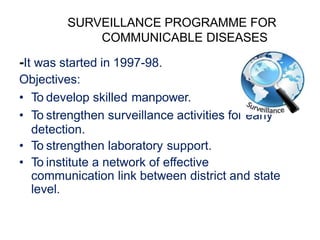
SURVEILLANCE PROGRAMME FOR
COMMUNICABLE DISEASES
-It was started in 1997-98.
Objectives:
• To develop skilled manpower.
• To strengthen surveillance activities for early
detection.
• To strengthen laboratory support.
• To institute a network of effective
communication link between district and state
level.
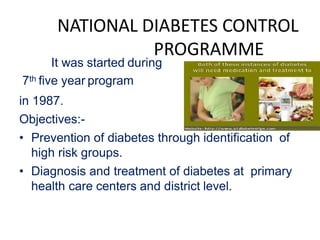
NATIONAL DIABETES CONTROL
PROGRAMME
It was started during
7th five year program
in 1987.
Objectives:-
• Prevention of diabetes through identification of
high risk groups.
• Diagnosis and treatment of diabetes at primary
health care centers and district level.
NATIONAL DIARRHEAL
DISEASES
CONTROL PROGRAMME
launched in 1981.
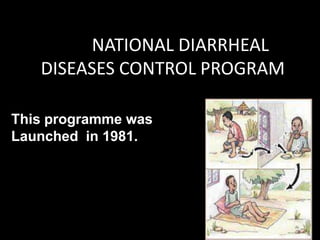
NATIONAL DIARRHEAL
DISEASES CONTROL PROGRAM
This programme was
Launched in 1981.
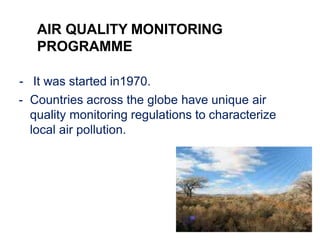
AIR QUALITY MONITORING
PROGRAMME
- It was started in1970.
- Countries across the globe have unique air
quality monitoring regulations to characterize
local air pollution.
EPI was initiated in India in 1974
against 6 killer diseases.
(WHO)
Pulse
polio
UNIVERSAL IMMUNIZATION PROGRAMME
-EPI was renamed as UIP &
started in 1985.
Objectives:-
Immunization of pregnant
women against TT &
immunization of children.
NATIONAL FAMILY WELFARE
SCHEMES
•It was started in 1977.
This programme include:
1. National family welfare programme
2. National population policy
3. National rural health mission
4. Urban family welfare schemes
5. Reproductive and child health progamme
NATIONAL FAMILY WELFARE
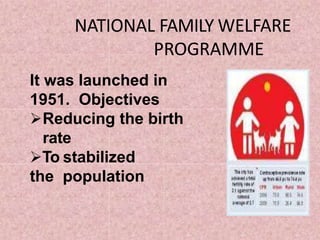
PROGRAMME
It was launched in
1951. Objectives
Reducing the birth
rate
To stabilized
the population
NATIONAL POPULATION POLICY
• National Population Policy of India was
formulated in the year 2000.
Objective of the policy is
• to address the unmet needs for contraception, health
care infrastructure, and health personnel, and
• to provide integrated service delivery for basic
reproductive and child health care
• To reduce TFR & achieve stable population.
URBAN FAMILY WELFARE
SCHEMES
• It was introduced in 1983 , recommendation of
Krishnan committee
Aims
 RCH services
 Preventive services
 First-aid and referral services
 Distribution of contraceptives
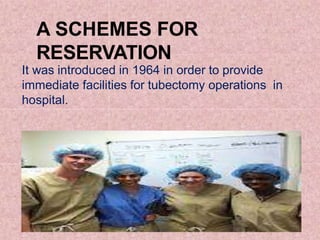
A SCHEMES FOR
RESERVATION
It was introduced in 1964 in order to provide
immediate facilities for tubectomy operations in
hospital.
It was launched in
October 1997.
• Objectives:- to reduce maternal & child mortality
& morbidity with emphasis on rural health care.
• It was added various services :
a. Reproductive tract infection
b. Janani Suraksha Yojana
c. Rehabilitation of polio victims
National Health Program .pptx

National Health Program .pptx

  • 1.
    NATIONAL HEALTH PROGRAMS OFINDIA 1 Dr. E Srikaanth Reddy •Associate Professor in Community Medicine •Ex-National Medical Consultant in N.T.EP, World Health Organization , INDIA, posted at Odisha 2019-2020
  • 2.
  • 3.
  • 4.
    6 Over the decadesthe public health is able to deliver best of its capacity to bring changes in various health indicators. (Koppaka R 2011). Introductio Reduction of child mortality Access to safe water and control of HIV/AIDS Malaria sanitation Prevention and prevention and control of Tobacco TB control
  • 5.
    7 Poverty, Inequity Public Demands,Marginalizing Public Health Services, Public health delivery Epidemiological transition Climatic change and environmental health, New psychosocial issues, Rapid population growth Various challenges to Public Health Introductio
  • 6.
    8 • Since Indiabecame independent, several measures have been taken under by the National Government to Improve the health of the people. • Program among these measures are the NATIONAL HEALTH PROGRAMS, which have been launched by the central government of control/ eradication of communicable diseases, improvement of environmental sanitation, raising the standard of nutrition, control of population and improving rural health. Introductio
  • 7.
    9 • Various Internationalagencies like WHO ,UNICEF, UNFPA ,world Bank, as also a no. of foreign agencies like SIDA ,DANIDA ,NORAD ,USAID have been providing technical and material assistance in the implementation of these programs. Introductio
  • 8.
    * *National Vector BorneDiseases Control Programme (NVBDCP) *Revised National Tuberculosis Control Programme *National Leprosy Eradication Programme *National AIDS Control Programme *Universal Immunization Programme *National Guinea worm Eradication Programme *Yaws Control Programme *Integrated Disease Surveillance Programme
  • 9.
    * • *National CancerControl Program • *National Mental Health Program • *National Diabetes Control Program • *National Program for Control and treatment of Occupational Diseases • *National Program for Control of Blindness • *National program for control of diabetes, cardiovascular disease and stroke • *National program for prevention and control of deafness
  • 10.
    * Integrated Child DevelopmentServices Scheme *Midday Meal Programme *Special Nutrition Programme (SNP) *National Nutritional Anemia Prophylaxis Programme *National Iodine Deficiency Disorders Control Programme * Balvadi nutrition programme.
  • 11.
    * *National Reproductive andChild Health Programme *Rural Health Mission *National Water supply & Sanitation Programme *20 Points Programme
  • 12.
  • 13.
    ADVANTAGES OF INTERSECTORALCOORDINATION • To provide sustainable basic health service to the community and to integrate these services with other health services provided by other health sectors. • Early detection, treatment of patients within the community itself. • To promote corporation and mutual understanding among various sectors. • To take pressure off the one sector alone. • To make the services available to people with early and easy access.
  • 14.
  • 15.
    This agencies arosebecause there was an unmet health need. They are the organizations that are formed by groups of people because of their interest in a particular health concern. These are funded by donations.
  • 16.
    VOLUNTARY AGENCIES Voluntary agencies playan important role in research and education, although they may provide a few direct health services. 2 types, i.e. national & international.
  • 17.
    PROFESSIONAL HEALTH ORGANIZATION Professionalagencies are made of health professionals who have completed specialized education and have met the standards of registration, licensure for their respective fields. E.g. INC, ANA.
  • 18.
    ROLE OF PROFESSIONALAGENCIES •Promoting high standards of professional practice for their specific profession, thus improving health of society. •Certification of continuing education programme for professional renewal. •Lobbying for example INC has a powerful lobby nationally.
  • 19.
    PHILANTHROPIC FOUNDATIONS These foundationsupports community health throughout the world by funding programmes and research on the prevention, control and treatment of many diseases.
  • 20.
    SERVICE, SOCIAL ANDRELIGIOUS ORGANIZATIONS •These play an important role in community health. E.g.:- Rotary clubs, lion clubs. •Members enjoy social interactions with people of similar interests in addition to fulfilling the needs of community. •Though their specific mission is not health but they make important contribution in that direction by raising money and funding health related problems.
  • 21.
    CONT… • Religious groupdonated money for mission. It is should be noted that some religious groups have hindered the work of community health workers. • Almost every community in the country can provide an example where a religious organization has protected the offering of a school district’s sex education programme.
  • 22.
    CORPORATE AGENCIES •These agenciessupport health related programme both at and away from the worksite.
  • 23.
    RECENT TRENDS  World’s1st malaria vaccine (mosquirix) approved after 30yrs of trials.  NRHM included some new programs like RMNCH+A, JSSK, Rashtria Kishor Swasthaya Karyakram, Rashtriya Bal Swasthaya Karyakram.  India launched massive health campaign (Filaria Free India/ Hathipaon Mukt Bharat) to eliminate lymphatic filariasis.  A mobile app “TrackTheBite” was launched to track the mosquito infestation in India.
  • 24.
  • 25.
    NATIONAL VECTOR BORNEDISEASE CONTROL PROGRAM
  • 26.
    MISSION STATEMENT Integrated acceleratedaction towards:-  Reducing mortality on account of Malaria, Dengue and JE by half.  Elimination of Kala-azar by 2025.  Elimination of lymphatic filariasis by year 2025.
  • 27.
    STRATEGY UNDER NVBDCP A)Diseasemanagement B) Integrated vector management C)Supportive interventions D) Environment management
  • 28.
    NATIONAL ANTI-MALARIA PROGRAMME (NAMP) 1953- NMCP Objectives- to reduce the morbidity rate of malaria.  1958- NMEP Objectives:- ending transmission of malaria by killing entire vectors & elimination of reservoir of infections.  1999- NAMP
  • 29.
    NATIONAL FILARIA CONTROL PROGRAMME(NFCP) - Launched in 1955. - Control measures:- • Assessing the extent of problem of filaria. • Treating & diagnosed cases with DEC. • Controlling the disease through anti-larva & anti- parasite measures in urban areas. • IEC activities for community awareness.
  • 30.
  • 31.
    KALA –AZAR CONTROLPROGRAM  Launched in 1990-91.  Goal- to eradicate by 2010.  Action:- - reduce no. of vector & the transmission by sprinkling of chemical. - early diagnosis & treatment - providing health education
  • 32.
    JAPANESE ENCEPHALITIS CONTROL PROGRAM -ThisDisease caused by small virus spread by mosquitoes - This program was started in 1978.
  • 33.
    DENGUE FEVER CONTROL PROGRAMME •The National Dengue Prevention and Control Program were first initiated by the Department of health (DOH) in 1993.
  • 34.
    CHIKUNGUNYA CONTROL PROGRAMME Chikungunya isa viral disease. During 2006 there was huge outbreak of Chikungunya in India. There is no specific treatment. Only symptomatic & supportive treatment is provided to patients.
  • 35.
    Launched in 1955with the objective to remove leprosy from our country.
  • 36.
    Control measures:- 1) Decentralizationand Institutional Development 2) Strengthening Delivery sysem 3) Disability Prevention ,Care and Rehabilitation 4) IEC activities 5) Training of staff of General Health Services India achieved elimination of leprosy in Dec. 2005. Cont….
  • 37.
  • 38.
    Cont… -NTCP was launchedin 1962, with the objective to detect the TB cases & provide domiciliary treatment to TB patients. -In 1992, revised strategy of TB was launched & renamed as RNTCP. WORLD TB DAY:- 24TH MARCH
  • 39.
    Cont… Control measures:- Strengthen Intersectoralcoordination and involving Medical colleges  IEC activities. Improving laboratory facilities for sputum culture and drug sensitivity Implementation of DOTS –Plus strategy for Multi Drug Resistant Tuberculosis (MDR-TB)
  • 40.
    NACP Phase- Iwas launched in 1987 & phase-II in 1999-2001 & phase-III in 2006- 2011.
  • 41.
    AIMS:- -To prevent furthertransmission of HIV. -To decrease morbidity and mortality. CONTROL MEASURES:-  establishment of surveillance centers  Identification of high risk groups  Clinical management of detected cases  Control of STDs & condom programme
  • 42.
  • 43.
    NATIONAL PROGRAMME FOR CONTROLOF BLINDNESS 1963- National trachoma control program 1970- national prophylaxis program against blindness 1976- National programme for control of blindness
  • 44.
    Activities:- •Establishing regional institute ofophthalmology •Improving level of ophthalmic services •Training & appointing ophthalmic units. •Vision 2020: RIGHT TO SIGHT •School level program
  • 45.
    NATIONAL NUTRITIONAL PROGRAM i) Specialnutritional program(1970-71)(MNP) ii) Balwadi nutritional program(1970-71) iii) Applied nutritional program(in 1963, it was introduced as a pilot scheme in Odisha. But in 1973, it was extended to all the state of country.) iv) Mid-day meal program(1995)(Tamil Nadu) v) National nutritional Anemia prophylaxis program(1970)(RCH)
  • 46.
    NATIONAL IODINE DEFICIENCYDISORDERS CONTROL PROGRAMME(NIDDCP) • 1962- national goiter control program. • 1992 - NIDDCP. The major components are : • Provision of iodized salt • Monitoring • Surveillance • Mass communication
  • 47.
    NATIONAL CANCER CONTROL PROGRAMME(NCCP) -started as cancer control program in the year 1975-76 & and renamed as NCCP in 1985 & revised in 2004 . OBJECTIVES:- • Primary prevention:- health education • Secondary prevention:- early detection & diagnosis. • Tertiary prevention:- strengthening of the existing institutions for comprehensive therapy includingpalliative care.
  • 48.
    NATIONAL WATER SUPPLYAND SANITATION PROGRAMME -It was initiated in 1954. ACTIVITIES:- • Establishing urban developmental fund • Encouraging participation • low cost techniques • Training to personals. 31
  • 49.
    MINIMUM NEEDS PROGRAMME Itwas introduced in 1974-78. -The minimum needs are : -Nutrition -Elementary education -Rural water supply -Rural electrification -Rural health -Adult education - Rural road -Rural housing -Environmental improvement of urban slum
  • 50.
    20-POINT PROGRAMME -It wasinitiated in 1975. Objectives:- •Eradication of poverty •Raising productivity •Reducing inequality •Removing social and economic disparities •Improving quality of life
  • 51.
  • 52.
    NMHP OBJECTIVES:- • Mental healthcare services to all. •Identify the high risks group in community. Activities:- • Mass education • Follow up of mental patients • Guidance and Counseling • Awareness programme
  • 53.
    CHILD SURVIVAL ANDSAFE MOTHERHOOD PROGRAMME(CSSM) -launched in 20 Aug 1992. Activities: •Control of infection & diseases of reproductive system. •Safe abortion services, Sterility removal services. •Referral services, Growth monitoring, nutrition education. •Control on maternal morbidity & mortality, Family planning services.
  • 54.
    SURVEILLANCE PROGRAMME FOR COMMUNICABLEDISEASES -It was started in 1997-98. Objectives: • To develop skilled manpower. • To strengthen surveillance activities for early detection. • To strengthen laboratory support. • To institute a network of effective communication link between district and state level.
  • 55.
    NATIONAL DIABETES CONTROL PROGRAMME Itwas started during 7th five year program in 1987. Objectives:- • Prevention of diabetes through identification of high risk groups. • Diagnosis and treatment of diabetes at primary health care centers and district level.
  • 56.
    NATIONAL DIARRHEAL DISEASES CONTROL PROGRAMME launchedin 1981. NATIONAL DIARRHEAL DISEASES CONTROL PROGRAM This programme was Launched in 1981.
  • 57.
    AIR QUALITY MONITORING PROGRAMME -It was started in1970. - Countries across the globe have unique air quality monitoring regulations to characterize local air pollution.
  • 58.
    EPI was initiatedin India in 1974 against 6 killer diseases. (WHO)
  • 59.
  • 60.
    UNIVERSAL IMMUNIZATION PROGRAMME -EPIwas renamed as UIP & started in 1985. Objectives:- Immunization of pregnant women against TT & immunization of children.
  • 61.
    NATIONAL FAMILY WELFARE SCHEMES •Itwas started in 1977. This programme include: 1. National family welfare programme 2. National population policy 3. National rural health mission 4. Urban family welfare schemes 5. Reproductive and child health progamme
  • 62.
    NATIONAL FAMILY WELFARE PROGRAMME Itwas launched in 1951. Objectives Reducing the birth rate To stabilized the population
  • 63.
    NATIONAL POPULATION POLICY •National Population Policy of India was formulated in the year 2000. Objective of the policy is • to address the unmet needs for contraception, health care infrastructure, and health personnel, and • to provide integrated service delivery for basic reproductive and child health care • To reduce TFR & achieve stable population.
  • 64.
    URBAN FAMILY WELFARE SCHEMES •It was introduced in 1983 , recommendation of Krishnan committee Aims  RCH services  Preventive services  First-aid and referral services  Distribution of contraceptives
  • 65.
    A SCHEMES FOR RESERVATION Itwas introduced in 1964 in order to provide immediate facilities for tubectomy operations in hospital.
  • 66.
    It was launchedin October 1997.
  • 67.
    • Objectives:- toreduce maternal & child mortality & morbidity with emphasis on rural health care. • It was added various services : a. Reproductive tract infection b. Janani Suraksha Yojana c. Rehabilitation of polio victims