Community health nursing
 National health programme which have been
launched by the central government for the
control or eradication of communicable diseases,
improvement of environmental sanitation, raising
the standard of nutrition, control of population
and improving rural health. Various international
agencies like WHO, UNICEF, UNFPA as also
number of foreign agencies like SIDA, DANIDA,
NORAD and USAID have been providing
technical and material assistance in the
implementation of these prorammes.
 Various national health programmes are
currently in operation for the purpose of….
“Improvement of child health by prevention of
chilhood diseases”
 NATIONAL MALARIA ERADICATION PROGRAMME (1958)
 NATIONLA FILARIA CONTROL PROGRAMME(1955)
 NATIONAL KALA-AZAR CONTROL PROGRAMME(1991)
 JAPANESE ENCEPHALITIS PREVENTION AND CONTROL
 NATIONAL LEPROSY ERADICATION PROGRAMME (1955)
 PREVENTION AND CONTROL OF DENGUE
 NATIONAL TUBERCULOSIS CONTROL PROGRAMME(1962) AND
RNTCP(1992):
 NATIONAL SURVEILLANCE PROGRAMME FOR
COMMUNICABLE DISEASES (1997-1998):
 DIARROHEAL DISEASE CONTROL PROGRAMME
 SCHOOL HEALTH PROGRAMME
 NAVAJAT SHISHU SURAKSHA KARYAKRAM
 APPLIED NUTRITION PROGRAMME
 Special nutrition programme
 National goiter control programme
 Mid day meal programme
 Vitamin-A prophylaxis programme
 Integrated child development service scheme
 National diarrhoeal control programme
 Reproductive and child health services
 Maternal child health programme
 Balawadi nutrition programme
 Special nutrition programme
 Applied nutrition programme
 Navajat shishu suraksha karyakram
 School health programme
 • Remarkable success 1958-1965
 • But since 1965 upsurge is seen high in malaria.
 OBJECTIVES:
• To prevent death due to malaria.
• Reduction in period of sickess.
• Agricultural and industrial production to be maintained by undertaking intense
antimalarial measures.
• To consolidate the achievements obtained so far.
To attain this modified plan of operation envisages 3 strategies, they are
1. Early case detection and prompt treatment.
2. Vector control by house to house spray in rural areas with annual parasite
incidence 2 and above per 1000 population with appropriate insecticide and by
recurrent antilarval measures in urban areas.
3. Health education and community participation.
The following efforts are mobilized to implement these strategies by.
1. Govt. efforts, people participation, research, training, publicity, international
assistance.
2. Urban malaria scheme was launched in 1981 with the object to reduce or
interrupt transmission of malaria in town through vector control by antilarval
measkures.
 Under NFCP following activities are being undertaken
• Delimitation of the problem in unsurveyed area.
• Control in urban area through recurrent antilarval measures, antiparasitic
measures.
• Control in rural areas through treatment and detection of microfilaria
carriers or persons with disease manifestation on expereimental basis.
• Currently there are 206 control units and 199 filaria clinics functioning in
the endemic area for carrying.
• Antilarval measures which includes weekly spray of approved larvicide and
biological control.
• Source reduction through environmental and water management.
• Antiparasitic measures which includes diagnosis and treatment of
microfilaria carriers and cases.
• Information, education and communication for community awareness.
In 1977 a new strategy comprising of mass administration of single dose of
DCC to reduce transmission of filarial.
 Kala-azar is a serious public health problem in
Bihar, Jharkhand and west Bangal. The strategy
for kala azar control are:
• Interruption of transmission for reducing vector
population by undertaking indoor residual
insecticidal spray twice annually.
• Early diagnosis and complete treatment of kala-
azar cases.
• Information, education and communication for
community awareness and community
involvement.
 JE is a zoonotic diseases mainly occurring in pigs and birds
and man is an accidental dead end host to the disease.
Major strategy for prevention and control of Japanese
Encephalitis are:
 • Early diagnosis and prompt case management.
 • Vector control through anticipatory insecticide spray in
animal dwelling and fogging for epidemic containment as
well as antilarval operation whenever feasible.
 • Information, education, communication for community
awareness to promote early case reporting, personal
protection, isolation of host etc.
 • Vaccination of high risk population groups.
 No separate budget for JE.
 Dengue is a viral infection widely prevalent in
India. Strategies for prevention and control of
dengue are:
 • Surveillance for disease and vector.
 • Early diagnosis and prompt case management.
 • Vector control through community participation
and social mobilization.
 • Capacity building.
 • There is no separate programme for prevention
and control of dengue.
 Under the programme, emphasis is given on early
detection of cases through surveys.
 Contract examination and regular short term
multi drug therapy health education,
rehabilitation activities etc.
 Various strategies which have been undertaken
includes as under:
 • Information, education and communication.
 • Staff motivation and special project for difficult
areas.
 • NGO’s participation (WHO, UNICEF)
 • Modified leprosy elimination campaign.
 Objectives:
1. To achieve at least 85% cure rate of infectious TB cases
through administration of DOT
2. To detect at least 70% of estimated cases by augmenting
case finding through quality sputum microscopy.
3. To involve NGO’s for IEC and improved operational
research.
The RNTCP strategy comprises 5 components viz.
• Political commitment
• Sputum microscopy as primary tool as diagnosis
• Short courses CT with uninterrupted drug supply.
• Direct observation.
• Accountability.
 Under the programme, the surveillance programme is strengthened
through:
 • Training of medical and paramedical personnel.
 • Dissemination of technical information and guidelines.
 • Modernization of communication and data processing system.
 • Multidisciplinary rapid response teams have been constituted at
state and district levels under the programmes.
 These teams have been provided training in surveillance, prevention
and control of outbreak.
 • All the states and district level epidemiology cells have been
procured computers, fax machines and telephones for data
processing and rapid communication of information.
 • Networking between districts, state, regional laboratories and
other specialized institutes of repute in the country besides national
level has been initiated.
 Launched in 1980- 85 during 6th five year
plan. ORS programme started in 1986- 87 is
being implemented in a phased manner
supplies of ORS packets to the states.
 Twice a year 150 packets of ORS provided to
all subcentres, adequate nutritional case of the
child with diarrhea and proper advice to
mothers on feeding are two important areas of
this programme.
 School Health Programme Can Be Powerful For Shaping Of Health
Behaviour Of The Children
 The School Health Programme is defined as the school Procedures That
Contribute To the Maintainace And Improvement Of Health Of The Pupils
And including health services , healthful living and health education
 And This Period Is Important For Growth And Development Of School
Children.
 GOALS
 To prepare younger generation to adopt measures to remain healthy so as
to help them to utilize theire leisure time to enjoy recreation.
 To help the younger generation become healthy and useful citizen who
will be able to perform theire role effectively for the welfare of
themselves.
 AIMS The Aim Of The School Health Programme
 Is to promote healthy children so that they can reach optimum growth and
development. Which will enable them to lead and study.
 Protecting from diseases.
 Appropriate medical and dental care.
 Promote Of Positive Health.
 Early Detection And Prompt Treatment /
Reffereal.
 Prevention And Control Of Communicable And
Non- communicable Diseases.
 Provide The Healthy And Safe Environment
For Overall Development Of The Child.
 Regular medical checkup of the school going
child.
 Ensure a healthful environment, eg. Drinking
water and sanitation.
 Accident prevention and food hygiene.
 REGULAR HEALTH CHECKUP
 PROTECTION FROM DISEASES THROUGH ADMINISTERING OF
IMMUNIZATIONS.
 TRAINING OF TEACHERS
 ENSURING A HEALTHFUL SCHOOL ENVIRONMENT PROVISION OF
NUTRITIONAL SUPLEMENTS BY MID DAY MEAL.
SHOOL HEALTH SERVICES
Determining of health status of each child.
Continually appraise changes in health status of the child.
Conduct special screening programmes.
Counsel pupils and their parents regarding finding of the health appraisals.
Assist maintaining the health status of school personnel.
Give emergency care in case of sudden accident and illness.
Offer immunization programmes to prevent communicable diseases
 ROLE OF NURSE IN SHP
 HEALTH SUPERVISION-
 HEALTH COUNCELLING-
 HEALTH EDUCATION-
 This Was Launched In 1969.
 The Term Maternal And Child Health Refers Promotive, Curative,
Preventive And Rehabilitative Health Care Of The Mothers And
Children's.
 OBJECTIVES OF MCH
To Reduce Maternal Infant And Chilhood Mortality And Morbidity.
To Promote Reproductive Health.
To Promote Physical And Psychological Development Of Children.
The Health Of The Child Is Similarly Linked With Mothers Health.
Certain Diseases Inflicting The Mother During Pregnacy Can Have That
Deterious Effect On The Health Of The Fetus.
 Even after the birth child is depended for its feeding upon the mother at
least in the first year of life.
 The mental and social development of the child is dependent of the
mother.
 And mother is the earlier teacher of the child.
 Maternal health
 Child health
 School health
 Family planning
 Handicapped children
 Guidelines for implementation of MCH
the service should be delivered as close to
homes of beneficiaries as possible.
Services for mothers and childrens should be
delivered in an integrated manner.
Voluntary agencies working in the area should
be involved in providing MCH services.
 To ensure the birth of healthy infant to every expectant mother.
 To provide services to promote the healthy growth and development of children
up to the age of under five children.
 To indetify health problems of mothers and childrens at an early stage and
initiate proper treatment.
 To prevent malnutrition in mothers and childrens.
 To prevent communicable and non communicable disease in children's and
mothers.
 To promote family planning services to improve the health of mother and
children .
 To educate the mothers an improvement in their own and their childrens health.
 PACKAGES OF MCH
 Antenatal Care
 Intranatal Care
 Postnatal Care
 Nutrition Advice
 Immunization
 Primary Health Care
 Navajat shishu suraksha karyakram is a programme
aimed to train health personnel in basic newborn care and
resuscitation.
 It has been launched to address care at birth issue
like……
 GOALS
prevention of hypothermia , prevention of infections ,
early initiation of breast feeding and basic newborn
resuscitation.
COMPONENTS
The other interventions like-additional ANM’S , public
health nurse, private anesthetist, safe motherhood
consultant, 24 hours delivery services at PHC’S and
CHC’S, referral transport, RCH camp and training of dais.
 The number of antenatal case registered.
 The number of pregnant women who had 3 antenatal checkups.
 Number of high risk women referred.
 Number of pregnant women ho had taken 2 doses of T.T.
INJECTION.
 Number of pregnant women under prophylaxis and treatment of
anemia.
 Number of deliveries done by trained and untrained birth
attendants.
 Number of newborns with birth recorded.
 Number Of Women Given Three Postnatal Checkups.
 Number Of Rti&std Case Detected And Treated.
 Number Of Women Fully Immunized.
 Number Of Cases Motivated And Followuped For Contraception.
 This Was Launched In India 1960
 It Was Started First In Orissa And Andhra Pradesh And Extended In 1960 To
Tamilnadu And In 1962 It Came to Uttar Pradesh And Finally 1963 It Was
Extended To Whole Country By Government Of India.
 OBJECTIVES
To Make People Conscious About Their Nutritional Needs.
To Increase Production Of Nutritional Foods.
To Provide Supplementary Nutrition To Vulnerable Groups Through Locally
Produced Foods
 The beneficiaries are children between 2 and 6 years and pregnant and lactating
mothers.
 The children and women given supplementary nutrition.
 A single supplementary meal is given weekly for 52 days in a year .
 the programme lacked effective supervision and has almost become defunct.
 ACTIVITIES
Supplementary Feeding
Non-formal Preschool Education
Nutrition Education
Raising Kitchen Gardens
 The special nutrition programme was launched
in 1970 as a crash programme to provide
supplementary nutrition to children below 6 years
of age and pregnant and lactating mothers.
GOALS
The socially and economically handicapped
are reached to programme e.g. those in slums ,
drought prone and food affected areas.
It is now envisaged that the special nutrition
programme should include some of the
components of the ICDS in order to render it
more effectively.
 To improve the nutritional status of the
pregnant and lactating mother and
 children below 6 years of age in the weakest
section and most vulnerable areas
 Reduction of mortality and morbidity of the
children below 6 years of age,
 enhancing the capacity of the mothers to look
after the daily health and
 nutritional needs of the children and to
strengthen supportive services
 To provide supplementary nutrition.
 To provide health services including vitamin –
A solution and iron and folic acid tablets.
 - This programme is for the nutritional benefit
of children's below 6 years of age, pregnant and
nursing mothers and it is operation in urban
slums, tribal areas and backward rural areas.
 -The supplementary good supplies about 30
kcal and 10-12 gm of protein child/day.
 -This programme is gradually merged in to
ICDS programme
 NGCP is established by ministry of health and family
welfare in 1962.
 The sheet anchor of the programme is universal
iodization of common salt and its consumption
 The government of india upgraded the national goiter
control programme into national iodine deficiency
disorder control programme during 1992
 AIM
To reduce the incidence of IDD
To less than 10 percent among adults
To less than 5 percent among children 10 to 14 year
To zero percent of certain among the newborn by the
year2000
 The major components are :
• Provision of iodized salt
• Monitoring
• Surveillance
• Mass communication
OBJECTIVES
To assess the magnitude of the IDD problem in the country.
To assess the impact of control measures after every 5
years.
To monitor the quality of iodated salt available
to consumers and estimate their urinary iodine excretion
pattern
.
 Also known as school lunch programme
 This programme operation since 1961 throughout
country.
 Objectives
The major objectives of this programme are…
attract more children for admission to school retain
them.
The following broad principles kept in mind….
The meal should be A supplement and not A
substitute to the home diet.
The meal should supply at least one third of the total
energy requirement and half of the protein need
 This was launched by Indian govt.during 1970 and
merged as a component of a national programme for
the prevention of control of blindness.
 Vitamin-a deficiency result in blindness of several
hundred thousand children a year. Globally 21% of
children have vitamin –A deficiency .
 According to this programme, the infant who are not
breast feed should receive A 500,000 units supplement
of vitamin-A by 2 months of age in areas of endemic
vitamin-a deficiencies
 Every infant should be administered 1 dose of 1 lac
unit of vitamin- A along with measles @ 9 month’s.
 Main important thing is of this programme is to
prevent nutritional blindness among children's.
 Food menu
Consumption of vitamin –A food should be
encouraged including locally available carotene
rich foods that is green leafy vegetables, orange
leafy vegetables.
Fruits like pumpkin, papaya, mango, orange
along with cereals and Pulses, milk and milk
products, egg liver must be provided.
 The cost of the meal is reasonably low.
 The meal should be such that it can be prepared easily in schools.
 No complicated cooking process should be involved
 as far as possible locally available food should be used, this will
reduce the cost of the meal
 the menu should be frequently changed to avoid monotomy. Like
cereals and millets, pulses, oils and fats, leafy vegetables,
 non-leafy vegetables should be provide alternatively.
 GOALS
To minimize the malnutrition in schooler children, it is a vital
stage for growth and development of children.
To provide the nutritional support to schooler children's who all
are not receiving in their homes due to poverty.
 IT was launched in 2nd October 1975 BY GOVT. OF INDIA Today the ICDS
scheme represent one of the world largest programme for early childhood
development
 Indias response to the challenge of providing preschool education on one hand
breaking the visious cycle of malnutrition morbidity and mortality on other hand.
The benificiaries are
Children Below The 6 Years,
Pregnant And Lactating Mothers,
 OBJECTIVES
To improve the nutrition and health status of children in the age group of 0-6
years.
To lay the foundation of proper psychological, physical and social development of
the child
To reduce the malnutrition, mortality, morbidity and school dropout.
To enhance the capability of the mother to look after the normal health and
Nutritional needs of the child through proper nutrition and health education.
 Referral services.
 Supplementary Nutrition Like Iron, Folic
Acid, Vitamin-a Services.
 Treatment Of Minor Illness, Nutrition And
Health Education To Women.
 Pre-school Non-formal Education Of
Children In The Age Group Of 3-6 Years.
 Immunization.
 Health Checkup.
 RCH Approach Has Been Defined….
 “People Have The Ability To Reproduce And Regulate Their
Fertility’
 Women are able to go through pregnancy and child birth safely,
the outcome of pregnancies is successful in terms of maternal and
infant survival and well being and couples are able to have sexual
relations free of fear of pregnancy and contacting diseases.
 HIGHLIHTS
 The programme integrates all interventions of fertility regulation,
maternal and child health with reproductive health for both men and
women.
 The services to be provided are client oriented, demand driven ,
high quality and based on needs of community.
 The first referral unit being set up at sub district level to provide
emergency comprehensive obstetric and new born care .
 Facilities of obstetric care , MTP and IUD insertion in the PHC
level are improved.
 Early registration of pregnancy.
 To provide minimum three antenatal
checkups.
 T.T. immunization for all pregnant women.
 Advice on food, nutrition, rest.
 Detection of high risk pregnancies and
prompt referral.
 Clean deliveries by trained personnel.
 Birth spacing and
 Promotion of instructional deliveries.
 Guiding principles which provided in PHC’S
Promoting of food supply and proper nutrition
An adequate supply of safe water and basic
Sanitation
Maternal and child care including family planning
Immunization against the major infectious diseases
Provision of essential drugs
 Ninth five year plan has mentioned the following programme of RCH
 1.Effective maternal and child health care
 2.Increased access to contraceptive care
 3.Safe treatment and management of unwanted pregnancies
 4.Nutritional services to vulnerable groups
 5.Prevention and treatment of RTI/STD’S
 6.Prevention and treatment of gynecological problems
 7.Screening and treatment of cancers, especially that of uterine, cervix and
breast
 This was launched in 1950
 The majority of diseases cause for child mortality like
ARI, malaria, measles and malnutrition is substantial. Most
of the sick children's present with signs and symptoms of
more than one of these conditions.
 An integrated approach to manage sick children's is
necessary
 is a strategy for an integrated approach to the
management of childhood illness as it is important for child
health programmes to look beyond a single disease.
 This is cost effective and emphasizes prevention of
diseases and promotion of child health.
 IMNCI CODE DISTRUBUTION
 ASSESS-A Child By Checking First For Danger Signs, Asking
Questions About Common Conditions, Examining The Child, And
Checking Nutrition And Immunization Status, Assessment Includes
Checking The Child For Other Health Problems.
 CLASSIFY-A Childs Illnesses Using A Color Coded Triage System.
Because Many Children Have More Than One Conditions, Each Illness Is
Classified According To Whether It Requires.
 INDETIFY-After Classifying…we Have To Identify Specific Treatment
For The Child. If The Child Requires Urgent Referral .Give Essential
Treatment Before Transferring Child.
 TREATMENT-Provide Practical Treatment Instructions Including
Teaching The Care Taker, How To Give Oral Drugs, How To Feed And
Give Fluids During Illness And How To Treat Local Infections At Home.
 Councel-to solve the any problem of mother by councelling e.G. Feeding
Problem
 And Tell Her Regarding Her Own Health Maintenance
 FOLLOW UP-When Child Came Back To The Hospital Give Follow-up
Care. And If Necessary Reassessment Should Be Done.
 This programme was launched in the country on 1995
under this programme children under five years of age are
given additional oral polio drops in December and January
every year on fixed day
 Since there is A significant decline in the incidence of
poliomyelitis
 Introduction of hepatitis-b vaccine A pilot project for the
introduction of hepatitis B vaccine in the national
immunization programme was initiated in June 2002, under
this programme the hep- B vaccine is administered to
infants along with the primary dose of dpt vaccine on 6th,
10th ,14th week
 The project is being implemented in 33 districts and 15
metropolitan cities, in this programme are auto disable
syringes are being introduced.
 In order to accelerate the reduction of measles
related to morbidity and mortality, the national
technical advisory group on immunization
recommended introduction of Measles vaccine
to children between 9 month .
 OBJECTIVES reducing the mortality and
morbidity resulting from vaccine preventable
disease of childhood
 Started as cancer control program in the year
1975-76 & and renamed as NCCP in 1985 &
revised in 2004 .
 OBJECTIVES:-
• Primary prevention:- health education
• Secondary prevention:- early detection &
diagnosis.
• Tertiary prevention:- strengthening of the
existing institutions for comprehensive
therapy including palliative care.
 It was initiated in 1954.
 ACTIVITIES:-
• Establishing urban developmental fund
• Encouraging participation
• low cost techniques
• Training to personals.
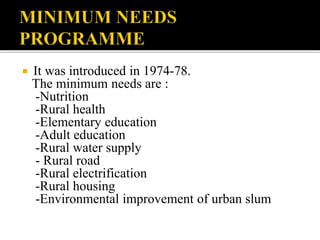
 It was introduced in 1974-78.
The minimum needs are :
-Nutrition
-Rural health
-Elementary education
-Adult education
-Rural water supply
- Rural road
-Rural electrification
-Rural housing
-Environmental improvement of urban slum
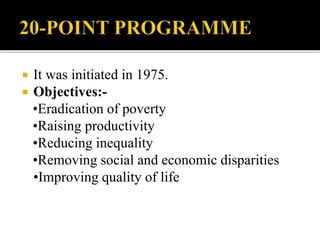
 It was initiated in 1975.
 Objectives:-
•Eradication of poverty
•Raising productivity
•Reducing inequality
•Removing social and economic disparities
•Improving quality of life
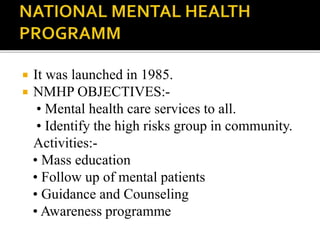
 It was launched in 1985.
 NMHP OBJECTIVES:-
• Mental health care services to all.
• Identify the high risks group in community.
Activities:-
• Mass education
• Follow up of mental patients
• Guidance and Counseling
• Awareness programme
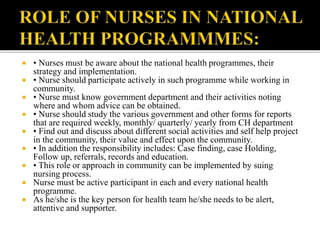
 • Nurses must be aware about the national health programmes, their
strategy and implementation.
 • Nurse should participate actively in such programme while working in
community.
 • Nurse must know government department and their activities noting
where and whom advice can be obtained.
 • Nurse should study the various government and other forms for reports
that are required weekly, monthly/ quarterly/ yearly from CH department
 • Find out and discuss about different social activities and self help project
in the community, their value and effect upon the community.
 • In addition the responsibility includes: Case finding, case Holding,
Follow up, referrals, records and education.
 • This role or approach in community can be implemented by suing
nursing process.
 Nurse must be active participant in each and every national health
programme.
 As he/she is the key person for health team he/she needs to be alert,
attentive and supporter.
 We have discussed regarding various national
health programmes related to child health
care…..
 And when, why, how the this was operated
throughout country
 This all was started by central government of
india and currently which runs by state
governments
 National health programme globally accepted to
see change in health status of community people.
To achieve goals towards health such
programmes are helpful to achieve or know about
health and disease. Various international agencies
like WHO, UNICEF, UNFPA as also number of
foreign agencies like SIDA, DANIDA, NORAD
and USAID have been providing technical and
material assistance in the implementation of these
prorammes.
 • Swarnkar Keshav “ The Text Book Of Community Health Nursing” 3rd
edition. Page no.- 838-846,714-723
 • K Park “Text Book Of Community Health Nursing” 2nd edition ,page
no.- 279-285
 • Kk Gulani “Text Book Of Community Health Nursing” 4th edition. Page
no.- 445-451 • http://www.wikipedia.org/health-programme-india/
 • Gulani k.k., Community Health Nursing (Principles & Practices), Kumar
publishing, 2nd edition, Pg. 643-750.
 • Basheer Shebeer P, A concise text book of Advance Nursing Practice,
EMMESS medical publisher, 1st edition, pg. 97-101.
 • Park K, Preventive & Social Medicine, Bhanot publisher (2011) 23rd
edition, Pg. 380-420.
 • Gupta MC & Mahajan BK, Preventive & Social Medicine, Jaypee
publisher, 4th edition, Pg. 260-341.
 • www.nhp.gov.in
 • www.nursingppt.in
THANK YOU

NATIONAL PROGRAMMES.pptx

  • 1.
  • 2.
     National healthprogramme which have been launched by the central government for the control or eradication of communicable diseases, improvement of environmental sanitation, raising the standard of nutrition, control of population and improving rural health. Various international agencies like WHO, UNICEF, UNFPA as also number of foreign agencies like SIDA, DANIDA, NORAD and USAID have been providing technical and material assistance in the implementation of these prorammes.
  • 3.
     Various nationalhealth programmes are currently in operation for the purpose of…. “Improvement of child health by prevention of chilhood diseases”
  • 4.
     NATIONAL MALARIAERADICATION PROGRAMME (1958)  NATIONLA FILARIA CONTROL PROGRAMME(1955)  NATIONAL KALA-AZAR CONTROL PROGRAMME(1991)  JAPANESE ENCEPHALITIS PREVENTION AND CONTROL  NATIONAL LEPROSY ERADICATION PROGRAMME (1955)  PREVENTION AND CONTROL OF DENGUE  NATIONAL TUBERCULOSIS CONTROL PROGRAMME(1962) AND RNTCP(1992):  NATIONAL SURVEILLANCE PROGRAMME FOR COMMUNICABLE DISEASES (1997-1998):  DIARROHEAL DISEASE CONTROL PROGRAMME  SCHOOL HEALTH PROGRAMME  NAVAJAT SHISHU SURAKSHA KARYAKRAM  APPLIED NUTRITION PROGRAMME  Special nutrition programme
  • 5.
     National goitercontrol programme  Mid day meal programme  Vitamin-A prophylaxis programme  Integrated child development service scheme  National diarrhoeal control programme  Reproductive and child health services  Maternal child health programme  Balawadi nutrition programme  Special nutrition programme  Applied nutrition programme  Navajat shishu suraksha karyakram  School health programme
  • 6.
     • Remarkablesuccess 1958-1965  • But since 1965 upsurge is seen high in malaria.  OBJECTIVES: • To prevent death due to malaria. • Reduction in period of sickess. • Agricultural and industrial production to be maintained by undertaking intense antimalarial measures. • To consolidate the achievements obtained so far. To attain this modified plan of operation envisages 3 strategies, they are 1. Early case detection and prompt treatment. 2. Vector control by house to house spray in rural areas with annual parasite incidence 2 and above per 1000 population with appropriate insecticide and by recurrent antilarval measures in urban areas. 3. Health education and community participation. The following efforts are mobilized to implement these strategies by. 1. Govt. efforts, people participation, research, training, publicity, international assistance. 2. Urban malaria scheme was launched in 1981 with the object to reduce or interrupt transmission of malaria in town through vector control by antilarval measkures.
  • 7.
     Under NFCPfollowing activities are being undertaken • Delimitation of the problem in unsurveyed area. • Control in urban area through recurrent antilarval measures, antiparasitic measures. • Control in rural areas through treatment and detection of microfilaria carriers or persons with disease manifestation on expereimental basis. • Currently there are 206 control units and 199 filaria clinics functioning in the endemic area for carrying. • Antilarval measures which includes weekly spray of approved larvicide and biological control. • Source reduction through environmental and water management. • Antiparasitic measures which includes diagnosis and treatment of microfilaria carriers and cases. • Information, education and communication for community awareness. In 1977 a new strategy comprising of mass administration of single dose of DCC to reduce transmission of filarial.
  • 8.
     Kala-azar isa serious public health problem in Bihar, Jharkhand and west Bangal. The strategy for kala azar control are: • Interruption of transmission for reducing vector population by undertaking indoor residual insecticidal spray twice annually. • Early diagnosis and complete treatment of kala- azar cases. • Information, education and communication for community awareness and community involvement.
  • 9.
     JE isa zoonotic diseases mainly occurring in pigs and birds and man is an accidental dead end host to the disease. Major strategy for prevention and control of Japanese Encephalitis are:  • Early diagnosis and prompt case management.  • Vector control through anticipatory insecticide spray in animal dwelling and fogging for epidemic containment as well as antilarval operation whenever feasible.  • Information, education, communication for community awareness to promote early case reporting, personal protection, isolation of host etc.  • Vaccination of high risk population groups.  No separate budget for JE.
  • 10.
     Dengue isa viral infection widely prevalent in India. Strategies for prevention and control of dengue are:  • Surveillance for disease and vector.  • Early diagnosis and prompt case management.  • Vector control through community participation and social mobilization.  • Capacity building.  • There is no separate programme for prevention and control of dengue.
  • 11.
     Under theprogramme, emphasis is given on early detection of cases through surveys.  Contract examination and regular short term multi drug therapy health education, rehabilitation activities etc.  Various strategies which have been undertaken includes as under:  • Information, education and communication.  • Staff motivation and special project for difficult areas.  • NGO’s participation (WHO, UNICEF)  • Modified leprosy elimination campaign.
  • 12.
     Objectives: 1. Toachieve at least 85% cure rate of infectious TB cases through administration of DOT 2. To detect at least 70% of estimated cases by augmenting case finding through quality sputum microscopy. 3. To involve NGO’s for IEC and improved operational research. The RNTCP strategy comprises 5 components viz. • Political commitment • Sputum microscopy as primary tool as diagnosis • Short courses CT with uninterrupted drug supply. • Direct observation. • Accountability.
  • 13.
     Under theprogramme, the surveillance programme is strengthened through:  • Training of medical and paramedical personnel.  • Dissemination of technical information and guidelines.  • Modernization of communication and data processing system.  • Multidisciplinary rapid response teams have been constituted at state and district levels under the programmes.  These teams have been provided training in surveillance, prevention and control of outbreak.  • All the states and district level epidemiology cells have been procured computers, fax machines and telephones for data processing and rapid communication of information.  • Networking between districts, state, regional laboratories and other specialized institutes of repute in the country besides national level has been initiated.
  • 14.
     Launched in1980- 85 during 6th five year plan. ORS programme started in 1986- 87 is being implemented in a phased manner supplies of ORS packets to the states.  Twice a year 150 packets of ORS provided to all subcentres, adequate nutritional case of the child with diarrhea and proper advice to mothers on feeding are two important areas of this programme.
  • 15.
     School HealthProgramme Can Be Powerful For Shaping Of Health Behaviour Of The Children  The School Health Programme is defined as the school Procedures That Contribute To the Maintainace And Improvement Of Health Of The Pupils And including health services , healthful living and health education  And This Period Is Important For Growth And Development Of School Children.  GOALS  To prepare younger generation to adopt measures to remain healthy so as to help them to utilize theire leisure time to enjoy recreation.  To help the younger generation become healthy and useful citizen who will be able to perform theire role effectively for the welfare of themselves.  AIMS The Aim Of The School Health Programme  Is to promote healthy children so that they can reach optimum growth and development. Which will enable them to lead and study.  Protecting from diseases.  Appropriate medical and dental care.
  • 16.
     Promote OfPositive Health.  Early Detection And Prompt Treatment / Reffereal.  Prevention And Control Of Communicable And Non- communicable Diseases.  Provide The Healthy And Safe Environment For Overall Development Of The Child.  Regular medical checkup of the school going child.  Ensure a healthful environment, eg. Drinking water and sanitation.  Accident prevention and food hygiene.
  • 17.
     REGULAR HEALTHCHECKUP  PROTECTION FROM DISEASES THROUGH ADMINISTERING OF IMMUNIZATIONS.  TRAINING OF TEACHERS  ENSURING A HEALTHFUL SCHOOL ENVIRONMENT PROVISION OF NUTRITIONAL SUPLEMENTS BY MID DAY MEAL. SHOOL HEALTH SERVICES Determining of health status of each child. Continually appraise changes in health status of the child. Conduct special screening programmes. Counsel pupils and their parents regarding finding of the health appraisals. Assist maintaining the health status of school personnel. Give emergency care in case of sudden accident and illness. Offer immunization programmes to prevent communicable diseases  ROLE OF NURSE IN SHP  HEALTH SUPERVISION-  HEALTH COUNCELLING-  HEALTH EDUCATION-
  • 18.
     This WasLaunched In 1969.  The Term Maternal And Child Health Refers Promotive, Curative, Preventive And Rehabilitative Health Care Of The Mothers And Children's.  OBJECTIVES OF MCH To Reduce Maternal Infant And Chilhood Mortality And Morbidity. To Promote Reproductive Health. To Promote Physical And Psychological Development Of Children. The Health Of The Child Is Similarly Linked With Mothers Health. Certain Diseases Inflicting The Mother During Pregnacy Can Have That Deterious Effect On The Health Of The Fetus.  Even after the birth child is depended for its feeding upon the mother at least in the first year of life.  The mental and social development of the child is dependent of the mother.  And mother is the earlier teacher of the child.
  • 19.
     Maternal health Child health  School health  Family planning  Handicapped children  Guidelines for implementation of MCH the service should be delivered as close to homes of beneficiaries as possible. Services for mothers and childrens should be delivered in an integrated manner. Voluntary agencies working in the area should be involved in providing MCH services.
  • 20.
     To ensurethe birth of healthy infant to every expectant mother.  To provide services to promote the healthy growth and development of children up to the age of under five children.  To indetify health problems of mothers and childrens at an early stage and initiate proper treatment.  To prevent malnutrition in mothers and childrens.  To prevent communicable and non communicable disease in children's and mothers.  To promote family planning services to improve the health of mother and children .  To educate the mothers an improvement in their own and their childrens health.  PACKAGES OF MCH  Antenatal Care  Intranatal Care  Postnatal Care  Nutrition Advice  Immunization  Primary Health Care
  • 21.
     Navajat shishusuraksha karyakram is a programme aimed to train health personnel in basic newborn care and resuscitation.  It has been launched to address care at birth issue like……  GOALS prevention of hypothermia , prevention of infections , early initiation of breast feeding and basic newborn resuscitation. COMPONENTS The other interventions like-additional ANM’S , public health nurse, private anesthetist, safe motherhood consultant, 24 hours delivery services at PHC’S and CHC’S, referral transport, RCH camp and training of dais.
  • 22.
     The numberof antenatal case registered.  The number of pregnant women who had 3 antenatal checkups.  Number of high risk women referred.  Number of pregnant women ho had taken 2 doses of T.T. INJECTION.  Number of pregnant women under prophylaxis and treatment of anemia.  Number of deliveries done by trained and untrained birth attendants.  Number of newborns with birth recorded.  Number Of Women Given Three Postnatal Checkups.  Number Of Rti&std Case Detected And Treated.  Number Of Women Fully Immunized.  Number Of Cases Motivated And Followuped For Contraception.
  • 23.
     This WasLaunched In India 1960  It Was Started First In Orissa And Andhra Pradesh And Extended In 1960 To Tamilnadu And In 1962 It Came to Uttar Pradesh And Finally 1963 It Was Extended To Whole Country By Government Of India.  OBJECTIVES To Make People Conscious About Their Nutritional Needs. To Increase Production Of Nutritional Foods. To Provide Supplementary Nutrition To Vulnerable Groups Through Locally Produced Foods  The beneficiaries are children between 2 and 6 years and pregnant and lactating mothers.  The children and women given supplementary nutrition.  A single supplementary meal is given weekly for 52 days in a year .  the programme lacked effective supervision and has almost become defunct.  ACTIVITIES Supplementary Feeding Non-formal Preschool Education Nutrition Education Raising Kitchen Gardens
  • 24.
     The specialnutrition programme was launched in 1970 as a crash programme to provide supplementary nutrition to children below 6 years of age and pregnant and lactating mothers. GOALS The socially and economically handicapped are reached to programme e.g. those in slums , drought prone and food affected areas. It is now envisaged that the special nutrition programme should include some of the components of the ICDS in order to render it more effectively.
  • 25.
     To improvethe nutritional status of the pregnant and lactating mother and  children below 6 years of age in the weakest section and most vulnerable areas  Reduction of mortality and morbidity of the children below 6 years of age,  enhancing the capacity of the mothers to look after the daily health and  nutritional needs of the children and to strengthen supportive services
  • 26.
     To providesupplementary nutrition.  To provide health services including vitamin – A solution and iron and folic acid tablets.  - This programme is for the nutritional benefit of children's below 6 years of age, pregnant and nursing mothers and it is operation in urban slums, tribal areas and backward rural areas.  -The supplementary good supplies about 30 kcal and 10-12 gm of protein child/day.  -This programme is gradually merged in to ICDS programme
  • 27.
     NGCP isestablished by ministry of health and family welfare in 1962.  The sheet anchor of the programme is universal iodization of common salt and its consumption  The government of india upgraded the national goiter control programme into national iodine deficiency disorder control programme during 1992  AIM To reduce the incidence of IDD To less than 10 percent among adults To less than 5 percent among children 10 to 14 year To zero percent of certain among the newborn by the year2000
  • 28.
     The majorcomponents are : • Provision of iodized salt • Monitoring • Surveillance • Mass communication OBJECTIVES To assess the magnitude of the IDD problem in the country. To assess the impact of control measures after every 5 years. To monitor the quality of iodated salt available to consumers and estimate their urinary iodine excretion pattern .
  • 29.
     Also knownas school lunch programme  This programme operation since 1961 throughout country.  Objectives The major objectives of this programme are… attract more children for admission to school retain them. The following broad principles kept in mind…. The meal should be A supplement and not A substitute to the home diet. The meal should supply at least one third of the total energy requirement and half of the protein need
  • 30.
     This waslaunched by Indian govt.during 1970 and merged as a component of a national programme for the prevention of control of blindness.  Vitamin-a deficiency result in blindness of several hundred thousand children a year. Globally 21% of children have vitamin –A deficiency .  According to this programme, the infant who are not breast feed should receive A 500,000 units supplement of vitamin-A by 2 months of age in areas of endemic vitamin-a deficiencies  Every infant should be administered 1 dose of 1 lac unit of vitamin- A along with measles @ 9 month’s.
  • 31.
     Main importantthing is of this programme is to prevent nutritional blindness among children's.  Food menu Consumption of vitamin –A food should be encouraged including locally available carotene rich foods that is green leafy vegetables, orange leafy vegetables. Fruits like pumpkin, papaya, mango, orange along with cereals and Pulses, milk and milk products, egg liver must be provided.
  • 32.
     The costof the meal is reasonably low.  The meal should be such that it can be prepared easily in schools.  No complicated cooking process should be involved  as far as possible locally available food should be used, this will reduce the cost of the meal  the menu should be frequently changed to avoid monotomy. Like cereals and millets, pulses, oils and fats, leafy vegetables,  non-leafy vegetables should be provide alternatively.  GOALS To minimize the malnutrition in schooler children, it is a vital stage for growth and development of children. To provide the nutritional support to schooler children's who all are not receiving in their homes due to poverty.
  • 33.
     IT waslaunched in 2nd October 1975 BY GOVT. OF INDIA Today the ICDS scheme represent one of the world largest programme for early childhood development  Indias response to the challenge of providing preschool education on one hand breaking the visious cycle of malnutrition morbidity and mortality on other hand. The benificiaries are Children Below The 6 Years, Pregnant And Lactating Mothers,  OBJECTIVES To improve the nutrition and health status of children in the age group of 0-6 years. To lay the foundation of proper psychological, physical and social development of the child To reduce the malnutrition, mortality, morbidity and school dropout. To enhance the capability of the mother to look after the normal health and Nutritional needs of the child through proper nutrition and health education.
  • 34.
     Referral services. Supplementary Nutrition Like Iron, Folic Acid, Vitamin-a Services.  Treatment Of Minor Illness, Nutrition And Health Education To Women.  Pre-school Non-formal Education Of Children In The Age Group Of 3-6 Years.  Immunization.  Health Checkup.
  • 35.
     RCH ApproachHas Been Defined….  “People Have The Ability To Reproduce And Regulate Their Fertility’  Women are able to go through pregnancy and child birth safely, the outcome of pregnancies is successful in terms of maternal and infant survival and well being and couples are able to have sexual relations free of fear of pregnancy and contacting diseases.  HIGHLIHTS  The programme integrates all interventions of fertility regulation, maternal and child health with reproductive health for both men and women.  The services to be provided are client oriented, demand driven , high quality and based on needs of community.  The first referral unit being set up at sub district level to provide emergency comprehensive obstetric and new born care .  Facilities of obstetric care , MTP and IUD insertion in the PHC level are improved.
  • 36.
     Early registrationof pregnancy.  To provide minimum three antenatal checkups.  T.T. immunization for all pregnant women.  Advice on food, nutrition, rest.  Detection of high risk pregnancies and prompt referral.  Clean deliveries by trained personnel.  Birth spacing and  Promotion of instructional deliveries.
  • 37.
     Guiding principleswhich provided in PHC’S Promoting of food supply and proper nutrition An adequate supply of safe water and basic Sanitation Maternal and child care including family planning Immunization against the major infectious diseases Provision of essential drugs  Ninth five year plan has mentioned the following programme of RCH  1.Effective maternal and child health care  2.Increased access to contraceptive care  3.Safe treatment and management of unwanted pregnancies  4.Nutritional services to vulnerable groups  5.Prevention and treatment of RTI/STD’S  6.Prevention and treatment of gynecological problems  7.Screening and treatment of cancers, especially that of uterine, cervix and breast
  • 38.
     This waslaunched in 1950  The majority of diseases cause for child mortality like ARI, malaria, measles and malnutrition is substantial. Most of the sick children's present with signs and symptoms of more than one of these conditions.  An integrated approach to manage sick children's is necessary  is a strategy for an integrated approach to the management of childhood illness as it is important for child health programmes to look beyond a single disease.  This is cost effective and emphasizes prevention of diseases and promotion of child health.  IMNCI CODE DISTRUBUTION
  • 39.
     ASSESS-A ChildBy Checking First For Danger Signs, Asking Questions About Common Conditions, Examining The Child, And Checking Nutrition And Immunization Status, Assessment Includes Checking The Child For Other Health Problems.  CLASSIFY-A Childs Illnesses Using A Color Coded Triage System. Because Many Children Have More Than One Conditions, Each Illness Is Classified According To Whether It Requires.  INDETIFY-After Classifying…we Have To Identify Specific Treatment For The Child. If The Child Requires Urgent Referral .Give Essential Treatment Before Transferring Child.  TREATMENT-Provide Practical Treatment Instructions Including Teaching The Care Taker, How To Give Oral Drugs, How To Feed And Give Fluids During Illness And How To Treat Local Infections At Home.  Councel-to solve the any problem of mother by councelling e.G. Feeding Problem  And Tell Her Regarding Her Own Health Maintenance  FOLLOW UP-When Child Came Back To The Hospital Give Follow-up Care. And If Necessary Reassessment Should Be Done.
  • 40.
     This programmewas launched in the country on 1995 under this programme children under five years of age are given additional oral polio drops in December and January every year on fixed day  Since there is A significant decline in the incidence of poliomyelitis  Introduction of hepatitis-b vaccine A pilot project for the introduction of hepatitis B vaccine in the national immunization programme was initiated in June 2002, under this programme the hep- B vaccine is administered to infants along with the primary dose of dpt vaccine on 6th, 10th ,14th week  The project is being implemented in 33 districts and 15 metropolitan cities, in this programme are auto disable syringes are being introduced.
  • 41.
     In orderto accelerate the reduction of measles related to morbidity and mortality, the national technical advisory group on immunization recommended introduction of Measles vaccine to children between 9 month .  OBJECTIVES reducing the mortality and morbidity resulting from vaccine preventable disease of childhood
  • 42.
     Started ascancer control program in the year 1975-76 & and renamed as NCCP in 1985 & revised in 2004 .  OBJECTIVES:- • Primary prevention:- health education • Secondary prevention:- early detection & diagnosis. • Tertiary prevention:- strengthening of the existing institutions for comprehensive therapy including palliative care.
  • 43.
     It wasinitiated in 1954.  ACTIVITIES:- • Establishing urban developmental fund • Encouraging participation • low cost techniques • Training to personals.
  • 44.
     It wasintroduced in 1974-78. The minimum needs are : -Nutrition -Rural health -Elementary education -Adult education -Rural water supply - Rural road -Rural electrification -Rural housing -Environmental improvement of urban slum
  • 45.
     It wasinitiated in 1975.  Objectives:- •Eradication of poverty •Raising productivity •Reducing inequality •Removing social and economic disparities •Improving quality of life
  • 46.
     It waslaunched in 1985.  NMHP OBJECTIVES:- • Mental health care services to all. • Identify the high risks group in community. Activities:- • Mass education • Follow up of mental patients • Guidance and Counseling • Awareness programme
  • 47.
     • Nursesmust be aware about the national health programmes, their strategy and implementation.  • Nurse should participate actively in such programme while working in community.  • Nurse must know government department and their activities noting where and whom advice can be obtained.  • Nurse should study the various government and other forms for reports that are required weekly, monthly/ quarterly/ yearly from CH department  • Find out and discuss about different social activities and self help project in the community, their value and effect upon the community.  • In addition the responsibility includes: Case finding, case Holding, Follow up, referrals, records and education.  • This role or approach in community can be implemented by suing nursing process.  Nurse must be active participant in each and every national health programme.  As he/she is the key person for health team he/she needs to be alert, attentive and supporter.
  • 48.
     We havediscussed regarding various national health programmes related to child health care…..  And when, why, how the this was operated throughout country  This all was started by central government of india and currently which runs by state governments
  • 49.
     National healthprogramme globally accepted to see change in health status of community people. To achieve goals towards health such programmes are helpful to achieve or know about health and disease. Various international agencies like WHO, UNICEF, UNFPA as also number of foreign agencies like SIDA, DANIDA, NORAD and USAID have been providing technical and material assistance in the implementation of these prorammes.
  • 50.
     • SwarnkarKeshav “ The Text Book Of Community Health Nursing” 3rd edition. Page no.- 838-846,714-723  • K Park “Text Book Of Community Health Nursing” 2nd edition ,page no.- 279-285  • Kk Gulani “Text Book Of Community Health Nursing” 4th edition. Page no.- 445-451 • http://www.wikipedia.org/health-programme-india/  • Gulani k.k., Community Health Nursing (Principles & Practices), Kumar publishing, 2nd edition, Pg. 643-750.  • Basheer Shebeer P, A concise text book of Advance Nursing Practice, EMMESS medical publisher, 1st edition, pg. 97-101.  • Park K, Preventive & Social Medicine, Bhanot publisher (2011) 23rd edition, Pg. 380-420.  • Gupta MC & Mahajan BK, Preventive & Social Medicine, Jaypee publisher, 4th edition, Pg. 260-341.  • www.nhp.gov.in  • www.nursingppt.in
  • 51.