
HOW TO WRITE A
RESEARCH
PROPOSAL
Dr. C.THANAVATHI,
M.A., M.Phil., M.Ed., M.Phil., SET, PGDHE,
DGT, DCA, Ph.D.,
Assistant Professor of History
V.O.C.College of Education,
Thoothukudi.
9629256771
thanavathic@thanavathi-edu.in
http://thanavathi-edu.in/index.html
What is Research Proposal?
 It is a brief report about the study that a
researcher intends studying.
 It is comparable to the blueprint which the
architect prepares before the building
commences.
 It is subject to modification in the light of the
analysis by the researcher or his/her project
advisor.
 It provides the basis for evaluation and the basis
for assistance.
 It provides the systematic plan of procedure.
 Preparation of a proposal is crucial in research
 It provides different steps involved in the
research process
 It refers to an outline of a systematic,
scientific inquiry
 It is precisely called Blue Print of the research
work
 It ensures a workable plan of exploration,
investigation, experimentation, etc.
Dr.C.Thanavathi VOCCE 3
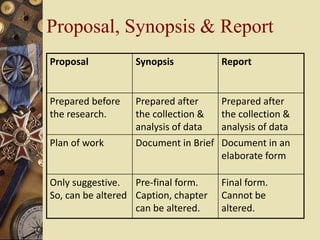
Proposal, Synopsis & Report
Proposal Synopsis Report
Prepared before
the research.
Prepared after
the collection &
analysis of data
Prepared after
the collection &
analysis of data
Plan of work Document in Brief Document in an
elaborate form
Only suggestive.
So, can be altered
Pre-final form.
Caption, chapter
can be altered.
Final form.
Cannot be
altered.
FORMS OF PROPOSALS
 For Masters Dissertations
 For Doctorate Thesis
 For Minor Projects
 For Major Projects
Dr.C.Thanavathi VOCCE 5
TYPES OF PROPOSALS
 Solicited Proposals
It refers to the proposals marked for specific
needs of the society, industry, nation and other
organizations. It is a form of applied research which
is concerned with understanding the ways of
functioning by nature and others. Its Aim is to
answer specific research questions.
 Unsolicited Proposals
It refers to a routine work and is a form of pure
research consisting of natural course of events. It
involves library research, theory construction, cross
validation etc. Dr.C.Thanavathi VOCCE 6
Description
 Research Proposal therefore is a planned
document proposing a project generally in
Science, Social Sciences, Behavioral
sciences, Humanities and other Academia
containing a request for Degree,
Sponsorship and funding having a notable
scope and significance. Such Proposals are
evaluated in respect of its potential impact,
relevance, scope, cost and time schedule.
Dr.C.Thanavathi VOCCE 7
Dr.C.Thanavathi VOCCE 8
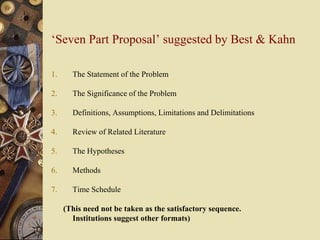
‘Seven Part Proposal’ suggested by Best & Kahn
1. The Statement of the Problem
2. The Significance of the Problem
3. Definitions, Assumptions, Limitations and Delimitations
4. Review of Related Literature
5. The Hypotheses
6. Methods
7. Time Schedule
(This need not be taken as the satisfactory sequence.
Institutions suggest other formats)
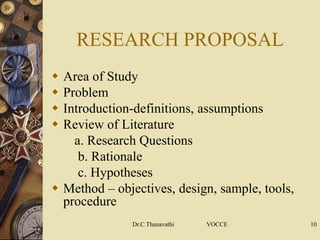
RESEARCH PROPOSAL
 Area of Study
 Problem
 Introduction-definitions, assumptions
 Review of Literature
a. Research Questions
b. Rationale
c. Hypotheses
 Method – objectives, design, sample, tools,
procedure
Dr.C.Thanavathi VOCCE 10
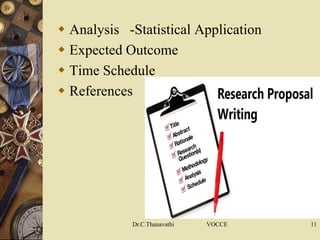
 Analysis -Statistical Application
 Expected Outcome
 Time Schedule
 References
Dr.C.Thanavathi VOCCE 11
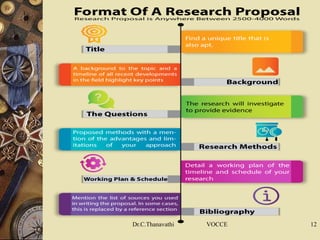
Dr.C.Thanavathi VOCCE 12
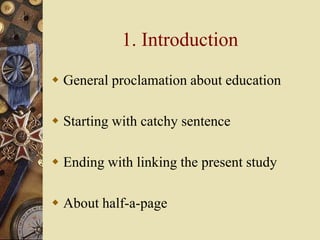
1. Introduction
 General proclamation about education
 Starting with catchy sentence
 Ending with linking the present study
 About half-a-page
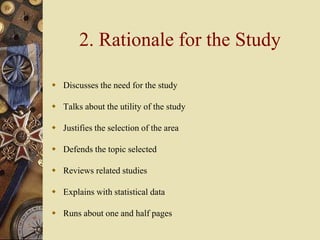
2. Rationale for the Study
 Discusses the need for the study
 Talks about the utility of the study
 Justifies the selection of the area
 Defends the topic selected
 Reviews related studies
 Explains with statistical data
 Runs about one and half pages
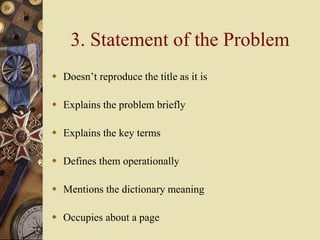
3. Statement of the Problem
 Doesn’t reproduce the title as it is
 Explains the problem briefly
 Explains the key terms
 Defines them operationally
 Mentions the dictionary meaning
 Occupies about a page
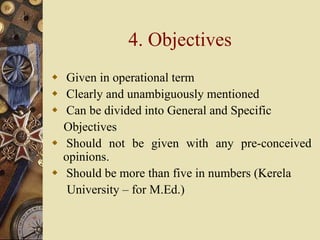
4. Objectives
 Given in operational term
 Clearly and unambiguously mentioned
 Can be divided into General and Specific
Objectives
 Should not be given with any pre-conceived
opinions.
 Should be more than five in numbers (Kerela
University – for M.Ed.)
5. Hypotheses
 Not given in some proposals
 Should be scientific
 At par with objectives
 Preferably Research Hypotheses
6. Research Paradigm
 Means model or design
 Portrays different forms of work
 Includes methods, sample, variables, tool (s),
statistical techniques, etc.
 Shows different phases of work
Method
 Fix the method
 If possible, justify the selection
 Discuss the phase
Sample
 Fix the population
 Finalise the No. of subjects
 Design the sampling technique
 Justify your choice, if possible
Variables
 Understand different types of variables
 Classify the variables you intend to select
 Mention them
 ‘Background Variables’ is the phrase used
Tool (s)
 Select the tool (s)
 Mention whether it is self-made or already
standardised
Statistical Technique
 Have thorough knowledge of statistics
 Discuss with experts
 Finalise the statistical technique you intend
to apply
7. Delimitations
 Understand the difference between limitations and delimitations.
Limitations are the conditions beyond researcher’s control. It
may place the restrictions on the conclusions of the study and
their applications.
Delimitations are the boundaries of the study and conclusions
are not to be extended beyond this sample.
 Delimitations only may better be given.
 They should be mentioned taking title for an account.
8. Time-Schedule
 Take available times
 Analyse the nature of every work and the time
required to complete it
 Plan your work accordingly
 Apply the principles of flexibility
 Adhere to it
9. Expected Outcome
 Discusses the utility value of the work
 Can be given either in paragraph or one
by one
 It is more important, when the proposal
is sent for funding agency.
RESEARCH
PROPOSAL
Model
Dr.C.Thanavathi VOCCE 28
TITLE
STUDY ON AWARENESS OF
E-WASTE MANAGEMENT
AMONG STUDENT TEACHERS
1.0 Statement of the Problem
Society is growing not only in population but also in
technology. Technology place is an important role in
growth of nation. And so and so lot of electronic
gadgets have been discovered and invented by humans
for the purpose of easy living.
Nowadays more than the population, the quantity of
electronic gadgets has been increased. And the
humankind is in hyper-tension mode of handling
electronic waste or e-waste. So proper awareness
should be need for the student teachers to improve their
E-Waste management.
The present investigation is a descriptive one aiming at
study on awareness of e-waste management among
student teachers.
Dr.C.Thanavathi VOCCE 30
2.0 Title of Study
 The title of the study is entitled as “Study
on Awareness of E-Waste Management
among Student Teachers”.
Dr.C.Thanavathi VOCCE 31
3.0 Significance of the Study
The world is polluted by various kind of pollutes such us air
pollutants, water pollutants, sanitary waste, medical waste and in recent
days. Electronic waste, managing and disposals of electronic waste had
been one of the greatest challenges faced by mankind. If humankind
allows the e-waste as waste on earth for longer time, the earth would
become toxic and unworthy to live.
So proper measures should be taken in handling e-waste. An
estimated 50 million tons of e-waste are produced each year. The
environmental protection agency estimates that only 15-20% of e-waste
is recycled, the rest of these electronics go directly into landfills and
incinerations. This information makes our heart to stop. It alarms that
this should be handled immediately with at most concern. Mishandling
of e-waste may cause damage to human life and endanger the lives
around it.
Hence needed efforts should be taken in handling e-waste. Student
teachers designed to create modern India with the help of students. So
it’s needy to measure the awareness of student teacher.
Dr.C.Thanavathi VOCCE 32
4.0 Review of Related Literature
 Brijesh Sivathanu (2016) conducted a study on User’s Perspective:
Knowledge and Attitude towards E-Waste. In this study, the investigator
discussed the consumers’ awareness and preference towards the disposal
of e-waste. A primary survey was conducted using a structured
questionnaire among 600 consumers in Pune city. The exploratory factor
analysis technique was deployed to identify the awareness factors
contributing to the consumer’s preference towards the proper disposal
and management of e-waste. The findings showed that five important
factors contribute to the consumer’s preference during the disposal of e-
waste. Cynthia S. Subhaprada, Kalyani (2017) conducted Study on
awareness of e-waste management among medical students. Health
education to create awareness regarding the hazards and management of
e-waste is the need of the hour to reduce, reuse and recycle e-waste.
Sapna Mishra and Shamanna (2018) conducted Exploring the
Awareness Regarding E-waste and its Health Hazards among the
Informal Handlers in Musheerabad Area of Hyderabad. This study
highlights the need for awareness campaigns on proper e-waste
management practices to ensure occupational safety among the waste
handlers who belong to lower socio-economic strata.
Dr.C.Thanavathi VOCCE 33
 Pauline Achieng Pesa (2016) conducted a study on assessing user awareness on
environmentally sound disposal of e-waste in Kenya. The main objective of the
study were; analysis of sound disposal options available to consumers and
whether consumers are aware of these options and to find out users awareness of
enforcement mechanisms in place with regard to disposal of E-Waste. The study
was conducted through primary and secondary research. Primary data was
gathered through face to face interviews with the people selected in the sample.
The disposal of the same is not done in the appropriate manner leading to health
hazards and environmental degradation. One of the reasons for such improper
disposal is lack of awareness of the users on how to handle E-Waste. Arnav
Chowdhury and Jitendra Patel (2018) conducted a study on E-Waste
Management and its Consequences: A Literature. Central issue of the present
study is electronic-waste (e-waste) that is rising as a brand new environmental
challenge for twenty first century. The implications and toxicity is thanks to
discharge of lead, mercury, cadmium, metallic element and alternative virulent
substances. Developed countries export this waste within the type of donation to
developing countries. China and some Asian nations, where environmental
standards are low, are the most important recipients of e-waste which, in most
cases, is processed illicitly. The environmental burden of e-waste is born by
people that sleep in developing countries. Despite varied laws and directives in
developed countries, the e-waste management is uncontrollable. The current
study focuses on the effect of usage, marketing and use of the electronic waste on
the natural setting.
Dr.C.Thanavathi VOCCE 34
5.0 Hypotheses
Objective of the Study
 To find the awareness of e-waste management among student
teachers.
Null Hypotheses
 To find out the levels in awareness of e-waste management
among student teachers is moderate.
 There is no significant difference between male and female
student teachers in their awareness of e-waste management.
 There is no significant difference between rural and urban
student teachers in their awareness of e-waste management.
 There is no significant difference between graduate and
postgraduate student teachers in their awareness of e-waste
management.
 There is no significant difference among usage of e-gadgets
among student teachers in their awareness of e-waste
management. Dr.C.Thanavathi VOCCE 35
6.0 Methods
6.1 Subjects:
 The investigator has decided to take the student
teachers in Thoothukudi district as the population.
From the above population the investigator will be
choosing 300 student teachers as the sample by
using simple random sampling technique.
6.2 Procedure:
 The investigator has proposed to use survey method
of research. The investigator will be used a self
made tool.
6.3 Data Analysis:
 The appropriate statistical techniques will be used.
Dr.C.Thanavathi VOCCE 36
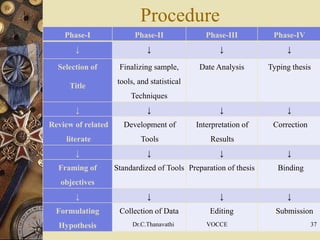
Phase-I Phase-II Phase-III Phase-IV
↓ ↓ ↓ ↓
Selection of
Title
Finalizing sample,
tools, and statistical
Techniques
Date Analysis Typing thesis
↓ ↓ ↓ ↓
Review of related
literate
Development of
Tools
Interpretation of
Results
Correction
↓ ↓ ↓ ↓
Framing of
objectives
Standardized of Tools Preparation of thesis Binding
↓ ↓ ↓ ↓
Formulating
Hypothesis
Collection of Data Editing Submission
Procedure
Dr.C.Thanavathi VOCCE 37
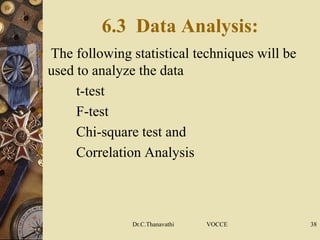
6.3 Data Analysis:
 The following statistical techniques will be
used to analyze the data
 t-test
 F-test
 Chi-square test and
 Correlation Analysis
Dr.C.Thanavathi VOCCE 38
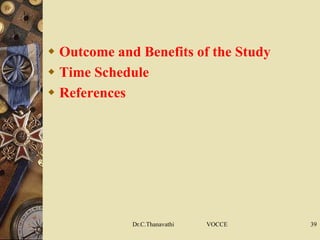
 Outcome and Benefits of the Study
 Time Schedule
 References
Dr.C.Thanavathi VOCCE 39
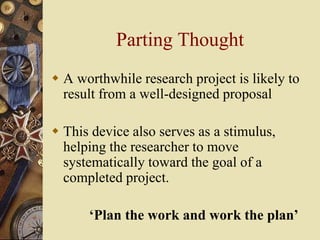
Parting Thought
 A worthwhile research project is likely to
result from a well-designed proposal
 This device also serves as a stimulus,
helping the researcher to move
systematically toward the goal of a
completed project.
‘Plan the work and work the plan’
Good luck with your
research proposals!
Dr.C.Thanavathi VOCCE 42

How to write a research proposal

  • 1.
    HOW TO WRITEA RESEARCH PROPOSAL Dr. C.THANAVATHI, M.A., M.Phil., M.Ed., M.Phil., SET, PGDHE, DGT, DCA, Ph.D., Assistant Professor of History V.O.C.College of Education, Thoothukudi. 9629256771 thanavathic@thanavathi-edu.in http://thanavathi-edu.in/index.html
  • 2.
    What is ResearchProposal?  It is a brief report about the study that a researcher intends studying.  It is comparable to the blueprint which the architect prepares before the building commences.  It is subject to modification in the light of the analysis by the researcher or his/her project advisor.  It provides the basis for evaluation and the basis for assistance.  It provides the systematic plan of procedure.
  • 3.
     Preparation ofa proposal is crucial in research  It provides different steps involved in the research process  It refers to an outline of a systematic, scientific inquiry  It is precisely called Blue Print of the research work  It ensures a workable plan of exploration, investigation, experimentation, etc. Dr.C.Thanavathi VOCCE 3
  • 4.
    Proposal, Synopsis &Report Proposal Synopsis Report Prepared before the research. Prepared after the collection & analysis of data Prepared after the collection & analysis of data Plan of work Document in Brief Document in an elaborate form Only suggestive. So, can be altered Pre-final form. Caption, chapter can be altered. Final form. Cannot be altered.
  • 5.
    FORMS OF PROPOSALS For Masters Dissertations  For Doctorate Thesis  For Minor Projects  For Major Projects Dr.C.Thanavathi VOCCE 5
  • 6.
    TYPES OF PROPOSALS Solicited Proposals It refers to the proposals marked for specific needs of the society, industry, nation and other organizations. It is a form of applied research which is concerned with understanding the ways of functioning by nature and others. Its Aim is to answer specific research questions.  Unsolicited Proposals It refers to a routine work and is a form of pure research consisting of natural course of events. It involves library research, theory construction, cross validation etc. Dr.C.Thanavathi VOCCE 6
  • 7.
    Description  Research Proposaltherefore is a planned document proposing a project generally in Science, Social Sciences, Behavioral sciences, Humanities and other Academia containing a request for Degree, Sponsorship and funding having a notable scope and significance. Such Proposals are evaluated in respect of its potential impact, relevance, scope, cost and time schedule. Dr.C.Thanavathi VOCCE 7
  • 8.
  • 9.
    ‘Seven Part Proposal’suggested by Best & Kahn 1. The Statement of the Problem 2. The Significance of the Problem 3. Definitions, Assumptions, Limitations and Delimitations 4. Review of Related Literature 5. The Hypotheses 6. Methods 7. Time Schedule (This need not be taken as the satisfactory sequence. Institutions suggest other formats)
  • 10.
    RESEARCH PROPOSAL  Areaof Study  Problem  Introduction-definitions, assumptions  Review of Literature a. Research Questions b. Rationale c. Hypotheses  Method – objectives, design, sample, tools, procedure Dr.C.Thanavathi VOCCE 10
  • 11.
     Analysis -StatisticalApplication  Expected Outcome  Time Schedule  References Dr.C.Thanavathi VOCCE 11
  • 12.
  • 13.
    1. Introduction  Generalproclamation about education  Starting with catchy sentence  Ending with linking the present study  About half-a-page
  • 14.
    2. Rationale forthe Study  Discusses the need for the study  Talks about the utility of the study  Justifies the selection of the area  Defends the topic selected  Reviews related studies  Explains with statistical data  Runs about one and half pages
  • 15.
    3. Statement ofthe Problem  Doesn’t reproduce the title as it is  Explains the problem briefly  Explains the key terms  Defines them operationally  Mentions the dictionary meaning  Occupies about a page
  • 16.
    4. Objectives  Givenin operational term  Clearly and unambiguously mentioned  Can be divided into General and Specific Objectives  Should not be given with any pre-conceived opinions.  Should be more than five in numbers (Kerela University – for M.Ed.)
  • 17.
    5. Hypotheses  Notgiven in some proposals  Should be scientific  At par with objectives  Preferably Research Hypotheses
  • 18.
    6. Research Paradigm Means model or design  Portrays different forms of work  Includes methods, sample, variables, tool (s), statistical techniques, etc.  Shows different phases of work
  • 19.
    Method  Fix themethod  If possible, justify the selection  Discuss the phase
  • 20.
    Sample  Fix thepopulation  Finalise the No. of subjects  Design the sampling technique  Justify your choice, if possible
  • 21.
    Variables  Understand differenttypes of variables  Classify the variables you intend to select  Mention them  ‘Background Variables’ is the phrase used
  • 22.
    Tool (s)  Selectthe tool (s)  Mention whether it is self-made or already standardised
  • 23.
    Statistical Technique  Havethorough knowledge of statistics  Discuss with experts  Finalise the statistical technique you intend to apply
  • 24.
    7. Delimitations  Understandthe difference between limitations and delimitations. Limitations are the conditions beyond researcher’s control. It may place the restrictions on the conclusions of the study and their applications. Delimitations are the boundaries of the study and conclusions are not to be extended beyond this sample.  Delimitations only may better be given.  They should be mentioned taking title for an account.
  • 25.
    8. Time-Schedule  Takeavailable times  Analyse the nature of every work and the time required to complete it  Plan your work accordingly  Apply the principles of flexibility  Adhere to it
  • 26.
    9. Expected Outcome Discusses the utility value of the work  Can be given either in paragraph or one by one  It is more important, when the proposal is sent for funding agency.
  • 27.
  • 28.
  • 29.
    TITLE STUDY ON AWARENESSOF E-WASTE MANAGEMENT AMONG STUDENT TEACHERS
  • 30.
    1.0 Statement ofthe Problem Society is growing not only in population but also in technology. Technology place is an important role in growth of nation. And so and so lot of electronic gadgets have been discovered and invented by humans for the purpose of easy living. Nowadays more than the population, the quantity of electronic gadgets has been increased. And the humankind is in hyper-tension mode of handling electronic waste or e-waste. So proper awareness should be need for the student teachers to improve their E-Waste management. The present investigation is a descriptive one aiming at study on awareness of e-waste management among student teachers. Dr.C.Thanavathi VOCCE 30
  • 31.
    2.0 Title ofStudy  The title of the study is entitled as “Study on Awareness of E-Waste Management among Student Teachers”. Dr.C.Thanavathi VOCCE 31
  • 32.
    3.0 Significance ofthe Study The world is polluted by various kind of pollutes such us air pollutants, water pollutants, sanitary waste, medical waste and in recent days. Electronic waste, managing and disposals of electronic waste had been one of the greatest challenges faced by mankind. If humankind allows the e-waste as waste on earth for longer time, the earth would become toxic and unworthy to live. So proper measures should be taken in handling e-waste. An estimated 50 million tons of e-waste are produced each year. The environmental protection agency estimates that only 15-20% of e-waste is recycled, the rest of these electronics go directly into landfills and incinerations. This information makes our heart to stop. It alarms that this should be handled immediately with at most concern. Mishandling of e-waste may cause damage to human life and endanger the lives around it. Hence needed efforts should be taken in handling e-waste. Student teachers designed to create modern India with the help of students. So it’s needy to measure the awareness of student teacher. Dr.C.Thanavathi VOCCE 32
  • 33.
    4.0 Review ofRelated Literature  Brijesh Sivathanu (2016) conducted a study on User’s Perspective: Knowledge and Attitude towards E-Waste. In this study, the investigator discussed the consumers’ awareness and preference towards the disposal of e-waste. A primary survey was conducted using a structured questionnaire among 600 consumers in Pune city. The exploratory factor analysis technique was deployed to identify the awareness factors contributing to the consumer’s preference towards the proper disposal and management of e-waste. The findings showed that five important factors contribute to the consumer’s preference during the disposal of e- waste. Cynthia S. Subhaprada, Kalyani (2017) conducted Study on awareness of e-waste management among medical students. Health education to create awareness regarding the hazards and management of e-waste is the need of the hour to reduce, reuse and recycle e-waste. Sapna Mishra and Shamanna (2018) conducted Exploring the Awareness Regarding E-waste and its Health Hazards among the Informal Handlers in Musheerabad Area of Hyderabad. This study highlights the need for awareness campaigns on proper e-waste management practices to ensure occupational safety among the waste handlers who belong to lower socio-economic strata. Dr.C.Thanavathi VOCCE 33
  • 34.
     Pauline AchiengPesa (2016) conducted a study on assessing user awareness on environmentally sound disposal of e-waste in Kenya. The main objective of the study were; analysis of sound disposal options available to consumers and whether consumers are aware of these options and to find out users awareness of enforcement mechanisms in place with regard to disposal of E-Waste. The study was conducted through primary and secondary research. Primary data was gathered through face to face interviews with the people selected in the sample. The disposal of the same is not done in the appropriate manner leading to health hazards and environmental degradation. One of the reasons for such improper disposal is lack of awareness of the users on how to handle E-Waste. Arnav Chowdhury and Jitendra Patel (2018) conducted a study on E-Waste Management and its Consequences: A Literature. Central issue of the present study is electronic-waste (e-waste) that is rising as a brand new environmental challenge for twenty first century. The implications and toxicity is thanks to discharge of lead, mercury, cadmium, metallic element and alternative virulent substances. Developed countries export this waste within the type of donation to developing countries. China and some Asian nations, where environmental standards are low, are the most important recipients of e-waste which, in most cases, is processed illicitly. The environmental burden of e-waste is born by people that sleep in developing countries. Despite varied laws and directives in developed countries, the e-waste management is uncontrollable. The current study focuses on the effect of usage, marketing and use of the electronic waste on the natural setting. Dr.C.Thanavathi VOCCE 34
  • 35.
    5.0 Hypotheses Objective ofthe Study  To find the awareness of e-waste management among student teachers. Null Hypotheses  To find out the levels in awareness of e-waste management among student teachers is moderate.  There is no significant difference between male and female student teachers in their awareness of e-waste management.  There is no significant difference between rural and urban student teachers in their awareness of e-waste management.  There is no significant difference between graduate and postgraduate student teachers in their awareness of e-waste management.  There is no significant difference among usage of e-gadgets among student teachers in their awareness of e-waste management. Dr.C.Thanavathi VOCCE 35
  • 36.
    6.0 Methods 6.1 Subjects: The investigator has decided to take the student teachers in Thoothukudi district as the population. From the above population the investigator will be choosing 300 student teachers as the sample by using simple random sampling technique. 6.2 Procedure:  The investigator has proposed to use survey method of research. The investigator will be used a self made tool. 6.3 Data Analysis:  The appropriate statistical techniques will be used. Dr.C.Thanavathi VOCCE 36
  • 37.
    Phase-I Phase-II Phase-IIIPhase-IV ↓ ↓ ↓ ↓ Selection of Title Finalizing sample, tools, and statistical Techniques Date Analysis Typing thesis ↓ ↓ ↓ ↓ Review of related literate Development of Tools Interpretation of Results Correction ↓ ↓ ↓ ↓ Framing of objectives Standardized of Tools Preparation of thesis Binding ↓ ↓ ↓ ↓ Formulating Hypothesis Collection of Data Editing Submission Procedure Dr.C.Thanavathi VOCCE 37
  • 38.
    6.3 Data Analysis: The following statistical techniques will be used to analyze the data  t-test  F-test  Chi-square test and  Correlation Analysis Dr.C.Thanavathi VOCCE 38
  • 39.
     Outcome andBenefits of the Study  Time Schedule  References Dr.C.Thanavathi VOCCE 39
  • 40.
    Parting Thought  Aworthwhile research project is likely to result from a well-designed proposal  This device also serves as a stimulus, helping the researcher to move systematically toward the goal of a completed project. ‘Plan the work and work the plan’
  • 41.
    Good luck withyour research proposals!
  • 42.