RECENT DEVELOPMENT IN
SCHOOL CURRICULUM
Mrs.R.Kohila Devi
Asst. Prof. in Education
Thiagarajar College of Preceptors
Madurai -9
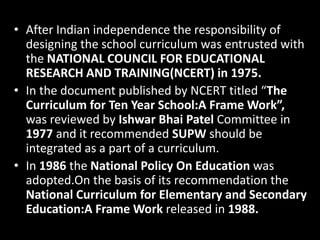
• After Indian independence the responsibility of
designing the school curriculum was entrusted with
the NATIONAL COUNCIL FOR EDUCATIONAL
RESEARCH AND TRAINING(NCERT) in 1975.
• In the document published by NCERT titled “The
Curriculum for Ten Year School:A Frame Work”,
was reviewed by Ishwar Bhai Patel Committee in
1977 and it recommended SUPW should be
integrated as a part of a curriculum.
• In 1986 the National Policy On Education was
adopted.On the basis of its recommendation the
National Curriculum for Elementary and Secondary
Education:A Frame Work released in 1988.
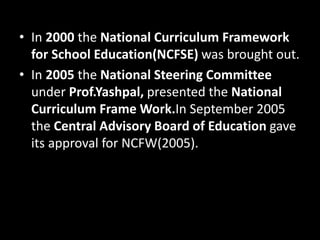
• In 2000 the National Curriculum Framework
for School Education(NCFSE) was brought out.
• In 2005 the National Steering Committee
under Prof.Yashpal, presented the National
Curriculum Frame Work.In September 2005
the Central Advisory Board of Education gave
its approval for NCFW(2005).
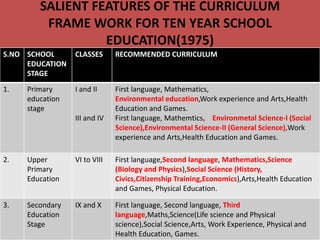
SALIENT FEATURES OF THE CURRICULUM
FRAME WORK FOR TEN YEAR SCHOOL
EDUCATION(1975)
S.NO SCHOOL
EDUCATION
STAGE
CLASSES RECOMMENDED CURRICULUM
1. Primary
education
stage
I and II
III and IV
First language, Mathematics,
Environmental education,Work experience and Arts,Health
Education and Games.
First language, Mathemtics, Environmetal Science-I (Social
Science),Environmental Science-II (General Science),Work
experience and Arts,Health Education and Games.
2. Upper
Primary
Education
VI to VIII First language,Second language, Mathematics,Science
(Biology and Physics),Social Science (History,
Civics,Citizenship Training,Economics),Arts,Health Education
and Games, Physical Education.
3. Secondary
Education
Stage
IX and X First language, Second language, Third
language,Maths,Science(Life science and Physical
science),Social Science,Arts, Work Experience, Physical and
Health Education, Games.
THE SALIENT FEATURES OF
NATIONAL CURRICULUM FRAME
WORK FOR ELEMENTARY AND
SECONDARYEDUCATION(1988)
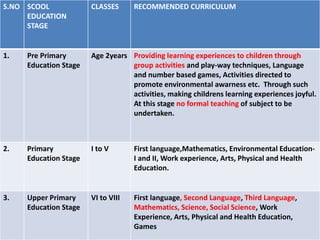
S.NO SCOOL
EDUCATION
STAGE
CLASSES RECOMMENDED CURRICULUM
1. Pre Primary
Education Stage
Age 2years Providing learning experiences to children through
group activities and play-way techniques, Language
and number based games, Activities directed to
promote environmental awarness etc. Through such
activities, making childrens learning experiences joyful.
At this stage no formal teaching of subject to be
undertaken.
2. Primary
Education Stage
I to V First language,Mathematics, Environmental Education-
I and II, Work experience, Arts, Physical and Health
Education.
3. Upper Primary
Education Stage
VI to VIII First language, Second Language, Third Language,
Mathematics, Science, Social Science, Work
Experience, Arts, Physical and Health Education,
Games
SALIENT FEATURES OF THE
NATIONAL CURRICULUM
FRAMEWORK(2000)
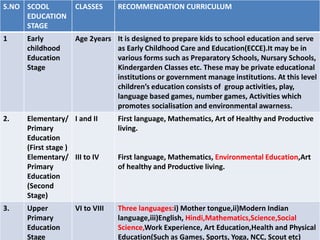
S.NO SCOOL
EDUCATION
STAGE
CLASSES RECOMMENDATION CURRICULUM
1 Early
childhood
Education
Stage
Age 2years It is designed to prepare kids to school education and serve
as Early Childhood Care and Education(ECCE).It may be in
various forms such as Preparatory Schools, Nursary Schools,
Kindergarden Classes etc. These may be private educational
institutions or government manage institutions. At this level
children’s education consists of group activities, play,
language based games, number games, Activities which
promotes socialisation and environmental awarness.
2. Elementary/
Primary
Education
(First stage )
Elementary/
Primary
Education
(Second
Stage)
I and II
III to IV
First language, Mathematics, Art of Healthy and Productive
living.
First language, Mathematics, Environmental Education,Art
of healthy and Productive living.
3. Upper
Primary
Education
Stage
VI to VIII Three languages:i) Mother tongue,ii)Modern Indian
language,iii)English, Hindi,Mathematics,Science,Social
Science,Work Experience, Art Education,Health and Physical
Education(Such as Games, Sports, Yoga, NCC, Scout etc)
SALIENT FEATURES OF NATIONAL
CURRICULUM FRAMEWORK-2005
• The National Policy on education
1986, a National Steering Committee
under Prof. Yashpal was constituted
in 2005.
• It framed the National Curriculum for
school education in 2005 with the
help of its 21 sub-committees.
The document it presented includes
five segments. They are,
• Perspective of NCF
• Learning and knowledge
• Curricular area, school stages and assessment
• School and classroom environment
• Systematic reforms
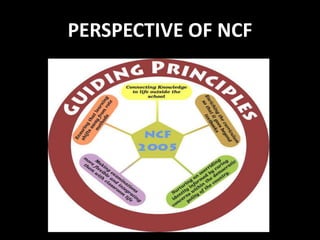
PERSPECTIVE OF NCF
PERSPECTIVE OF NCF
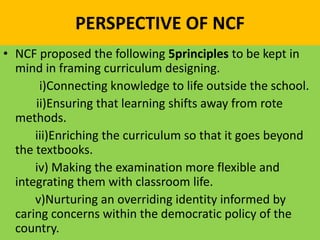
• NCF proposed the following 5principles to be kept in
mind in framing curriculum designing.
i)Connecting knowledge to life outside the school.
ii)Ensuring that learning shifts away from rote
methods.
iii)Enriching the curriculum so that it goes beyond
the textbooks.
iv) Making the examination more flexible and
integrating them with classroom life.
v)Nurturing an overriding identity informed by
caring concerns within the democratic policy of the
country.
LEARNING AND KNOWLEDGE
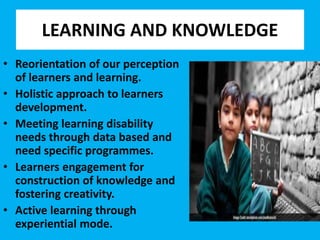
• Reorientation of our perception
of learners and learning.
• Holistic approach to learners
development.
• Meeting learning disability
needs through data based and
need specific programmes.
• Learners engagement for
construction of knowledge and
fostering creativity.
• Active learning through
experiential mode.
• Adequate room for voicing children’s thinking,
curiosity and questions in teaching.
• Activities for developing critical perspectives on
socio-cultural realities need to find place in
curricular practices.
• Connecting knowledge across disciplinary
boundaries to provide a broader frame for
insightful construction of knowledge.
Forms of learner engagement : experience,
making and doing, experimenting, reading,
discussion, asking, listening, thinking and
reflecting, expressing oneself.
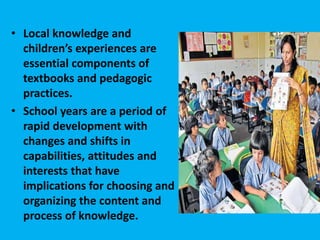
• Local knowledge and
children’s experiences are
essential components of
textbooks and pedagogic
practices.
• School years are a period of
rapid development with
changes and shifts in
capabilities, attitudes and
interests that have
implications for choosing and
organizing the content and
process of knowledge.
CURRICULAR AREAS, SCHOOL STAGES AND
ASSESMENT
• LANGUAGE:
Implementation of three
language formula.
• MATHEMATICS:
Teaching of maths is to develop
the thinking and reasoning, to
visualize and handle abstractions,
to formulate and solve problems.
• SCIENCE:
Teaching of science is to enable
learners to acquire method and
process that will nurture the
thinking process, curiosity and
creativity.
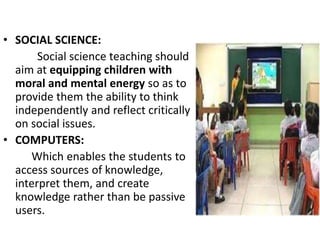
• SOCIAL SCIENCE:
Social science teaching should
aim at equipping children with
moral and mental energy so as to
provide them the ability to think
independently and reflect critically
on social issues.
• COMPUTERS:
Which enables the students to
access sources of knowledge,
interpret them, and create
knowledge rather than be passive
users.
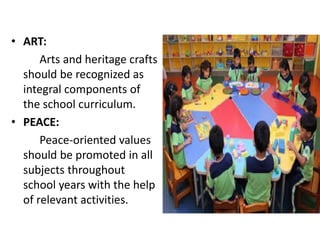
• ART:
Arts and heritage crafts
should be recognized as
integral components of
the school curriculum.
• PEACE:
Peace-oriented values
should be promoted in all
subjects throughout
school years with the help
of relevant activities.
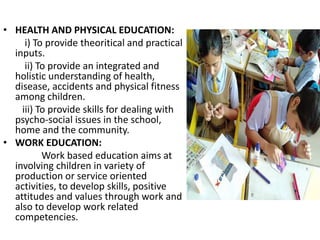
• HEALTH AND PHYSICAL EDUCATION:
i) To provide theoritical and practical
inputs.
ii) To provide an integrated and
holistic understanding of health,
disease, accidents and physical fitness
among children.
iii) To provide skills for dealing with
psycho-social issues in the school,
home and the community.
• WORK EDUCATION:
Work based education aims at
involving children in variety of
production or service oriented
activities, to develop skills, positive
attitudes and values through work and
also to develop work related
competencies.
SCHOOL AND CLASSROOM
ENVIRONMENT
SCHOOL AND CLASSROOM
ENVIRONMENT
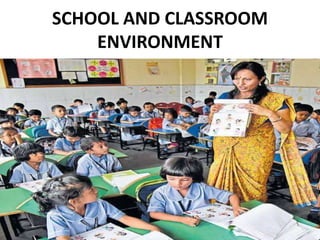
• Availability of minimum infrastructure and material
facilities, and support for planning a flexible daily
schedule are critical for improved teacher
performance.
• Teacher student ratio is to be maintained as 1:30.
• Democratic classroom practices
• Participation of all learners in class work.
• Education technology, libraries and laboratories are
to be well maintained in all schools.
SYSTEMATIC REFORMS
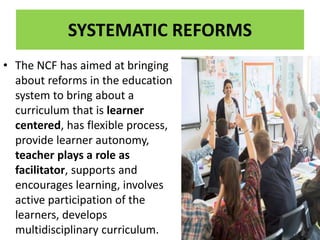
• The NCF has aimed at bringing
about reforms in the education
system to bring about a
curriculum that is learner
centered, has flexible process,
provide learner autonomy,
teacher plays a role as
facilitator, supports and
encourages learning, involves
active participation of the
learners, develops
multidisciplinary curriculum.
THANKYOU

RECENT DEVELOPMENT IN SCHOOL SUBJECT AND CURRICULUM

  • 1.
    RECENT DEVELOPMENT IN SCHOOLCURRICULUM Mrs.R.Kohila Devi Asst. Prof. in Education Thiagarajar College of Preceptors Madurai -9
  • 2.
    • After Indianindependence the responsibility of designing the school curriculum was entrusted with the NATIONAL COUNCIL FOR EDUCATIONAL RESEARCH AND TRAINING(NCERT) in 1975. • In the document published by NCERT titled “The Curriculum for Ten Year School:A Frame Work”, was reviewed by Ishwar Bhai Patel Committee in 1977 and it recommended SUPW should be integrated as a part of a curriculum. • In 1986 the National Policy On Education was adopted.On the basis of its recommendation the National Curriculum for Elementary and Secondary Education:A Frame Work released in 1988.
  • 3.
    • In 2000the National Curriculum Framework for School Education(NCFSE) was brought out. • In 2005 the National Steering Committee under Prof.Yashpal, presented the National Curriculum Frame Work.In September 2005 the Central Advisory Board of Education gave its approval for NCFW(2005).
  • 4.
    SALIENT FEATURES OFTHE CURRICULUM FRAME WORK FOR TEN YEAR SCHOOL EDUCATION(1975) S.NO SCHOOL EDUCATION STAGE CLASSES RECOMMENDED CURRICULUM 1. Primary education stage I and II III and IV First language, Mathematics, Environmental education,Work experience and Arts,Health Education and Games. First language, Mathemtics, Environmetal Science-I (Social Science),Environmental Science-II (General Science),Work experience and Arts,Health Education and Games. 2. Upper Primary Education VI to VIII First language,Second language, Mathematics,Science (Biology and Physics),Social Science (History, Civics,Citizenship Training,Economics),Arts,Health Education and Games, Physical Education. 3. Secondary Education Stage IX and X First language, Second language, Third language,Maths,Science(Life science and Physical science),Social Science,Arts, Work Experience, Physical and Health Education, Games.
  • 5.
    THE SALIENT FEATURESOF NATIONAL CURRICULUM FRAME WORK FOR ELEMENTARY AND SECONDARYEDUCATION(1988)
  • 6.
    S.NO SCOOL EDUCATION STAGE CLASSES RECOMMENDEDCURRICULUM 1. Pre Primary Education Stage Age 2years Providing learning experiences to children through group activities and play-way techniques, Language and number based games, Activities directed to promote environmental awarness etc. Through such activities, making childrens learning experiences joyful. At this stage no formal teaching of subject to be undertaken. 2. Primary Education Stage I to V First language,Mathematics, Environmental Education- I and II, Work experience, Arts, Physical and Health Education. 3. Upper Primary Education Stage VI to VIII First language, Second Language, Third Language, Mathematics, Science, Social Science, Work Experience, Arts, Physical and Health Education, Games
  • 7.
    SALIENT FEATURES OFTHE NATIONAL CURRICULUM FRAMEWORK(2000)
  • 8.
    S.NO SCOOL EDUCATION STAGE CLASSES RECOMMENDATIONCURRICULUM 1 Early childhood Education Stage Age 2years It is designed to prepare kids to school education and serve as Early Childhood Care and Education(ECCE).It may be in various forms such as Preparatory Schools, Nursary Schools, Kindergarden Classes etc. These may be private educational institutions or government manage institutions. At this level children’s education consists of group activities, play, language based games, number games, Activities which promotes socialisation and environmental awarness. 2. Elementary/ Primary Education (First stage ) Elementary/ Primary Education (Second Stage) I and II III to IV First language, Mathematics, Art of Healthy and Productive living. First language, Mathematics, Environmental Education,Art of healthy and Productive living. 3. Upper Primary Education Stage VI to VIII Three languages:i) Mother tongue,ii)Modern Indian language,iii)English, Hindi,Mathematics,Science,Social Science,Work Experience, Art Education,Health and Physical Education(Such as Games, Sports, Yoga, NCC, Scout etc)
  • 9.
    SALIENT FEATURES OFNATIONAL CURRICULUM FRAMEWORK-2005 • The National Policy on education 1986, a National Steering Committee under Prof. Yashpal was constituted in 2005. • It framed the National Curriculum for school education in 2005 with the help of its 21 sub-committees.
  • 10.
    The document itpresented includes five segments. They are, • Perspective of NCF • Learning and knowledge • Curricular area, school stages and assessment • School and classroom environment • Systematic reforms
  • 11.
  • 12.
    PERSPECTIVE OF NCF •NCF proposed the following 5principles to be kept in mind in framing curriculum designing. i)Connecting knowledge to life outside the school. ii)Ensuring that learning shifts away from rote methods. iii)Enriching the curriculum so that it goes beyond the textbooks. iv) Making the examination more flexible and integrating them with classroom life. v)Nurturing an overriding identity informed by caring concerns within the democratic policy of the country.
  • 13.
    LEARNING AND KNOWLEDGE •Reorientation of our perception of learners and learning. • Holistic approach to learners development. • Meeting learning disability needs through data based and need specific programmes. • Learners engagement for construction of knowledge and fostering creativity. • Active learning through experiential mode.
  • 14.
    • Adequate roomfor voicing children’s thinking, curiosity and questions in teaching. • Activities for developing critical perspectives on socio-cultural realities need to find place in curricular practices. • Connecting knowledge across disciplinary boundaries to provide a broader frame for insightful construction of knowledge. Forms of learner engagement : experience, making and doing, experimenting, reading, discussion, asking, listening, thinking and reflecting, expressing oneself.
  • 15.
    • Local knowledgeand children’s experiences are essential components of textbooks and pedagogic practices. • School years are a period of rapid development with changes and shifts in capabilities, attitudes and interests that have implications for choosing and organizing the content and process of knowledge.
  • 16.
    CURRICULAR AREAS, SCHOOLSTAGES AND ASSESMENT • LANGUAGE: Implementation of three language formula. • MATHEMATICS: Teaching of maths is to develop the thinking and reasoning, to visualize and handle abstractions, to formulate and solve problems. • SCIENCE: Teaching of science is to enable learners to acquire method and process that will nurture the thinking process, curiosity and creativity.
  • 17.
    • SOCIAL SCIENCE: Socialscience teaching should aim at equipping children with moral and mental energy so as to provide them the ability to think independently and reflect critically on social issues. • COMPUTERS: Which enables the students to access sources of knowledge, interpret them, and create knowledge rather than be passive users.
  • 18.
    • ART: Arts andheritage crafts should be recognized as integral components of the school curriculum. • PEACE: Peace-oriented values should be promoted in all subjects throughout school years with the help of relevant activities.
  • 19.
    • HEALTH ANDPHYSICAL EDUCATION: i) To provide theoritical and practical inputs. ii) To provide an integrated and holistic understanding of health, disease, accidents and physical fitness among children. iii) To provide skills for dealing with psycho-social issues in the school, home and the community. • WORK EDUCATION: Work based education aims at involving children in variety of production or service oriented activities, to develop skills, positive attitudes and values through work and also to develop work related competencies.
  • 20.
  • 21.
    SCHOOL AND CLASSROOM ENVIRONMENT •Availability of minimum infrastructure and material facilities, and support for planning a flexible daily schedule are critical for improved teacher performance. • Teacher student ratio is to be maintained as 1:30. • Democratic classroom practices • Participation of all learners in class work. • Education technology, libraries and laboratories are to be well maintained in all schools.
  • 22.
    SYSTEMATIC REFORMS • TheNCF has aimed at bringing about reforms in the education system to bring about a curriculum that is learner centered, has flexible process, provide learner autonomy, teacher plays a role as facilitator, supports and encourages learning, involves active participation of the learners, develops multidisciplinary curriculum.
  • 23.