Power Storage
Saurjyesh Nayak
2020A3PS1537P
PS1- Pyrotech electronics
1
Necessity
• Solar Energy is not readily available to be harnessed at all
times
• It depends on the time and weather conditions
• Majority of the electricity produced is during the day when
demand is usually low
• Electricity if not stored will have to be used at the time of
generation itself
• Energy storage allows surplus generation and the stored
energy can be made use of when supply reduces and demand
increases due to any factors
2
Methods
• Energy generated is used to heat water or melt salt. This is
then used as a heat source and generate heat when required.
• Flywheel is a rotating mechanical device that is used to store
rotational energy that can be called up instantaneously. At the
most basic level, a flywheel contains a spinning mass in its
center that is driven by a motor.
• Water is pumped uphill into a reservoir and then stored till
there is an energy requirement. Then it is allowed to flow
downhill.
• In Compressed air energy storage ambient air or another gas is
compressed and stored under pressure in an underground
cavern or container. 3
Battery storage
• Unlike some of the conventional methods batteries can be
used to store energy on a small scale basis and for a short
duration.
• These can be used in individual homes along with separate
solar panels.
• The storage may be connected to the grid or not.
• Grid connected storages can send surplus power back to the
grid i.e. that they will be selling some of the generated power.
Also they can draw power from the grid when required
• Storages without a connection to the grid will be completely
independent.
4
Battery specifications
• Capacity: Tells the energy stored in the battery in kilowatt
hours depending on your needs you chose a suitable one
Generally they range from 3 kWh to 13 kWh.
• Power rating: Tells the power rating in kW
• Depth of discharge: Tells the percentage energy which can be
used from a battery before it needs to be recharged.
• Battery cycles: Tells how many time can the battery the
battery can discharge from 100% to depth of discharge.
• End of lifetime: Tells the percentage of total capacity of energy
which when becomes the maximum charge then the battery
needs to be replaced.
5
Battery technologies
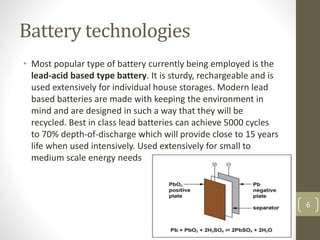
• Most popular type of battery currently being employed is the
lead-acid based type battery. It is sturdy, rechargeable and is
used extensively for individual house storages. Modern lead
based batteries are made with keeping the environment in
mind and are designed in such a way that they will be
recycled. Best in class lead batteries can achieve 5000 cycles
to 70% depth-of-discharge which will provide close to 15 years
life when used intensively. Used extensively for small to
medium scale energy needs
6
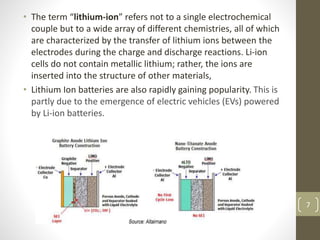
• The term “lithium-ion” refers not to a single electrochemical
couple but to a wide array of different chemistries, all of which
are characterized by the transfer of lithium ions between the
electrodes during the charge and discharge reactions. Li-ion
cells do not contain metallic lithium; rather, the ions are
inserted into the structure of other materials,
• Lithium Ion batteries are also rapidly gaining popularity. This is
partly due to the emergence of electric vehicles (EVs) powered
by Li-ion batteries.
7
• The flexibility of Li-ion technology in EV applications, from
small high-power batteries for power buffering in hybrids, to
medium-power batteries providing both electric-only range
and power buffering in plug-in hybrids, to high-energy
batteries in electric-only vehicles, is one of the reasons Li-ion
batteries are popular.
• Li-ion cells do not contain metallic lithium; rather, the ions are
inserted into the structure of other materials, such as lithiated
metal oxides or phosphates in the positive electrode (cathode)
and carbon (typically graphite) or lithium titanate in the
negative (anode).
• Li-ion cells may be produced in cylindrical or prismatic
(rectangular) format. These cells are then typically built into
multi-cell modules in series and/or parallel arrays, and the
modules are connected together to form a battery string at
the required voltage, with each string being controlled by a
battery management system. 8
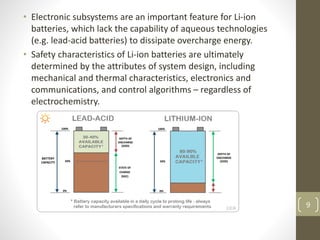
• Electronic subsystems are an important feature for Li-ion
batteries, which lack the capability of aqueous technologies
(e.g. lead-acid batteries) to dissipate overcharge energy.
• Safety characteristics of Li-ion batteries are ultimately
determined by the attributes of system design, including
mechanical and thermal characteristics, electronics and
communications, and control algorithms – regardless of
electrochemistry.
9
Batteries for EVs
• The EV market still faces two significant challenges: cost and
driving range. The latter is considered to be the major trend
for full EV adoption. One way to reduce costs and increase
system efficiency is to integrate the powertrain. Integration
also reduces the need for excess packaging materials and
eliminates redundant hardware, significantly reducing the
weight and volume of the system.
• EVs incorporating technologies such as automotive-qualified
GaN (Gallium Nitride) technology can help extend driving
range by operating at higher efficiency and conserving thermal
energy. This means fewer cooling components and lower
costs.
10
• GaN is an extremely versatile semiconductor material that can
operate at high temperatures and voltages, helping to
efficiently meet a wide range of communications and
industrial designs. One of the challenges in the field of EVs is
fast and efficient charging. GaN technology can offer fast
charging that uses energy in a much more efficient way.
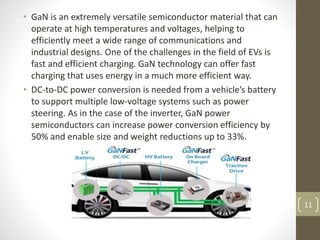
• DC-to-DC power conversion is needed from a vehicle’s battery
to support multiple low-voltage systems such as power
steering. As in the case of the inverter, GaN power
semiconductors can increase power conversion efficiency by
50% and enable size and weight reductions up to 33%.
11
Conclusion
• Efficient storage is very important to ensuring energy security
and self sufficiency in generation. This in turn will reduce
dependence on
12

Solar Power Shortage.pptx

  • 1.
  • 2.
    Necessity • Solar Energyis not readily available to be harnessed at all times • It depends on the time and weather conditions • Majority of the electricity produced is during the day when demand is usually low • Electricity if not stored will have to be used at the time of generation itself • Energy storage allows surplus generation and the stored energy can be made use of when supply reduces and demand increases due to any factors 2
  • 3.
    Methods • Energy generatedis used to heat water or melt salt. This is then used as a heat source and generate heat when required. • Flywheel is a rotating mechanical device that is used to store rotational energy that can be called up instantaneously. At the most basic level, a flywheel contains a spinning mass in its center that is driven by a motor. • Water is pumped uphill into a reservoir and then stored till there is an energy requirement. Then it is allowed to flow downhill. • In Compressed air energy storage ambient air or another gas is compressed and stored under pressure in an underground cavern or container. 3
  • 4.
    Battery storage • Unlikesome of the conventional methods batteries can be used to store energy on a small scale basis and for a short duration. • These can be used in individual homes along with separate solar panels. • The storage may be connected to the grid or not. • Grid connected storages can send surplus power back to the grid i.e. that they will be selling some of the generated power. Also they can draw power from the grid when required • Storages without a connection to the grid will be completely independent. 4
  • 5.
    Battery specifications • Capacity:Tells the energy stored in the battery in kilowatt hours depending on your needs you chose a suitable one Generally they range from 3 kWh to 13 kWh. • Power rating: Tells the power rating in kW • Depth of discharge: Tells the percentage energy which can be used from a battery before it needs to be recharged. • Battery cycles: Tells how many time can the battery the battery can discharge from 100% to depth of discharge. • End of lifetime: Tells the percentage of total capacity of energy which when becomes the maximum charge then the battery needs to be replaced. 5
  • 6.
    Battery technologies • Mostpopular type of battery currently being employed is the lead-acid based type battery. It is sturdy, rechargeable and is used extensively for individual house storages. Modern lead based batteries are made with keeping the environment in mind and are designed in such a way that they will be recycled. Best in class lead batteries can achieve 5000 cycles to 70% depth-of-discharge which will provide close to 15 years life when used intensively. Used extensively for small to medium scale energy needs 6
  • 7.
    • The term“lithium-ion” refers not to a single electrochemical couple but to a wide array of different chemistries, all of which are characterized by the transfer of lithium ions between the electrodes during the charge and discharge reactions. Li-ion cells do not contain metallic lithium; rather, the ions are inserted into the structure of other materials, • Lithium Ion batteries are also rapidly gaining popularity. This is partly due to the emergence of electric vehicles (EVs) powered by Li-ion batteries. 7
  • 8.
    • The flexibilityof Li-ion technology in EV applications, from small high-power batteries for power buffering in hybrids, to medium-power batteries providing both electric-only range and power buffering in plug-in hybrids, to high-energy batteries in electric-only vehicles, is one of the reasons Li-ion batteries are popular. • Li-ion cells do not contain metallic lithium; rather, the ions are inserted into the structure of other materials, such as lithiated metal oxides or phosphates in the positive electrode (cathode) and carbon (typically graphite) or lithium titanate in the negative (anode). • Li-ion cells may be produced in cylindrical or prismatic (rectangular) format. These cells are then typically built into multi-cell modules in series and/or parallel arrays, and the modules are connected together to form a battery string at the required voltage, with each string being controlled by a battery management system. 8
  • 9.
    • Electronic subsystemsare an important feature for Li-ion batteries, which lack the capability of aqueous technologies (e.g. lead-acid batteries) to dissipate overcharge energy. • Safety characteristics of Li-ion batteries are ultimately determined by the attributes of system design, including mechanical and thermal characteristics, electronics and communications, and control algorithms – regardless of electrochemistry. 9
  • 10.
    Batteries for EVs •The EV market still faces two significant challenges: cost and driving range. The latter is considered to be the major trend for full EV adoption. One way to reduce costs and increase system efficiency is to integrate the powertrain. Integration also reduces the need for excess packaging materials and eliminates redundant hardware, significantly reducing the weight and volume of the system. • EVs incorporating technologies such as automotive-qualified GaN (Gallium Nitride) technology can help extend driving range by operating at higher efficiency and conserving thermal energy. This means fewer cooling components and lower costs. 10
  • 11.
    • GaN isan extremely versatile semiconductor material that can operate at high temperatures and voltages, helping to efficiently meet a wide range of communications and industrial designs. One of the challenges in the field of EVs is fast and efficient charging. GaN technology can offer fast charging that uses energy in a much more efficient way. • DC-to-DC power conversion is needed from a vehicle’s battery to support multiple low-voltage systems such as power steering. As in the case of the inverter, GaN power semiconductors can increase power conversion efficiency by 50% and enable size and weight reductions up to 33%. 11
  • 12.
    Conclusion • Efficient storageis very important to ensuring energy security and self sufficiency in generation. This in turn will reduce dependence on 12