Main Headquarters: 120 Water Street, Suite 350, North Andover, MA 01845 With offices in: NY, ME, TX, CA, OR www.ers-inc.com
FACILITY SCALE BATTERY STORAGE
Jesse Remillard – Energy & Resource Solutions
 To ensure power quality and level demand
 For integration of renewable generation
 Others?
Incentives
 NYSERDA and Con Edison
 $2,100/kW for batteries
 PG&E
 $1,620/kW for advanced energy storage
WHY ENERGY STORAGE
11/4/2015 2
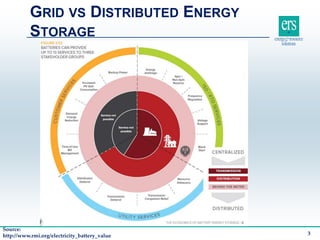
GRID VS DISTRIBUTED ENERGY
STORAGE
Source:
http://www.rmi.org/electricity_battery_value 3
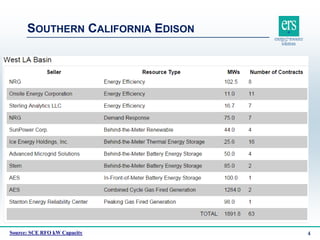
SOUTHERN CALIFORNIA EDISON
4Source: SCE RFO kW Capacity
1. Introduction
2. Definitions and key terminology
3. Facility scale value streams
4. Energy storage technologies
5. Technical and market barriers
AGENDA
11/4/2015 5
KEY TERMINOLOGY
11/4/2015 6
 Power capacity = rated kW
 Energy capacity = rated kWh
 Discharge time =
Energy capacity
Avg. power output
 Depth of discharge (DOD) = capacity used
 Roundtrip Efficiency
 Cycle life = number of useful cycles
1. Supply = Power Plant
a. Energy = kWh
b. Demand = kW
2. Transmission
a. Wires and poles
b. Controls
c. Maintenance
d. Oversight
UTILITY BILLS
11/4/2015 7
EXAMPLE UTILITY BILL
11/4/2015 8
1. Power quality and dependability
2. Demand charge reduction
3. Demand response
4. Retail energy time shift
5. Renewables integration
FACILITY BENEFITS
11/4/2015 9
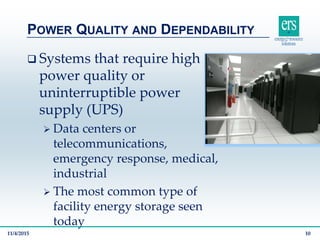
 Systems that require high
power quality or
uninterruptible power
supply (UPS)
 Data centers or
telecommunications,
emergency response, medical,
industrial
 The most common type of
facility energy storage seen
today
POWER QUALITY AND DEPENDABILITY
11/4/2015 10
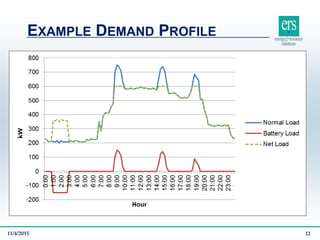
 Arguably the most important emerging
application
 Facilities with >50% of their electric bill from
demand charges are key candidates.
 Simple payback approximately 5 years
DEMAND CHARGE REDUCTION
11/4/2015 11
EXAMPLE DEMAND PROFILE
11/4/2015 12
 Some utilities incentivize demand
reduction during peak demand events
 Peak demand events are typically during
hot summer days and are not known
until just prior
 Cost savings of $10,000 to $15,000 for a
100kW system installed in NYC
DEMAND RESPONSE
11/4/2015 13
 Shifting use from high cost periods to
low cost periods
 On peak = price of electricity during the on
peak periods (daytime)
 Off peak = price of electricity during off
peak periods (nighttime)
RETAIL ENERGY TIME SHIFT
11/4/2015 14
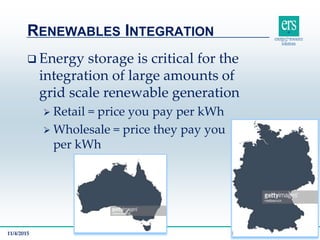
 Energy storage is critical for the
integration of large amounts of
grid scale renewable generation
 Retail = price you pay per kWh
 Wholesale = price they pay you
per kWh
RENEWABLES INTEGRATION
11/4/2015 15
Value of systems increases greatly with
stacked services
 Demand charge reduction/demand
response and retail energy time shift
 Demand response and emergency
response
 Demand charge reduction and demand
response
 UPS and grid support
DUAL PURPOSE SYSTEMS
11/4/2015 16
CASE STUDY 1
 Peak Demand Reduction and Emergency
Backup
 Barclay Tower during Hurricane Sandy
 Demand charge reduction and demand
response
 The owners of Barclay Tower,
Glenwood Management
 1 MW across portfolio in NYC
CASE STUDY 2
11/4/2015 18
 Demand response and emergency
response
 The Irving Company – largest landlord
in Orange County
 10 MW
 $$$ “Tens of millions” over 10 year
contract with SoCal Edison
CASE STUDY 3
11/4/2015 19
 Power quality and grid support
 Regional transmission organization
PJM
 DE, IL, NJ, NC, OH, PA, TN, VA, WV, DC
 Incentive of $40/MWh for frequency
regulation
CASE STUDY 4
11/4/2015 20
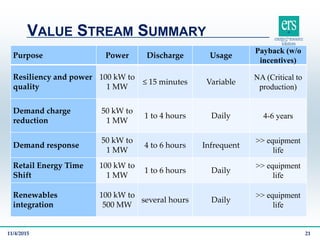
Purpose Power Discharge Usage
Payback (w/o
incentives)
Resiliency and power
quality
100 kW to
1 MW
≤ 15 minutes Variable
NA (Critical to
production)
Demand charge
reduction
50 kW to
1 MW
1 to 4 hours Daily 4-6 years
Demand response
50 kW to
1 MW
4 to 6 hours Infrequent
>> equipment
life
Retail Energy Time
Shift
100 kW to
1 MW
1 to 6 hours Daily
>> equipment
life
Renewables
integration
100 kW to
500 MW
several hours Daily
>> equipment
life
VALUE STREAM SUMMARY
11/4/2015 21
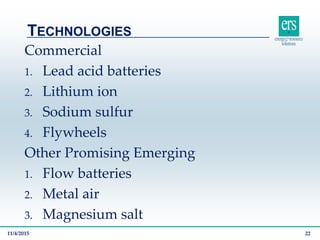
Commercial
1. Lead acid batteries
2. Lithium ion
3. Sodium sulfur
4. Flywheels
Other Promising Emerging
1. Flow batteries
2. Metal air
3. Magnesium salt
TECHNOLOGIES
11/4/2015 22
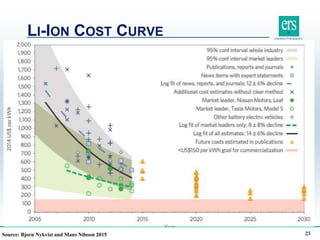
LI-ION COST CURVE
23Source: Bjorn Nykvist and Mans Nilsson 2015
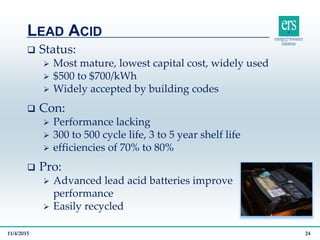
 Status:
 Most mature, lowest capital cost, widely used
 $500 to $700/kWh
 Widely accepted by building codes
 Con:
 Performance lacking
 300 to 500 cycle life, 3 to 5 year shelf life
 efficiencies of 70% to 80%
 Pro:
 Advanced lead acid batteries improve
performance
 Easily recycled
LEAD ACID
11/4/2015 24
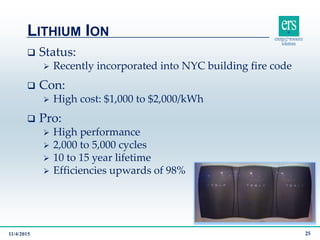
LITHIUM ION
25
 Status:
 Recently incorporated into NYC building fire code
 Con:
 High cost: $1,000 to $2,000/kWh
 Pro:
 High performance
 2,000 to 5,000 cycles
 10 to 15 year lifetime
 Efficiencies upwards of 98%
11/4/2015
SODIUM SULFUR (MOLTEN SALT)
11/4/2015 26
 Status:
 Best suited to larger capacity
 Competitive cost: $750 to $2,000/kWh
 Not widely accepted by codes
 Con:
 Limited manufacturers
 High operating temp (>300F)
 Pro:
 Good performance
 2,000 to 4,500 cycle life
 10 to 15 year shelf life
 Efficiencies of 70% to 80%
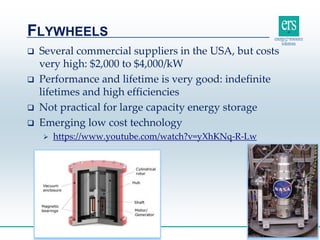
 Several commercial suppliers in the USA, but costs
very high: $2,000 to $4,000/kW
 Performance and lifetime is very good: indefinite
lifetimes and high efficiencies
 Not practical for large capacity energy storage
 Emerging low cost technology
 https://www.youtube.com/watch?v=yXhKNq-R-Lw
FLYWHEELS
27
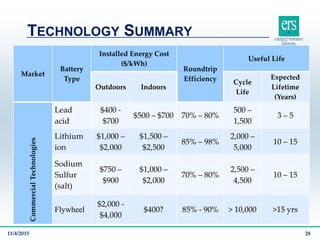
TECHNOLOGY SUMMARY
11/4/2015 28
Market
Battery
Type
Installed Energy Cost
($/kWh)
Roundtrip
Efficiency
Useful Life
Outdoors Indoors
Cycle
Life
Expected
Lifetime
(Years)
CommercialTechnologies
Lead
acid
$400 -
$700
$500 – $700 70% – 80%
500 –
1,500
3 – 5
Lithium
ion
$1,000 –
$2,000
$1,500 –
$2,500
85% – 98%
2,000 –
5,000
10 – 15
Sodium
Sulfur
(salt)
$750 –
$900
$1,000 –
$2,000
70% – 80%
2,500 –
4,500
10 – 15
Flywheel
$2,000 -
$4,000
$400? 85% - 90% > 10,000 >15 yrs
 Flow
 Liquid Metal
 Zinc Air
 Sodium Nickel Chloride
 Magnesium Salt
 Breakthrough technology yet to come?
EMERGING TECHNOLOGIES
11/4/2015 29
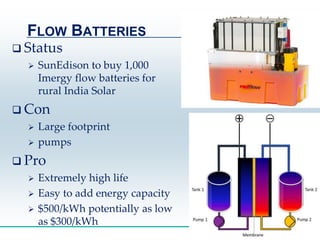
 Status
 SunEdison to buy 1,000
Imergy flow batteries for
rural India Solar
 Con
 Large footprint
 pumps
 Pro
 Extremely high life
 Easy to add energy capacity
 $500/kWh potentially as low
as $300/kWh
FLOW BATTERIES
30
 Status
 Multiple startups targeting it: Eos, ZAF,
Fluidic
 Cons
 Inherent problems with charging
 Up to 5,000 cycle life, same as Li-ion
 Pros
 Costs supposedly as low as $160/kWh
ZINC AIR
11/4/2015 31
 Status
 Available now from Aquion
 Cons
 Lifetime – 5 years = not much better than Pb acid
 Pros
 Cheap ~ $250/kWh
 Most environmentally benign
MAGNESIUM SALT
11/4/2015 32
 Status
 Progression of sodium sulfur batteries
 Cons
 High temperature
 Cycle life not as long as some other emerging
techs
 Pros
 Cheaper
 Safer than NaS batteries
SODIUM NICKEL CHLORIDE
11/4/2015 33
 Status
 Based on research at MIT
 Ambri postponed release of product to
spring 2016
 Cons
 High temperature
 Not suitable for mobile applications
 Pros
 Cheap
LIQUID METAL
11/4/2015 34
Yet unknown what dominant
technologies will be
 Cheaper
 Targeting $160/kWh to $300/kWh
 Longer lifetimes
 Targeting 3,000 to 10,000+ cycles
 More attractive marketing
EMERGING TECHNOLOGIES
SUMMARY
11/4/2015 35
 High costs
 Limited lifetimes
 Large
 Heavy
 Toxic
 Fire hazards
TECHNICAL BARRIERS
11/4/2015 36
 Public perception of hazards
 Challenging to find suitable locations in
urban environments
 Local fire codes are especially wary of
newer commercial systems
MARKET BARRIERS
11/4/2015 37
 Future grids will need energy storage to some
extent
 Many questions, but research is on-going
 CA goal of 33% generation from renewables
by 2020 will create market pull for storage
 Costs are coming down
 Utilities, code officials, and facilities need to
work together to integrate energy storage to
mutual benefit
SUMMARY
11/4/2015 38
CONTACTS
 Jesse Remillard
jremillard@ers-inc.com
207.622.6888 x 414
11/4/2015 39
 Multiple battery type energy storage
systems?
 Future uses when batteries are cheaper?
 Most promising battery technology?
DISCUSSION
11/4/2015 40
 http://www.ease-
storage.eu/technologies.html
 http://www.ambri.com/
 http://www.velkess.com/
 http://www.johnsoncontrols.com/content/
us/en/products/power-solutions/battery-
brands.html
 http://www.teslamotors.com/powerwall
 http://www.aquionenergy.com/
ADDITIONAL INFORMATION
11/4/2015 41

Facility Scale Battery Storage

  • 1.
    Main Headquarters: 120Water Street, Suite 350, North Andover, MA 01845 With offices in: NY, ME, TX, CA, OR www.ers-inc.com FACILITY SCALE BATTERY STORAGE Jesse Remillard – Energy & Resource Solutions
  • 2.
     To ensurepower quality and level demand  For integration of renewable generation  Others? Incentives  NYSERDA and Con Edison  $2,100/kW for batteries  PG&E  $1,620/kW for advanced energy storage WHY ENERGY STORAGE 11/4/2015 2
  • 3.
    GRID VS DISTRIBUTEDENERGY STORAGE Source: http://www.rmi.org/electricity_battery_value 3
  • 4.
  • 5.
    1. Introduction 2. Definitionsand key terminology 3. Facility scale value streams 4. Energy storage technologies 5. Technical and market barriers AGENDA 11/4/2015 5
  • 6.
    KEY TERMINOLOGY 11/4/2015 6 Power capacity = rated kW  Energy capacity = rated kWh  Discharge time = Energy capacity Avg. power output  Depth of discharge (DOD) = capacity used  Roundtrip Efficiency  Cycle life = number of useful cycles
  • 7.
    1. Supply =Power Plant a. Energy = kWh b. Demand = kW 2. Transmission a. Wires and poles b. Controls c. Maintenance d. Oversight UTILITY BILLS 11/4/2015 7
  • 8.
  • 9.
    1. Power qualityand dependability 2. Demand charge reduction 3. Demand response 4. Retail energy time shift 5. Renewables integration FACILITY BENEFITS 11/4/2015 9
  • 10.
     Systems thatrequire high power quality or uninterruptible power supply (UPS)  Data centers or telecommunications, emergency response, medical, industrial  The most common type of facility energy storage seen today POWER QUALITY AND DEPENDABILITY 11/4/2015 10
  • 11.
     Arguably themost important emerging application  Facilities with >50% of their electric bill from demand charges are key candidates.  Simple payback approximately 5 years DEMAND CHARGE REDUCTION 11/4/2015 11
  • 12.

  • 13.
     Some utilitiesincentivize demand reduction during peak demand events  Peak demand events are typically during hot summer days and are not known until just prior  Cost savings of $10,000 to $15,000 for a 100kW system installed in NYC DEMAND RESPONSE 11/4/2015 13
  • 14.
     Shifting usefrom high cost periods to low cost periods  On peak = price of electricity during the on peak periods (daytime)  Off peak = price of electricity during off peak periods (nighttime) RETAIL ENERGY TIME SHIFT 11/4/2015 14
  • 15.
     Energy storageis critical for the integration of large amounts of grid scale renewable generation  Retail = price you pay per kWh  Wholesale = price they pay you per kWh RENEWABLES INTEGRATION 11/4/2015 15
  • 16.
    Value of systemsincreases greatly with stacked services  Demand charge reduction/demand response and retail energy time shift  Demand response and emergency response  Demand charge reduction and demand response  UPS and grid support DUAL PURPOSE SYSTEMS 11/4/2015 16
  • 17.
    CASE STUDY 1 Peak Demand Reduction and Emergency Backup  Barclay Tower during Hurricane Sandy
  • 18.
     Demand chargereduction and demand response  The owners of Barclay Tower, Glenwood Management  1 MW across portfolio in NYC CASE STUDY 2 11/4/2015 18
  • 19.
     Demand responseand emergency response  The Irving Company – largest landlord in Orange County  10 MW  $$$ “Tens of millions” over 10 year contract with SoCal Edison CASE STUDY 3 11/4/2015 19
  • 20.
     Power qualityand grid support  Regional transmission organization PJM  DE, IL, NJ, NC, OH, PA, TN, VA, WV, DC  Incentive of $40/MWh for frequency regulation CASE STUDY 4 11/4/2015 20
  • 21.
    Purpose Power DischargeUsage Payback (w/o incentives) Resiliency and power quality 100 kW to 1 MW ≤ 15 minutes Variable NA (Critical to production) Demand charge reduction 50 kW to 1 MW 1 to 4 hours Daily 4-6 years Demand response 50 kW to 1 MW 4 to 6 hours Infrequent >> equipment life Retail Energy Time Shift 100 kW to 1 MW 1 to 6 hours Daily >> equipment life Renewables integration 100 kW to 500 MW several hours Daily >> equipment life VALUE STREAM SUMMARY 11/4/2015 21
  • 22.
    Commercial 1. Lead acidbatteries 2. Lithium ion 3. Sodium sulfur 4. Flywheels Other Promising Emerging 1. Flow batteries 2. Metal air 3. Magnesium salt TECHNOLOGIES 11/4/2015 22
  • 23.
    LI-ION COST CURVE 23Source:Bjorn Nykvist and Mans Nilsson 2015
  • 24.
     Status:  Mostmature, lowest capital cost, widely used  $500 to $700/kWh  Widely accepted by building codes  Con:  Performance lacking  300 to 500 cycle life, 3 to 5 year shelf life  efficiencies of 70% to 80%  Pro:  Advanced lead acid batteries improve performance  Easily recycled LEAD ACID 11/4/2015 24
  • 25.
    LITHIUM ION 25  Status: Recently incorporated into NYC building fire code  Con:  High cost: $1,000 to $2,000/kWh  Pro:  High performance  2,000 to 5,000 cycles  10 to 15 year lifetime  Efficiencies upwards of 98% 11/4/2015
  • 26.
    SODIUM SULFUR (MOLTENSALT) 11/4/2015 26  Status:  Best suited to larger capacity  Competitive cost: $750 to $2,000/kWh  Not widely accepted by codes  Con:  Limited manufacturers  High operating temp (>300F)  Pro:  Good performance  2,000 to 4,500 cycle life  10 to 15 year shelf life  Efficiencies of 70% to 80%
  • 27.
     Several commercialsuppliers in the USA, but costs very high: $2,000 to $4,000/kW  Performance and lifetime is very good: indefinite lifetimes and high efficiencies  Not practical for large capacity energy storage  Emerging low cost technology  https://www.youtube.com/watch?v=yXhKNq-R-Lw FLYWHEELS 27
  • 28.
    TECHNOLOGY SUMMARY 11/4/2015 28 Market Battery Type InstalledEnergy Cost ($/kWh) Roundtrip Efficiency Useful Life Outdoors Indoors Cycle Life Expected Lifetime (Years) CommercialTechnologies Lead acid $400 - $700 $500 – $700 70% – 80% 500 – 1,500 3 – 5 Lithium ion $1,000 – $2,000 $1,500 – $2,500 85% – 98% 2,000 – 5,000 10 – 15 Sodium Sulfur (salt) $750 – $900 $1,000 – $2,000 70% – 80% 2,500 – 4,500 10 – 15 Flywheel $2,000 - $4,000 $400? 85% - 90% > 10,000 >15 yrs
  • 29.
     Flow  LiquidMetal  Zinc Air  Sodium Nickel Chloride  Magnesium Salt  Breakthrough technology yet to come? EMERGING TECHNOLOGIES 11/4/2015 29
  • 30.
     Status  SunEdisonto buy 1,000 Imergy flow batteries for rural India Solar  Con  Large footprint  pumps  Pro  Extremely high life  Easy to add energy capacity  $500/kWh potentially as low as $300/kWh FLOW BATTERIES 30
  • 31.
     Status  Multiplestartups targeting it: Eos, ZAF, Fluidic  Cons  Inherent problems with charging  Up to 5,000 cycle life, same as Li-ion  Pros  Costs supposedly as low as $160/kWh ZINC AIR 11/4/2015 31
  • 32.
     Status  Availablenow from Aquion  Cons  Lifetime – 5 years = not much better than Pb acid  Pros  Cheap ~ $250/kWh  Most environmentally benign MAGNESIUM SALT 11/4/2015 32
  • 33.
     Status  Progressionof sodium sulfur batteries  Cons  High temperature  Cycle life not as long as some other emerging techs  Pros  Cheaper  Safer than NaS batteries SODIUM NICKEL CHLORIDE 11/4/2015 33
  • 34.
     Status  Basedon research at MIT  Ambri postponed release of product to spring 2016  Cons  High temperature  Not suitable for mobile applications  Pros  Cheap LIQUID METAL 11/4/2015 34
  • 35.
    Yet unknown whatdominant technologies will be  Cheaper  Targeting $160/kWh to $300/kWh  Longer lifetimes  Targeting 3,000 to 10,000+ cycles  More attractive marketing EMERGING TECHNOLOGIES SUMMARY 11/4/2015 35
  • 36.
     High costs Limited lifetimes  Large  Heavy  Toxic  Fire hazards TECHNICAL BARRIERS 11/4/2015 36
  • 37.
     Public perceptionof hazards  Challenging to find suitable locations in urban environments  Local fire codes are especially wary of newer commercial systems MARKET BARRIERS 11/4/2015 37
  • 38.
     Future gridswill need energy storage to some extent  Many questions, but research is on-going  CA goal of 33% generation from renewables by 2020 will create market pull for storage  Costs are coming down  Utilities, code officials, and facilities need to work together to integrate energy storage to mutual benefit SUMMARY 11/4/2015 38
  • 39.
  • 40.
     Multiple batterytype energy storage systems?  Future uses when batteries are cheaper?  Most promising battery technology? DISCUSSION 11/4/2015 40
  • 41.
     http://www.ease- storage.eu/technologies.html  http://www.ambri.com/ http://www.velkess.com/  http://www.johnsoncontrols.com/content/ us/en/products/power-solutions/battery- brands.html  http://www.teslamotors.com/powerwall  http://www.aquionenergy.com/ ADDITIONAL INFORMATION 11/4/2015 41

Editor's Notes

  • #2 Who am I Research from interviews with 5 battery manufacturers and 4 energy storage system providers Who are you What you should get from this I would like you to walk away excited about the possibilities of energy storage’s role in future utility grids
  • #3 Incentives because batteries are useful to the grid from behind the meter. RMI study says more from behind the meter then from utility scale. Improves the overall health of the utility grid. Emergency response Electrical energy storage is an incredibly useful tool
  • #7 Power output = speed Energy capacity = gas Discharge time = miles you can drive DOD = percent of tank used
  • #8 How many people have paid utility bills Generation is like the kWhs Demand is the kW
  • #12 Leads to other uses
  • #16 Early energy storage adopters behind the grid were people trying to become grid independent. What countries are these
  • #20 http://www.latimes.com/business/la-fi-irvine-energy-storage-20151013-story.html http://abc7.com/technology/new-hybrid-electric-buildings-in-oc-to-cut-energy-costs/1030108/
  • #22 How do these compare against utility uses. RMI paper Will cheaper batteries lead to Undiscovered uses?
  • #23 Ambri speaker will be there
  • #24 Costs are expected to continue dropping rapidly especially for Li-ion, which is being driven by the electric vehicle market. Some say the commercial energy storage market will be driven by whatever is passed down from the transportation industry.
  • #26 Tesla Powerwall 7kWh at $7,000
  • #27 NGK
  • #28 First 20 seconds of video http://www.velkess.com/ 3 kW ,15 kWh released in 2016 reserve order now $6,000 Drop in replacement for standard 48 VDC lead acid batteries Zero maintenance 40”x40”x40” round trip eff = 80% 750 lbs
  • #30 Would anyone like to comment on what they think will be the dominant technology in the future and why?
  • #31 Vanadium –IMERGY, American Vanadium, UET Zinc bromine – Redflow Imergy - $500/kWh targeting $300/ kWh Enervault Primus Power
  • #32 Eos – targets $160 /kWh http://www.cnet.com/news/cheap-zinc-air-battery-promises-beefier-power-grid/ ZAF Fluidic
  • #33 Aquion
  • #34 Eagle Picher Fiamm
  • #35 Ambri Is she there to talk about them