G325 1B Narrative
Narrative

      Narrative is about how stories are told. Applying different
       models of narrative structure to your work may reveal
       unconscious things that you did in the way you have
       constructed it.


 2
What does narrative mean?

  The way that stories are told, how meaning is constructed to achieve
   the understanding of the audience.
  Groups events into cause and effect – action and inaction.
  Organises time and space in very compressed form.
  The voice of the narrative can vary; whose story is being told and
   from whose perspective?
  Narrative plot refers to everything audibly or visibly present, i.e.
   selective.
  Narrative story refers to all the events, explicitly presented or referred.
  In film, narrative is constructed through elements like camerawork,
   lighting, sound, mise-en-scene and editing.


3
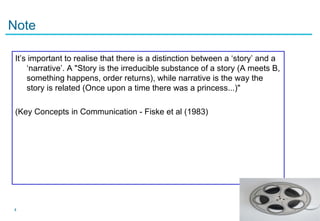
Note

 It’s important to realise that there is a distinction between a ‘story’ and a
     ‘narrative’. A "Story is the irreducible substance of a story (A meets B,
     something happens, order returns), while narrative is the way the
     story is related (Once upon a time there was a princess...)"

 (Key Concepts in Communication - Fiske et al (1983)


4
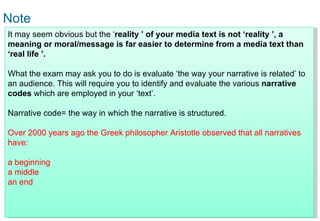
Note
It may seem obvious but the ‘reality ’ of your media text is not ‘reality ’, a
meaning or moral/message is far easier to determine from a media text than
‘real life ’.

What the exam may ask you to do is evaluate ‘the way your narrative is related’ to
an audience. This will require you to identify and evaluate the various narrative
codes which are employed in your ‘text’.

Narrative code= the way in which the narrative is structured.

Over 2000 years ago the Greek philosopher Aristotle observed that all narratives
have:

a beginning
a middle
an end


 5
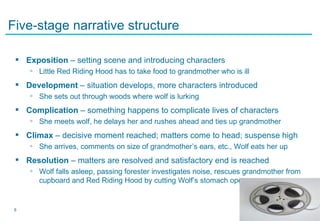
Five-stage narrative structure

  Exposition – setting scene and introducing characters
     ▫ Little Red Riding Hood has to take food to grandmother who is ill
  Development – situation develops, more characters introduced
     ▫ She sets out through woods where wolf is lurking
  Complication – something happens to complicate lives of characters
     ▫ She meets wolf, he delays her and rushes ahead and ties up grandmother
  Climax – decisive moment reached; matters come to head; suspense high
     ▫ She arrives, comments on size of grandmother’s ears, etc., Wolf eats her up
  Resolution – matters are resolved and satisfactory end is reached
     ▫ Wolf falls asleep, passing forester investigates noise, rescues grandmother from
       cupboard and Red Riding Hood by cutting Wolf’s stomach open


 6
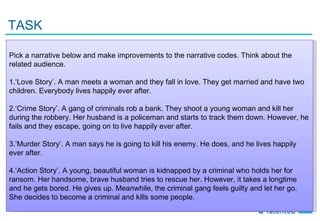
TASK

Pick a narrative below and make improvements to the narrative codes. Think about the
related audience.

1.‘Love Story’. A man meets a woman and they fall in love. They get married and have two
children. Everybody lives happily ever after.

2.‘Crime Story’. A gang of criminals rob a bank. They shoot a young woman and kill her
during the robbery. Her husband is a policeman and starts to track them down. However, he
fails and they escape, going on to live happily ever after.

3.‘Murder Story’. A man says he is going to kill his enemy. He does, and he lives happily
ever after.

4.‘Action Story’. A young, beautiful woman is kidnapped by a criminal who holds her for
ransom. Her handsome, brave husband tries to rescue her. However, it takes a longtime
and he gets bored. He gives up. Meanwhile, the criminal gang feels guilty and let her go.
She decides to become a criminal and kills some people.
 7
Narrative Conventions
When unpacking a narrative in order to find its meaning, there are
a series of codes and conventions that need to be considered.
When we look at a narrative we examine the conventions of
•Genre
•Character
•Form
•Time


8
Roland Barthes 5 codes of narrative

  Hermeneutic (Enigma) Code

 The hermeneutic code refers to plot elements of a story that are not
   explained. They exist as enigmas that the reader wishes to be
   resolved.

 A detective story, for example, is a narrative that operates primarily
   by the hermeneutic code. A crime is exposed and the rest of the
   narrative is devoted to answering questions raised by the initial
   event.


 9
Roland Barthes 5 codes of narrative

 Proairetic (Action) Code:

The Proairetic code refers to plot events that imply further
narrative action.

For example, a story character confronts an enemy and the reader
  wonders what the resolution of this action will be. Suspense is
  created by action rather than by a reader's wish to have mysteries
  explained.


10
Roland Barthes 5 codes of narrative
Cultural Code

The cultural code designates any element in a narrative that refers to
common bodies of knowledge such as historical, mythological or
scientific. The cultural codes point to knowledge about the way the
world works as shared by a community or culture.

Symbolic Code

The symbolic code refers to a structural structure that organizes
meanings by way of antitheses, binary oppositions or sexual and
psychological conflicts. These oppositions can be expressed
through action, character and setting.

11
Roland Barthes 5 codes of narrative
 Semantic Code

A seme is a unit of meaning or a sign that express cultural
  stereotypes. These signs allow the author to describe characters,
  settings and events. The semic code focuses upon information
  that the narration provides in order to suggest abstract concepts.

The semic code allows the text to 'show' instead of 'tell' by
  describing material things.


12
Task

 Annotate one production with examples of the above codes


13
Todorov’s approach to narrative
• Todorov suggests that all narratives begin with
  equilibrium or an initial situation (where everything is
  balanced).
• This is followed by some form of disruption, which is
  later resolved.
• With the resolution at the end of the narrative a new
  equilibrium is usually established.


                                                         14
Todorov’s approach to narrative
There are five stages a narrative has to pass through:

3.   The state of equilibrium (state of normality – good, bad or neutral).
4.   An event disrupts the equilibrium (a character or an action).
5.   The main protagonist recognises that the equilibrium has been disrupted.
6.   Protagonist attempts to rectify this in order to restore equilibrium.
7.   Equilibrium is restored but, because causal transformations have occurred,
     there are differences (good, bad, or neutral) from original equilibrium, which
     establish it as a new equilibrium.


                                                                                15
Propp’s approach to narrative
•   Vladimir Propp studied hundreds of Russian folk and fairytales before deciding that
    all narratives have a common structure.
•   He observed that narratives are shaped and directed by certain types of characters
    and specific kinds of actions
•   He believed that there are 31 possible stages or functions in any narrative.
•   These may not all appear in a single story, but nevertheless always appear in the
    same sequence.
•   A function is a plot motif or event in the story.
•   A tale may skip functions but it cannot shuffle their unvarying order.


                                                                                      16
Propp’s approach to narrative
Propp believed that there are seven roles which any character may assume in
the story:
•   Villain − struggles with hero
•   Donor − prepares and/or provides hero with magical agent
•   Helper − assists, rescues, solves and/or transfigures the hero
•   Princess − a sought-for person (and/or her father) who exists as goal and often
    recognises and marries hero and/or punishes villain
•   Dispatcher − sends hero off
•   Hero − departs on a search (seeker-hero), reacts to donor and weds at end
•   False Hero − claims to be the hero, often seeking and reacting like a real hero


                                                                                      17
Task
Try where possible to apply these roles to elements
of your narrative.

By doing this you might notice some of the flaws in
this theoretical approach.


                                                      18
Propp’s 31 narrative functions
After the initial situation is depicted, the tale takes the following sequence of 31 functions
Preparatory section

 One of members of a family absents him/herself from home
 An interdiction (ban) is addressed to the hero
 Interdiction is violated (villain usually enters story here)
 Villain makes an attempt at reconnaissance (either villain tries to find children/jewels
  etc. or intended victim questions villain)
 Villain receives information about victim (villain gets an answer)
 Villain attempts to deceive victim by using persuasion, magic or deception (trickery;
  villain disguised, tries to win confidence of victim)
 Victim submits to deception and thereby unwittingly helps enemy (hero sleeps)


                                                                                                 19
Villainy/lack (plot set in motion)

3.   Villain causes harm or injury to member of a family (e.g. abduction, theft, casts
     spell on someone).
     Alternatively, a member of family lacks something, desires or desires to have
     something (magical potion, etc.).
5.   Misfortune or lack is made known: hero is approached with a request or command;
     hero allowed to go or is dispatched.
6.   Seeker (hero) agrees to or decides upon counteractions.
7.   Hero leaves home interrogated, attacked, etc. which prepares way for receiving
     magical agent or helper (donor usually enters story here).
8.   Hero reacts to actions of future donor (withstands/fails the test, frees captive,
     reconciles disputants, performs service, uses adversary's powers.
9.   Hero is tested against them.


                                                                                         20
2.    Hero acquires use of magical agent (directly transferred, purchased, etc.).
3.    Hero is transferred, delivered or led to whereabouts of object of search.

Path A: Struggle and victory over villain; end of lack and return

7.  Hero and villain join in direct combat.
8.  Hero is branded (wounded/marked, receives ring or scarf).
9.  Villain is defeated (killed in combat, defeated in contest, etc.).
10. The initial misfortune or lack is liquidated (object of search distributed; spell
    broken, slain person revived, captive freed).
11. Hero returns.
12. Hero is pursued (pursuer tries to kill, eat, undermine the hero).
13. Hero is rescued from pursuit (obstacles delay pursuer, hero hides, etc.).


                                                                                        21
Path B: Unrecognised arrival, task, recognition, punishment, wedding

   Hero, unrecognised, arrived home or in another country.
   False hero presents unfounded claims.
   Difficult task is proposed to hero (trial by drink, riddle, test of strength).
   Task is resolved or accomplished.
   Hero is recognised, often by mark or object.
   False hero or villain is exposed and/or punished.
   Hero is given new appearance (is made whole, handsome, etc.).
   Villain is pursued.
   Hero is married and ascends throne.


TASK:
Whilst I do not expect you to memorise all 31 functions you MUST identify key
    functions within your text. Explain how these help your narrative to function


                                                                                     22
Claude Levi-Strauss’s approach to
             narrative
• After studying hundreds of myths and legends from
  around the world, Levi-Strauss observed that we
  make sense of the world, people and events by
  seeing and using binary opposites everywhere.

• He observed that all narratives are organised around
  the conflict between such binary opposites.


                                                      23
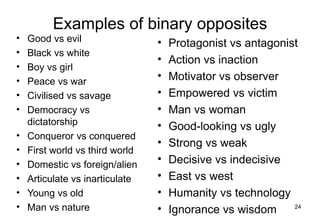
Examples of binary opposites
•   Good vs evil                 •   Protagonist vs antagonist
•   Black vs white
                                 •   Action vs inaction
•   Boy vs girl
•   Peace vs war
                                 •   Motivator vs observer
•   Civilised vs savage          •   Empowered vs victim
•   Democracy vs                 •   Man vs woman
    dictatorship                 •   Good-looking vs ugly
•   Conqueror vs conquered
                                 •   Strong vs weak
•   First world vs third world
•   Domestic vs foreign/alien
                                 •   Decisive vs indecisive
•   Articulate vs inarticulate   •   East vs west
•   Young vs old                 •   Humanity vs technology
•   Man vs nature                •   Ignorance vs wisdom     24
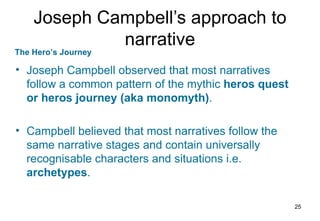
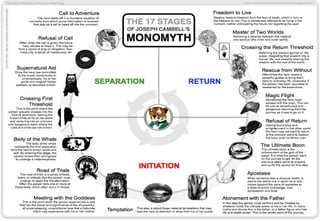
Joseph Campbell’s approach to
             narrative
The Hero’s Journey

• Joseph Campbell observed that most narratives
  follow a common pattern of the mythic heros quest
  or heros journey (aka monomyth).

• Campbell believed that most narratives follow the
  same narrative stages and contain universally
  recognisable characters and situations i.e.
  archetypes.

                                                      25
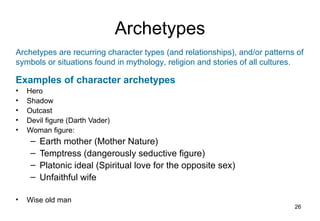
Archetypes
Archetypes are recurring character types (and relationships), and/or patterns of
symbols or situations found in mythology, religion and stories of all cultures.

Examples of character archetypes
•   Hero
•   Shadow
•   Outcast
•   Devil figure (Darth Vader)
•   Woman figure:
     –   Earth mother (Mother Nature)
     –   Temptress (dangerously seductive figure)
     –   Platonic ideal (Spiritual love for the opposite sex)
     –   Unfaithful wife

•   Wise old man
                                                                             26
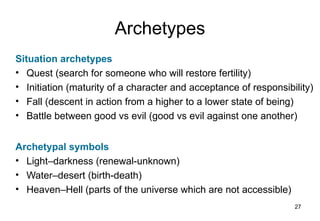
Archetypes
Situation archetypes
• Quest (search for someone who will restore fertility)
• Initiation (maturity of a character and acceptance of responsibility)
• Fall (descent in action from a higher to a lower state of being)
• Battle between good vs evil (good vs evil against one another)


Archetypal symbols
• Light–darkness (renewal-unknown)
• Water–desert (birth-death)
• Heaven–Hell (parts of the universe which are not accessible)
                                                                  27
28
Chris Vogler and the hero’s journey in Hollywood
• Vogler developed and simplified Campbell’s stages of the hero’s
  journey.

• Vogler argues that great films are such because they ‘have an
  appeal that can be felt by everyone, because they well up from a
  universal source in the shared unconscious and reflect universal
  concerns’.

• Vogler’s re-definition of character archetypes and the 12 'stages' of
  the hero's journey has become very influential in Hollywood.


                                                                   29
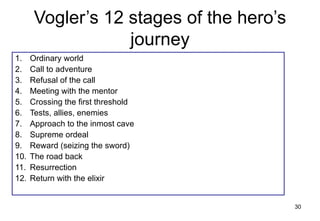
Vogler’s 12 stages of the hero’s
                   journey
1.    Ordinary world
2.    Call to adventure
3.    Refusal of the call
4.    Meeting with the mentor
5.    Crossing the first threshold
6.    Tests, allies, enemies
7.    Approach to the inmost cave
8.    Supreme ordeal
9.    Reward (seizing the sword)
10.   The road back
11.   Resurrection
12.   Return with the elixir


                                          30
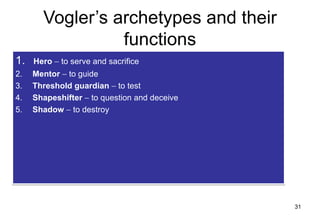
Vogler’s archetypes and their
                 functions
1.   Hero − to serve and sacrifice
2.   Mentor − to guide
3.   Threshold guardian − to test
4.   Shapeshifter − to question and deceive
5.   Shadow − to destroy


                                              31
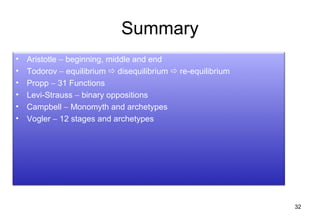
Summary
•   Aristotle − beginning, middle and end
•   Todorov − equilibrium  disequilibrium  re-equilibrium
•   Propp − 31 Functions
•   Levi-Strauss − binary oppositions
•   Campbell − Monomyth and archetypes
•   Vogler − 12 stages and archetypes


                                                              32

Narrative theory

  • 1.
  • 2.
    Narrative  Narrative is about how stories are told. Applying different models of narrative structure to your work may reveal unconscious things that you did in the way you have constructed it. 2
  • 3.
    What does narrativemean?  The way that stories are told, how meaning is constructed to achieve the understanding of the audience.  Groups events into cause and effect – action and inaction.  Organises time and space in very compressed form.  The voice of the narrative can vary; whose story is being told and from whose perspective?  Narrative plot refers to everything audibly or visibly present, i.e. selective.  Narrative story refers to all the events, explicitly presented or referred.  In film, narrative is constructed through elements like camerawork, lighting, sound, mise-en-scene and editing. 3
  • 4.
    Note It’s importantto realise that there is a distinction between a ‘story’ and a ‘narrative’. A "Story is the irreducible substance of a story (A meets B, something happens, order returns), while narrative is the way the story is related (Once upon a time there was a princess...)" (Key Concepts in Communication - Fiske et al (1983) 4
  • 5.
    Note It may seemobvious but the ‘reality ’ of your media text is not ‘reality ’, a meaning or moral/message is far easier to determine from a media text than ‘real life ’. What the exam may ask you to do is evaluate ‘the way your narrative is related’ to an audience. This will require you to identify and evaluate the various narrative codes which are employed in your ‘text’. Narrative code= the way in which the narrative is structured. Over 2000 years ago the Greek philosopher Aristotle observed that all narratives have: a beginning a middle an end 5
  • 6.
    Five-stage narrative structure  Exposition – setting scene and introducing characters ▫ Little Red Riding Hood has to take food to grandmother who is ill  Development – situation develops, more characters introduced ▫ She sets out through woods where wolf is lurking  Complication – something happens to complicate lives of characters ▫ She meets wolf, he delays her and rushes ahead and ties up grandmother  Climax – decisive moment reached; matters come to head; suspense high ▫ She arrives, comments on size of grandmother’s ears, etc., Wolf eats her up  Resolution – matters are resolved and satisfactory end is reached ▫ Wolf falls asleep, passing forester investigates noise, rescues grandmother from cupboard and Red Riding Hood by cutting Wolf’s stomach open 6
  • 7.
    TASK Pick a narrativebelow and make improvements to the narrative codes. Think about the related audience. 1.‘Love Story’. A man meets a woman and they fall in love. They get married and have two children. Everybody lives happily ever after. 2.‘Crime Story’. A gang of criminals rob a bank. They shoot a young woman and kill her during the robbery. Her husband is a policeman and starts to track them down. However, he fails and they escape, going on to live happily ever after. 3.‘Murder Story’. A man says he is going to kill his enemy. He does, and he lives happily ever after. 4.‘Action Story’. A young, beautiful woman is kidnapped by a criminal who holds her for ransom. Her handsome, brave husband tries to rescue her. However, it takes a longtime and he gets bored. He gives up. Meanwhile, the criminal gang feels guilty and let her go. She decides to become a criminal and kills some people. 7
  • 8.
    Narrative Conventions When unpackinga narrative in order to find its meaning, there are a series of codes and conventions that need to be considered. When we look at a narrative we examine the conventions of •Genre •Character •Form •Time 8
  • 9.
    Roland Barthes 5codes of narrative  Hermeneutic (Enigma) Code The hermeneutic code refers to plot elements of a story that are not explained. They exist as enigmas that the reader wishes to be resolved. A detective story, for example, is a narrative that operates primarily by the hermeneutic code. A crime is exposed and the rest of the narrative is devoted to answering questions raised by the initial event. 9
  • 10.
    Roland Barthes 5codes of narrative  Proairetic (Action) Code: The Proairetic code refers to plot events that imply further narrative action. For example, a story character confronts an enemy and the reader wonders what the resolution of this action will be. Suspense is created by action rather than by a reader's wish to have mysteries explained. 10
  • 11.
    Roland Barthes 5codes of narrative Cultural Code The cultural code designates any element in a narrative that refers to common bodies of knowledge such as historical, mythological or scientific. The cultural codes point to knowledge about the way the world works as shared by a community or culture. Symbolic Code The symbolic code refers to a structural structure that organizes meanings by way of antitheses, binary oppositions or sexual and psychological conflicts. These oppositions can be expressed through action, character and setting. 11
  • 12.
    Roland Barthes 5codes of narrative  Semantic Code A seme is a unit of meaning or a sign that express cultural stereotypes. These signs allow the author to describe characters, settings and events. The semic code focuses upon information that the narration provides in order to suggest abstract concepts. The semic code allows the text to 'show' instead of 'tell' by describing material things. 12
  • 13.
    Task  Annotate oneproduction with examples of the above codes 13
  • 14.
    Todorov’s approach tonarrative • Todorov suggests that all narratives begin with equilibrium or an initial situation (where everything is balanced). • This is followed by some form of disruption, which is later resolved. • With the resolution at the end of the narrative a new equilibrium is usually established. 14
  • 15.
    Todorov’s approach tonarrative There are five stages a narrative has to pass through: 3. The state of equilibrium (state of normality – good, bad or neutral). 4. An event disrupts the equilibrium (a character or an action). 5. The main protagonist recognises that the equilibrium has been disrupted. 6. Protagonist attempts to rectify this in order to restore equilibrium. 7. Equilibrium is restored but, because causal transformations have occurred, there are differences (good, bad, or neutral) from original equilibrium, which establish it as a new equilibrium. 15
  • 16.
    Propp’s approach tonarrative • Vladimir Propp studied hundreds of Russian folk and fairytales before deciding that all narratives have a common structure. • He observed that narratives are shaped and directed by certain types of characters and specific kinds of actions • He believed that there are 31 possible stages or functions in any narrative. • These may not all appear in a single story, but nevertheless always appear in the same sequence. • A function is a plot motif or event in the story. • A tale may skip functions but it cannot shuffle their unvarying order. 16
  • 17.
    Propp’s approach tonarrative Propp believed that there are seven roles which any character may assume in the story: • Villain − struggles with hero • Donor − prepares and/or provides hero with magical agent • Helper − assists, rescues, solves and/or transfigures the hero • Princess − a sought-for person (and/or her father) who exists as goal and often recognises and marries hero and/or punishes villain • Dispatcher − sends hero off • Hero − departs on a search (seeker-hero), reacts to donor and weds at end • False Hero − claims to be the hero, often seeking and reacting like a real hero 17
  • 18.
    Task Try where possibleto apply these roles to elements of your narrative. By doing this you might notice some of the flaws in this theoretical approach. 18
  • 19.
    Propp’s 31 narrativefunctions After the initial situation is depicted, the tale takes the following sequence of 31 functions Preparatory section  One of members of a family absents him/herself from home  An interdiction (ban) is addressed to the hero  Interdiction is violated (villain usually enters story here)  Villain makes an attempt at reconnaissance (either villain tries to find children/jewels etc. or intended victim questions villain)  Villain receives information about victim (villain gets an answer)  Villain attempts to deceive victim by using persuasion, magic or deception (trickery; villain disguised, tries to win confidence of victim)  Victim submits to deception and thereby unwittingly helps enemy (hero sleeps) 19
  • 20.
    Villainy/lack (plot setin motion) 3. Villain causes harm or injury to member of a family (e.g. abduction, theft, casts spell on someone). Alternatively, a member of family lacks something, desires or desires to have something (magical potion, etc.). 5. Misfortune or lack is made known: hero is approached with a request or command; hero allowed to go or is dispatched. 6. Seeker (hero) agrees to or decides upon counteractions. 7. Hero leaves home interrogated, attacked, etc. which prepares way for receiving magical agent or helper (donor usually enters story here). 8. Hero reacts to actions of future donor (withstands/fails the test, frees captive, reconciles disputants, performs service, uses adversary's powers. 9. Hero is tested against them. 20
  • 21.
    2. Hero acquires use of magical agent (directly transferred, purchased, etc.). 3. Hero is transferred, delivered or led to whereabouts of object of search. Path A: Struggle and victory over villain; end of lack and return 7. Hero and villain join in direct combat. 8. Hero is branded (wounded/marked, receives ring or scarf). 9. Villain is defeated (killed in combat, defeated in contest, etc.). 10. The initial misfortune or lack is liquidated (object of search distributed; spell broken, slain person revived, captive freed). 11. Hero returns. 12. Hero is pursued (pursuer tries to kill, eat, undermine the hero). 13. Hero is rescued from pursuit (obstacles delay pursuer, hero hides, etc.). 21
  • 22.
    Path B: Unrecognisedarrival, task, recognition, punishment, wedding  Hero, unrecognised, arrived home or in another country.  False hero presents unfounded claims.  Difficult task is proposed to hero (trial by drink, riddle, test of strength).  Task is resolved or accomplished.  Hero is recognised, often by mark or object.  False hero or villain is exposed and/or punished.  Hero is given new appearance (is made whole, handsome, etc.).  Villain is pursued.  Hero is married and ascends throne. TASK: Whilst I do not expect you to memorise all 31 functions you MUST identify key functions within your text. Explain how these help your narrative to function 22
  • 23.
    Claude Levi-Strauss’s approachto narrative • After studying hundreds of myths and legends from around the world, Levi-Strauss observed that we make sense of the world, people and events by seeing and using binary opposites everywhere. • He observed that all narratives are organised around the conflict between such binary opposites. 23
  • 24.
    Examples of binaryopposites • Good vs evil • Protagonist vs antagonist • Black vs white • Action vs inaction • Boy vs girl • Peace vs war • Motivator vs observer • Civilised vs savage • Empowered vs victim • Democracy vs • Man vs woman dictatorship • Good-looking vs ugly • Conqueror vs conquered • Strong vs weak • First world vs third world • Domestic vs foreign/alien • Decisive vs indecisive • Articulate vs inarticulate • East vs west • Young vs old • Humanity vs technology • Man vs nature • Ignorance vs wisdom 24
  • 25.
    Joseph Campbell’s approachto narrative The Hero’s Journey • Joseph Campbell observed that most narratives follow a common pattern of the mythic heros quest or heros journey (aka monomyth). • Campbell believed that most narratives follow the same narrative stages and contain universally recognisable characters and situations i.e. archetypes. 25
  • 26.
    Archetypes Archetypes are recurringcharacter types (and relationships), and/or patterns of symbols or situations found in mythology, religion and stories of all cultures. Examples of character archetypes • Hero • Shadow • Outcast • Devil figure (Darth Vader) • Woman figure: – Earth mother (Mother Nature) – Temptress (dangerously seductive figure) – Platonic ideal (Spiritual love for the opposite sex) – Unfaithful wife • Wise old man 26
  • 27.
    Archetypes Situation archetypes • Quest(search for someone who will restore fertility) • Initiation (maturity of a character and acceptance of responsibility) • Fall (descent in action from a higher to a lower state of being) • Battle between good vs evil (good vs evil against one another) Archetypal symbols • Light–darkness (renewal-unknown) • Water–desert (birth-death) • Heaven–Hell (parts of the universe which are not accessible) 27
  • 28.
  • 29.
    Chris Vogler andthe hero’s journey in Hollywood • Vogler developed and simplified Campbell’s stages of the hero’s journey. • Vogler argues that great films are such because they ‘have an appeal that can be felt by everyone, because they well up from a universal source in the shared unconscious and reflect universal concerns’. • Vogler’s re-definition of character archetypes and the 12 'stages' of the hero's journey has become very influential in Hollywood. 29
  • 30.
    Vogler’s 12 stagesof the hero’s journey 1. Ordinary world 2. Call to adventure 3. Refusal of the call 4. Meeting with the mentor 5. Crossing the first threshold 6. Tests, allies, enemies 7. Approach to the inmost cave 8. Supreme ordeal 9. Reward (seizing the sword) 10. The road back 11. Resurrection 12. Return with the elixir 30
  • 31.
    Vogler’s archetypes andtheir functions 1. Hero − to serve and sacrifice 2. Mentor − to guide 3. Threshold guardian − to test 4. Shapeshifter − to question and deceive 5. Shadow − to destroy 31
  • 32.
    Summary • Aristotle − beginning, middle and end • Todorov − equilibrium  disequilibrium  re-equilibrium • Propp − 31 Functions • Levi-Strauss − binary oppositions • Campbell − Monomyth and archetypes • Vogler − 12 stages and archetypes 32