Connect…
04/09/2014 Term 1, Lesson 1 1
Connect
Can you create a 3 panel story
similar to GARFIELD?
Think Carefully – Time Is Against
You!
Narrative
• Narrative: A story (plot) or a description of a series of events.
• The sequence of events in narrative cinema revolves around the concept
of 'cause and affect' otherwise known as;
Causality: Cause and Affect
• 'A narrative is a sequence of events taking place in time and space, in a
casual relationship. A sequence of random events does not make a
narrative' Bordwell and Thompson, Film Art; An introduction.
4
Story
Plot
Plot describes a set of events as they relate to
each other. The term is concerned with how
to sequence and select the events of a story
as a structure for its telling and how that
telling can find maximum effect.
Narrative
How the events are told. Narrative is the
ordering of events into a consumable format.
Narratives may involve a reordering of the
events of a story. The story’s events can be
set out of chronological order; be combined
with elements from outside of the story to
better tell the consumer what is going on; or
to build dramatic effect.
5
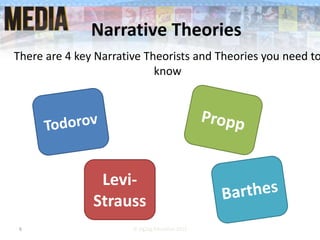
Narrative Theories
6 © ZigZag Education 2015
Levi-
Strauss
There are 4 key Narrative Theorists and Theories you need to
know
Todorov
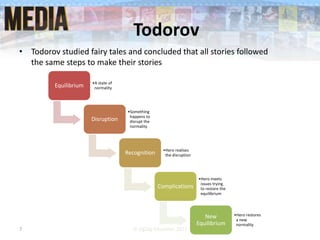
• Todorov studied fairy tales and concluded that all stories followed
the same steps to make their stories
7 © ZigZag Education 2015
Equilibrium •A state of
normality
Disruption
•Something
happens to
disrupt the
normality
Recognition •Hero realises
the disruption
Complications
•Hero meets
issues trying
to restore the
equilibrium
New
Equilibrium
•Hero restores
a new
normality
Todorov in Action
• https://www.youtube.com/watch?v=RSD_zp8
yZFo
04/09/2014 Term 1, Lesson 1 8
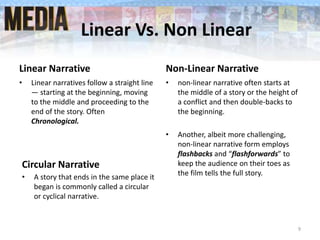
Linear Vs. Non Linear
Linear Narrative
• Linear narratives follow a straight line
— starting at the beginning, moving
to the middle and proceeding to the
end of the story. Often
Chronological.
Non-Linear Narrative
• non-linear narrative often starts at
the middle of a story or the height of
a conflict and then double-backs to
the beginning.
• Another, albeit more challenging,
non-linear narrative form employs
flashbacks and “flashforwards” to
keep the audience on their toes as
the film tells the full story.
Circular Narrative
• A story that ends in the same place it
began is commonly called a circular
or cyclical narrative.
9
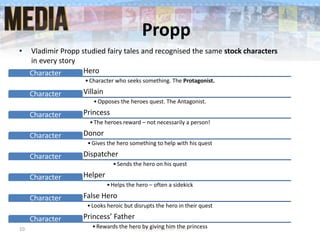
Propp
• Vladimir Propp studied fairy tales and recognised the same stock characters
in every story
10 © ZigZag Education 2015
HeroCharacter
•Character who seeks something. The Protagonist.
VillainCharacter
•Opposes the heroes quest. The Antagonist.
PrincessCharacter
•The heroes reward – not necessarily a person!
DonorCharacter
•Gives the hero something to help with his quest
DispatcherCharacter
•Sends the hero on his quest
HelperCharacter
•Helps the hero – often a sidekick
False HeroCharacter
•Looks heroic but disrupts the hero in their quest
Princess’ FatherCharacter
•Rewards the hero by giving him the princess
Propp in Action
• https://www.youtube.com/watch?v=4q2-Eg-
ZiMs
04/09/2014 Term 1, Lesson 1 11
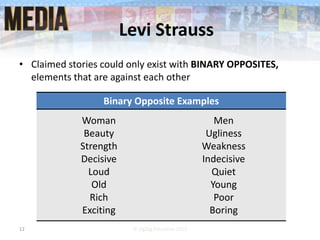
Levi Strauss
• Claimed stories could only exist with BINARY OPPOSITES,
elements that are against each other
12 © ZigZag Education 2015
Binary Opposite Examples
Woman
Beauty
Strength
Decisive
Loud
Old
Rich
Exciting
Men
Ugliness
Weakness
Indecisive
Quiet
Young
Poor
Boring
04/09/2014 Term 1, Lesson 1 13
Barthes
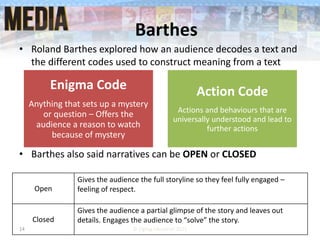
• Roland Barthes explored how an audience decodes a text and
the different codes used to construct meaning from a text
• Barthes also said narratives can be OPEN or CLOSED
14 © ZigZag Education 2015
Enigma Code
Anything that sets up a mystery
or question – Offers the
audience a reason to watch
because of mystery
Action Code
Actions and behaviours that are
universally understood and lead to
further actions
Open
Gives the audience the full storyline so they feel fully engaged –
feeling of respect.
Closed
Gives the audience a partial glimpse of the story and leaves out
details. Engages the audience to “solve” the story.
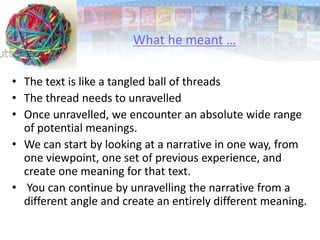
• The text is like a tangled ball of threads
• The thread needs to unravelled
• Once unravelled, we encounter an absolute wide range
of potential meanings.
• We can start by looking at a narrative in one way, from
one viewpoint, one set of previous experience, and
create one meaning for that text.
• You can continue by unravelling the narrative from a
different angle and create an entirely different meaning.
What he meant …
Other Narrative
DevicesDevice Definition
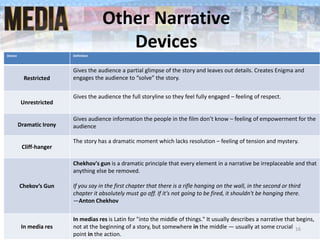
Restricted
Gives the audience a partial glimpse of the story and leaves out details. Creates Enigma and
engages the audience to “solve” the story.
Unrestricted
Gives the audience the full storyline so they feel fully engaged – feeling of respect.
Dramatic Irony
Gives audience information the people in the film don’t know – feeling of empowerment for the
audience
Cliff-hanger
The story has a dramatic moment which lacks resolution – feeling of tension and mystery.
Chekov’s Gun
Chekhov's gun is a dramatic principle that every element in a narrative be irreplaceable and that
anything else be removed.
If you say in the first chapter that there is a rifle hanging on the wall, in the second or third
chapter it absolutely must go off. If it's not going to be fired, it shouldn't be hanging there.
—Anton Chekhov
In media res
In medias res is Latin for "into the middle of things." It usually describes a narrative that begins,
not at the beginning of a story, but somewhere in the middle — usually at some crucial
point in the action.
16
Plenary
• Can you tell todays lesson as a story?
• How might you include any of the 4 Narrative
Theories?
• Can you use any Narrative Devices?
04/09/2014 Term 1, Lesson 1 17
Celebrate

L3 Narrative

  • 1.
    Connect… 04/09/2014 Term 1,Lesson 1 1 Connect Can you create a 3 panel story similar to GARFIELD? Think Carefully – Time Is Against You!
  • 2.
    Narrative • Narrative: Astory (plot) or a description of a series of events. • The sequence of events in narrative cinema revolves around the concept of 'cause and affect' otherwise known as; Causality: Cause and Affect • 'A narrative is a sequence of events taking place in time and space, in a casual relationship. A sequence of random events does not make a narrative' Bordwell and Thompson, Film Art; An introduction. 4
  • 3.
    Story Plot Plot describes aset of events as they relate to each other. The term is concerned with how to sequence and select the events of a story as a structure for its telling and how that telling can find maximum effect. Narrative How the events are told. Narrative is the ordering of events into a consumable format. Narratives may involve a reordering of the events of a story. The story’s events can be set out of chronological order; be combined with elements from outside of the story to better tell the consumer what is going on; or to build dramatic effect. 5
  • 4.
    Narrative Theories 6 ©ZigZag Education 2015 Levi- Strauss There are 4 key Narrative Theorists and Theories you need to know
  • 5.
    Todorov • Todorov studiedfairy tales and concluded that all stories followed the same steps to make their stories 7 © ZigZag Education 2015 Equilibrium •A state of normality Disruption •Something happens to disrupt the normality Recognition •Hero realises the disruption Complications •Hero meets issues trying to restore the equilibrium New Equilibrium •Hero restores a new normality
  • 6.
    Todorov in Action •https://www.youtube.com/watch?v=RSD_zp8 yZFo 04/09/2014 Term 1, Lesson 1 8
  • 7.
    Linear Vs. NonLinear Linear Narrative • Linear narratives follow a straight line — starting at the beginning, moving to the middle and proceeding to the end of the story. Often Chronological. Non-Linear Narrative • non-linear narrative often starts at the middle of a story or the height of a conflict and then double-backs to the beginning. • Another, albeit more challenging, non-linear narrative form employs flashbacks and “flashforwards” to keep the audience on their toes as the film tells the full story. Circular Narrative • A story that ends in the same place it began is commonly called a circular or cyclical narrative. 9
  • 8.
    Propp • Vladimir Proppstudied fairy tales and recognised the same stock characters in every story 10 © ZigZag Education 2015 HeroCharacter •Character who seeks something. The Protagonist. VillainCharacter •Opposes the heroes quest. The Antagonist. PrincessCharacter •The heroes reward – not necessarily a person! DonorCharacter •Gives the hero something to help with his quest DispatcherCharacter •Sends the hero on his quest HelperCharacter •Helps the hero – often a sidekick False HeroCharacter •Looks heroic but disrupts the hero in their quest Princess’ FatherCharacter •Rewards the hero by giving him the princess
  • 9.
    Propp in Action •https://www.youtube.com/watch?v=4q2-Eg- ZiMs 04/09/2014 Term 1, Lesson 1 11
  • 10.
    Levi Strauss • Claimedstories could only exist with BINARY OPPOSITES, elements that are against each other 12 © ZigZag Education 2015 Binary Opposite Examples Woman Beauty Strength Decisive Loud Old Rich Exciting Men Ugliness Weakness Indecisive Quiet Young Poor Boring
  • 11.
    04/09/2014 Term 1,Lesson 1 13
  • 12.
    Barthes • Roland Barthesexplored how an audience decodes a text and the different codes used to construct meaning from a text • Barthes also said narratives can be OPEN or CLOSED 14 © ZigZag Education 2015 Enigma Code Anything that sets up a mystery or question – Offers the audience a reason to watch because of mystery Action Code Actions and behaviours that are universally understood and lead to further actions Open Gives the audience the full storyline so they feel fully engaged – feeling of respect. Closed Gives the audience a partial glimpse of the story and leaves out details. Engages the audience to “solve” the story.
  • 13.
    • The textis like a tangled ball of threads • The thread needs to unravelled • Once unravelled, we encounter an absolute wide range of potential meanings. • We can start by looking at a narrative in one way, from one viewpoint, one set of previous experience, and create one meaning for that text. • You can continue by unravelling the narrative from a different angle and create an entirely different meaning. What he meant …
  • 14.
    Other Narrative DevicesDevice Definition Restricted Givesthe audience a partial glimpse of the story and leaves out details. Creates Enigma and engages the audience to “solve” the story. Unrestricted Gives the audience the full storyline so they feel fully engaged – feeling of respect. Dramatic Irony Gives audience information the people in the film don’t know – feeling of empowerment for the audience Cliff-hanger The story has a dramatic moment which lacks resolution – feeling of tension and mystery. Chekov’s Gun Chekhov's gun is a dramatic principle that every element in a narrative be irreplaceable and that anything else be removed. If you say in the first chapter that there is a rifle hanging on the wall, in the second or third chapter it absolutely must go off. If it's not going to be fired, it shouldn't be hanging there. —Anton Chekhov In media res In medias res is Latin for "into the middle of things." It usually describes a narrative that begins, not at the beginning of a story, but somewhere in the middle — usually at some crucial point in the action. 16
  • 15.
    Plenary • Can youtell todays lesson as a story? • How might you include any of the 4 Narrative Theories? • Can you use any Narrative Devices? 04/09/2014 Term 1, Lesson 1 17 Celebrate

Editor's Notes

  • #8 https://www.youtube.com/watch?v=RSD_zp8yZFo
  • #11 https://www.youtube.com/watch?v=4q2-Eg-ZiMs
  • #15 https://www.youtube.com/watch?v=7yshUmxuEjE