Narrative theories  Media
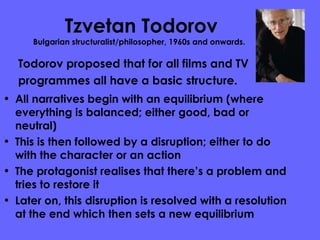
Tzvetan Todorov  Todorov proposed that for all films and TV programmes all have a basic structure.  All narratives begin with an equilibrium (where everything is balanced; either good, bad or neutral) This is then followed by a disruption; either to do with the character or an action  The protagonist realises that there’s a problem and tries to restore it Later on, this disruption is resolved with a resolution at the end which then sets a new equilibrium  Bulgarian structuralist/philosopher, 1960s and onwards.
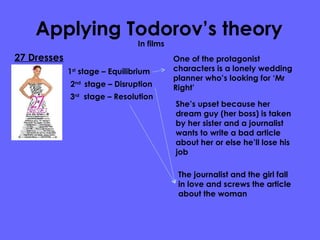
Applying Todorov’s theory In films  27 Dresses 1 st  stage – Equilibrium   One of the protagonist characters is a lonely wedding planner who’s looking for ‘Mr Right’ 2 nd  stage – Disruption   She’s upset because her dream guy (her boss) is taken by her sister and a journalist wants to write a bad article about her or else he’ll lose his job The journalist and the girl fall in love and screws the article about the woman  3 rd   stage – Resolution
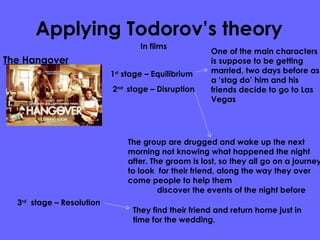
Applying Todorov’s theory In films  The Hangover 1 st  stage – Equilibrium   2 nd  stage – Disruption   3 rd   stage – Resolution One of the main characters is suppose to be getting married, two days before as a ‘stag do’ him and his friends decide to go to Las Vegas The group are drugged and wake up the next morning not knowing what happened the night after. The groom is lost, so they all go on a journey to look  for their friend, along the way they over come people to help them  discover the events of the night before  They find their friend and return home just in time for the wedding.
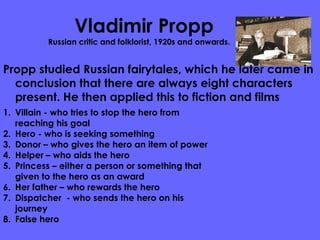
Vladimir Propp Russian critic and folklorist, 1920s and onwards.  Propp studied Russian fairytales, which he later came in conclusion that there are always eight characters present. He then applied this to fiction and films  Villain - who tries to stop the hero from reaching his goal Hero - who is seeking something Donor – who gives the hero an item of power  Helper – who aids the hero Princess – either a person or something that given to the hero as an award  Her father – who rewards the hero Dispatcher  - who sends the hero on his journey  False hero
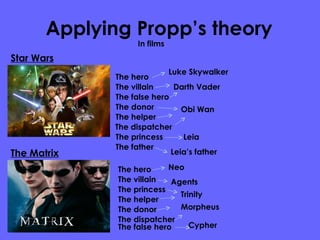
Applying Propp’s theory Star Wars The hero Luke Skywalker The villain Darth Vader The donor Obi Wan The helper The princess Leia The dispatcher The false hero The father Leia’s father Neo The hero The villain Agents The princess The helper Trinity The dispatcher Morpheus The donor The false hero Cypher The Matrix In films
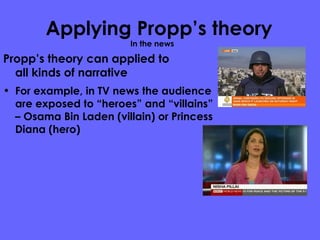
Applying Propp’s theory Propp’s theory can applied to all kinds of narrative For example, in TV news the audience are exposed to “heroes” and “villains” – Osama Bin Laden (villain) or Princess Diana (hero)  In the news
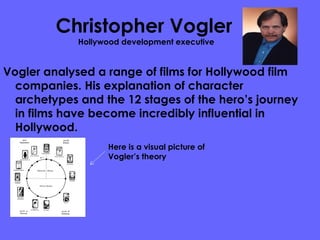
Christopher Vogler Hollywood development executive  Vogler analysed a range of films for Hollywood film companies. His explanation of character archetypes and the 12 stages of the hero’s journey in films have become incredibly influential in Hollywood.  Here is a visual picture of Vogler’s theory
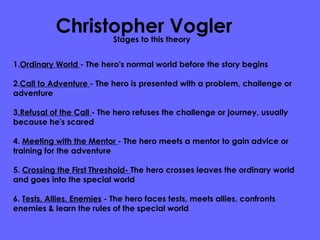
Christopher Vogler Stages to this theory 1. Ordinary World  - The hero's normal world before the story begins 2. Call to Adventure  - The hero is presented with a problem, challenge or adventure  3 .Refusal of the Call  - The hero refuses the challenge or journey, usually because he's scared 4.  Meeting with the Mentor  - The hero meets a mentor to gain advice or training for the adventure 5.  Crossing the First Threshold-  The hero crosses leaves the ordinary world and goes into the special world 6.  Tests, Allies, Enemies  - The hero faces tests, meets allies, confronts enemies & learn the rules of the special world
Christopher Vogler Stages to this theory cont. 7.  Approach  - The hero has hit setbacks during tests & may need to try a new idea  8.  Ordeal  - The biggest life or death crisis  9.  Reward  - The hero has survived death, overcomes his fear and now earns the reward  10.  The Road Back  - The hero must return to the Ordinary World 11.  Resurrection Hero  - another test where the hero faces death – he has to use everything he's learned 12.  Return with Elixir  - The hero returns from the journey with the “elixir”, and uses it to help everyone in the Ordinary World
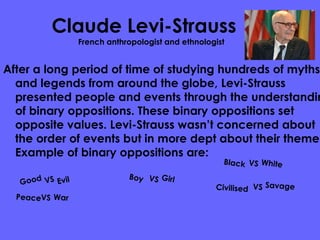
Claude Levi-Strauss French anthropologist and ethnologist After a long period of time of studying hundreds of myths and legends from around the globe, Levi-Strauss presented people and events through the understanding of binary oppositions. These binary oppositions set opposite values. Levi-Strauss wasn’t concerned about the order of events but in more dept about their themes. Example of binary oppositions are: Good VS Evil Black VS White Boy VS Girl Peace  VS War Civilised VS Savage

Narrative theories

  • 1.
  • 2.
    Tzvetan Todorov Todorov proposed that for all films and TV programmes all have a basic structure. All narratives begin with an equilibrium (where everything is balanced; either good, bad or neutral) This is then followed by a disruption; either to do with the character or an action The protagonist realises that there’s a problem and tries to restore it Later on, this disruption is resolved with a resolution at the end which then sets a new equilibrium Bulgarian structuralist/philosopher, 1960s and onwards.
  • 3.
    Applying Todorov’s theoryIn films 27 Dresses 1 st stage – Equilibrium One of the protagonist characters is a lonely wedding planner who’s looking for ‘Mr Right’ 2 nd stage – Disruption She’s upset because her dream guy (her boss) is taken by her sister and a journalist wants to write a bad article about her or else he’ll lose his job The journalist and the girl fall in love and screws the article about the woman 3 rd stage – Resolution
  • 4.
    Applying Todorov’s theoryIn films The Hangover 1 st stage – Equilibrium 2 nd stage – Disruption 3 rd stage – Resolution One of the main characters is suppose to be getting married, two days before as a ‘stag do’ him and his friends decide to go to Las Vegas The group are drugged and wake up the next morning not knowing what happened the night after. The groom is lost, so they all go on a journey to look for their friend, along the way they over come people to help them discover the events of the night before They find their friend and return home just in time for the wedding.
  • 5.
    Vladimir Propp Russiancritic and folklorist, 1920s and onwards. Propp studied Russian fairytales, which he later came in conclusion that there are always eight characters present. He then applied this to fiction and films Villain - who tries to stop the hero from reaching his goal Hero - who is seeking something Donor – who gives the hero an item of power Helper – who aids the hero Princess – either a person or something that given to the hero as an award Her father – who rewards the hero Dispatcher - who sends the hero on his journey False hero
  • 6.
    Applying Propp’s theoryStar Wars The hero Luke Skywalker The villain Darth Vader The donor Obi Wan The helper The princess Leia The dispatcher The false hero The father Leia’s father Neo The hero The villain Agents The princess The helper Trinity The dispatcher Morpheus The donor The false hero Cypher The Matrix In films
  • 7.
    Applying Propp’s theoryPropp’s theory can applied to all kinds of narrative For example, in TV news the audience are exposed to “heroes” and “villains” – Osama Bin Laden (villain) or Princess Diana (hero) In the news
  • 8.
    Christopher Vogler Hollywooddevelopment executive Vogler analysed a range of films for Hollywood film companies. His explanation of character archetypes and the 12 stages of the hero’s journey in films have become incredibly influential in Hollywood. Here is a visual picture of Vogler’s theory
  • 9.
    Christopher Vogler Stagesto this theory 1. Ordinary World - The hero's normal world before the story begins 2. Call to Adventure - The hero is presented with a problem, challenge or adventure 3 .Refusal of the Call - The hero refuses the challenge or journey, usually because he's scared 4. Meeting with the Mentor - The hero meets a mentor to gain advice or training for the adventure 5. Crossing the First Threshold- The hero crosses leaves the ordinary world and goes into the special world 6. Tests, Allies, Enemies - The hero faces tests, meets allies, confronts enemies & learn the rules of the special world
  • 10.
    Christopher Vogler Stagesto this theory cont. 7. Approach - The hero has hit setbacks during tests & may need to try a new idea 8. Ordeal - The biggest life or death crisis 9. Reward - The hero has survived death, overcomes his fear and now earns the reward 10. The Road Back - The hero must return to the Ordinary World 11. Resurrection Hero - another test where the hero faces death – he has to use everything he's learned 12. Return with Elixir - The hero returns from the journey with the “elixir”, and uses it to help everyone in the Ordinary World
  • 11.
    Claude Levi-Strauss Frenchanthropologist and ethnologist After a long period of time of studying hundreds of myths and legends from around the globe, Levi-Strauss presented people and events through the understanding of binary oppositions. These binary oppositions set opposite values. Levi-Strauss wasn’t concerned about the order of events but in more dept about their themes. Example of binary oppositions are: Good VS Evil Black VS White Boy VS Girl Peace VS War Civilised VS Savage