Learning Objectives:
• Learn a variety of theories on narrative.

• Understand how to answer question 1b on
  narrative.

• Decide which of your productions you
  would write about for a question on
  narrative.
Noam Chomsky
“Narrative is fundamental to human
understanding.”
Plot vs Narrative
• The plot of a film is everything that
  happens to the characters in chronological
  order.
• The narrative of a film is the coherence or
  organisation given to a sequence of
  events.
• It is up to the audience to decode the
  narrative and work out what the plot is.
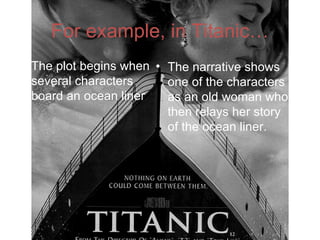
For example, in Titanic…
• The plot begins when • The narrative shows
  several characters     one of the characters
  board an ocean liner   as an old woman who
                         then relays her story
                         of the ocean liner.
Storytime vs Screen Time
• The story time is the length of the entire story
  whereas the screen time is the length of the film.
• Usually the story time is longer than the screen
  time.
• Sometimes the story and screen times are the
  same (eg 24 (arguably!))
• Can you think of a possible way that the screen
  time could be longer than the story time?
Time Manipulation
•   Summary (e.g time compression)
•   Ellipsis (cutting out intervening time)
•   Flashbacks
•   Dream Sequences
•   Repetition
•   Different characters POV
•   Flash Forwards
Location Manipulation
• Establishing shots
  – New York skyline
• Creative Geography
  – Separate shots of different locations –
    audience assumes they must be related.
• Location conventions
  – Often associated with genre and form –
    spaceships.
Propp’s approach to narrative

• Vladimir Propp studied hundreds of Russian folk and
  fairytales before deciding that all narratives have a
  common structure.
• He observed that narratives are shaped and directed by
  certain types of characters and specific kinds of actions
• He believed that there are 31 possible stages or
  functions in any narrative
• These may not all appear in a single story, but
  nevertheless always appear in the same sequence.
• A function is a plot motif or event in the story.
• A tale may skip functions but it cannot shuffle their
  unvarying order.
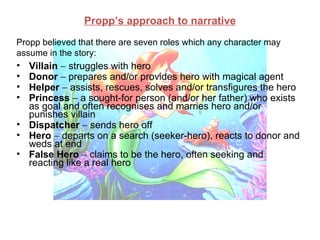
Propp’s approach to narrative
Propp believed that there are seven roles which any character may
assume in the story:
• Villain − struggles with hero
• Donor − prepares and/or provides hero with magical agent
• Helper − assists, rescues, solves and/or transfigures the hero
• Princess − a sought-for person (and/or her father) who exists
  as goal and often recognises and marries hero and/or
  punishes villain
• Dispatcher − sends hero off
• Hero − departs on a search (seeker-hero), reacts to donor and
  weds at end
• False Hero − claims to be the hero, often seeking and
  reacting like a real hero
Todorov’s approach to narrative
There are five stages a narrative has to pass through:

•   The state of equilibrium (state of normality – good, bad
    or neutral).
•   An event disrupts the equilibrium (a character or an
    action).
•   The main protagonist recognises that the equilibrium
    has been disrupted.
•   Protagonist attempts to rectify this in order to restore
    equilibrium.
•   Equilibrium is restored but, because causal
    transformations have occurred, there are differences
    (good, bad, or neutral) from original equilibrium, which
    establish it as a new equilibrium.
The Structure Of The Classic Narrative
                 System
According to Pam Cook (1985), the standard
  Hollywood narrative structure should have:
• Linearity of cause and effect within an
  overall trajectory of enigma resolution.
• A high degree of narrative closure.
• A fictional world that contains
  verisimilitude especially governed by
  spatial and temporal coherence.
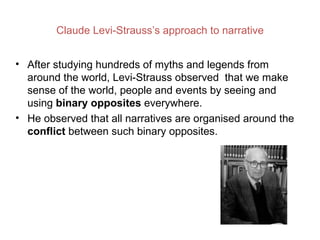
Claude Levi-Strauss’s approach to narrative


• After studying hundreds of myths and legends from
  around the world, Levi-Strauss observed that we make
  sense of the world, people and events by seeing and
  using binary opposites everywhere.
• He observed that all narratives are organised around the
  conflict between such binary opposites.
Examples of binary opposites
•   Good vs evil                 •   Protagonist vs antagonist
•   Black vs white               •   Action vs inaction
•   Boy vs girl
                                 •   Motivator vs observer
•   Peace vs war
•                                •   Empowered vs victim
    Civilised vs savage
•   Democracy vs dictatorship    •   Man vs woman
•   Conqueror vs conquered       •   Good-looking vs ugly
•   First world vs third world   •   Strong vs weak
•   Domestic vs foreign/alien    •   Decisive vs indecisive
•   Articulate vs inarticulate   •   East vs west
•   Young vs old                 •   Humanity vs technology
•   Man vs nature                •   Ignorance vs wisdom
Roland Barthes Codes
• Action codes – symbolic/iconographic
  images that communicate events from the
  narrative, e.g. characters brushing hands
  to retrieve spilled papers suggest that they
  are falling in love
• Enigma codes – questions raised by a
  narrative that the audience yearn to
  answer
Narrative
• How useful is the concept of narrative in
  understanding your work?
• What is the narrative structure of your work?
• How have narrative techniques been used to
  appeal to the audience?
• How have you used characters in your work? Is
  Propp useful to understanding your production?
• What other narrative conventions can you
  consider? Does your work support or subvert
  them?
• How does the narrative shape the meaning of your
  production?
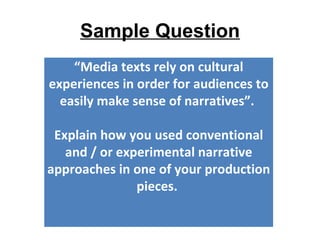
Sample Question
    “Media texts rely on cultural
experiences in order for audiences to
  easily make sense of narratives”.

 Explain how you used conventional
   and / or experimental narrative
approaches in one of your production
               pieces.

Exam 1 b narrative

  • 1.
    Learning Objectives: • Learna variety of theories on narrative. • Understand how to answer question 1b on narrative. • Decide which of your productions you would write about for a question on narrative.
  • 2.
    Noam Chomsky “Narrative isfundamental to human understanding.”
  • 3.
    Plot vs Narrative •The plot of a film is everything that happens to the characters in chronological order. • The narrative of a film is the coherence or organisation given to a sequence of events. • It is up to the audience to decode the narrative and work out what the plot is.
  • 4.
    For example, inTitanic… • The plot begins when • The narrative shows several characters one of the characters board an ocean liner as an old woman who then relays her story of the ocean liner.
  • 5.
    Storytime vs ScreenTime • The story time is the length of the entire story whereas the screen time is the length of the film. • Usually the story time is longer than the screen time. • Sometimes the story and screen times are the same (eg 24 (arguably!)) • Can you think of a possible way that the screen time could be longer than the story time?
  • 6.
    Time Manipulation • Summary (e.g time compression) • Ellipsis (cutting out intervening time) • Flashbacks • Dream Sequences • Repetition • Different characters POV • Flash Forwards
  • 7.
    Location Manipulation • Establishingshots – New York skyline • Creative Geography – Separate shots of different locations – audience assumes they must be related. • Location conventions – Often associated with genre and form – spaceships.
  • 8.
    Propp’s approach tonarrative • Vladimir Propp studied hundreds of Russian folk and fairytales before deciding that all narratives have a common structure. • He observed that narratives are shaped and directed by certain types of characters and specific kinds of actions • He believed that there are 31 possible stages or functions in any narrative • These may not all appear in a single story, but nevertheless always appear in the same sequence. • A function is a plot motif or event in the story. • A tale may skip functions but it cannot shuffle their unvarying order.
  • 9.
    Propp’s approach tonarrative Propp believed that there are seven roles which any character may assume in the story: • Villain − struggles with hero • Donor − prepares and/or provides hero with magical agent • Helper − assists, rescues, solves and/or transfigures the hero • Princess − a sought-for person (and/or her father) who exists as goal and often recognises and marries hero and/or punishes villain • Dispatcher − sends hero off • Hero − departs on a search (seeker-hero), reacts to donor and weds at end • False Hero − claims to be the hero, often seeking and reacting like a real hero
  • 10.
    Todorov’s approach tonarrative There are five stages a narrative has to pass through: • The state of equilibrium (state of normality – good, bad or neutral). • An event disrupts the equilibrium (a character or an action). • The main protagonist recognises that the equilibrium has been disrupted. • Protagonist attempts to rectify this in order to restore equilibrium. • Equilibrium is restored but, because causal transformations have occurred, there are differences (good, bad, or neutral) from original equilibrium, which establish it as a new equilibrium.
  • 11.
    The Structure OfThe Classic Narrative System According to Pam Cook (1985), the standard Hollywood narrative structure should have: • Linearity of cause and effect within an overall trajectory of enigma resolution. • A high degree of narrative closure. • A fictional world that contains verisimilitude especially governed by spatial and temporal coherence.
  • 12.
    Claude Levi-Strauss’s approachto narrative • After studying hundreds of myths and legends from around the world, Levi-Strauss observed that we make sense of the world, people and events by seeing and using binary opposites everywhere. • He observed that all narratives are organised around the conflict between such binary opposites.
  • 13.
    Examples of binaryopposites • Good vs evil • Protagonist vs antagonist • Black vs white • Action vs inaction • Boy vs girl • Motivator vs observer • Peace vs war • • Empowered vs victim Civilised vs savage • Democracy vs dictatorship • Man vs woman • Conqueror vs conquered • Good-looking vs ugly • First world vs third world • Strong vs weak • Domestic vs foreign/alien • Decisive vs indecisive • Articulate vs inarticulate • East vs west • Young vs old • Humanity vs technology • Man vs nature • Ignorance vs wisdom
  • 14.
    Roland Barthes Codes •Action codes – symbolic/iconographic images that communicate events from the narrative, e.g. characters brushing hands to retrieve spilled papers suggest that they are falling in love • Enigma codes – questions raised by a narrative that the audience yearn to answer
  • 15.
    Narrative • How usefulis the concept of narrative in understanding your work? • What is the narrative structure of your work? • How have narrative techniques been used to appeal to the audience? • How have you used characters in your work? Is Propp useful to understanding your production? • What other narrative conventions can you consider? Does your work support or subvert them? • How does the narrative shape the meaning of your production?
  • 16.
    Sample Question “Media texts rely on cultural experiences in order for audiences to easily make sense of narratives”. Explain how you used conventional and / or experimental narrative approaches in one of your production pieces.