NARRATIVE
      THEORY
UNIT G325 - SECTION A –Q1B
INTRODUCTION TO NARRATIVE

Narrative explores the conventions of:

• Genre

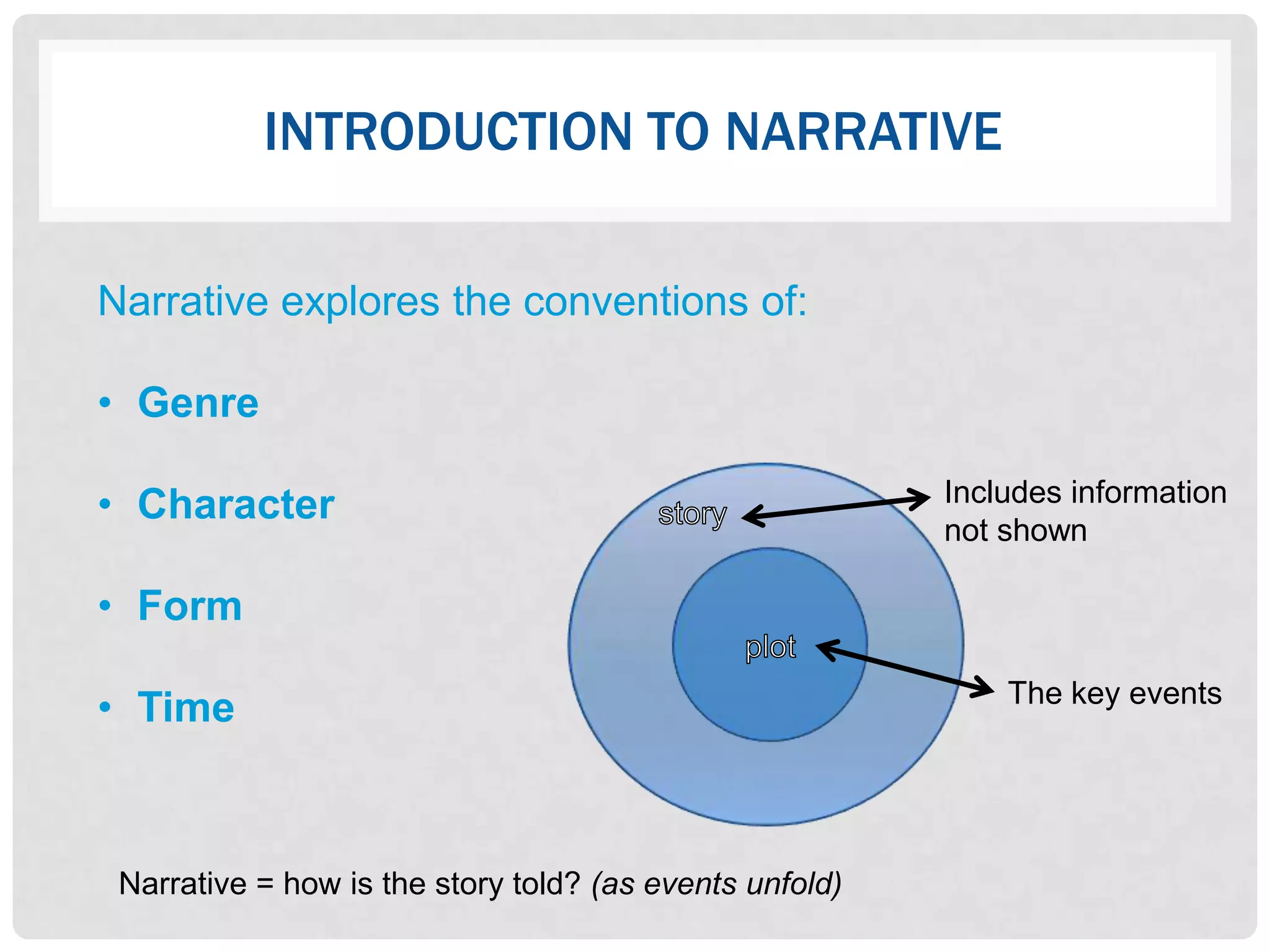
• Character                                              Includes information
                                                         not shown

• Form
                                                             The key events
• Time


 Narrative = how is the story told? (as events unfold)
NARRATIVE STRUCTURE
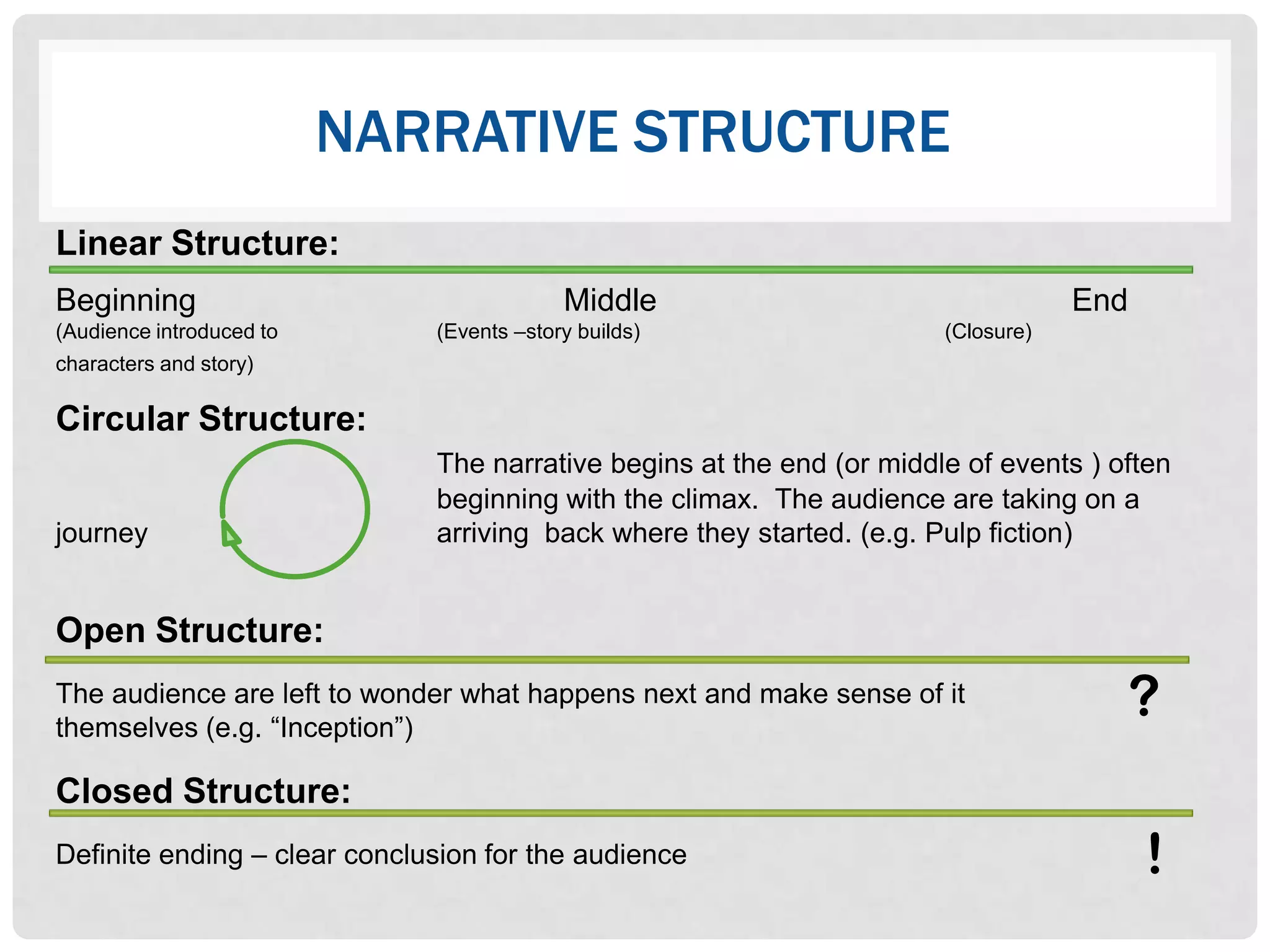
Linear Structure:
Beginning                                  Middle                                  End
(Audience introduced to       (Events –story builds)                   (Closure)
characters and story)

Circular Structure:
                              The narrative begins at the end (or middle of events ) often
                              beginning with the climax. The audience are taking on a
journey                       arriving back where they started. (e.g. Pulp fiction)


Open Structure:
The audience are left to wonder what happens next and make sense of it
themselves (e.g. “Inception”)
                                                                                      ?
Closed Structure:
Definite ending – clear conclusion for the audience                                      !
COMPLEX NARRATIVE STRUCTURE

Today‟s narratives have become increasingly complex as producers know that
audiences have a greater sense of media literacy when it comes to making
meaning of the text and reading the signs. There are often numerous plot twists
and surprises that keep the audience intrigued with carefully spun storylines.

Films such as “Memento” (Nolan,2000) which weaves the story in reverse gives the
audience a similar experience to the protagonist who has short term memory
loss, as they try and fit the clues together through the use of restricted narrative.

Unrestricted Narrative: What the audience are assumed to know
e.g. In a thriller there will be a crime so they will be expecting it

Restricted Narrative: The information that is withheld from the audience


Now test your knowledge:
            http://quizlet.com/4162490/narrative-theorists-flash-cards/
An Ellipsis
An ellipsis is a break in time –it would be difficult to show everything
that happens in a film in 'real-time‟.

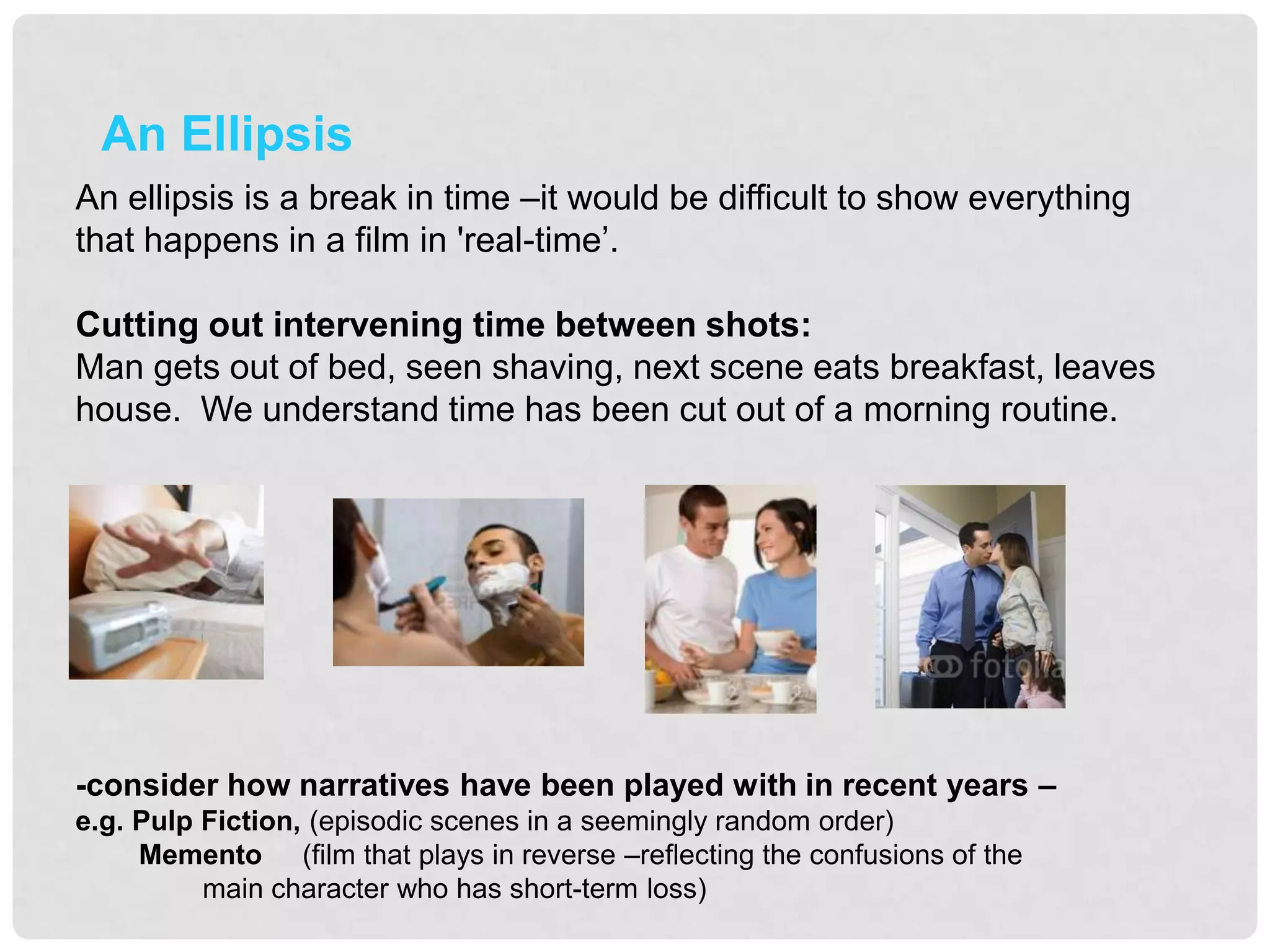
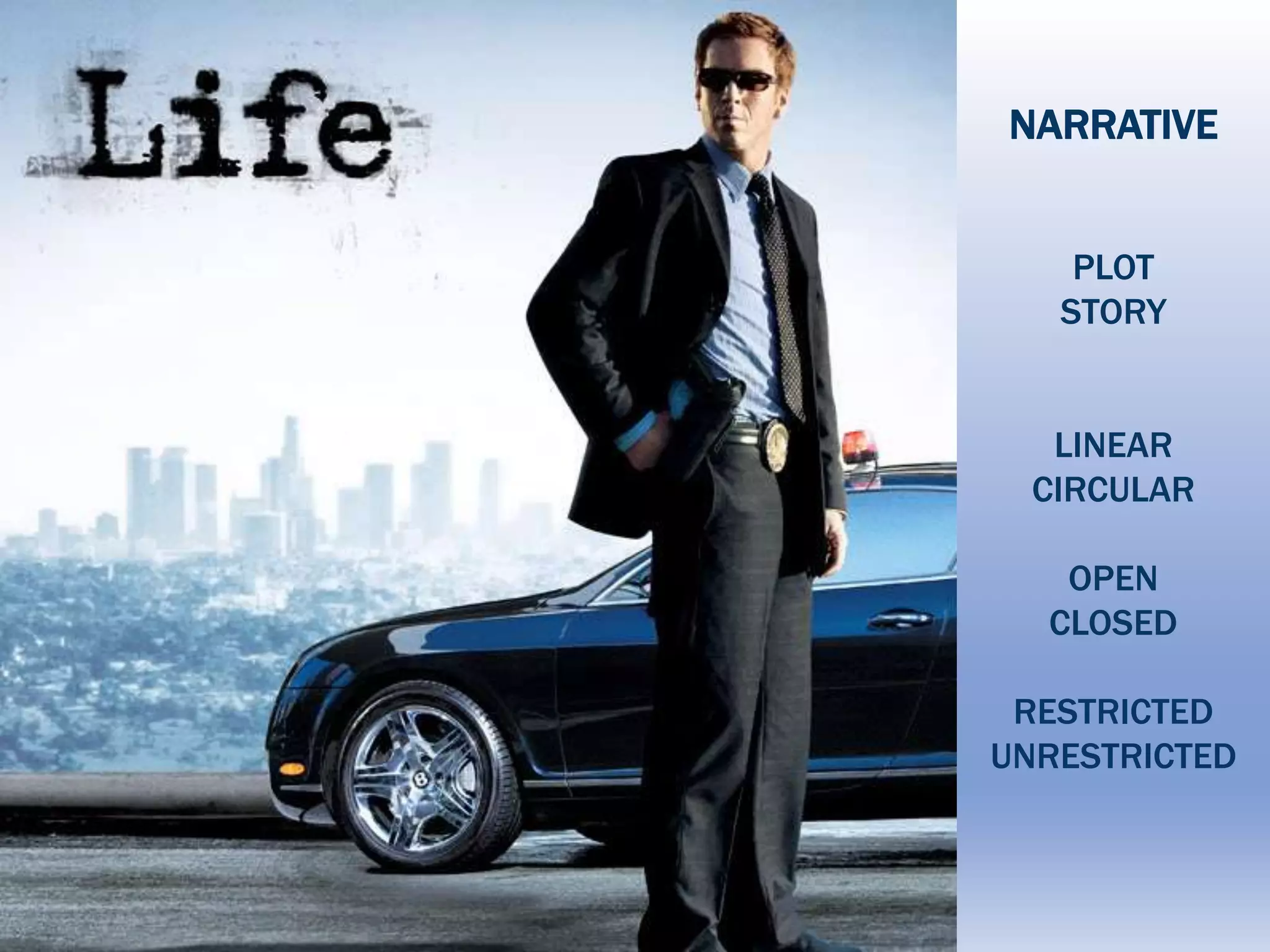
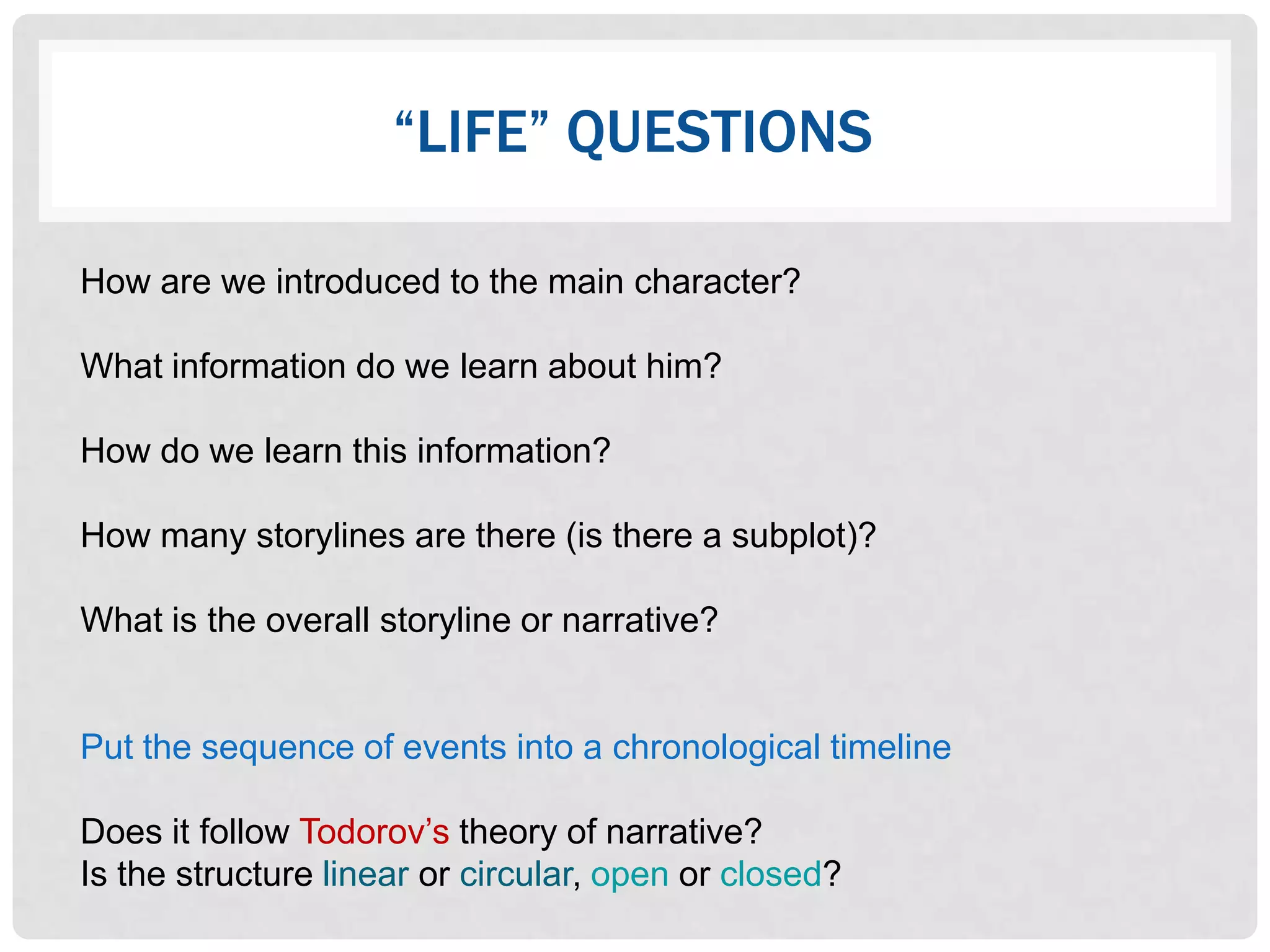
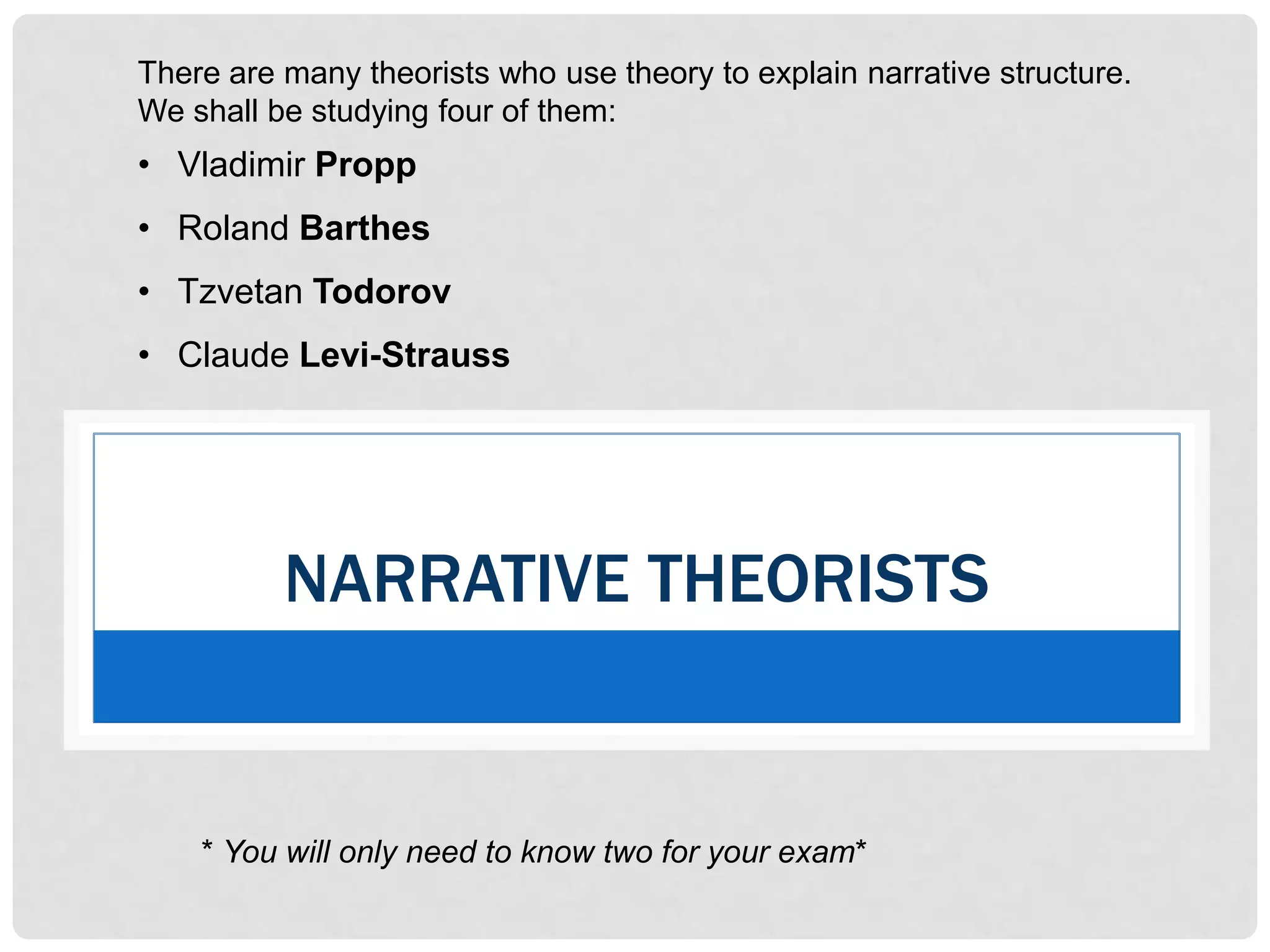
Cutting out intervening time between shots:
Man gets out of bed, seen shaving, next scene eats breakfast, leaves
house. We understand time has been cut out of a morning routine.


-consider how narratives have been played with in recent years –
e.g. Pulp Fiction, (episodic scenes in a seemingly random order)
     Memento (film that plays in reverse –reflecting the confusions of the
          main character who has short-term loss)
NARRATIVE


    PLOT
   STORY


   LINEAR
  CIRCULAR

   OPEN
  CLOSED

 RESTRICTED
UNRESTRICTED
“LIFE” QUESTIONS

How are we introduced to the main character?

What information do we learn about him?

How do we learn this information?

How many storylines are there (is there a subplot)?

What is the overall storyline or narrative?


Put the sequence of events into a chronological timeline

Does it follow Todorov‟s theory of narrative?
Is the structure linear or circular, open or closed?
There are many theorists who use theory to explain narrative structure.
We shall be studying four of them:
• Vladimir Propp
• Roland Barthes
• Tzvetan Todorov
• Claude Levi-Strauss


          NARRATIVE THEORISTS


    * You will only need to know two for your exam*
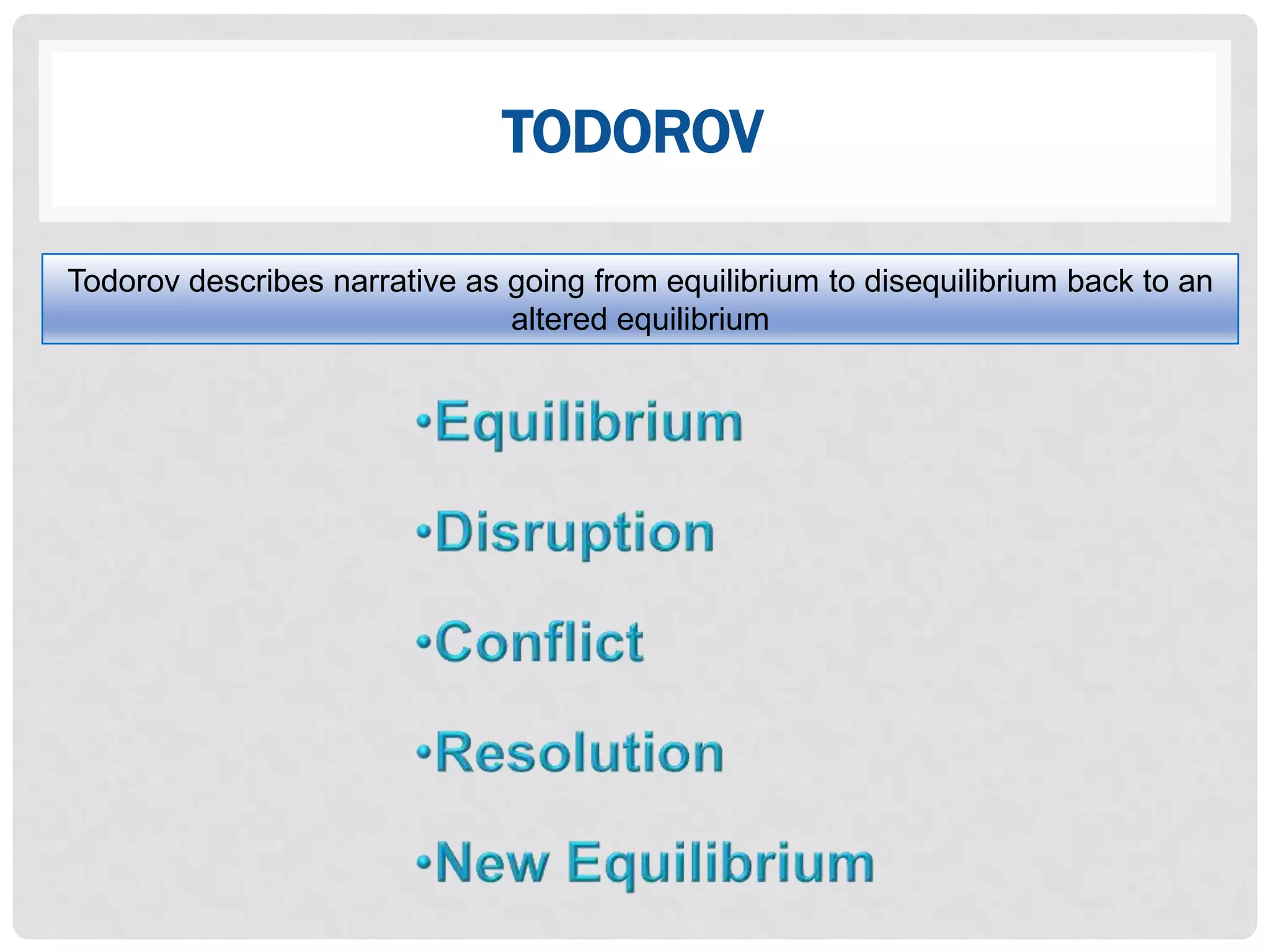
TODOROV

Todorov describes narrative as going from equilibrium to disequilibrium back to an
                               altered equilibrium
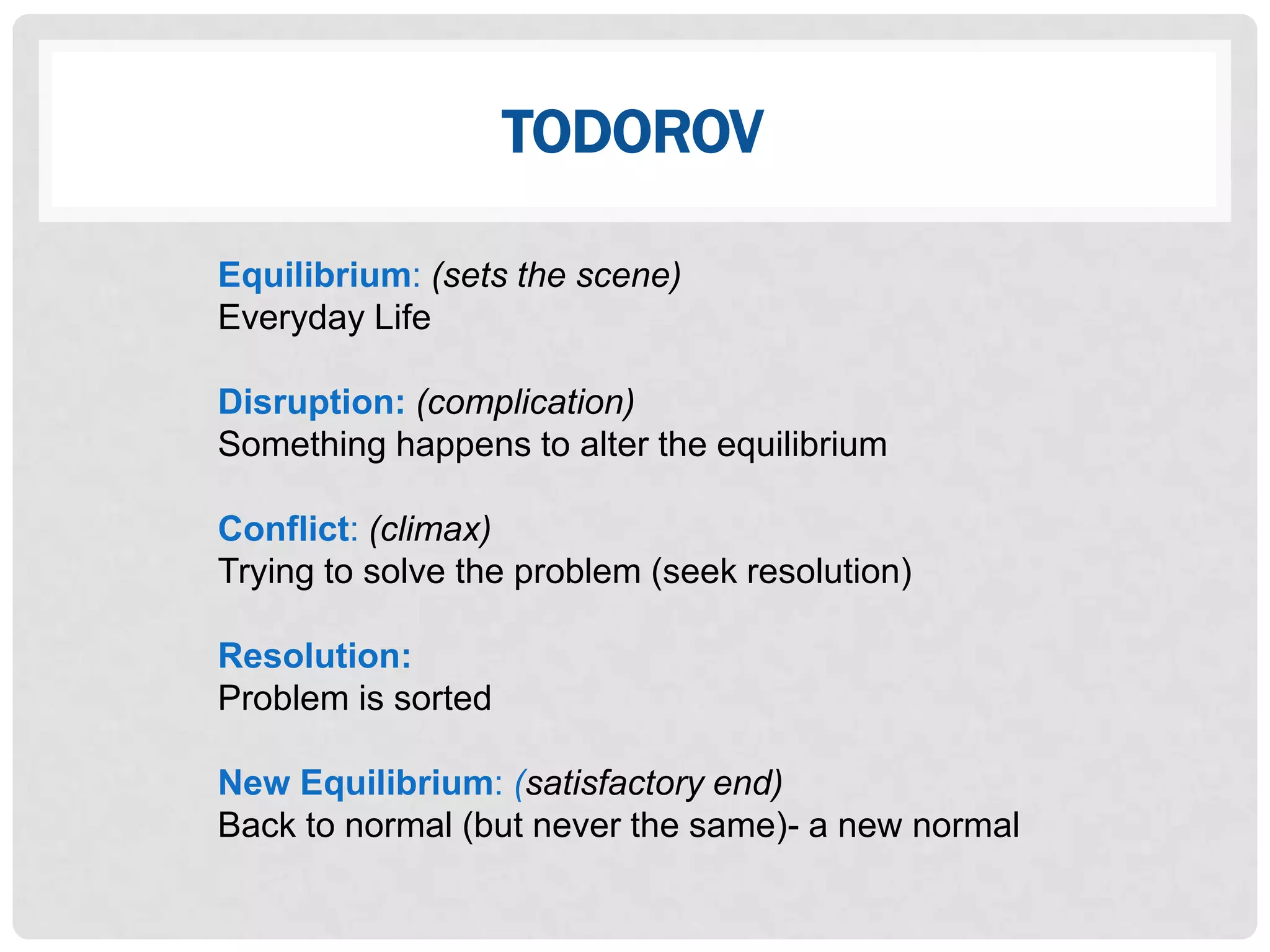
TODOROV

Equilibrium: (sets the scene)
Everyday Life

Disruption: (complication)
Something happens to alter the equilibrium

Conflict: (climax)
Trying to solve the problem (seek resolution)

Resolution:
Problem is sorted

New Equilibrium: (satisfactory end)
Back to normal (but never the same)- a new normal
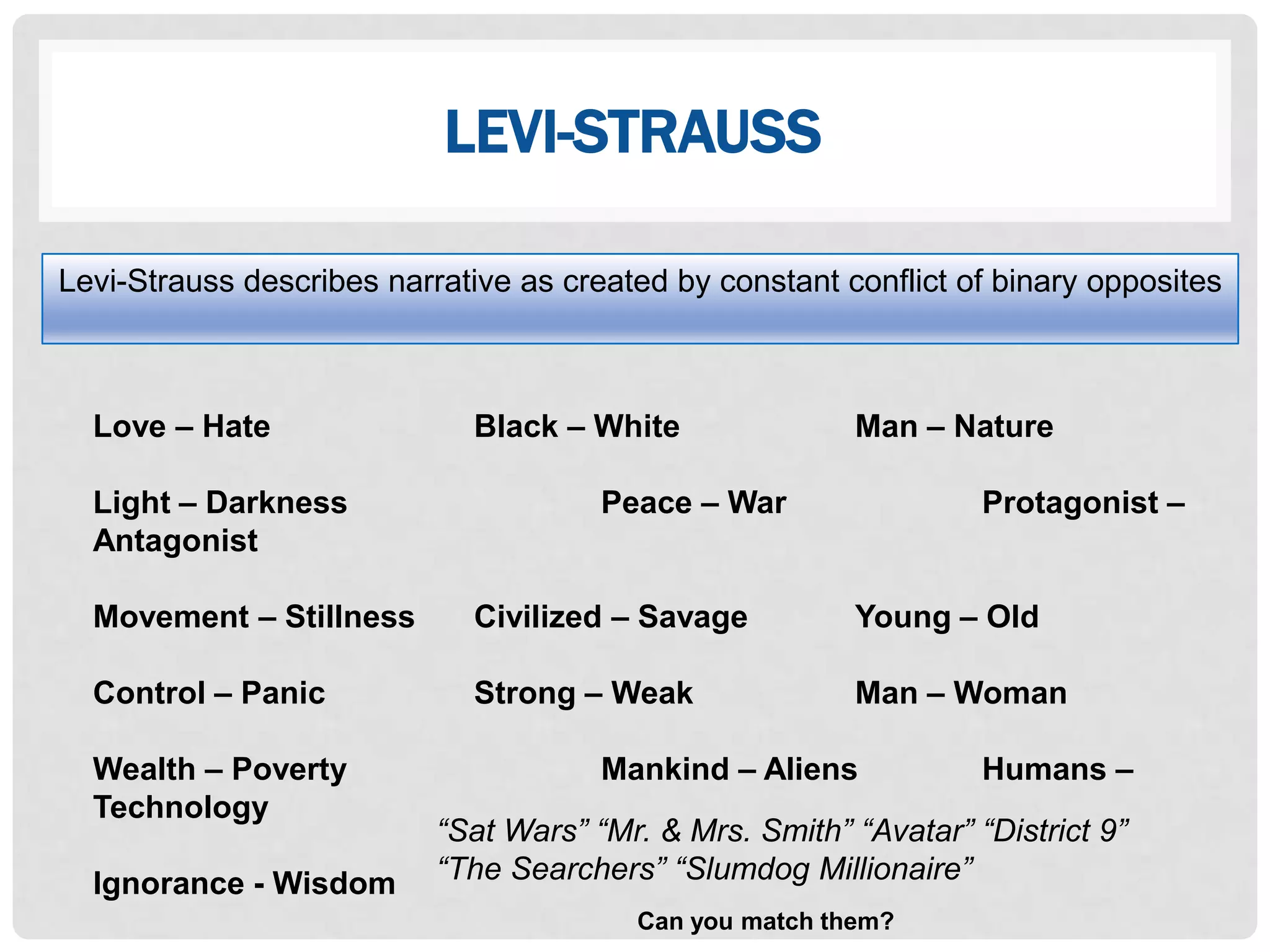
LEVI-STRAUSS

Levi-Strauss describes narrative as created by constant conflict of binary opposites


  Love – Hate                Black – White               Man – Nature

  Light – Darkness                     Peace – War                 Protagonist –
  Antagonist

  Movement – Stillness       Civilized – Savage          Young – Old

  Control – Panic            Strong – Weak               Man – Woman

  Wealth – Poverty                     Mankind – Aliens            Humans –
  Technology
                           “Sat Wars” “Mr. & Mrs. Smith” “Avatar” “District 9”
  Ignorance - Wisdom       “The Searchers” “Slumdog Millionaire”
                                         Can you match them?
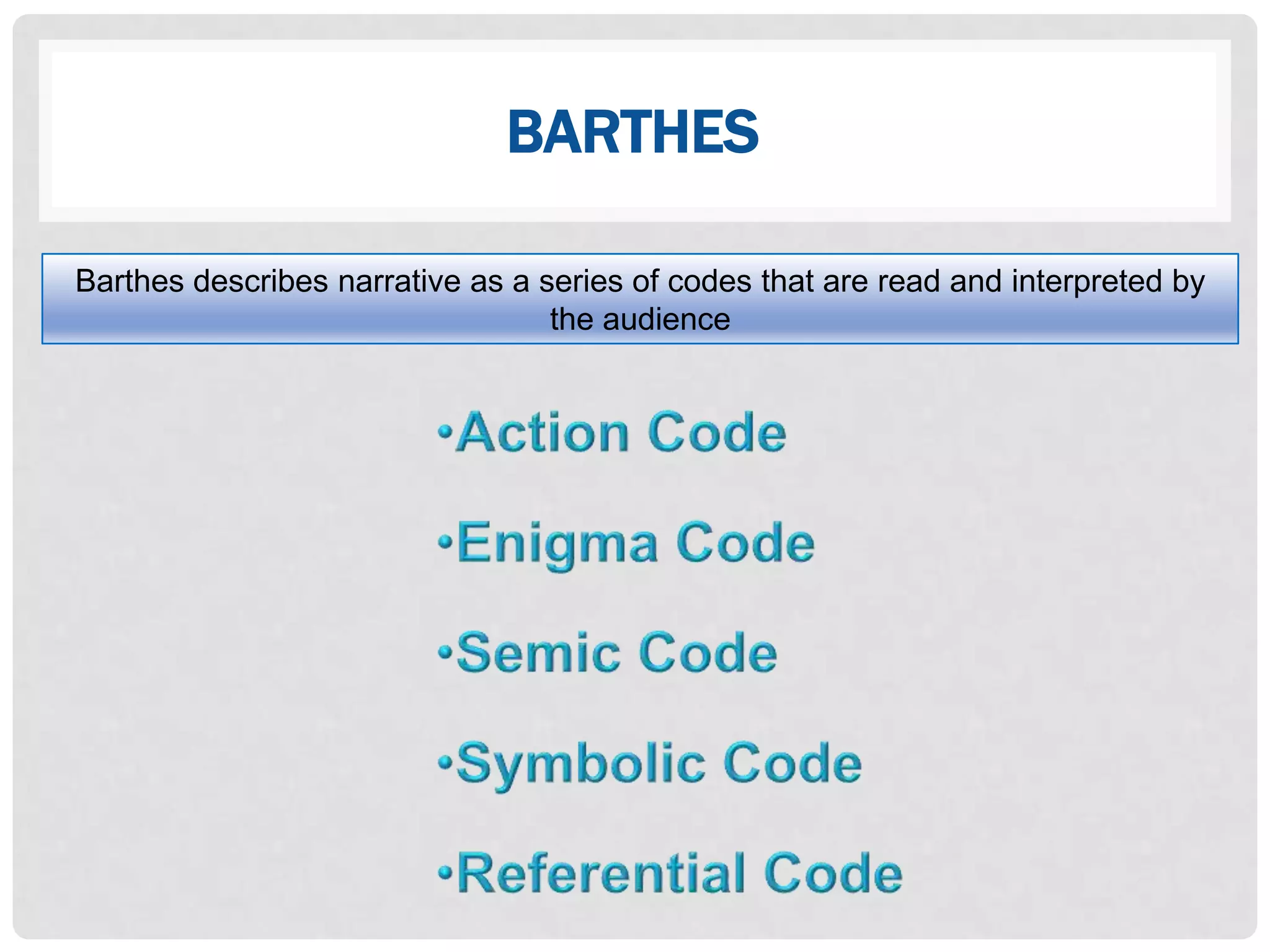
BARTHES

Barthes describes narrative as a series of codes that are read and interpreted by
                                  the audience
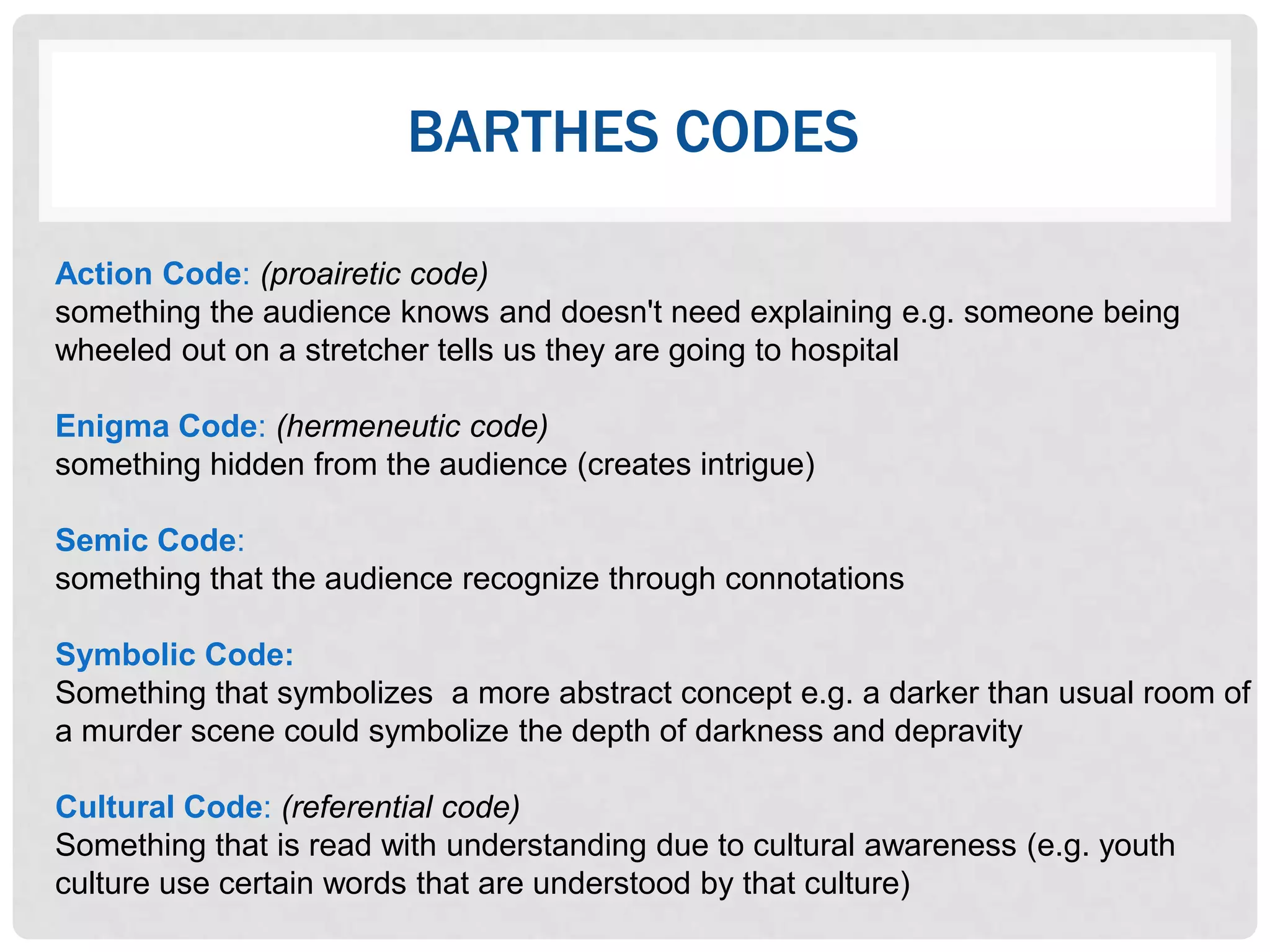
BARTHES CODES

Action Code: (proairetic code)
something the audience knows and doesn't need explaining e.g. someone being
wheeled out on a stretcher tells us they are going to hospital

Enigma Code: (hermeneutic code)
something hidden from the audience (creates intrigue)

Semic Code:
something that the audience recognize through connotations

Symbolic Code:
Something that symbolizes a more abstract concept e.g. a darker than usual room of
a murder scene could symbolize the depth of darkness and depravity

Cultural Code: (referential code)
Something that is read with understanding due to cultural awareness (e.g. youth
culture use certain words that are understood by that culture)
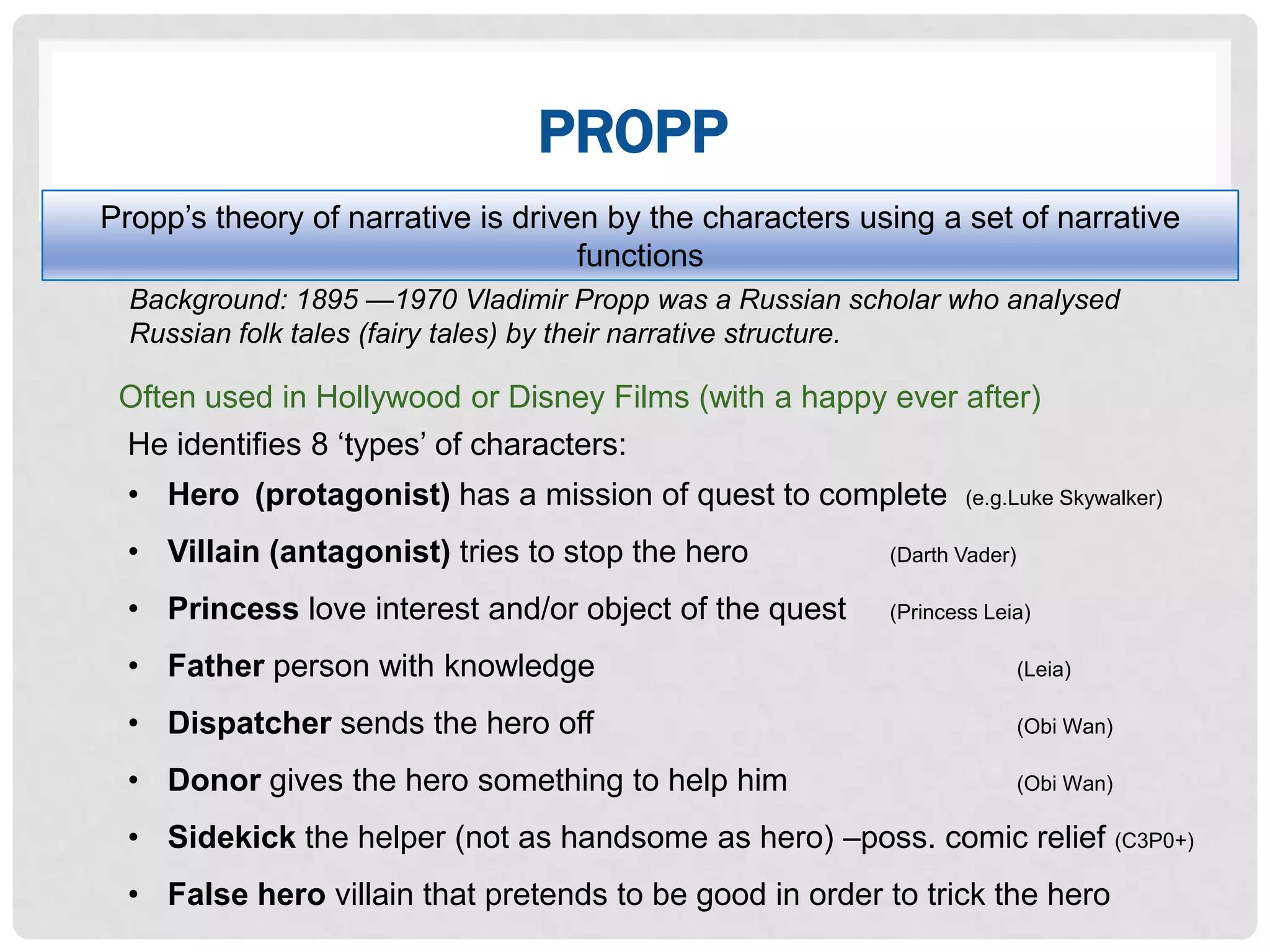
PROPP
Propp‟s theory of narrative is driven by the characters using a set of narrative
                                    functions
  Background: 1895 —1970 Vladimir Propp was a Russian scholar who analysed
  Russian folk tales (fairy tales) by their narrative structure.

 Often used in Hollywood or Disney Films (with a happy ever after)
 He identifies 8 „types‟ of characters:
  • Hero (protagonist) has a mission of quest to complete         (e.g.Luke Skywalker)

  • Villain (antagonist) tries to stop the hero           (Darth Vader)

  • Princess love interest and/or object of the quest     (Princess Leia)

  • Father person with knowledge                                          (Leia)

  • Dispatcher sends the hero off                                         (Obi Wan)

  • Donor gives the hero something to help him                            (Obi Wan)

  • Sidekick the helper (not as handsome as hero) –poss. comic relief (C3P0+)
  • False hero villain that pretends to be good in order to trick the hero
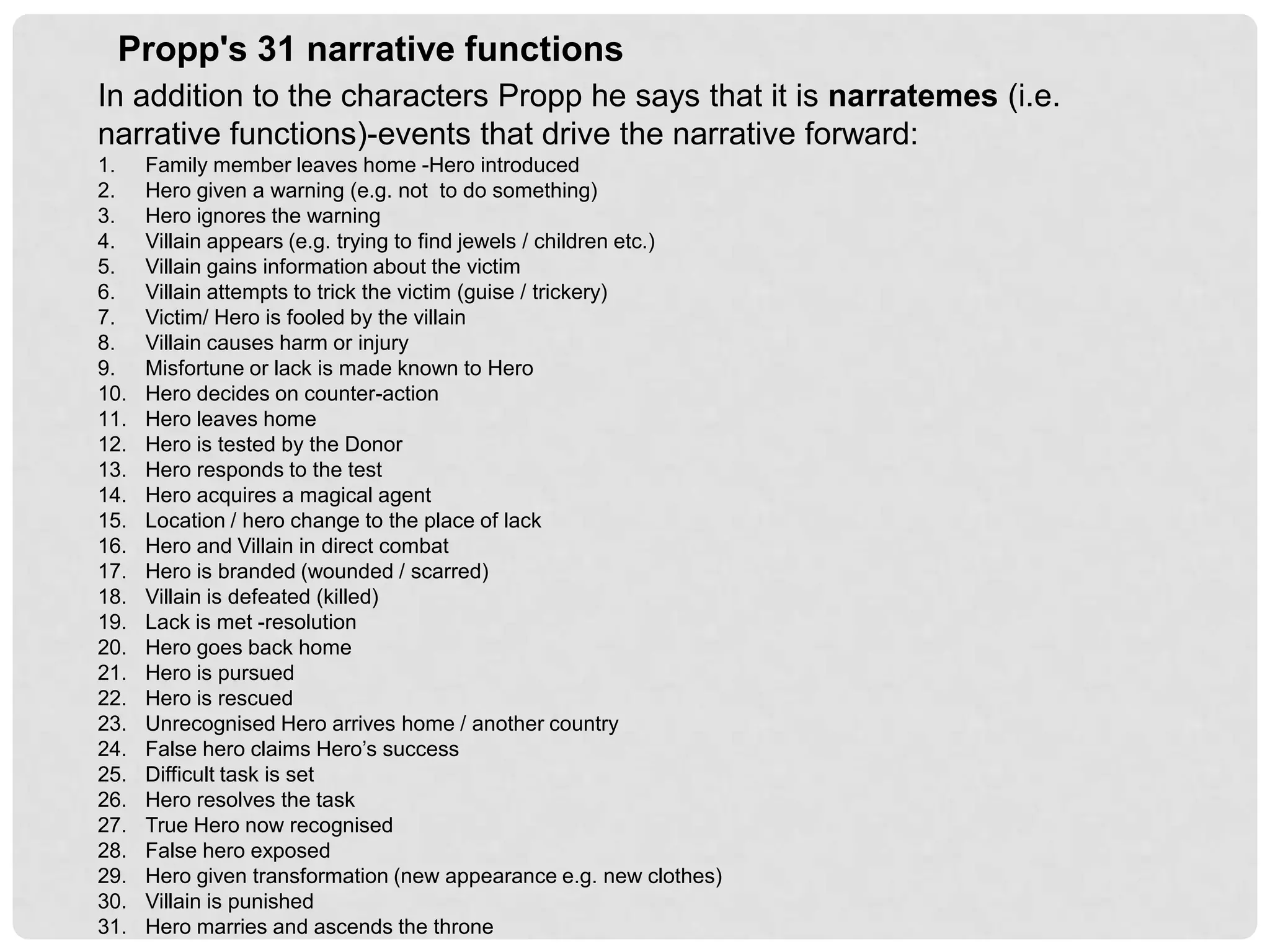
Propp's 31 narrative functions
In addition to the characters Propp he says that it is narratemes (i.e.
narrative functions)-events that drive the narrative forward:
1.    Family member leaves home -Hero introduced
2.    Hero given a warning (e.g. not to do something)
3.    Hero ignores the warning
4.    Villain appears (e.g. trying to find jewels / children etc.)
5.    Villain gains information about the victim
6.    Villain attempts to trick the victim (guise / trickery)
7.    Victim/ Hero is fooled by the villain
8.    Villain causes harm or injury
9.    Misfortune or lack is made known to Hero
10.   Hero decides on counter-action
11.   Hero leaves home
12.   Hero is tested by the Donor
13.   Hero responds to the test
14.   Hero acquires a magical agent
15.   Location / hero change to the place of lack
16.   Hero and Villain in direct combat
17.   Hero is branded (wounded / scarred)
18.   Villain is defeated (killed)
19.   Lack is met -resolution
20.   Hero goes back home
21.   Hero is pursued
22.   Hero is rescued
23.   Unrecognised Hero arrives home / another country
24.   False hero claims Hero‟s success
25.   Difficult task is set
26.   Hero resolves the task
27.   True Hero now recognised
28.   False hero exposed
29.   Hero given transformation (new appearance e.g. new clothes)
30.   Villain is punished
31.   Hero marries and ascends the throne
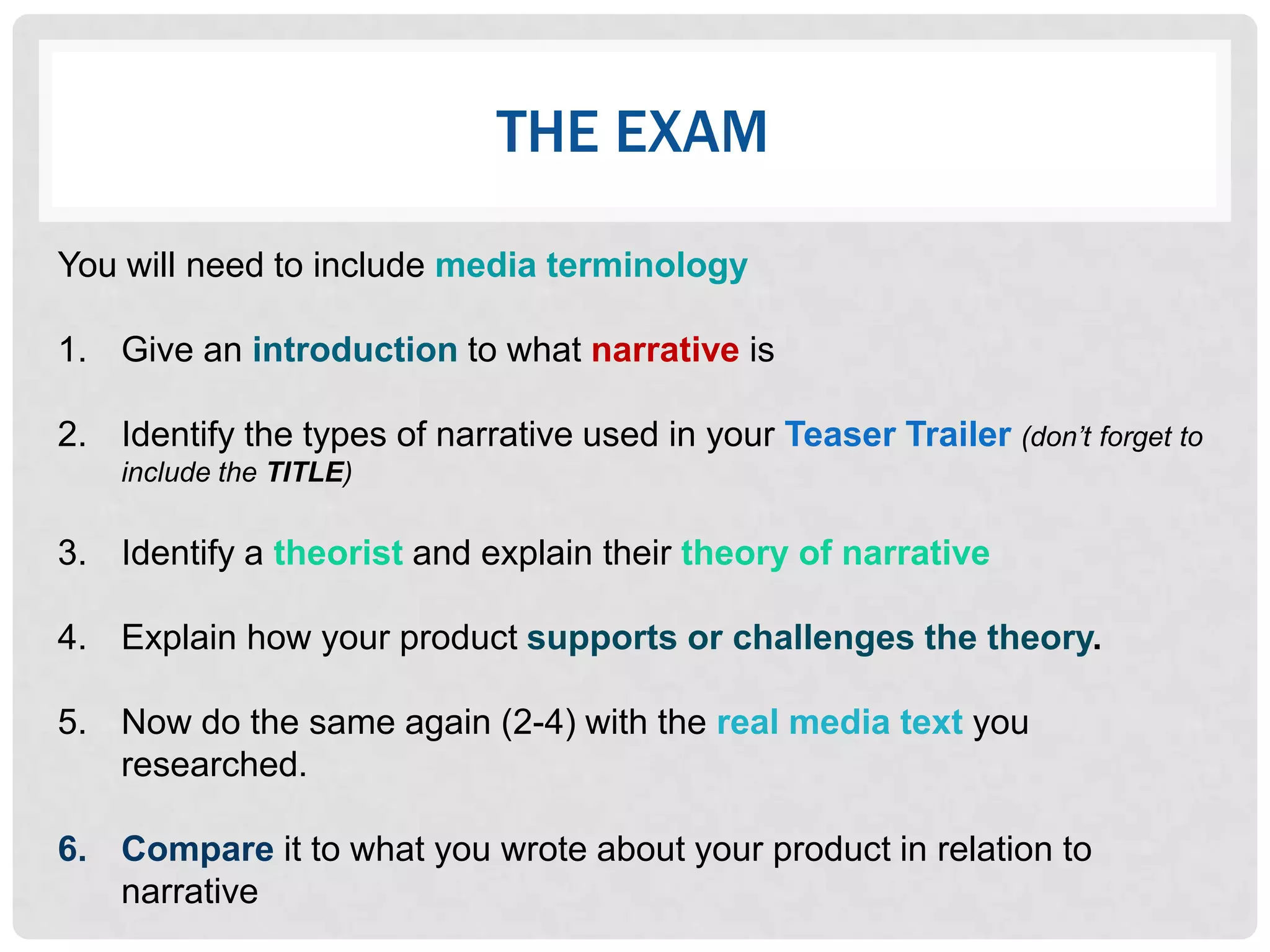
THE EXAM

You will need to include media terminology

1. Give an introduction to what narrative is

2. Identify the types of narrative used in your Teaser Trailer (don’t forget to
    include the TITLE)

3. Identify a theorist and explain their theory of narrative

4. Explain how your product supports or challenges the theory.

5. Now do the same again (2-4) with the real media text you
   researched.

6. Compare it to what you wrote about your product in relation to
   narrative
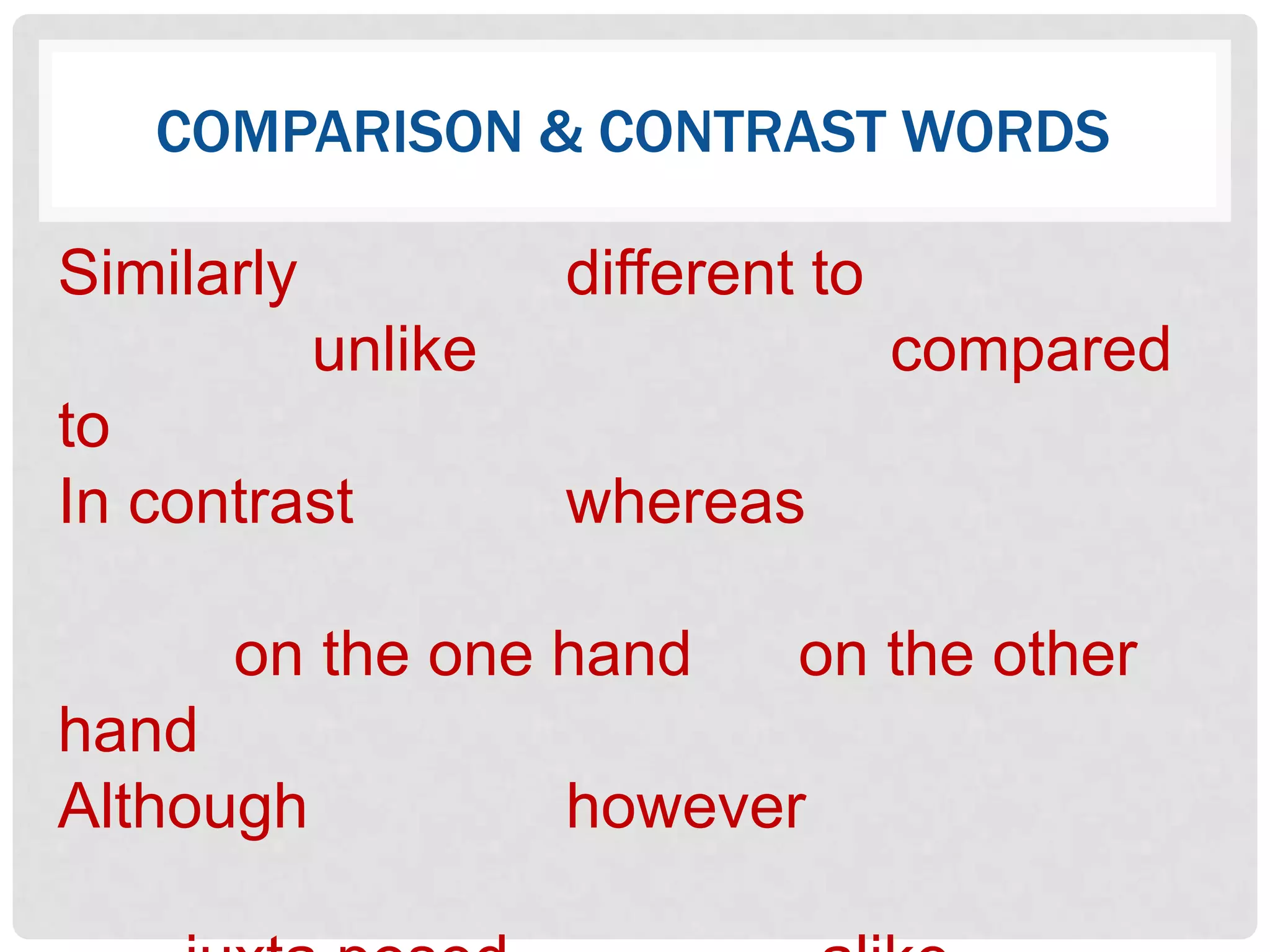
COMPARISON & CONTRAST WORDS

Similarly            different to
            unlike                  compared
to
In contrast          whereas

      on the one hand         on the other
hand
Although             however

Narrative theorists

  • 1.
    NARRATIVE THEORY UNIT G325 - SECTION A –Q1B
  • 2.
    INTRODUCTION TO NARRATIVE Narrativeexplores the conventions of: • Genre • Character Includes information not shown • Form The key events • Time Narrative = how is the story told? (as events unfold)
  • 3.
    NARRATIVE STRUCTURE Linear Structure: Beginning Middle End (Audience introduced to (Events –story builds) (Closure) characters and story) Circular Structure: The narrative begins at the end (or middle of events ) often beginning with the climax. The audience are taking on a journey arriving back where they started. (e.g. Pulp fiction) Open Structure: The audience are left to wonder what happens next and make sense of it themselves (e.g. “Inception”) ? Closed Structure: Definite ending – clear conclusion for the audience !
  • 4.
    COMPLEX NARRATIVE STRUCTURE Today‟snarratives have become increasingly complex as producers know that audiences have a greater sense of media literacy when it comes to making meaning of the text and reading the signs. There are often numerous plot twists and surprises that keep the audience intrigued with carefully spun storylines. Films such as “Memento” (Nolan,2000) which weaves the story in reverse gives the audience a similar experience to the protagonist who has short term memory loss, as they try and fit the clues together through the use of restricted narrative. Unrestricted Narrative: What the audience are assumed to know e.g. In a thriller there will be a crime so they will be expecting it Restricted Narrative: The information that is withheld from the audience Now test your knowledge: http://quizlet.com/4162490/narrative-theorists-flash-cards/
  • 5.
    An Ellipsis An ellipsisis a break in time –it would be difficult to show everything that happens in a film in 'real-time‟. Cutting out intervening time between shots: Man gets out of bed, seen shaving, next scene eats breakfast, leaves house. We understand time has been cut out of a morning routine. -consider how narratives have been played with in recent years – e.g. Pulp Fiction, (episodic scenes in a seemingly random order) Memento (film that plays in reverse –reflecting the confusions of the main character who has short-term loss)
  • 6.
    NARRATIVE PLOT STORY LINEAR CIRCULAR OPEN CLOSED RESTRICTED UNRESTRICTED
  • 7.
    “LIFE” QUESTIONS How arewe introduced to the main character? What information do we learn about him? How do we learn this information? How many storylines are there (is there a subplot)? What is the overall storyline or narrative? Put the sequence of events into a chronological timeline Does it follow Todorov‟s theory of narrative? Is the structure linear or circular, open or closed?
  • 8.
    There are manytheorists who use theory to explain narrative structure. We shall be studying four of them: • Vladimir Propp • Roland Barthes • Tzvetan Todorov • Claude Levi-Strauss NARRATIVE THEORISTS * You will only need to know two for your exam*
  • 9.
    TODOROV Todorov describes narrativeas going from equilibrium to disequilibrium back to an altered equilibrium
  • 10.
    TODOROV Equilibrium: (sets thescene) Everyday Life Disruption: (complication) Something happens to alter the equilibrium Conflict: (climax) Trying to solve the problem (seek resolution) Resolution: Problem is sorted New Equilibrium: (satisfactory end) Back to normal (but never the same)- a new normal
  • 11.
    LEVI-STRAUSS Levi-Strauss describes narrativeas created by constant conflict of binary opposites Love – Hate Black – White Man – Nature Light – Darkness Peace – War Protagonist – Antagonist Movement – Stillness Civilized – Savage Young – Old Control – Panic Strong – Weak Man – Woman Wealth – Poverty Mankind – Aliens Humans – Technology “Sat Wars” “Mr. & Mrs. Smith” “Avatar” “District 9” Ignorance - Wisdom “The Searchers” “Slumdog Millionaire” Can you match them?
  • 12.
    BARTHES Barthes describes narrativeas a series of codes that are read and interpreted by the audience
  • 13.
    BARTHES CODES Action Code:(proairetic code) something the audience knows and doesn't need explaining e.g. someone being wheeled out on a stretcher tells us they are going to hospital Enigma Code: (hermeneutic code) something hidden from the audience (creates intrigue) Semic Code: something that the audience recognize through connotations Symbolic Code: Something that symbolizes a more abstract concept e.g. a darker than usual room of a murder scene could symbolize the depth of darkness and depravity Cultural Code: (referential code) Something that is read with understanding due to cultural awareness (e.g. youth culture use certain words that are understood by that culture)
  • 14.
    PROPP Propp‟s theory ofnarrative is driven by the characters using a set of narrative functions Background: 1895 —1970 Vladimir Propp was a Russian scholar who analysed Russian folk tales (fairy tales) by their narrative structure. Often used in Hollywood or Disney Films (with a happy ever after) He identifies 8 „types‟ of characters: • Hero (protagonist) has a mission of quest to complete (e.g.Luke Skywalker) • Villain (antagonist) tries to stop the hero (Darth Vader) • Princess love interest and/or object of the quest (Princess Leia) • Father person with knowledge (Leia) • Dispatcher sends the hero off (Obi Wan) • Donor gives the hero something to help him (Obi Wan) • Sidekick the helper (not as handsome as hero) –poss. comic relief (C3P0+) • False hero villain that pretends to be good in order to trick the hero
  • 15.
    Propp's 31 narrativefunctions In addition to the characters Propp he says that it is narratemes (i.e. narrative functions)-events that drive the narrative forward: 1. Family member leaves home -Hero introduced 2. Hero given a warning (e.g. not to do something) 3. Hero ignores the warning 4. Villain appears (e.g. trying to find jewels / children etc.) 5. Villain gains information about the victim 6. Villain attempts to trick the victim (guise / trickery) 7. Victim/ Hero is fooled by the villain 8. Villain causes harm or injury 9. Misfortune or lack is made known to Hero 10. Hero decides on counter-action 11. Hero leaves home 12. Hero is tested by the Donor 13. Hero responds to the test 14. Hero acquires a magical agent 15. Location / hero change to the place of lack 16. Hero and Villain in direct combat 17. Hero is branded (wounded / scarred) 18. Villain is defeated (killed) 19. Lack is met -resolution 20. Hero goes back home 21. Hero is pursued 22. Hero is rescued 23. Unrecognised Hero arrives home / another country 24. False hero claims Hero‟s success 25. Difficult task is set 26. Hero resolves the task 27. True Hero now recognised 28. False hero exposed 29. Hero given transformation (new appearance e.g. new clothes) 30. Villain is punished 31. Hero marries and ascends the throne
  • 16.
    THE EXAM You willneed to include media terminology 1. Give an introduction to what narrative is 2. Identify the types of narrative used in your Teaser Trailer (don’t forget to include the TITLE) 3. Identify a theorist and explain their theory of narrative 4. Explain how your product supports or challenges the theory. 5. Now do the same again (2-4) with the real media text you researched. 6. Compare it to what you wrote about your product in relation to narrative
  • 17.
    COMPARISON & CONTRASTWORDS Similarly different to unlike compared to In contrast whereas on the one hand on the other hand Although however