G325: Critical Perspectives in MediaTheoretical Evaluation of Production - Question 1(b)Narrative
Narrative• Tim O’Sullivan (1998) argues that allmedia texts tell us some kind of story.•Media texts offer a way of telling stories about ourselves – not usually our own personal stories, but the story of us as a culture or set of cultures.• Narrative theory sets out to show that whatwe experience when we ‘read’ a story is tounderstand a particular set of constructions,or conventions, and that it is important tobe aware of how these constructions are puttogether.
3 important words…Narrative: The structure of a story.Diegesis: The fictional space and time implied by the narrative – the world in which the story takes place.Verisimilitude: Literally – the quality ofappearing to be real or true. For a story toengage us it must appear to be real to us aswe watch it (the diegetic effect). The storymust therefore have verisimilitude –following the rules of continuity, temporaland spacial coherence.
The Structure Of The Classic NarrativeAccording to Pam Cook (1985), thestandard Hollywood narrative structureshould have:Linearity of cause and effect within an overall trajectory of enigma resolution.A high degree of narrative closure.A fictional world that contains verisimilitude especially governed by spatial and temporal coherence.
Tzvetan Todorov (1977)Bulgarian structural linguist.He was interested in the way language isordered to infer particular meanings and hasbeen very influential in the field of narrativetheory.
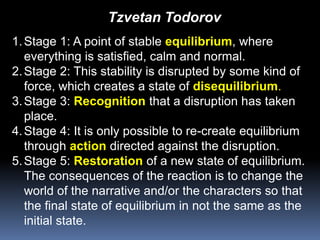
Tzvetan TodorovStage 1: A point of stable equilibrium, where everything is satisfied, calm and normal.Stage 2: This stability is disrupted by some kind of force, which creates a state of disequilibrium.Stage 3: Recognition that a disruption has taken place.Stage 4: It is only possible to re-create equilibrium through action directed against the disruption.Stage 5: Restoration of a new state of equilibrium. The consequences of the reaction is to change the world of the narrative and/or the characters so that the final state of equilibrium in not the same as the initial state.
Roland Barthes (1977)Establishmentof plot or theme. This is then followed by the developmentof the problem, an enigma, an increase in tension.Finally comes the resolution of the plot.Such narratives can be unambiguous andlinear.
According to Kate Domaille (2001) every storyever told can be fitted into one of eightnarrative types. Each of these narrative typeshas a source, an original story upon which theothers are based. These stories are as follows:Achilles: The fatal flawthat leads to the destruction of the previously flawless, or almost flawless, person, e.g. Superman, Fatal Attraction.Candide: The indomitable herowho cannot be put down, e.g. Indiana Jones, James Bond, Rocky etc.Cinderella: The dream comes true, e.g. Pretty Woman.
Circe: The Chase, the spider and the fly, the innocent and the victim e.g. The Terminator. Faust: Selling your soul to the devil may bring riches but eventually your soul belongs to him, e.g. Devil’s Advocate, Wall Street.Orpheus: The loss of something personal, the gift that is taken away, the tragedy of loss or the journey which follows the loss, e.g. The Sixth Sense, Born On the Fourth Of July.Romeo And Juliet: The love story, e.g. Titanic.Tristan and Iseult: The love triangle. Man loves woman…unfortunately one or both of them are  already spoken for, or a third party intervenes, e.g. Casablanca.
The Russian theorist Vladimir Propp (1928)studied the narrative structure of RussianFolk Tales.Propp concluded that regardless of the individual differences in terms of plot, characters and settings, such narratives would share common structural features.
He also concluded that all the characters could beresolved into only seven character typesin the 100 taleshe analyzed:The villain — struggles against the hero.The donor — prepares the hero or gives the hero some magical object.The (magical) helper — helps the hero in the quest.The princess and her father — gives the task to the hero,identifies the false hero, marries the hero, often sought for during the narrative. Propp noted that functionally, the princess and the father can not be clearly distinguished.The dispatcher — character who makes the lack known and sends the hero off.The hero or victim/seeker hero — reacts to the donor, weds the princess.[False hero] — takes credit for the hero’s actions or tries to marry the princess.
When brought together and broken down into their constitute parts these myths can be used to formulate a universal monomyththat is essentially the condensed, basic hero narrative that forms the basis for every myth and legend in the world and is, therefore, common to allcultures.Both George Lucas and Stephen Spielbergwere heavily influenced by Campbell’stheories and Star Wars conforms toCampbell’s model of the Monomyth almostexactly.
Ordinary World – the ordered world that the hero will choose (or be forced) to abandon.Call To Adventure – a problem or challenge arises.Refusal Of The Call – fear or reluctance may strike the hero.Meeting With The Mentor – the mentor is a key character.Crossing The First Threshold – the hero commits to the adventure.Test, Allies, Enemies – the hero must learn the rules that will govern his quest.Approach To The Innermost Cave – the most dangerous confrontation yet, perhaps the location of the treasure, or the object of the quest.Ordeal – the hero must face his fear or mortal enemy who will seem more powerful. Mental or physical torture may occur.Reward (Seizing The Sword) – the hero can celebrate the victory.The Road Back – vengeful forces controlled by the villain are unleashed.Resurrection – perhaps a final confrontation with death.Return With The Elixir – return to the ordinary world with some wisdom, knowledge or something else gained from the adventure.
These structures are not unique to film but also advertising and news stories.In fact the structures presented are an integral part of the majority of both western and eastern cultures - details how narrative works in society to inform the audience of events, people, places through mediated ideologies within them.Narratives have a common structure
Jonathan Culler (2001) describesnarratology as comprising many strands“implicitly united in the recognition thatnarrative theory requires a distinctionbetween story, a sequence of actions orevents conceived as independent of theirmanifestation in discourse, anddiscourse, the discursive presentation ornarration of events.”Structure is different to theme – narrative presents the form in which the theme is mediated/discussed.
Claude Lèvi-Strauss(1958) his ideas aboutnarrative amount to the fact that he believed all stories operated to certain clear Binary Opposites e.g. good vs. evil, black vs. white, rich vs. poor etc.The importance of these ideas is that essentially a complicated world is reduced to a simple either/or structure. Things are either right or wrong, good or bad. There is no in between.This structure has ideological implications, if, for example, you want to show that the hero was not wholly correct in what they did, and the villains weren’t always bad. (Postmodernism?)
Levi-Strauss also looked deeper into theway that narrative were arranged in termsof themes within that were ultimatelyalways systematic oppositions.The order of events can be called thesyntagmatic structure of a narrative, butLevi-Strauss was more concerned with thedeeper of paradigmatic arrangement ofthemes.There is a choice of elements (paradigms)and they are arranged/dealt with in aparticular way (syntagms).
Think of this question as the first part of your revision...“Media texts rely on cultural experiences inorder for audiences to easily make sense ofnarratives”. Explain how you used conventional and / or experimental narrative approaches in one of your production pieces.

Narrative powerpoint

  • 1.
    G325: Critical Perspectivesin MediaTheoretical Evaluation of Production - Question 1(b)Narrative
  • 2.
    Narrative• Tim O’Sullivan(1998) argues that allmedia texts tell us some kind of story.•Media texts offer a way of telling stories about ourselves – not usually our own personal stories, but the story of us as a culture or set of cultures.• Narrative theory sets out to show that whatwe experience when we ‘read’ a story is tounderstand a particular set of constructions,or conventions, and that it is important tobe aware of how these constructions are puttogether.
  • 3.
    3 important words…Narrative:The structure of a story.Diegesis: The fictional space and time implied by the narrative – the world in which the story takes place.Verisimilitude: Literally – the quality ofappearing to be real or true. For a story toengage us it must appear to be real to us aswe watch it (the diegetic effect). The storymust therefore have verisimilitude –following the rules of continuity, temporaland spacial coherence.
  • 4.
    The Structure OfThe Classic NarrativeAccording to Pam Cook (1985), thestandard Hollywood narrative structureshould have:Linearity of cause and effect within an overall trajectory of enigma resolution.A high degree of narrative closure.A fictional world that contains verisimilitude especially governed by spatial and temporal coherence.
  • 5.
    Tzvetan Todorov (1977)Bulgarianstructural linguist.He was interested in the way language isordered to infer particular meanings and hasbeen very influential in the field of narrativetheory.
  • 6.
    Tzvetan TodorovStage 1:A point of stable equilibrium, where everything is satisfied, calm and normal.Stage 2: This stability is disrupted by some kind of force, which creates a state of disequilibrium.Stage 3: Recognition that a disruption has taken place.Stage 4: It is only possible to re-create equilibrium through action directed against the disruption.Stage 5: Restoration of a new state of equilibrium. The consequences of the reaction is to change the world of the narrative and/or the characters so that the final state of equilibrium in not the same as the initial state.
  • 7.
    Roland Barthes (1977)Establishmentofplot or theme. This is then followed by the developmentof the problem, an enigma, an increase in tension.Finally comes the resolution of the plot.Such narratives can be unambiguous andlinear.
  • 8.
    According to KateDomaille (2001) every storyever told can be fitted into one of eightnarrative types. Each of these narrative typeshas a source, an original story upon which theothers are based. These stories are as follows:Achilles: The fatal flawthat leads to the destruction of the previously flawless, or almost flawless, person, e.g. Superman, Fatal Attraction.Candide: The indomitable herowho cannot be put down, e.g. Indiana Jones, James Bond, Rocky etc.Cinderella: The dream comes true, e.g. Pretty Woman.
  • 9.
    Circe: The Chase,the spider and the fly, the innocent and the victim e.g. The Terminator. Faust: Selling your soul to the devil may bring riches but eventually your soul belongs to him, e.g. Devil’s Advocate, Wall Street.Orpheus: The loss of something personal, the gift that is taken away, the tragedy of loss or the journey which follows the loss, e.g. The Sixth Sense, Born On the Fourth Of July.Romeo And Juliet: The love story, e.g. Titanic.Tristan and Iseult: The love triangle. Man loves woman…unfortunately one or both of them are already spoken for, or a third party intervenes, e.g. Casablanca.
  • 10.
    The Russian theoristVladimir Propp (1928)studied the narrative structure of RussianFolk Tales.Propp concluded that regardless of the individual differences in terms of plot, characters and settings, such narratives would share common structural features.
  • 11.
    He also concludedthat all the characters could beresolved into only seven character typesin the 100 taleshe analyzed:The villain — struggles against the hero.The donor — prepares the hero or gives the hero some magical object.The (magical) helper — helps the hero in the quest.The princess and her father — gives the task to the hero,identifies the false hero, marries the hero, often sought for during the narrative. Propp noted that functionally, the princess and the father can not be clearly distinguished.The dispatcher — character who makes the lack known and sends the hero off.The hero or victim/seeker hero — reacts to the donor, weds the princess.[False hero] — takes credit for the hero’s actions or tries to marry the princess.
  • 12.
    When brought togetherand broken down into their constitute parts these myths can be used to formulate a universal monomyththat is essentially the condensed, basic hero narrative that forms the basis for every myth and legend in the world and is, therefore, common to allcultures.Both George Lucas and Stephen Spielbergwere heavily influenced by Campbell’stheories and Star Wars conforms toCampbell’s model of the Monomyth almostexactly.
  • 13.
    Ordinary World –the ordered world that the hero will choose (or be forced) to abandon.Call To Adventure – a problem or challenge arises.Refusal Of The Call – fear or reluctance may strike the hero.Meeting With The Mentor – the mentor is a key character.Crossing The First Threshold – the hero commits to the adventure.Test, Allies, Enemies – the hero must learn the rules that will govern his quest.Approach To The Innermost Cave – the most dangerous confrontation yet, perhaps the location of the treasure, or the object of the quest.Ordeal – the hero must face his fear or mortal enemy who will seem more powerful. Mental or physical torture may occur.Reward (Seizing The Sword) – the hero can celebrate the victory.The Road Back – vengeful forces controlled by the villain are unleashed.Resurrection – perhaps a final confrontation with death.Return With The Elixir – return to the ordinary world with some wisdom, knowledge or something else gained from the adventure.
  • 14.
    These structures arenot unique to film but also advertising and news stories.In fact the structures presented are an integral part of the majority of both western and eastern cultures - details how narrative works in society to inform the audience of events, people, places through mediated ideologies within them.Narratives have a common structure
  • 15.
    Jonathan Culler (2001)describesnarratology as comprising many strands“implicitly united in the recognition thatnarrative theory requires a distinctionbetween story, a sequence of actions orevents conceived as independent of theirmanifestation in discourse, anddiscourse, the discursive presentation ornarration of events.”Structure is different to theme – narrative presents the form in which the theme is mediated/discussed.
  • 16.
    Claude Lèvi-Strauss(1958) hisideas aboutnarrative amount to the fact that he believed all stories operated to certain clear Binary Opposites e.g. good vs. evil, black vs. white, rich vs. poor etc.The importance of these ideas is that essentially a complicated world is reduced to a simple either/or structure. Things are either right or wrong, good or bad. There is no in between.This structure has ideological implications, if, for example, you want to show that the hero was not wholly correct in what they did, and the villains weren’t always bad. (Postmodernism?)
  • 17.
    Levi-Strauss also lookeddeeper into theway that narrative were arranged in termsof themes within that were ultimatelyalways systematic oppositions.The order of events can be called thesyntagmatic structure of a narrative, butLevi-Strauss was more concerned with thedeeper of paradigmatic arrangement ofthemes.There is a choice of elements (paradigms)and they are arranged/dealt with in aparticular way (syntagms).
  • 18.
    Think of thisquestion as the first part of your revision...“Media texts rely on cultural experiences inorder for audiences to easily make sense ofnarratives”. Explain how you used conventional and / or experimental narrative approaches in one of your production pieces.