Media Forms and
Language
Narrative
In this lesson we will:
•   Define narrative
•   Identify 3 narrative theories
•   Apply these theories to media products
•   Define non / linear narrative
Firstly…
• Collect Misfits / Advert Homework

  (Those who do not have it will stay at 3.45 to
                  complete it)
• Give back special effects homework:

•   2 marks – spelling and grammar
•   2 marks – opinion
•   2 marks – terminology
•   2 marks – valid example


• Semiotics Terminology Quiz!
What is narrative?
• Narrative is about how stories are told


• So stories which are told again and again, can
  still have different narratives


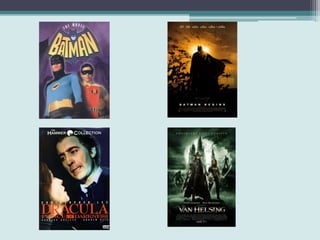
• What stories can you think of that have
  been told time and time again?
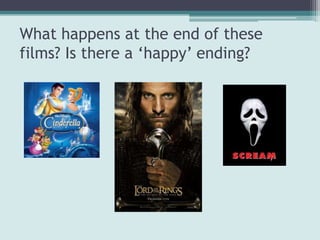
What happens at the end of these
films? Is there a ‘happy’ ending?
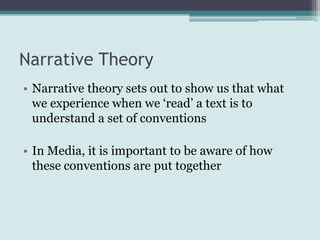
Narrative Theory
• Narrative theory sets out to show us that what
  we experience when we ‘read’ a text is to
  understand a set of conventions

• In Media, it is important to be aware of how
  these conventions are put together
Todorov
• Todorov argued that all stories share a
  common structure

• How do you think most stories could be
  structured?
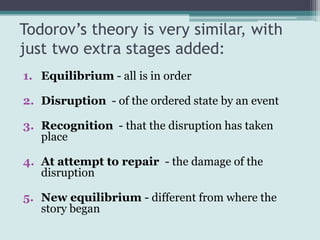
Todorov’s theory is very similar, with
just two extra stages added:
1. Equilibrium - all is in order

2. Disruption - of the ordered state by an event

3. Recognition - that the disruption has taken
   place

4. At attempt to repair - the damage of the
   disruption

5. New equilibrium - different from where the
   story began
Task
• Using a film of your choice apply Todorov’s
  theory of narrative

• 10 minutes
Linear and Non Linear Narratives
• What does linear mean?


• So a linear narrative will go in a straight line
  – or normally in chronological order


• A non linear narrative will be a story told
  out of order and can often be confusing for the
  viewer
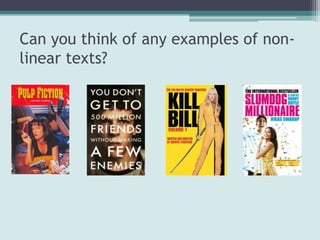
Can you think of any examples of non-
linear texts?
So, why are these texts non linear?
What devices do they use?

• Non chronological order

• Flashbacks

• Flash forwards
Vladimir Propp
• A Russian theorist who analysed fairytales

• He argued that whatever differences there might
  be in a story you can group together the
  characters into 7 character roles

• Can you guess what some of these might
  be?
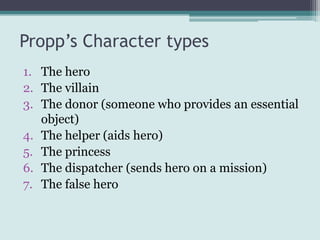
Propp’s Character types
1. The hero
2. The villain
3. The donor (someone who provides an essential
   object)
4. The helper (aids hero)
5. The princess
6. The dispatcher (sends hero on a mission)
7. The false hero
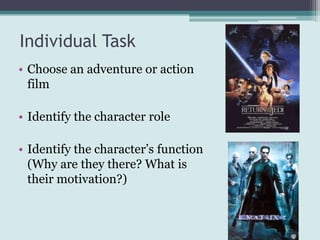
Individual Task
• Choose an adventure or action
  film

• Identify the character role

• Identify the character’s function
  (Why are they there? What is
  their motivation?)
Applying Todorov/Propp to other texts
• We need to practice identifying narrative
  structure and characters in other types of texts


• It is easy to identify some of the roles and
  structure in a film or a TV programme but what
  about texts on different platforms?
Binary Oppositions – Levi-Strauss
• He said that it is the constant creation of
  conflict/opposition that propels narrative

• Narrative can only end on a resolution of conflict

• Oppositions can be visual (light/darkness,
  movement/stillness) or conceptual (love/hate,
  control/panic)

• These are called ‘Binary Oppositions’
Some examples:
•   Love / hate
•   Beauty / ugliness
•   Law abiding / criminal
•   Freedom / imprisonment


• In what texts are these examples found?
Task – Watch the news from
yesterday
• 1) List the three main stories

• 2) What are the binary oppositions in each story?

• 3) Is there any language which indicates the ‘good’
  or ‘bad’ sides?

• 4) can you apply any of Propp’s character roles to
  the stories?

• 5) Can you apply Todorov’s narrative structure to
  the stories?
Homework Task – Due Thursday 13th
October
• Apply Propp and Todorov to a text of your choice
• If you can describe any binary oppositions you
  notice

The text must be one of the following:

•   A magazine article
•   A news broadcast
•   A reality TV programme
•   An advert

• You may use bullet points

Narrative

  • 1.
  • 2.
    In this lessonwe will: • Define narrative • Identify 3 narrative theories • Apply these theories to media products • Define non / linear narrative
  • 3.
    Firstly… • Collect Misfits/ Advert Homework (Those who do not have it will stay at 3.45 to complete it)
  • 4.
    • Give backspecial effects homework: • 2 marks – spelling and grammar • 2 marks – opinion • 2 marks – terminology • 2 marks – valid example • Semiotics Terminology Quiz!
  • 5.
    What is narrative? •Narrative is about how stories are told • So stories which are told again and again, can still have different narratives • What stories can you think of that have been told time and time again?
  • 8.
    What happens atthe end of these films? Is there a ‘happy’ ending?
  • 9.
    Narrative Theory • Narrativetheory sets out to show us that what we experience when we ‘read’ a text is to understand a set of conventions • In Media, it is important to be aware of how these conventions are put together
  • 10.
    Todorov • Todorov arguedthat all stories share a common structure • How do you think most stories could be structured?
  • 11.
    Todorov’s theory isvery similar, with just two extra stages added: 1. Equilibrium - all is in order 2. Disruption - of the ordered state by an event 3. Recognition - that the disruption has taken place 4. At attempt to repair - the damage of the disruption 5. New equilibrium - different from where the story began
  • 12.
    Task • Using afilm of your choice apply Todorov’s theory of narrative • 10 minutes
  • 13.
    Linear and NonLinear Narratives • What does linear mean? • So a linear narrative will go in a straight line – or normally in chronological order • A non linear narrative will be a story told out of order and can often be confusing for the viewer
  • 14.
    Can you thinkof any examples of non- linear texts?
  • 15.
    So, why arethese texts non linear? What devices do they use? • Non chronological order • Flashbacks • Flash forwards
  • 16.
    Vladimir Propp • ARussian theorist who analysed fairytales • He argued that whatever differences there might be in a story you can group together the characters into 7 character roles • Can you guess what some of these might be?
  • 17.
    Propp’s Character types 1.The hero 2. The villain 3. The donor (someone who provides an essential object) 4. The helper (aids hero) 5. The princess 6. The dispatcher (sends hero on a mission) 7. The false hero
  • 18.
    Individual Task • Choosean adventure or action film • Identify the character role • Identify the character’s function (Why are they there? What is their motivation?)
  • 19.
    Applying Todorov/Propp toother texts • We need to practice identifying narrative structure and characters in other types of texts • It is easy to identify some of the roles and structure in a film or a TV programme but what about texts on different platforms?
  • 20.
    Binary Oppositions –Levi-Strauss • He said that it is the constant creation of conflict/opposition that propels narrative • Narrative can only end on a resolution of conflict • Oppositions can be visual (light/darkness, movement/stillness) or conceptual (love/hate, control/panic) • These are called ‘Binary Oppositions’
  • 21.
    Some examples: • Love / hate • Beauty / ugliness • Law abiding / criminal • Freedom / imprisonment • In what texts are these examples found?
  • 22.
    Task – Watchthe news from yesterday • 1) List the three main stories • 2) What are the binary oppositions in each story? • 3) Is there any language which indicates the ‘good’ or ‘bad’ sides? • 4) can you apply any of Propp’s character roles to the stories? • 5) Can you apply Todorov’s narrative structure to the stories?
  • 23.
    Homework Task –Due Thursday 13th October • Apply Propp and Todorov to a text of your choice • If you can describe any binary oppositions you notice The text must be one of the following: • A magazine article • A news broadcast • A reality TV programme • An advert • You may use bullet points