Narrative Theory
Narrative - overview The study of narrative explores the different ways that media texts can tell a story. Narrative is strongly linked to the audience and purpose of the text.  Conventions used to tell the story are dependent on the medium. In film, for example, the condensing of time is important and may be shown through production techniques such as camera fades, whereas in a magazine article narrative conventions include production techniques such as layout and writing style is very important.
Narrative Very simply, the way in which the plot is told to the audience. For example, in Chaucer’s, "Wife of Bathe" Chaucer gives tales to characters, this twists the narrative in that we now have not only Chaucer’s opinions effecting the tales, but also the characters’.
Narrative can also be affected by time For example, Tarrantino’s ‘Reservoir Dogs’ is told in a series of flashbacks to present character profiles and the inevitable failure of “the perfect crime” The ‘person’ (first person/third person) perspective is significant in narrative too
Todorov’s Narrative Theory
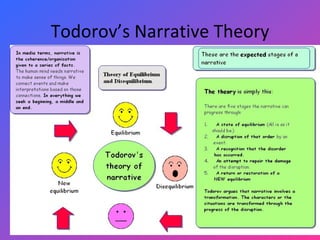
Todorov’s Narrative Theory TZVETAN TODOROV  (Bulgarian structuralist linguist publishing influential work on narrative from the 1960s onwards)  Todorov suggested that stories begin with an equilibrium or status quo where any potentially opposing forces are in balance. This is disrupted by some event, setting in chain a series of events. Problems are solved so that order can be restored to the world of the fiction.
Barthes’ Narrative Theory ACCORDING TO ROLAND BARTHES, all narratives share structural features that each narrative weaves together in different ways.  Despite the differences between individual narratives, any narrative employs a limited number of organizational structures (specifically, five of them) that affect our reading of texts.  Rather than see this situation as limiting, however, Barthes argues that we should take this plurality of codes as an invitation to read a text in such a way as to bring out its multiple meanings and connotations.
Barthes’ Narrative Theory Cont. HERMENEUTIC AND PROAIRETIC CODES : The two ways of creating suspense in narrative, the first caused by unanswered questions, the second by the anticipation of an action's resolution .  These terms come from the narratologist Roland Barthes, who wishes to distinguish between the two forces that drive narrative and, thus by implication, our own desires to keep reading or viewing a story.
Barthes’ Narrative Theory Cont: the hermeneutic code  The hermeneutic code refers to those plot elements that raise questions on the part of the reader of a text or the viewer of a film.  For example, in the Star Trek: TNG episode, "Cause and Effect," we see the Enterprise destroyed in the first five minutes, which leads us to ask the reason for such a traumatic event.  Indeed, we are not satisfied by a narrative unless all such "loose ends" are tied.  Another good example is the genre of the detective story.  The entire narrative of such a story operates primarily by the hermeneutic code. We witness a murder and the rest of the narrative is devoted to determining the questions that are raised by the initial scene of violence.
Barthes’ Narrative Theory Cont: The proairetic code The proairetic code, on the other hand, refers to mere actions—those plot events that simply lead to yet other actions.  For example, a gunslinger draws his gun on an adversary and we wonder what the resolution of this action will be.  We wait to see if he kills his opponent or is wounded himself.  Suspense is thus created by action rather than by a reader's or a viewer's wish to have mysteries explained.
Barthes’ Narrative Theory Cont. These first two codes tend to be aligned with temporal order and thus require, for full effect, that you read a book or view a film temporally from beginning to end. A traditional, "readerly" text tends to be especially "dependent on [these] two sequential codes: the revelation of truth and the coordination of the actions represented The next three codes tend to work "outside the constraints of time" and are, therefore, more properly reversible, which is to say that there is no necessary reason to read the instances of these codes in chronological order to make sense of them in the narrative.
Barthes’ Narrative Theory Cont: The Semantic Code The semantic code (SEM.) points to any element in a text that suggests a particular, often additional meaning by way of connotation.  By "connotation," Barthes does not mean a free-form association of ideas (where anything goes) but "a correlation immanent in the text, in the texts; or again, one may say that it is an association made by the text-as-subject within its own system"  In other words, Barthes marks out those semantic connotations that have special meaning for the work at hand.
Barthes’ Narrative Theory Cont: The Symbolic Code The symbolic code (SYM.) can be difficult to distinguish from the semantic code and Barthes is not always clear on the distinction between these two codes The easiest way to think of the symbolic code is as a "deeper" structural principle that organizes semantic meanings, usually by way of antitheses or by way of mediations (particularly, forbidden mediations) between antithetical terms.  The concept is perhaps most analogous to Algirdas Greimas' understanding of antagonism and contradiction in narrative structure.  A symbolic antithesis often marks a barrier for the text. As Barthes writes, "Every joining of two antithetical terms, every mixture, every conciliation—in short, every passage through the wall of the Antithesis—thus constitutes a transgression"
Barthes’ Narrative Theory Cont: The Cultural Code The cultural code (REF.) designates any element in a narrative that refers "to a science or a body of knowledge". In other words, the cultural codes tend to point to our shared knowledge about the way the world works, including properties that we can designate as "physical, physiological, medical, psychological, literary, historical, etc.".  The "gnomic" code is one of the cultural codes and refers to those cultural codes that are tied to clichés, proverbs, or popular sayings of various sorts.
Barthes’ Narrative Theory – basically... Action code which refers to the events taking place Enigma code which refers to the questions raised and answered Semantic code which refers to the characters and characterisation Referential code which refers to the information and explanation Symbolic code which refers to the connotations of signs
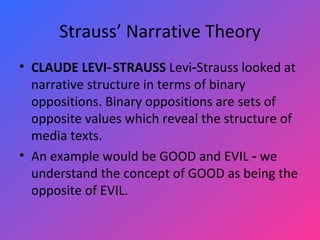
Strauss’ Narrative Theory CLAUDE LEVI‑STRAUSS  Levi‑Strauss looked at narrative structure in terms of binary oppositions. Binary oppositions are sets of opposite values which reveal the structure of media texts.  An example would be GOOD   and EVIL ‑ we understand the concept of GOOD   as being the opposite of EVIL.
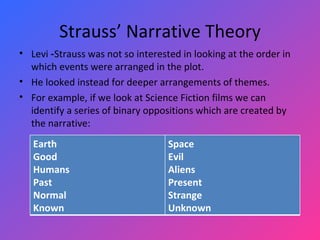
Strauss’ Narrative Theory Levi ‑Strauss was not so interested in looking at the order in which events were arranged in the plot.  He looked instead for deeper arrangements of themes.  For example, if we look at Science Fiction films we can identify a series of binary oppositions which are created by the narrative: Earth Good Humans Past Normal Known Space Evil Aliens Present Strange Unknown
Propp’s Narrative Theory Vladimir Yakovlevich Propp  was a Russian formalist scholar who analyzed the basic plot components of Russian folk tales to identify their simplest irreducible narrative elements.
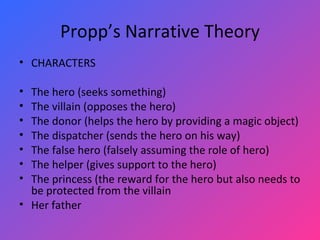
Propp’s Narrative Theory CHARACTERS The hero (seeks something) The villain (opposes the hero) The donor (helps the hero by providing a magic object) The dispatcher (sends the hero on his way) The false hero (falsely assuming the role of hero) The helper (gives support to the hero) The princess (the reward for the hero but also needs to be protected from the villain Her father
Propp’s Narrative Theory cont... NARRATIVE FUNCTIONS   Preparation  (or 1 st  sphere: the introductory sequence)   P1. A member of the family leaves home P2. A prohibition or rule is imposed on the hero P3. The prohibition or rule is broken P4. The villain makes and attempt at reconnaissance P5. The villain learns something about his victim P6. The villain tried to deceive the victim to get possession of his/her belongings P7. The victim unknowingly helps the villain by being deceived or influenced by the villain
Propp’s Narrative Theory cont... Complication  (or 2 nd  sphere: The body of the story)   C1. The villain harms a member of the family C2. A member of the family lacks or desires something C3. This lack or misfortune is made known; the hero is given a request or a command and he goes on a mission or quest C4. The seeker (often the hero) plans action against the villain
Propp’s Narrative Theory cont... Transference  (or 3 rd  sphere: The donor sequence (magic agent is obtained)   T1. The hero leaves home T2. The hero is tested, attached, interrogated and, as a result, receives either a magical agent or a helper T3. The Hero reacts to the actions of the future donor T4. The hero uses the magical agent T5. The hero is transferred to the general location of the object of his mission or quest
Propp’s Narrative Theory cont... Struggle  (or 4 th  sphere: The hero’s return)   S1. The hero and the villain join in direct combat S2. The hero is branded S3. The villain is defeated S4. The initial misfortune or lack is put right
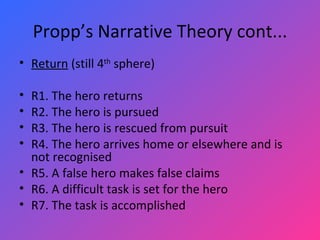
Propp’s Narrative Theory cont... Return  (still 4 th  sphere)   R1. The hero returns R2. The hero is pursued R3. The hero is rescued from pursuit R4. The hero arrives home or elsewhere and is not recognised R5. A false hero makes false claims R6. A difficult task is set for the hero R7. The task is accomplished
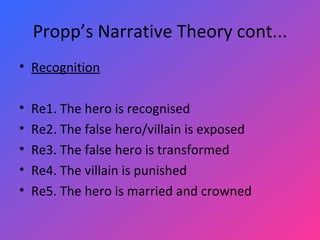
Propp’s Narrative Theory cont... Recognition   Re1. The hero is recognised Re2. The false hero/villain is exposed Re3. The false hero is transformed Re4. The villain is punished Re5. The hero is married and crowned

Narrative theory (2)

  • 1.
  • 2.
    Narrative - overviewThe study of narrative explores the different ways that media texts can tell a story. Narrative is strongly linked to the audience and purpose of the text. Conventions used to tell the story are dependent on the medium. In film, for example, the condensing of time is important and may be shown through production techniques such as camera fades, whereas in a magazine article narrative conventions include production techniques such as layout and writing style is very important.
  • 3.
    Narrative Very simply,the way in which the plot is told to the audience. For example, in Chaucer’s, "Wife of Bathe" Chaucer gives tales to characters, this twists the narrative in that we now have not only Chaucer’s opinions effecting the tales, but also the characters’.
  • 4.
    Narrative can alsobe affected by time For example, Tarrantino’s ‘Reservoir Dogs’ is told in a series of flashbacks to present character profiles and the inevitable failure of “the perfect crime” The ‘person’ (first person/third person) perspective is significant in narrative too
  • 5.
  • 6.
    Todorov’s Narrative TheoryTZVETAN TODOROV (Bulgarian structuralist linguist publishing influential work on narrative from the 1960s onwards) Todorov suggested that stories begin with an equilibrium or status quo where any potentially opposing forces are in balance. This is disrupted by some event, setting in chain a series of events. Problems are solved so that order can be restored to the world of the fiction.
  • 7.
    Barthes’ Narrative TheoryACCORDING TO ROLAND BARTHES, all narratives share structural features that each narrative weaves together in different ways. Despite the differences between individual narratives, any narrative employs a limited number of organizational structures (specifically, five of them) that affect our reading of texts. Rather than see this situation as limiting, however, Barthes argues that we should take this plurality of codes as an invitation to read a text in such a way as to bring out its multiple meanings and connotations.
  • 8.
    Barthes’ Narrative TheoryCont. HERMENEUTIC AND PROAIRETIC CODES : The two ways of creating suspense in narrative, the first caused by unanswered questions, the second by the anticipation of an action's resolution . These terms come from the narratologist Roland Barthes, who wishes to distinguish between the two forces that drive narrative and, thus by implication, our own desires to keep reading or viewing a story.
  • 9.
    Barthes’ Narrative TheoryCont: the hermeneutic code The hermeneutic code refers to those plot elements that raise questions on the part of the reader of a text or the viewer of a film. For example, in the Star Trek: TNG episode, "Cause and Effect," we see the Enterprise destroyed in the first five minutes, which leads us to ask the reason for such a traumatic event. Indeed, we are not satisfied by a narrative unless all such "loose ends" are tied. Another good example is the genre of the detective story. The entire narrative of such a story operates primarily by the hermeneutic code. We witness a murder and the rest of the narrative is devoted to determining the questions that are raised by the initial scene of violence.
  • 10.
    Barthes’ Narrative TheoryCont: The proairetic code The proairetic code, on the other hand, refers to mere actions—those plot events that simply lead to yet other actions. For example, a gunslinger draws his gun on an adversary and we wonder what the resolution of this action will be. We wait to see if he kills his opponent or is wounded himself. Suspense is thus created by action rather than by a reader's or a viewer's wish to have mysteries explained.
  • 11.
    Barthes’ Narrative TheoryCont. These first two codes tend to be aligned with temporal order and thus require, for full effect, that you read a book or view a film temporally from beginning to end. A traditional, "readerly" text tends to be especially "dependent on [these] two sequential codes: the revelation of truth and the coordination of the actions represented The next three codes tend to work "outside the constraints of time" and are, therefore, more properly reversible, which is to say that there is no necessary reason to read the instances of these codes in chronological order to make sense of them in the narrative.
  • 12.
    Barthes’ Narrative TheoryCont: The Semantic Code The semantic code (SEM.) points to any element in a text that suggests a particular, often additional meaning by way of connotation. By "connotation," Barthes does not mean a free-form association of ideas (where anything goes) but "a correlation immanent in the text, in the texts; or again, one may say that it is an association made by the text-as-subject within its own system" In other words, Barthes marks out those semantic connotations that have special meaning for the work at hand.
  • 13.
    Barthes’ Narrative TheoryCont: The Symbolic Code The symbolic code (SYM.) can be difficult to distinguish from the semantic code and Barthes is not always clear on the distinction between these two codes The easiest way to think of the symbolic code is as a "deeper" structural principle that organizes semantic meanings, usually by way of antitheses or by way of mediations (particularly, forbidden mediations) between antithetical terms. The concept is perhaps most analogous to Algirdas Greimas' understanding of antagonism and contradiction in narrative structure. A symbolic antithesis often marks a barrier for the text. As Barthes writes, "Every joining of two antithetical terms, every mixture, every conciliation—in short, every passage through the wall of the Antithesis—thus constitutes a transgression"
  • 14.
    Barthes’ Narrative TheoryCont: The Cultural Code The cultural code (REF.) designates any element in a narrative that refers "to a science or a body of knowledge". In other words, the cultural codes tend to point to our shared knowledge about the way the world works, including properties that we can designate as "physical, physiological, medical, psychological, literary, historical, etc.". The "gnomic" code is one of the cultural codes and refers to those cultural codes that are tied to clichés, proverbs, or popular sayings of various sorts.
  • 15.
    Barthes’ Narrative Theory– basically... Action code which refers to the events taking place Enigma code which refers to the questions raised and answered Semantic code which refers to the characters and characterisation Referential code which refers to the information and explanation Symbolic code which refers to the connotations of signs
  • 16.
    Strauss’ Narrative TheoryCLAUDE LEVI‑STRAUSS Levi‑Strauss looked at narrative structure in terms of binary oppositions. Binary oppositions are sets of opposite values which reveal the structure of media texts. An example would be GOOD and EVIL ‑ we understand the concept of GOOD as being the opposite of EVIL.
  • 17.
    Strauss’ Narrative TheoryLevi ‑Strauss was not so interested in looking at the order in which events were arranged in the plot. He looked instead for deeper arrangements of themes. For example, if we look at Science Fiction films we can identify a series of binary oppositions which are created by the narrative: Earth Good Humans Past Normal Known Space Evil Aliens Present Strange Unknown
  • 18.
    Propp’s Narrative TheoryVladimir Yakovlevich Propp was a Russian formalist scholar who analyzed the basic plot components of Russian folk tales to identify their simplest irreducible narrative elements.
  • 19.
    Propp’s Narrative TheoryCHARACTERS The hero (seeks something) The villain (opposes the hero) The donor (helps the hero by providing a magic object) The dispatcher (sends the hero on his way) The false hero (falsely assuming the role of hero) The helper (gives support to the hero) The princess (the reward for the hero but also needs to be protected from the villain Her father
  • 20.
    Propp’s Narrative Theorycont... NARRATIVE FUNCTIONS   Preparation (or 1 st sphere: the introductory sequence)   P1. A member of the family leaves home P2. A prohibition or rule is imposed on the hero P3. The prohibition or rule is broken P4. The villain makes and attempt at reconnaissance P5. The villain learns something about his victim P6. The villain tried to deceive the victim to get possession of his/her belongings P7. The victim unknowingly helps the villain by being deceived or influenced by the villain
  • 21.
    Propp’s Narrative Theorycont... Complication (or 2 nd sphere: The body of the story)   C1. The villain harms a member of the family C2. A member of the family lacks or desires something C3. This lack or misfortune is made known; the hero is given a request or a command and he goes on a mission or quest C4. The seeker (often the hero) plans action against the villain
  • 22.
    Propp’s Narrative Theorycont... Transference (or 3 rd sphere: The donor sequence (magic agent is obtained)   T1. The hero leaves home T2. The hero is tested, attached, interrogated and, as a result, receives either a magical agent or a helper T3. The Hero reacts to the actions of the future donor T4. The hero uses the magical agent T5. The hero is transferred to the general location of the object of his mission or quest
  • 23.
    Propp’s Narrative Theorycont... Struggle (or 4 th sphere: The hero’s return)   S1. The hero and the villain join in direct combat S2. The hero is branded S3. The villain is defeated S4. The initial misfortune or lack is put right
  • 24.
    Propp’s Narrative Theorycont... Return (still 4 th sphere)   R1. The hero returns R2. The hero is pursued R3. The hero is rescued from pursuit R4. The hero arrives home or elsewhere and is not recognised R5. A false hero makes false claims R6. A difficult task is set for the hero R7. The task is accomplished
  • 25.
    Propp’s Narrative Theorycont... Recognition   Re1. The hero is recognised Re2. The false hero/villain is exposed Re3. The false hero is transformed Re4. The villain is punished Re5. The hero is married and crowned