
Opioid Analgesics
• Opium: A dark brown, resinous material
obtained from poppy (Papaver somniferum)
capsule.
• Morphine is the principal alkaloid in opium
and is widely used till today. Therefore, it is
described as prototype.
CNS actions of Morphine
• Analgesia: Morphine is a strong analgesic.
• Sedation
• Mood and subjective effects: euphoria
• Respiratory centre: Morphine depresses
respiratory centre in a dose dependent
manner
• Cough centre: depressed by morphine
• Temperature regulating centre: depressed;
hypothermia occurs in cold surroundings
• Vasomotor centre It is depressed at higher
doses and contributes to the fall in BP
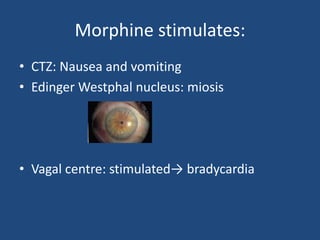
Morphine stimulates:
• CTZ: Nausea and vomiting
• Edinger Westphal nucleus: miosis
• Vagal centre: stimulated→ bradycardia
CVS
• Morphine causes vasodilatation due to:
• (a) histamine release.
• (b) depression of vasomotor centre.
• (c) direct action decreasing tone of blood
vessels.
• There is a shift of blood from pulmonary to
systemic circuit due to greater vasodilatation
in the latter.
• Intracranial tension tends to rise as a
consequence of CO2 retention leading to
cerebral vasodilatation.
GIT
• Constipation
• a) increases tone and segmentation but
decreases propulsive movements.
• (b) Spasm of pyloric, ileocaecal and anal
sphincters.
• urinary retention: tone of both sphinctor and
detrusor muscles is increased.
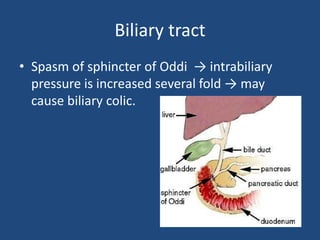
Biliary tract
• Spasm of sphincter of Oddi → intrabiliary
pressure is increased several fold → may
cause biliary colic.
Bronchi
• Bronchoconstriction due to histamine release
Pharmacokinetics
• oral absorption of morphine is unreliable
because of high and variable first pass
metabolism; oral bioavailability is 1/6th to
1/4th of parenterally administered drug.
Side effects
• Sedation
• Vomiting
• Constipation
• Respiratory depression
• blurring of vision
• BP may fall
• urinary retention
Idiosyncrasy and allergy
• A local reaction at injection site and
generalized itching may occur due to
histamine release.
Acute morphine poisoning
• Manifestations are extensions of the
pharmacological action.
• occasional breathing, cyanosis, pinpoint pupil,
fall in BP and shock.
• Treatment: respiratory support (positive
pressure respiration also opposes pulmonary
edema formation)
• maintenance of BP (i.v. fluids,vasoconstrictors)
• Gastric lavage
• Specific antidote: Naloxone 0.4–0.8 mg i.v.
repeated every 2–3 min till respiration picks
up.
Tolerance and dependence
• Tolerance is exhibited to most actions, but not
to miosis and constipation.
• Morphine produces pronounced psychological
and physical dependence, its abuse liability is
rated high.
• Treatment: consists of withdrawal of
morphine and substitution with oral
methadone (long-acting, orally effective)
followed by gradual withdrawal of
methadone.
Precautions and contraindications
• Infants and the elderly are more susceptible to
the respiratory depressant action of
morphine.
• It is dangerous in patients with respiratory
insufficiency (emphysema, pulmonary fibrosis,
cor pulmonale)
• Bronchial asthma: Morphine can precipitate
an attack by its histamine releasing action.
Precautions and contraindications
• Head injury:
• By retaining CO2, it increases intracranial
tension which will add to that caused by head
injury itself.
• Even therapeutic doses can cause marked
respiratory depression in these patients.
• Vomiting, miosis and altered mentation
produced by morphine interfere with
assessment of progress in head injury cases.
Precautions and contraindications
• Hypotensive states and hypovolaemia
exaggerate fall in BP due to morphine.
Precautions and contraindications
• Undiagnosed acute abdominal pain: morphine
can aggravate certain conditions, e.g. biliary
colic, pancreatitis. Inflamed appendix may
rupture.
• Morphine can be given after the diagnosis is
established.
Precautions and contraindications
• Elderly male: chances of urinary retention are
high.
Classification of Opioids
• 1. Natural opium alkaloids: Morphine,
Codeine
• 2. Semisynthetic opiates: Diacetylmorphine
(Heroin), Pholcodeine, Ethylmorphine.
• 3. Synthetic opioids: Pethidine (Meperidine),
Fentanyl, Methadone, Dextropropoxyphene,
Tramadol.
Codeine
• methyl-morphine
• less potent than morphine (1/10th as
analgesic)
• codeine is more selective cough suppressant
• good activity by the oral route
• Constipation is a prominent side effect when it
is used as analgesic.
Pethidine (Meperidine)
• It does not effectively suppress cough.
• Spasmodic action on smooth muscles is less
marked—miosis, constipation and urinary
retention are less prominent.
• It causes less histamine release and is safer in
asthmatics.
• Overdose of pethidine produces many
excitatory effects—tremors, mydriasis,
hyperreflexia, delirium, myoclonus and
convulsions.
• This is due to accumulation of norpethidine
which has excitant effects.
Fentanyl
• A pethidine congener, 80–100 times more
potent than morphine, both in analgesia and
respiratory depression.
• In the injectable form it is almost exclusively
used in anaesthesia.
• Transdermal fentanyl has become available for
use in cancer/ terminal illness or other types
of chronic pain for patients requiring opioid
analgesia.
Methadone
• The most important feature of methadone is high
oral: parenteral activity ratio (1 : 2) and its firm
binding to tissue proteins.
• it cumulates in tissues on repeated
administration—duration of action is
progressively lengthened due to gradual release
from these sites.
• Because of slow and persistent nature of action,
sedative and subjective effects are less intense.
• Methadone has been used primarily as
substitution therapy for opioid dependence
USES (Of morphine and its congeners)
• As analgesic: indicated in severe pain of any
type.
• It should be given promptly in myocardial
infarction to allay apprehension and reflex
sympathetic stimulation.
• Opioids, especially pethidine, have been
extensively used for obstetric analgesia, but
one must be prepared to deal with the foetal
and maternal complications.
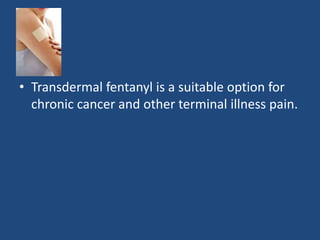
• Transdermal fentanyl is a suitable option for
chronic cancer and other terminal illness pain.
• Preanaesthetic medication:
• Morphine and pethidine are used in few
selected patients
• Balanced anaesthesia and surgical analgesia
• Fentanyl, morphine, pethidine, alfentanil or
sufentanil are an important component of
anaesthetic techniques
• Relief of anxiety and apprehension
• Especially in myocardial infarction, internal
bleeding (haematemesis, threatened abortion,
etc.)
• Acute left ventricular failure (cardiac asthma)
• Reducing preload on heart due to vasodilatation
and peripheral pooling of blood.
• Tending to shift blood from pulmonary to
systemic circuit; relieves pulmonary congestion
and edema.
• Allays air hunger and dyspnoea by depressing
respiratory centre.
• Cuts down sympathetic stimulation by calming
the patient, thereby reduces cardiac work.
• Cough
• Codeine or its substitutes are widely used for
suppressing dry, irritating cough
• Diarrhoea
• Loperamide and diphenoxylate
Thank You

Opioid analgesics

  • 1.
  • 2.
    • Opium: Adark brown, resinous material obtained from poppy (Papaver somniferum) capsule. • Morphine is the principal alkaloid in opium and is widely used till today. Therefore, it is described as prototype.
  • 4.
    CNS actions ofMorphine • Analgesia: Morphine is a strong analgesic. • Sedation • Mood and subjective effects: euphoria • Respiratory centre: Morphine depresses respiratory centre in a dose dependent manner • Cough centre: depressed by morphine
  • 5.
    • Temperature regulatingcentre: depressed; hypothermia occurs in cold surroundings • Vasomotor centre It is depressed at higher doses and contributes to the fall in BP
  • 6.
    Morphine stimulates: • CTZ:Nausea and vomiting • Edinger Westphal nucleus: miosis • Vagal centre: stimulated→ bradycardia
  • 7.
    CVS • Morphine causesvasodilatation due to: • (a) histamine release. • (b) depression of vasomotor centre. • (c) direct action decreasing tone of blood vessels.
  • 8.
    • There isa shift of blood from pulmonary to systemic circuit due to greater vasodilatation in the latter. • Intracranial tension tends to rise as a consequence of CO2 retention leading to cerebral vasodilatation.
  • 9.
    GIT • Constipation • a)increases tone and segmentation but decreases propulsive movements. • (b) Spasm of pyloric, ileocaecal and anal sphincters.
  • 10.
    • urinary retention:tone of both sphinctor and detrusor muscles is increased.
  • 11.
    Biliary tract • Spasmof sphincter of Oddi → intrabiliary pressure is increased several fold → may cause biliary colic.
  • 12.
  • 13.
    Pharmacokinetics • oral absorptionof morphine is unreliable because of high and variable first pass metabolism; oral bioavailability is 1/6th to 1/4th of parenterally administered drug.
  • 14.
    Side effects • Sedation •Vomiting • Constipation • Respiratory depression • blurring of vision • BP may fall • urinary retention
  • 15.
    Idiosyncrasy and allergy •A local reaction at injection site and generalized itching may occur due to histamine release.
  • 16.
    Acute morphine poisoning •Manifestations are extensions of the pharmacological action. • occasional breathing, cyanosis, pinpoint pupil, fall in BP and shock.
  • 17.
    • Treatment: respiratorysupport (positive pressure respiration also opposes pulmonary edema formation) • maintenance of BP (i.v. fluids,vasoconstrictors) • Gastric lavage • Specific antidote: Naloxone 0.4–0.8 mg i.v. repeated every 2–3 min till respiration picks up.
  • 18.
    Tolerance and dependence •Tolerance is exhibited to most actions, but not to miosis and constipation. • Morphine produces pronounced psychological and physical dependence, its abuse liability is rated high.
  • 19.
    • Treatment: consistsof withdrawal of morphine and substitution with oral methadone (long-acting, orally effective) followed by gradual withdrawal of methadone.
  • 20.
    Precautions and contraindications •Infants and the elderly are more susceptible to the respiratory depressant action of morphine. • It is dangerous in patients with respiratory insufficiency (emphysema, pulmonary fibrosis, cor pulmonale) • Bronchial asthma: Morphine can precipitate an attack by its histamine releasing action.
  • 21.
    Precautions and contraindications •Head injury: • By retaining CO2, it increases intracranial tension which will add to that caused by head injury itself. • Even therapeutic doses can cause marked respiratory depression in these patients. • Vomiting, miosis and altered mentation produced by morphine interfere with assessment of progress in head injury cases.
  • 22.
    Precautions and contraindications •Hypotensive states and hypovolaemia exaggerate fall in BP due to morphine.
  • 23.
    Precautions and contraindications •Undiagnosed acute abdominal pain: morphine can aggravate certain conditions, e.g. biliary colic, pancreatitis. Inflamed appendix may rupture. • Morphine can be given after the diagnosis is established.
  • 24.
    Precautions and contraindications •Elderly male: chances of urinary retention are high.
  • 25.
    Classification of Opioids •1. Natural opium alkaloids: Morphine, Codeine • 2. Semisynthetic opiates: Diacetylmorphine (Heroin), Pholcodeine, Ethylmorphine. • 3. Synthetic opioids: Pethidine (Meperidine), Fentanyl, Methadone, Dextropropoxyphene, Tramadol.
  • 26.
    Codeine • methyl-morphine • lesspotent than morphine (1/10th as analgesic) • codeine is more selective cough suppressant • good activity by the oral route • Constipation is a prominent side effect when it is used as analgesic.
  • 27.
    Pethidine (Meperidine) • Itdoes not effectively suppress cough. • Spasmodic action on smooth muscles is less marked—miosis, constipation and urinary retention are less prominent. • It causes less histamine release and is safer in asthmatics.
  • 28.
    • Overdose ofpethidine produces many excitatory effects—tremors, mydriasis, hyperreflexia, delirium, myoclonus and convulsions. • This is due to accumulation of norpethidine which has excitant effects.
  • 29.
    Fentanyl • A pethidinecongener, 80–100 times more potent than morphine, both in analgesia and respiratory depression. • In the injectable form it is almost exclusively used in anaesthesia. • Transdermal fentanyl has become available for use in cancer/ terminal illness or other types of chronic pain for patients requiring opioid analgesia.
  • 30.
    Methadone • The mostimportant feature of methadone is high oral: parenteral activity ratio (1 : 2) and its firm binding to tissue proteins. • it cumulates in tissues on repeated administration—duration of action is progressively lengthened due to gradual release from these sites. • Because of slow and persistent nature of action, sedative and subjective effects are less intense.
  • 31.
    • Methadone hasbeen used primarily as substitution therapy for opioid dependence
  • 32.
    USES (Of morphineand its congeners) • As analgesic: indicated in severe pain of any type. • It should be given promptly in myocardial infarction to allay apprehension and reflex sympathetic stimulation. • Opioids, especially pethidine, have been extensively used for obstetric analgesia, but one must be prepared to deal with the foetal and maternal complications.
  • 33.
    • Transdermal fentanylis a suitable option for chronic cancer and other terminal illness pain.
  • 34.
    • Preanaesthetic medication: •Morphine and pethidine are used in few selected patients
  • 35.
    • Balanced anaesthesiaand surgical analgesia • Fentanyl, morphine, pethidine, alfentanil or sufentanil are an important component of anaesthetic techniques
  • 36.
    • Relief ofanxiety and apprehension • Especially in myocardial infarction, internal bleeding (haematemesis, threatened abortion, etc.)
  • 37.
    • Acute leftventricular failure (cardiac asthma) • Reducing preload on heart due to vasodilatation and peripheral pooling of blood. • Tending to shift blood from pulmonary to systemic circuit; relieves pulmonary congestion and edema. • Allays air hunger and dyspnoea by depressing respiratory centre. • Cuts down sympathetic stimulation by calming the patient, thereby reduces cardiac work.
  • 38.
    • Cough • Codeineor its substitutes are widely used for suppressing dry, irritating cough
  • 39.
  • 40.

Editor's Notes

  • #10 (c) Decrease in all gastrointestinal secretions due to reduction in movement of water and electrolytes from mucosa to the lumen. d) Central action causing inattention to defecation reflex.