7TH SEMESTER
26 –FBAS/BSPHY/F-10
BS-PHYSICS(NANOTECHNOLOGY)
INTERNATIONAL ISLAMIC UNIVERSITY ISLAMABAD
PHYSICS AT NANOSCALE
PRESENTATION “INTRODUCTION TO
NANOTECHNOLOGY”
NANOTECHNOLOGY
NANOTECHNOLOGY???
Nanotechnology is the creation of the functional materials
,devices and systems through control of the matter on the
nanometer scale and the exploitation of the novel
phenomenon properties at that length scale .
(NASA)
NANOTECHNOLOGY is:
 Creation of useful materials, devices, and
systems through the manipulation of matter
on nanometer scale.
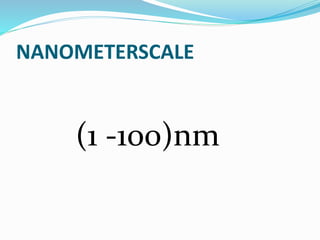
NANOMETERSCALE
(1 -100)nm
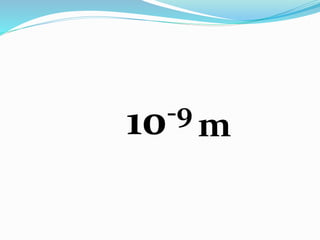
NANOMETER…..???
10-9
m
NANOMETER:
 ONE BILLIONTH PART OF A METER IS CALLED
NANOMETER.
 THE LENGTH EQUIVALENT TO TEN HYDROGEN
OR FIVE SILICON ATOMS ALLIGN IN A STRAIGHT
LINE.
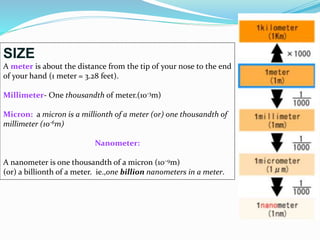
SIZE
A meter is about the distance from the tip of your nose to the end
of your hand (1 meter = 3.28 feet).
Millimeter- One thousandth of meter.(10-3m)
Micron: a micron is a millionth of a meter (or) one thousandth of
millimeter (10-6m)
Nanometer:
A nanometer is one thousandth of a micron (10–9m)
(or) a billionth of a meter. ie.,one billion nanometers in a meter.
NANOTECHNOLOGY
 - Generally nanotechnology deals with structures sized
between 1 to 100 nanometer in at least one dimension.
 Ability to design systems with defined structure and
function on the nanometer scale.
 Involves developing materials, devices within that
size
NANOTECHNOLOGY CONT…
Interdisciplinary area :
Biology, Physics, Chemistry, Material
science, Electronics,
Chemical Engineering, Information
technology
NANOTECHNOLOGY
→ Nanotechnology is science, engineering, and
technology conducted at the nanoscale, which is
about 1 to 100 nanometers..
→ Nanoscience and nanotechnology are the study
and application of extremely small things and can be
used across all the other science fields, such as
chemistry, biology, Physics.
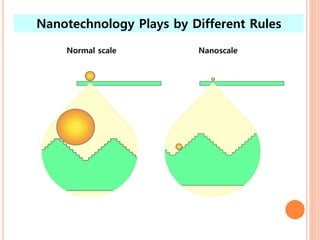
Nanotechnology Plays by Different Rules
Normal scale Nanoscale
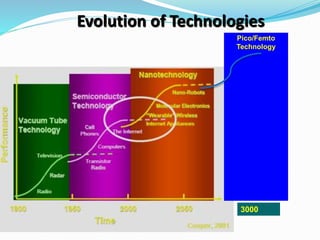
Evolution of Technologies
Pico/Femto
Technology
3000
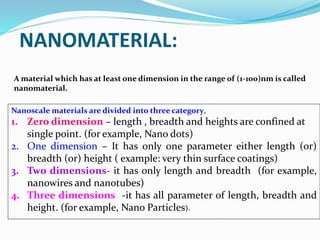
NANOMATERIAL:
 A material which has at least one dimension in
the range of (1-100)nm is called nanomaterial.
Nanoscale materials are divided into three category,
1. Zero dimension – length , breadth and heights are confined at
single point. (for example, Nano dots)
2. One dimension – It has only one parameter either length (or)
breadth (or) height ( example: very thin surface coatings)
3. Two dimensions- it has only length and breadth (for example,
nanowires and nanotubes)
4. Three dimensions -it has all parameter of length, breadth and
height. (for example, Nano Particles).
A material which has at least one dimension in the range of (1-100)nm is called
nanomaterial.
NANOMATERIAL:
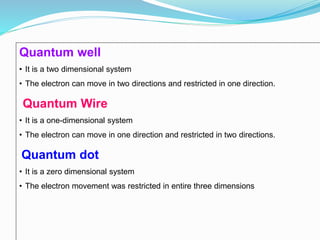
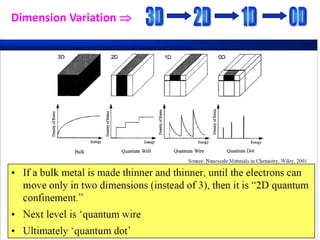
Quantum well
• It is a two dimensional system
• The electron can move in two directions and restricted in one direction.
Quantum Wire
• It is a one-dimensional system
• The electron can move in one direction and restricted in two directions.
Quantum dot
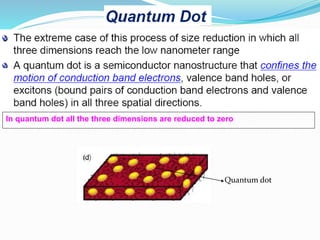
• It is a zero dimensional system
• The electron movement was restricted in entire three dimensions
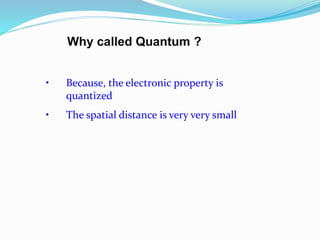
Why called Quantum ?
• Because, the electronic property is
quantized
• The spatial distance is very very small
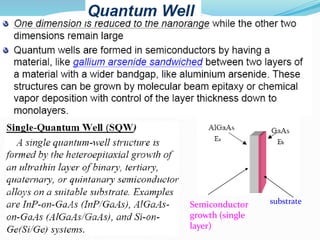
substrateSemiconductor
growth (single
layer)
• Nanoparticles
• Nanocapsules
• Nanofibers
• Nanowires
• Fullerenes (carbon 60)
• Nanotubes
• Nanosprings
• Nanobelts
• Quantum dots
• Nanofluidies
Based on the size and shape, the Nano materials are classified as follows
In quantum dot all the three dimensions are reduced to zero
Quantum dot
Dimension Variation 
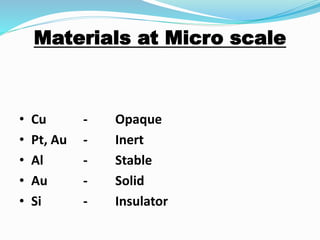
• Cu - Opaque
• Pt, Au - Inert
• Al - Stable
• Au - Solid
• Si - Insulator
Materials at Micro scale
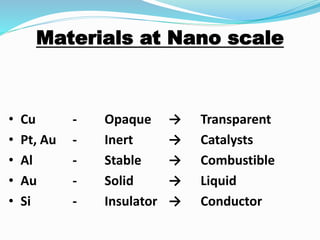
Materials at Nano scale
• Cu - Opaque → Transparent
• Pt, Au - Inert → Catalysts
• Al - Stable → Combustible
• Au - Solid → Liquid
• Si - Insulator → Conductor
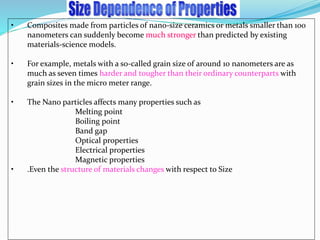
• Composites made from particles of nano-size ceramics or metals smaller than 100
nanometers can suddenly become much stronger than predicted by existing
materials-science models.
• For example, metals with a so-called grain size of around 10 nanometers are as
much as seven times harder and tougher than their ordinary counterparts with
grain sizes in the micro meter range.
• The Nano particles affects many properties such as
Melting point
Boiling point
Band gap
Optical properties
Electrical properties
Magnetic properties
• .Even the structure of materials changes with respect to Size
Why Nano changes the
properties of materials?
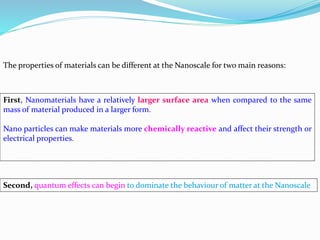
The properties of materials can be different at the Nanoscale for two main reasons:
First, Nanomaterials have a relatively larger surface area when compared to the same
mass of material produced in a larger form.
Nano particles can make materials more chemically reactive and affect their strength or
electrical properties.
Second, quantum effects can begin to dominate the behaviour of matter at the Nanoscale
WHY NANO WILL CHANGE THE PROPERTIES OF
MATERIALS?
AT THE NANO SCALE THE PROPERTIES
CHANGES DUE TO INCREASE IN
SURFACE TO VOLUME RATIO.
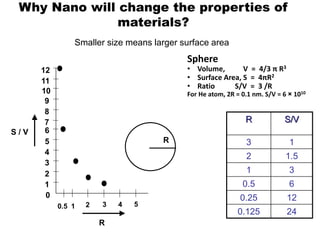
Why Nano will change the properties of
materials?
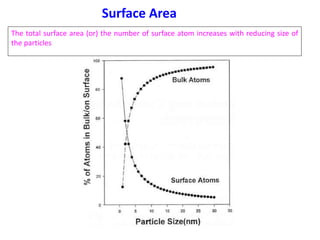
Smaller size means larger surface area
0.5 1 2 3 4
1
2
3
4
5
6
R
S / V
0
7
8
9
10
11
12
5
R
Sphere
• Volume, V = 4/3 π R3
• Surface Area, S = 4πR2
• Ratio S/V = 3 /R
For He atom, 2R = 0.1 nm. S/V = 6 × 10¹⁰
R S/V
3 1
2 1.5
1 3
0.5 6
0.25 12
0.125 24
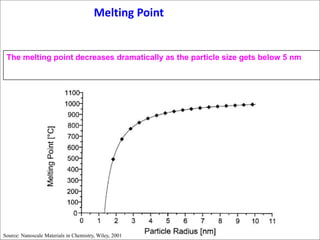
The melting point decreases dramatically as the particle size gets below 5 nm
Source: Nanoscale Materials in Chemistry, Wiley, 2001
Melting Point
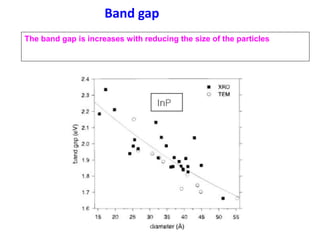
Band gap
The band gap is increases with reducing the size of the particles
Surface Area
The total surface area (or) the number of surface atom increases with reducing size of
the particles
• For semiconductors such as ZnO, CdS, and Si, the bandgap changes
with size
- Bandgap is the energy needed to promote an electron
from the valence band to the conduction band
- When the bandgaps lie in the visible spectrum, changing
bandgap with size means a change in color
• For magnetic materials such as Fe, Co, Ni, Fe3O4, etc., magnetic properties are size
dependent
- The ‘coercive force’ (or magnetic memory) needed to
reverse an internal magnetic field within the particle is
size dependent
- The strength of a particle’s internal magnetic field can be
size dependent
07-FBAS/BSPHY/F-10
MECHANICAL PROPERTIES
 Mechanical properties of nanomaterials may reach the
theoretical strength, which are one or two order of
magnitude higher than that of single crystal in the
bulk form .
 The enhancement in the mechanical strength is simply
due to the reduced probability of defects.
OPTICAL PROPERTIES
OPTICAL PROPERTIES
 In the classical sense, colour is caused by the optical
absorbtion of light by the electron in matter, resulting
in the visibility of the complementary part of the light.
 On the smooth metal surface, light is totally reflected
by the high density of electron, no colour , this is a size
dependent property.
MAGNETIC PROPERTY
MAGNETIC PROPERTY
 Magnetic properties of nano structured materials are
distinctly different from that of bulk materials e.g the
coercive force or the magnetic memory needed to
reverse an internal magnetic field changes with the
changes in the size.
 The internal magnetic field is also size dependent.
 Ferromagnetism disappears and transfers to
superparamagnetism in the nanometer scale range
due to huge surface energy.
WELCOME TO QAZI MAAZ US SALAM

Aazam khan

  • 1.
  • 2.
    PHYSICS AT NANOSCALE PRESENTATION“INTRODUCTION TO NANOTECHNOLOGY”
  • 3.
  • 4.
  • 5.
    Nanotechnology is thecreation of the functional materials ,devices and systems through control of the matter on the nanometer scale and the exploitation of the novel phenomenon properties at that length scale . (NASA)
  • 6.
    NANOTECHNOLOGY is:  Creationof useful materials, devices, and systems through the manipulation of matter on nanometer scale.
  • 7.
  • 8.
  • 9.
  • 10.
    NANOMETER:  ONE BILLIONTHPART OF A METER IS CALLED NANOMETER.  THE LENGTH EQUIVALENT TO TEN HYDROGEN OR FIVE SILICON ATOMS ALLIGN IN A STRAIGHT LINE.
  • 11.
    SIZE A meter isabout the distance from the tip of your nose to the end of your hand (1 meter = 3.28 feet). Millimeter- One thousandth of meter.(10-3m) Micron: a micron is a millionth of a meter (or) one thousandth of millimeter (10-6m) Nanometer: A nanometer is one thousandth of a micron (10–9m) (or) a billionth of a meter. ie.,one billion nanometers in a meter.
  • 12.
    NANOTECHNOLOGY  - Generallynanotechnology deals with structures sized between 1 to 100 nanometer in at least one dimension.  Ability to design systems with defined structure and function on the nanometer scale.  Involves developing materials, devices within that size
  • 13.
    NANOTECHNOLOGY CONT… Interdisciplinary area: Biology, Physics, Chemistry, Material science, Electronics, Chemical Engineering, Information technology
  • 14.
    NANOTECHNOLOGY → Nanotechnology isscience, engineering, and technology conducted at the nanoscale, which is about 1 to 100 nanometers.. → Nanoscience and nanotechnology are the study and application of extremely small things and can be used across all the other science fields, such as chemistry, biology, Physics.
  • 15.
    Nanotechnology Plays byDifferent Rules Normal scale Nanoscale
  • 16.
  • 17.
    NANOMATERIAL:  A materialwhich has at least one dimension in the range of (1-100)nm is called nanomaterial.
  • 20.
    Nanoscale materials aredivided into three category, 1. Zero dimension – length , breadth and heights are confined at single point. (for example, Nano dots) 2. One dimension – It has only one parameter either length (or) breadth (or) height ( example: very thin surface coatings) 3. Two dimensions- it has only length and breadth (for example, nanowires and nanotubes) 4. Three dimensions -it has all parameter of length, breadth and height. (for example, Nano Particles). A material which has at least one dimension in the range of (1-100)nm is called nanomaterial. NANOMATERIAL:
  • 21.
    Quantum well • Itis a two dimensional system • The electron can move in two directions and restricted in one direction. Quantum Wire • It is a one-dimensional system • The electron can move in one direction and restricted in two directions. Quantum dot • It is a zero dimensional system • The electron movement was restricted in entire three dimensions
  • 22.
    Why called Quantum? • Because, the electronic property is quantized • The spatial distance is very very small
  • 23.
  • 26.
    • Nanoparticles • Nanocapsules •Nanofibers • Nanowires • Fullerenes (carbon 60) • Nanotubes • Nanosprings • Nanobelts • Quantum dots • Nanofluidies Based on the size and shape, the Nano materials are classified as follows
  • 27.
    In quantum dotall the three dimensions are reduced to zero Quantum dot
  • 28.
  • 29.
    • Cu -Opaque • Pt, Au - Inert • Al - Stable • Au - Solid • Si - Insulator Materials at Micro scale
  • 30.
    Materials at Nanoscale • Cu - Opaque → Transparent • Pt, Au - Inert → Catalysts • Al - Stable → Combustible • Au - Solid → Liquid • Si - Insulator → Conductor
  • 31.
    • Composites madefrom particles of nano-size ceramics or metals smaller than 100 nanometers can suddenly become much stronger than predicted by existing materials-science models. • For example, metals with a so-called grain size of around 10 nanometers are as much as seven times harder and tougher than their ordinary counterparts with grain sizes in the micro meter range. • The Nano particles affects many properties such as Melting point Boiling point Band gap Optical properties Electrical properties Magnetic properties • .Even the structure of materials changes with respect to Size
  • 32.
    Why Nano changesthe properties of materials?
  • 33.
    The properties ofmaterials can be different at the Nanoscale for two main reasons: First, Nanomaterials have a relatively larger surface area when compared to the same mass of material produced in a larger form. Nano particles can make materials more chemically reactive and affect their strength or electrical properties. Second, quantum effects can begin to dominate the behaviour of matter at the Nanoscale
  • 34.
    WHY NANO WILLCHANGE THE PROPERTIES OF MATERIALS? AT THE NANO SCALE THE PROPERTIES CHANGES DUE TO INCREASE IN SURFACE TO VOLUME RATIO.
  • 35.
    Why Nano willchange the properties of materials? Smaller size means larger surface area 0.5 1 2 3 4 1 2 3 4 5 6 R S / V 0 7 8 9 10 11 12 5 R Sphere • Volume, V = 4/3 π R3 • Surface Area, S = 4πR2 • Ratio S/V = 3 /R For He atom, 2R = 0.1 nm. S/V = 6 × 10¹⁰ R S/V 3 1 2 1.5 1 3 0.5 6 0.25 12 0.125 24
  • 37.
    The melting pointdecreases dramatically as the particle size gets below 5 nm Source: Nanoscale Materials in Chemistry, Wiley, 2001 Melting Point
  • 38.
    Band gap The bandgap is increases with reducing the size of the particles
  • 39.
    Surface Area The totalsurface area (or) the number of surface atom increases with reducing size of the particles
  • 40.
    • For semiconductorssuch as ZnO, CdS, and Si, the bandgap changes with size - Bandgap is the energy needed to promote an electron from the valence band to the conduction band - When the bandgaps lie in the visible spectrum, changing bandgap with size means a change in color • For magnetic materials such as Fe, Co, Ni, Fe3O4, etc., magnetic properties are size dependent - The ‘coercive force’ (or magnetic memory) needed to reverse an internal magnetic field within the particle is size dependent - The strength of a particle’s internal magnetic field can be size dependent
  • 42.
  • 43.
  • 44.
    MECHANICAL PROPERTIES  Mechanicalproperties of nanomaterials may reach the theoretical strength, which are one or two order of magnitude higher than that of single crystal in the bulk form .  The enhancement in the mechanical strength is simply due to the reduced probability of defects.
  • 45.
  • 46.
    OPTICAL PROPERTIES  Inthe classical sense, colour is caused by the optical absorbtion of light by the electron in matter, resulting in the visibility of the complementary part of the light.  On the smooth metal surface, light is totally reflected by the high density of electron, no colour , this is a size dependent property.
  • 47.
  • 48.
    MAGNETIC PROPERTY  Magneticproperties of nano structured materials are distinctly different from that of bulk materials e.g the coercive force or the magnetic memory needed to reverse an internal magnetic field changes with the changes in the size.  The internal magnetic field is also size dependent.  Ferromagnetism disappears and transfers to superparamagnetism in the nanometer scale range due to huge surface energy.
  • 49.
    WELCOME TO QAZIMAAZ US SALAM