Engineering Physics
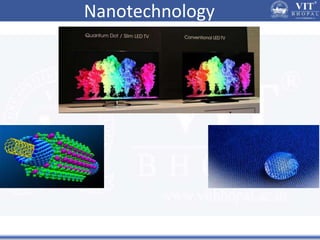
Nanotechnology
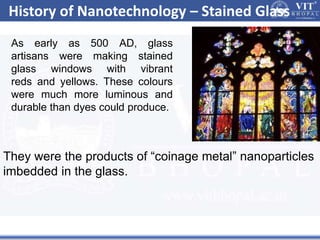
History of Nanotechnology – Stained Glass
As early as 500 AD, glass
artisans were making stained
glass windows with vibrant
reds and yellows. These colours
were much more luminous and
durable than dyes could produce.
They were the products of “coinage metal” nanoparticles
imbedded in the glass.
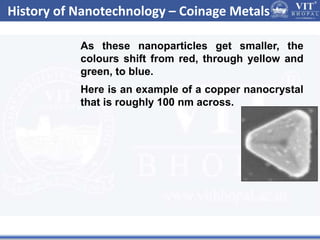
History of Nanotechnology – Coinage Metals
As these nanoparticles get smaller, the
colours shift from red, through yellow and
green, to blue.
Here is an example of a copper nanocrystal
that is roughly 100 nm across.
Impact of Nanotechnology
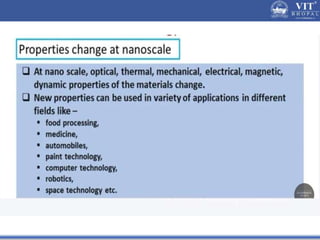
The benefit of nanotechnology is the
ability to introduce new characteristics
from materials:
•Antibacterial behaviour
•Colour
•Conductivity
•Tensile strength
•Chemical behaviour
•Interaction with water
•“Self-cleaning”
Moor’s law
The number of transistor in an integrated circuit doubles in every 18
or 24 months
Size of the transistor will be reduced
Moore's law refers to an observation made by Intel co-founder
Gordon Moore in 1965. He noticed that the number of
transistors per square inch on integrated circuits had doubled
every year since their invention.Moore's law predicts that this
trend will continue into the foreseeable future.
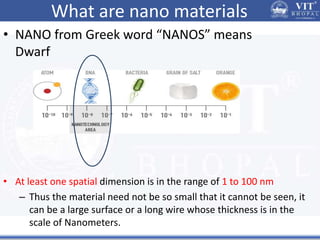
What are nano materials
• NANO from Greek word “NANOS” means
Dwarf
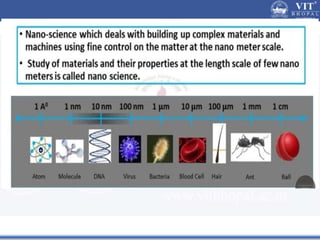
• At least one spatial dimension is in the range of 1 to 100 nm
– Thus the material need not be so small that it cannot be seen, it
can be a large surface or a long wire whose thickness is in the
scale of Nanometers.
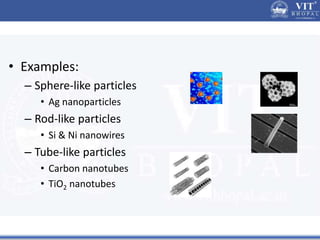
• Examples:
– Sphere-like particles
• Ag nanoparticles
– Rod-like particles
• Si & Ni nanowires
– Tube-like particles
• Carbon nanotubes
• TiO2 nanotubes
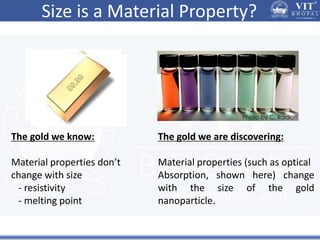
Size is a Material Property?
The gold we know:
Material properties don’t
change with size
- resistivity
- melting point
The gold we are discovering:
Material properties (such as optical
Absorption, shown here) change
with the size of the gold
nanoparticle.
Unique Characteristics of Nanoparticles
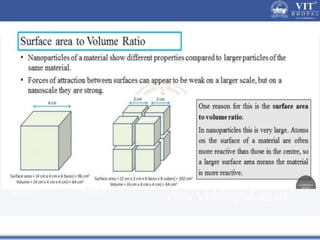
• Large surface to volume ratio
• High percentage of atoms/molecules on the surface
• Surface forces are very important, while bulk forces are not
as important.
• Metal nanoparticles have unique light scattering properties
and exhibit plasmon resonance.
• Semiconductor nanoparticles may exhibit confined energy
states in their electronic band structure (e.g., quantum
dots)
• Can have unique chemical and physical properties
• Same size scale as many biological structures
Physical Properties of Nanoparticles
• Physical properties of nanoparticles are
dependent on:
– Size
– Shape (spheres, rods, platelets, etc.)
– Composition
– Crystal Structure (FCC, BCC, etc.)
– Surface ligands or capping agents
– The medium in which they are dispersed
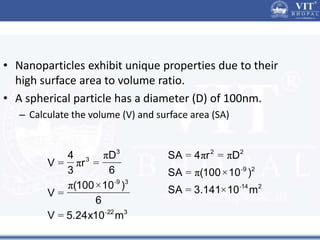
• Nanoparticles exhibit unique properties due to their
high surface area to volume ratio.
• A spherical particle has a diameter (D) of 100nm.
– Calculate the volume (V) and surface area (SA)
3
22
3
9
3
3
m
10
x
24
.
5
V
6
)
10
100
(
V
6
D
r
3
4
V
-
-
=
×
π
=
π
=
π
=
2
14
2
9
2
2
m
10
141
.
3
SA
)
10
100
(
SA
D
r
4
SA
-
-
×
=
×
π
=
π
=
π
=
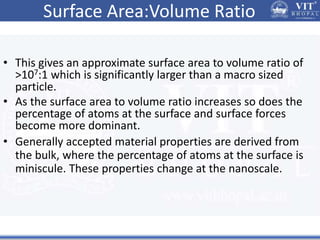
Surface Area:Volume Ratio
• This gives an approximate surface area to volume ratio of
>107:1 which is significantly larger than a macro sized
particle.
• As the surface area to volume ratio increases so does the
percentage of atoms at the surface and surface forces
become more dominant.
• Generally accepted material properties are derived from
the bulk, where the percentage of atoms at the surface is
miniscule. These properties change at the nanoscale.
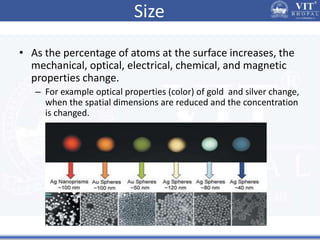
Size
• As the percentage of atoms at the surface increases, the
mechanical, optical, electrical, chemical, and magnetic
properties change.
– For example optical properties (color) of gold and silver change,
when the spatial dimensions are reduced and the concentration
is changed.
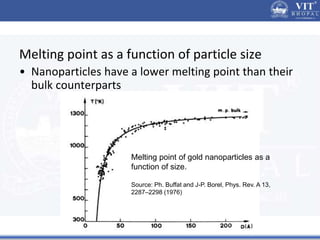
Melting point as a function of particle size
• Nanoparticles have a lower melting point than their
bulk counterparts
Melting point of gold nanoparticles as a
function of size.
Source: Ph. Buffat and J-P. Borel, Phys. Rev. A 13,
2287–2298 (1976)
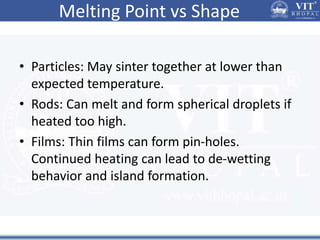
Melting Point vs Shape
• Particles: May sinter together at lower than
expected temperature.
• Rods: Can melt and form spherical droplets if
heated too high.
• Films: Thin films can form pin-holes.
Continued heating can lead to de-wetting
behavior and island formation.
Crystal Structure
• Most solids are crystalline with their atoms arranged
in a regular manner.
• This arrangement of atoms impacts the functionality
of the material.
• Some solids have this order presented over a long
range as in a crystal.
• Amorphous materials such as glass and wax lack long
range order, but they can have a limited short range
order, defined as the local environment that each
atom experiences.
Optical Properties
• The size dependence on the optical properties
of nanoparticles is the result of two distinct
phenomena:
– Surface plasmon resonance for metals
– Increased energy level spacing due to the
confinement of delocalized energy states. Most
prominent in semiconductors
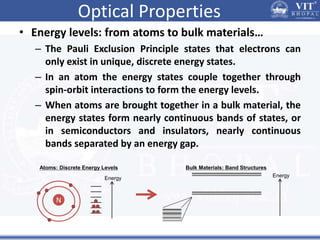
Optical Properties
• Energy levels: from atoms to bulk materials…
– The Pauli Exclusion Principle states that electrons can
only exist in unique, discrete energy states.
– In an atom the energy states couple together through
spin-orbit interactions to form the energy levels.
– When atoms are brought together in a bulk material, the
energy states form nearly continuous bands of states, or
in semiconductors and insulators, nearly continuous
bands separated by an energy gap.
N
Energy
Energy
Atoms: Discrete Energy Levels Bulk Materials: Band Structures
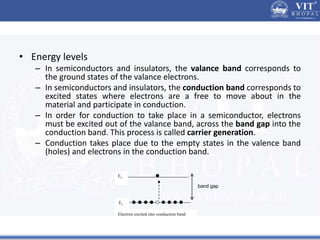
• Energy levels
– In semiconductors and insulators, the valance band corresponds to
the ground states of the valance electrons.
– In semiconductors and insulators, the conduction band corresponds to
excited states where electrons are a free to move about in the
material and participate in conduction.
– In order for conduction to take place in a semiconductor, electrons
must be excited out of the valance band, across the band gap into the
conduction band. This process is called carrier generation.
– Conduction takes place due to the empty states in the valence band
(holes) and electrons in the conduction band.
Ec
Ev
Electron excited into conduction band
band gap
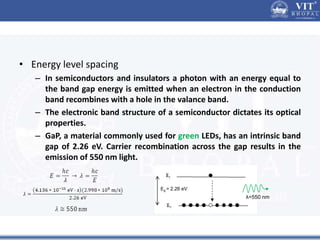
• Energy level spacing
– In semiconductors and insulators a photon with an energy equal to
the band gap energy is emitted when an electron in the conduction
band recombines with a hole in the valance band.
– The electronic band structure of a semiconductor dictates its optical
properties.
– GaP, a material commonly used for green LEDs, has an intrinsic band
gap of 2.26 eV. Carrier recombination across the gap results in the
emission of 550 nm light.
Eg = 2.26 eV
λ=550 nm
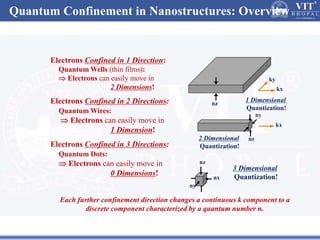
Quantum Confinement in Nanostructures: Overview
Electrons Confined in 1 Direction:
Quantum Wells (thin films):
 Electrons can easily move in
2 Dimensions!
Electrons Confined in 2 Directions:
Quantum Wires:
 Electrons can easily move in
1 Dimension!
Electrons Confined in 3 Directions:
Quantum Dots:
 Electrons can easily move in
0 Dimensions!
Each further confinement direction changes a continuous k component to a
discrete component characterized by a quantum number n.
kx
nz
ny
ny
nz
nx
kx
ky
nz
1 Dimensional
Quantization!
2 Dimensional
Quantization!
3 Dimensional
Quantization!
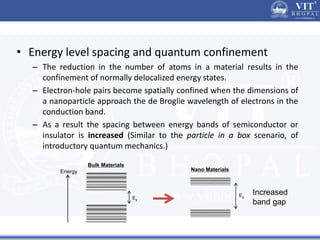
• Energy level spacing and quantum confinement
– The reduction in the number of atoms in a material results in the
confinement of normally delocalized energy states.
– Electron-hole pairs become spatially confined when the dimensions of
a nanoparticle approach the de Broglie wavelength of electrons in the
conduction band.
– As a result the spacing between energy bands of semiconductor or
insulator is increased (Similar to the particle in a box scenario, of
introductory quantum mechanics.)
Energy
Eg
Eg
Bulk Materials
Nano Materials
Increased
band gap
• Energy level spacing and quantum
confinement
– Semiconductor nanoparticles that exhibit 3
dimensional confinement in their electronic band
structure are called quantum dots.
– What does this all mean?
• Quantum dots are band gap tunable.
• We can engineer their optical properties by controlling
their size.
• For this reason quantum dots are highly desirable for
biological tagging.
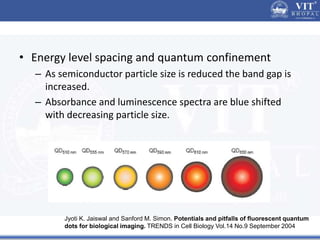
• Energy level spacing and quantum confinement
– As semiconductor particle size is reduced the band gap is
increased.
– Absorbance and luminescence spectra are blue shifted
with decreasing particle size.
CdSe quantum dots
Jyoti K. Jaiswal and Sanford M. Simon. Potentials and pitfalls of fluorescent quantum
dots for biological imaging. TRENDS in Cell Biology Vol.14 No.9 September 2004
Electrical Properties
• Effect of structure on conduction
– If nanostructures have fewer defects, one would
expect increased conductivity vs. macro scale
• Other electrical effects on the Nano scale:
– Surface Scattering
– Change in Electronic Structure
– Tunneling Conduction
– Microstructural Effects
Chemistry at the Nanoscale
It has already been stated that a nanomaterial is formed of at
least a cluster of atoms, often a cluster of molecules. It
follows that all types of bonding that are important in
chemistry are also important in nanoscience.
intramolecular bonding (chemical interactions): these are
bonding that involve changes in the chemical structure of the
molecules and include ionic, covalent and metallic bonds;
• intermolecular bonding (physical interaction): these are
bondings that do not involve changes in the chemical structure
of the molecules and include ion-ion and ion-dipole interactions;
van der Waals interactions; repulsive forces
Nanomaterials often arise from a number of molecules held
together or large molecules that assume specific three-
dimensional structures through intermolecular bonding
(macromolecules).
Therefore, nanoscience also deals with supramolecular
chemistry (i.e. the chemistry that deals with interactions
among molecules), which is just a sub-area of the general
field called ‘chemistry’. In these macromolecules,
intermolecular bonding often plays a crucial role.
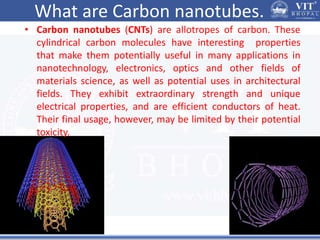
What are Carbon nanotubes.
• Carbon nanotubes (CNTs) are allotropes of carbon. These
cylindrical carbon molecules have interesting properties
that make them potentially useful in many applications in
nanotechnology, electronics, optics and other fields of
materials science, as well as potential uses in architectural
fields. They exhibit extraordinary strength and unique
electrical properties, and are efficient conductors of heat.
Their final usage, however, may be limited by their potential
toxicity.
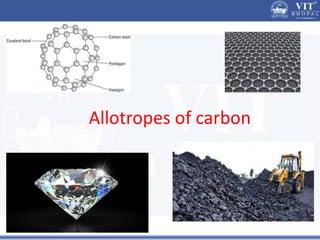
Allotropes of carbon
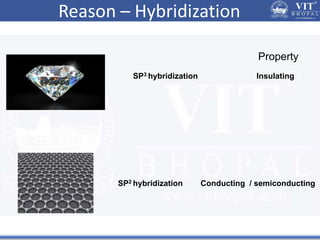
Reason – Hybridization
SP3 hybridization
SP2 hybridization
Insulating
Conducting / semiconducting
Property
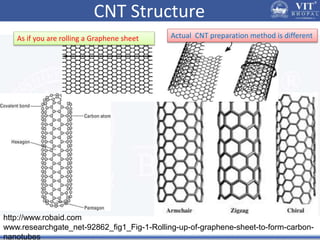
CNT Structure
http://www.robaid.com
www.researchgate_net-92862_fig1_Fig-1-Rolling-up-of-graphene-sheet-to-form-carbon-
nanotubes
As if you are rolling a Graphene sheet Actual CNT preparation method is different
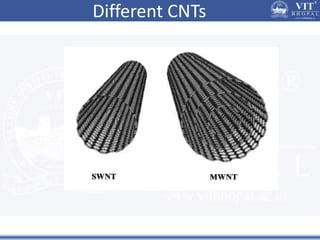
Different CNTs
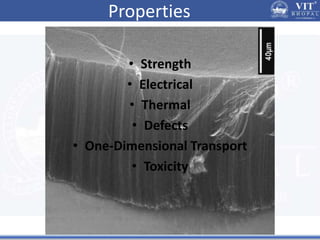
Properties
• Strength
• Electrical
• Thermal
• Defects
• One-Dimensional Transport
• Toxicity
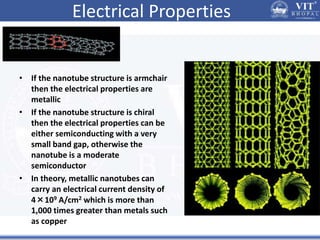
Electrical Properties
• If the nanotube structure is armchair
then the electrical properties are
metallic
• If the nanotube structure is chiral
then the electrical properties can be
either semiconducting with a very
small band gap, otherwise the
nanotube is a moderate
semiconductor
• In theory, metallic nanotubes can
carry an electrical current density of
4×10⁹ A/cm2 which is more than
1,000 times greater than metals such
as copper
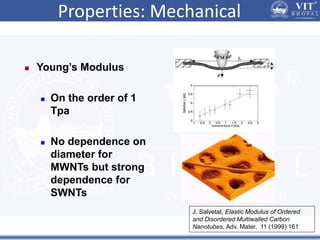
Properties: Mechanical
 Young’s Modulus
 On the order of 1
Tpa
 No dependence on
diameter for
MWNTs but strong
dependence for
SWNTs
J. Salvetat, Elastic Modulus of Ordered
and Disordered Multiwalled Carbon
Nanotubes, Adv. Mater. 11 (1999) 161
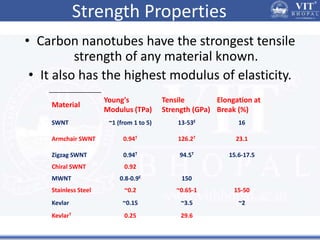
Strength Properties
• Carbon nanotubes have the strongest tensile
strength of any material known.
• It also has the highest modulus of elasticity.
Material
Young's
Modulus (TPa)
Tensile
Strength (GPa)
Elongation at
Break (%)
SWNT ~1 (from 1 to 5) 13-53E 16
Armchair SWNT 0.94T 126.2T 23.1
Zigzag SWNT 0.94T 94.5T 15.6-17.5
Chiral SWNT 0.92
MWNT 0.8-0.9E 150
Stainless Steel ~0.2 ~0.65-1 15-50
Kevlar ~0.15 ~3.5 ~2
KevlarT 0.25 29.6
Thermal Properties
• All nanotubes are expected to be very good thermal
conductors along the tube, but good insulators laterally to
the tube axis.
• It is predicted that carbon nanotubes will be able to
transmit up to 6000 watts per meter per Kelvin at room
temperature; compare this to copper, a metal well-known
for its good thermal conductivity, which transmits 385
watts per meter per K.
• The temperature stability of carbon nanotubes is estimated
to be up to 2800oC in vacuum and about 750oC in air.
CNT properties
Electrical property
• nanotube shows both metallic (armchair ) and semiconducting
(chiral) property
depending on the diameter and chirality
• band gap decrease with increasing diameter
• less defects to scatter electron , hence low resistivity. (metallic
nanotubes can carry
• an electrical current density of 4×10⁹ A/cm2 which is more than
1,000 times greater
than metals such as copper)
Mechanical property
• highly resilient (high young’s modulus)
• if bended, almost hexagonal carbon rings change in
structure but don’t break
High thermal conductivity
Defects
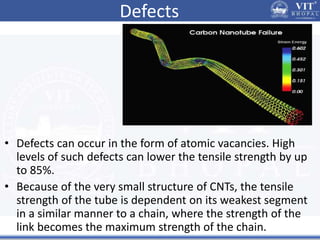
• Defects can occur in the form of atomic vacancies. High
levels of such defects can lower the tensile strength by up
to 85%.
• Because of the very small structure of CNTs, the tensile
strength of the tube is dependent on its weakest segment
in a similar manner to a chain, where the strength of the
link becomes the maximum strength of the chain.
One-Dimensional Transport
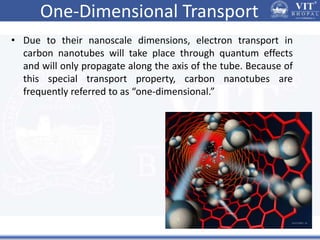
• Due to their nanoscale dimensions, electron transport in
carbon nanotubes will take place through quantum effects
and will only propagate along the axis of the tube. Because of
this special transport property, carbon nanotubes are
frequently referred to as “one-dimensional.”
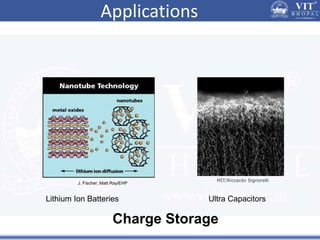
Applications
MIT/Riccardo Signorelli
J. Fischer, Matt Ray/EHP
Charge Storage
Lithium Ion Batteries Ultra Capacitors
• Quantum computing
• Energy technology
– CNT can be used to improve the efficiency of the
conventional Li ion battery
– High surface area
– Good electrical conductivity
– Linear geometry
• Medical sector
Drug delivery, cancer treatment, Tissue
regeneration
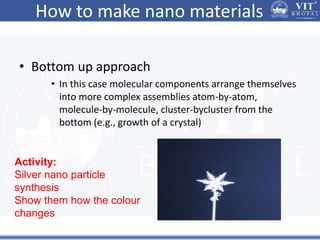
How to make nano materials
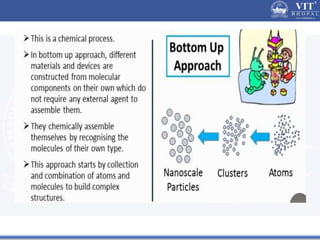
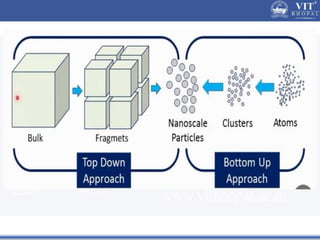
• Bottom up approach
• In this case molecular components arrange themselves
into more complex assemblies atom-by-atom,
molecule-by-molecule, cluster-bycluster from the
bottom (e.g., growth of a crystal)
Activity:
Silver nano particle
synthesis
Show them how the colour
changes
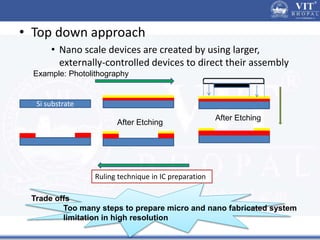
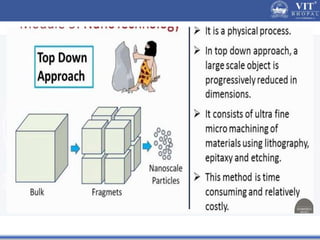
• Top down approach
• Nano scale devices are created by using larger,
externally-controlled devices to direct their assembly
Example: Photolithography
Si substrate
After Etching
After Etching
Ruling technique in IC preparation
Trade offs
Too many steps to prepare micro and nano fabricated system
limitation in high resolution
• Methods to Produce Nano materials
• Mechanical Method( Ball Milling Method)
• Sol gel Method
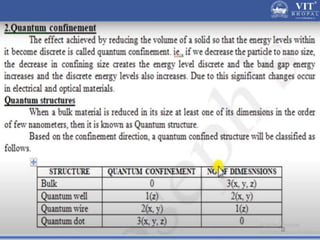
Quantum Confinement
 Trap particles and restrict their motion
 Quantum confinement produces new material behavior/phenomena
 “Engineer confinement”- control for specific applications
 Structures
(Scientific American)
 Quantum dots (0-D) only confined
states, and no freely moving ones
 Nanowires (1-D) particles travel only
along the wire
 Quantum wells (2-D) confines
particles within a thin layer
Applications of QDs: Light Emitters
• The discovery of quantum dots has led to the
development of an entirely new gamut of materials for
the active regions in LEDs and laser diodes.
• Solar Cells
• Photodetector devices
• Single Electron transistor

Nano technology.pptx

  • 1.
  • 2.
  • 12.
    History of Nanotechnology– Stained Glass As early as 500 AD, glass artisans were making stained glass windows with vibrant reds and yellows. These colours were much more luminous and durable than dyes could produce. They were the products of “coinage metal” nanoparticles imbedded in the glass.
  • 13.
    History of Nanotechnology– Coinage Metals As these nanoparticles get smaller, the colours shift from red, through yellow and green, to blue. Here is an example of a copper nanocrystal that is roughly 100 nm across.
  • 14.
    Impact of Nanotechnology Thebenefit of nanotechnology is the ability to introduce new characteristics from materials: •Antibacterial behaviour •Colour •Conductivity •Tensile strength •Chemical behaviour •Interaction with water •“Self-cleaning”
  • 15.
    Moor’s law The numberof transistor in an integrated circuit doubles in every 18 or 24 months Size of the transistor will be reduced Moore's law refers to an observation made by Intel co-founder Gordon Moore in 1965. He noticed that the number of transistors per square inch on integrated circuits had doubled every year since their invention.Moore's law predicts that this trend will continue into the foreseeable future.
  • 16.
    What are nanomaterials • NANO from Greek word “NANOS” means Dwarf • At least one spatial dimension is in the range of 1 to 100 nm – Thus the material need not be so small that it cannot be seen, it can be a large surface or a long wire whose thickness is in the scale of Nanometers.
  • 17.
    • Examples: – Sphere-likeparticles • Ag nanoparticles – Rod-like particles • Si & Ni nanowires – Tube-like particles • Carbon nanotubes • TiO2 nanotubes
  • 18.
    Size is aMaterial Property? The gold we know: Material properties don’t change with size - resistivity - melting point The gold we are discovering: Material properties (such as optical Absorption, shown here) change with the size of the gold nanoparticle.
  • 19.
    Unique Characteristics ofNanoparticles • Large surface to volume ratio • High percentage of atoms/molecules on the surface • Surface forces are very important, while bulk forces are not as important. • Metal nanoparticles have unique light scattering properties and exhibit plasmon resonance. • Semiconductor nanoparticles may exhibit confined energy states in their electronic band structure (e.g., quantum dots) • Can have unique chemical and physical properties • Same size scale as many biological structures
  • 20.
    Physical Properties ofNanoparticles • Physical properties of nanoparticles are dependent on: – Size – Shape (spheres, rods, platelets, etc.) – Composition – Crystal Structure (FCC, BCC, etc.) – Surface ligands or capping agents – The medium in which they are dispersed
  • 21.
    • Nanoparticles exhibitunique properties due to their high surface area to volume ratio. • A spherical particle has a diameter (D) of 100nm. – Calculate the volume (V) and surface area (SA) 3 22 3 9 3 3 m 10 x 24 . 5 V 6 ) 10 100 ( V 6 D r 3 4 V - - = × π = π = π = 2 14 2 9 2 2 m 10 141 . 3 SA ) 10 100 ( SA D r 4 SA - - × = × π = π = π =
  • 22.
    Surface Area:Volume Ratio •This gives an approximate surface area to volume ratio of >107:1 which is significantly larger than a macro sized particle. • As the surface area to volume ratio increases so does the percentage of atoms at the surface and surface forces become more dominant. • Generally accepted material properties are derived from the bulk, where the percentage of atoms at the surface is miniscule. These properties change at the nanoscale.
  • 23.
    Size • As thepercentage of atoms at the surface increases, the mechanical, optical, electrical, chemical, and magnetic properties change. – For example optical properties (color) of gold and silver change, when the spatial dimensions are reduced and the concentration is changed.
  • 24.
    Melting point asa function of particle size • Nanoparticles have a lower melting point than their bulk counterparts Melting point of gold nanoparticles as a function of size. Source: Ph. Buffat and J-P. Borel, Phys. Rev. A 13, 2287–2298 (1976)
  • 25.
    Melting Point vsShape • Particles: May sinter together at lower than expected temperature. • Rods: Can melt and form spherical droplets if heated too high. • Films: Thin films can form pin-holes. Continued heating can lead to de-wetting behavior and island formation.
  • 26.
    Crystal Structure • Mostsolids are crystalline with their atoms arranged in a regular manner. • This arrangement of atoms impacts the functionality of the material. • Some solids have this order presented over a long range as in a crystal. • Amorphous materials such as glass and wax lack long range order, but they can have a limited short range order, defined as the local environment that each atom experiences.
  • 27.
    Optical Properties • Thesize dependence on the optical properties of nanoparticles is the result of two distinct phenomena: – Surface plasmon resonance for metals – Increased energy level spacing due to the confinement of delocalized energy states. Most prominent in semiconductors
  • 28.
    Optical Properties • Energylevels: from atoms to bulk materials… – The Pauli Exclusion Principle states that electrons can only exist in unique, discrete energy states. – In an atom the energy states couple together through spin-orbit interactions to form the energy levels. – When atoms are brought together in a bulk material, the energy states form nearly continuous bands of states, or in semiconductors and insulators, nearly continuous bands separated by an energy gap. N Energy Energy Atoms: Discrete Energy Levels Bulk Materials: Band Structures
  • 29.
    • Energy levels –In semiconductors and insulators, the valance band corresponds to the ground states of the valance electrons. – In semiconductors and insulators, the conduction band corresponds to excited states where electrons are a free to move about in the material and participate in conduction. – In order for conduction to take place in a semiconductor, electrons must be excited out of the valance band, across the band gap into the conduction band. This process is called carrier generation. – Conduction takes place due to the empty states in the valence band (holes) and electrons in the conduction band. Ec Ev Electron excited into conduction band band gap
  • 30.
    • Energy levelspacing – In semiconductors and insulators a photon with an energy equal to the band gap energy is emitted when an electron in the conduction band recombines with a hole in the valance band. – The electronic band structure of a semiconductor dictates its optical properties. – GaP, a material commonly used for green LEDs, has an intrinsic band gap of 2.26 eV. Carrier recombination across the gap results in the emission of 550 nm light. Eg = 2.26 eV λ=550 nm
  • 32.
    Quantum Confinement inNanostructures: Overview Electrons Confined in 1 Direction: Quantum Wells (thin films):  Electrons can easily move in 2 Dimensions! Electrons Confined in 2 Directions: Quantum Wires:  Electrons can easily move in 1 Dimension! Electrons Confined in 3 Directions: Quantum Dots:  Electrons can easily move in 0 Dimensions! Each further confinement direction changes a continuous k component to a discrete component characterized by a quantum number n. kx nz ny ny nz nx kx ky nz 1 Dimensional Quantization! 2 Dimensional Quantization! 3 Dimensional Quantization!
  • 33.
    • Energy levelspacing and quantum confinement – The reduction in the number of atoms in a material results in the confinement of normally delocalized energy states. – Electron-hole pairs become spatially confined when the dimensions of a nanoparticle approach the de Broglie wavelength of electrons in the conduction band. – As a result the spacing between energy bands of semiconductor or insulator is increased (Similar to the particle in a box scenario, of introductory quantum mechanics.) Energy Eg Eg Bulk Materials Nano Materials Increased band gap
  • 34.
    • Energy levelspacing and quantum confinement – Semiconductor nanoparticles that exhibit 3 dimensional confinement in their electronic band structure are called quantum dots. – What does this all mean? • Quantum dots are band gap tunable. • We can engineer their optical properties by controlling their size. • For this reason quantum dots are highly desirable for biological tagging.
  • 35.
    • Energy levelspacing and quantum confinement – As semiconductor particle size is reduced the band gap is increased. – Absorbance and luminescence spectra are blue shifted with decreasing particle size. CdSe quantum dots Jyoti K. Jaiswal and Sanford M. Simon. Potentials and pitfalls of fluorescent quantum dots for biological imaging. TRENDS in Cell Biology Vol.14 No.9 September 2004
  • 36.
    Electrical Properties • Effectof structure on conduction – If nanostructures have fewer defects, one would expect increased conductivity vs. macro scale • Other electrical effects on the Nano scale: – Surface Scattering – Change in Electronic Structure – Tunneling Conduction – Microstructural Effects
  • 37.
    Chemistry at theNanoscale It has already been stated that a nanomaterial is formed of at least a cluster of atoms, often a cluster of molecules. It follows that all types of bonding that are important in chemistry are also important in nanoscience. intramolecular bonding (chemical interactions): these are bonding that involve changes in the chemical structure of the molecules and include ionic, covalent and metallic bonds; • intermolecular bonding (physical interaction): these are bondings that do not involve changes in the chemical structure of the molecules and include ion-ion and ion-dipole interactions; van der Waals interactions; repulsive forces
  • 38.
    Nanomaterials often arisefrom a number of molecules held together or large molecules that assume specific three- dimensional structures through intermolecular bonding (macromolecules). Therefore, nanoscience also deals with supramolecular chemistry (i.e. the chemistry that deals with interactions among molecules), which is just a sub-area of the general field called ‘chemistry’. In these macromolecules, intermolecular bonding often plays a crucial role.
  • 39.
    What are Carbonnanotubes. • Carbon nanotubes (CNTs) are allotropes of carbon. These cylindrical carbon molecules have interesting properties that make them potentially useful in many applications in nanotechnology, electronics, optics and other fields of materials science, as well as potential uses in architectural fields. They exhibit extraordinary strength and unique electrical properties, and are efficient conductors of heat. Their final usage, however, may be limited by their potential toxicity.
  • 40.
  • 41.
    Reason – Hybridization SP3hybridization SP2 hybridization Insulating Conducting / semiconducting Property
  • 42.
  • 43.
  • 44.
    Properties • Strength • Electrical •Thermal • Defects • One-Dimensional Transport • Toxicity
  • 45.
    Electrical Properties • Ifthe nanotube structure is armchair then the electrical properties are metallic • If the nanotube structure is chiral then the electrical properties can be either semiconducting with a very small band gap, otherwise the nanotube is a moderate semiconductor • In theory, metallic nanotubes can carry an electrical current density of 4×10⁹ A/cm2 which is more than 1,000 times greater than metals such as copper
  • 46.
    Properties: Mechanical  Young’sModulus  On the order of 1 Tpa  No dependence on diameter for MWNTs but strong dependence for SWNTs J. Salvetat, Elastic Modulus of Ordered and Disordered Multiwalled Carbon Nanotubes, Adv. Mater. 11 (1999) 161
  • 47.
    Strength Properties • Carbonnanotubes have the strongest tensile strength of any material known. • It also has the highest modulus of elasticity. Material Young's Modulus (TPa) Tensile Strength (GPa) Elongation at Break (%) SWNT ~1 (from 1 to 5) 13-53E 16 Armchair SWNT 0.94T 126.2T 23.1 Zigzag SWNT 0.94T 94.5T 15.6-17.5 Chiral SWNT 0.92 MWNT 0.8-0.9E 150 Stainless Steel ~0.2 ~0.65-1 15-50 Kevlar ~0.15 ~3.5 ~2 KevlarT 0.25 29.6
  • 48.
    Thermal Properties • Allnanotubes are expected to be very good thermal conductors along the tube, but good insulators laterally to the tube axis. • It is predicted that carbon nanotubes will be able to transmit up to 6000 watts per meter per Kelvin at room temperature; compare this to copper, a metal well-known for its good thermal conductivity, which transmits 385 watts per meter per K. • The temperature stability of carbon nanotubes is estimated to be up to 2800oC in vacuum and about 750oC in air.
  • 49.
    CNT properties Electrical property •nanotube shows both metallic (armchair ) and semiconducting (chiral) property depending on the diameter and chirality • band gap decrease with increasing diameter • less defects to scatter electron , hence low resistivity. (metallic nanotubes can carry • an electrical current density of 4×10⁹ A/cm2 which is more than 1,000 times greater than metals such as copper) Mechanical property • highly resilient (high young’s modulus) • if bended, almost hexagonal carbon rings change in structure but don’t break High thermal conductivity
  • 50.
    Defects • Defects canoccur in the form of atomic vacancies. High levels of such defects can lower the tensile strength by up to 85%. • Because of the very small structure of CNTs, the tensile strength of the tube is dependent on its weakest segment in a similar manner to a chain, where the strength of the link becomes the maximum strength of the chain.
  • 51.
    One-Dimensional Transport • Dueto their nanoscale dimensions, electron transport in carbon nanotubes will take place through quantum effects and will only propagate along the axis of the tube. Because of this special transport property, carbon nanotubes are frequently referred to as “one-dimensional.”
  • 52.
    Applications MIT/Riccardo Signorelli J. Fischer,Matt Ray/EHP Charge Storage Lithium Ion Batteries Ultra Capacitors
  • 53.
    • Quantum computing •Energy technology – CNT can be used to improve the efficiency of the conventional Li ion battery – High surface area – Good electrical conductivity – Linear geometry • Medical sector Drug delivery, cancer treatment, Tissue regeneration
  • 54.
    How to makenano materials • Bottom up approach • In this case molecular components arrange themselves into more complex assemblies atom-by-atom, molecule-by-molecule, cluster-bycluster from the bottom (e.g., growth of a crystal) Activity: Silver nano particle synthesis Show them how the colour changes
  • 55.
    • Top downapproach • Nano scale devices are created by using larger, externally-controlled devices to direct their assembly Example: Photolithography Si substrate After Etching After Etching Ruling technique in IC preparation Trade offs Too many steps to prepare micro and nano fabricated system limitation in high resolution
  • 59.
    • Methods toProduce Nano materials • Mechanical Method( Ball Milling Method) • Sol gel Method
  • 60.
    Quantum Confinement  Trapparticles and restrict their motion  Quantum confinement produces new material behavior/phenomena  “Engineer confinement”- control for specific applications  Structures (Scientific American)  Quantum dots (0-D) only confined states, and no freely moving ones  Nanowires (1-D) particles travel only along the wire  Quantum wells (2-D) confines particles within a thin layer
  • 61.
    Applications of QDs:Light Emitters • The discovery of quantum dots has led to the development of an entirely new gamut of materials for the active regions in LEDs and laser diodes. • Solar Cells • Photodetector devices • Single Electron transistor