THE SIXTH SENSE
TECHNOLOGY
INTRODUCTION
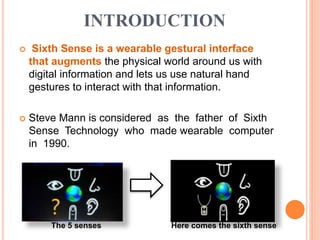
 Sixth Sense is a wearable gestural interface
that augments the physical world around us with
digital information and lets us use natural hand
gestures to interact with that information.
 Steve Mann is considered as the father of Sixth
Sense Technology who made wearable computer
in 1990.
The 5 senses Here comes the sixth sense
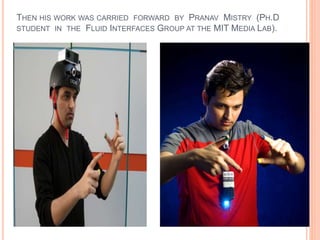
THEN HIS WORK WAS CARRIED FORWARD BY PRANAV MISTRY (PH.D
STUDENT IN THE FLUID INTERFACES GROUP AT THE MIT MEDIA LAB).
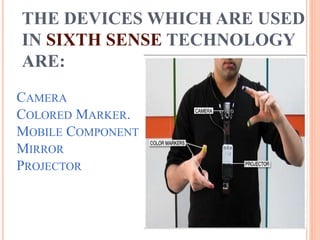
CAMERA
COLORED MARKER.
MOBILE COMPONENT
MIRROR
PROJECTOR
THE DEVICES WHICH ARE USED
IN SIXTH SENSE TECHNOLOGY
ARE:
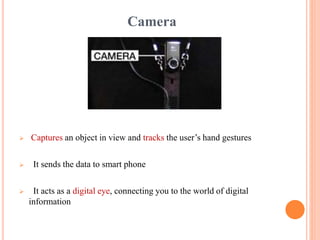
Camera
 Captures an object in view and tracks the user’s hand gestures
 It sends the data to smart phone
 It acts as a digital eye, connecting you to the world of digital
information
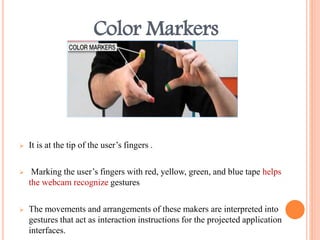
Color Markers
 It is at the tip of the user’s fingers .
 Marking the user’s fingers with red, yellow, green, and blue tape helps
the webcam recognize gestures
 The movements and arrangements of these makers are interpreted into
gestures that act as interaction instructions for the projected application
interfaces.
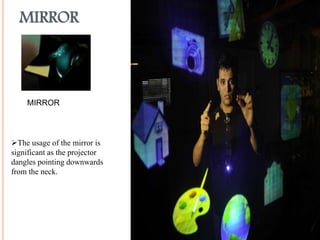
MIRROR
MIRROR
The usage of the mirror is
significant as the projector
dangles pointing downwards
from the neck.
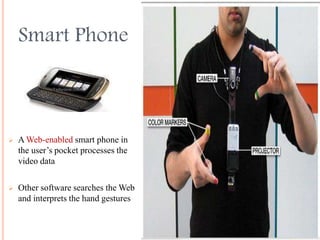
Smart Phone
 A Web-enabled smart phone in
the user’s pocket processes the
video data
 Other software searches the Web
and interprets the hand gestures
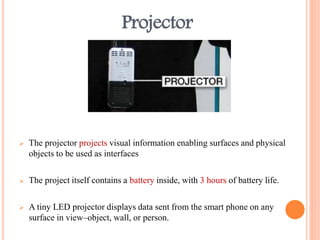
Projector
 The projector projects visual information enabling surfaces and physical
objects to be used as interfaces
 The project itself contains a battery inside, with 3 hours of battery life.
 A tiny LED projector displays data sent from the smart phone on any
surface in view–object, wall, or person.
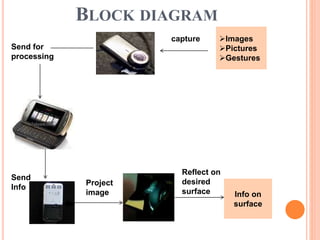
BLOCK DIAGRAM
Images
Pictures
Gestures
capture
Send for
processing
Send
Info
Info on
surface
Project
image
Reflect on
desired
surface
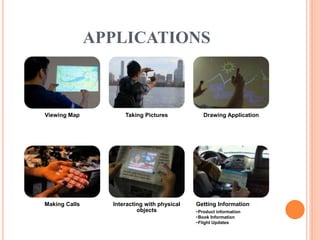
APPLICATIONS
Viewing Map Taking Pictures Drawing Application
Making Calls Interacting with physical
objects
Getting Information
•Product information
•Book Information
•Flight Updates
ADVANTAGES
 Portable
 Support Multi touch and Multi user interaction
 Cost Effective(300$)
 Data access directly from the machines in real time
 Mind map the idea anywhere
 Open Source Software
 Connectedness between world and information
DISADVANTAGES
 Hardware limitations of the devices, that we
currently carry around with us.
 For example many phones will not allow the
external camera feed to be manipulated in real
time.
 Post processing can occur however.
CONCLUSION
 Sixth Sense recognizes the objects around us, displaying
information automatically .
 The Sixth Sense prototype implements several applications
that demonstrate the usefulness, viability and flexibility of
the system.
 Allowing us to interact with this information via natural
hand gestures
FUTURE ENHANCEMENTS
 To get rid of color markers.
 To incorporate camera and projector inside
mobile computing device.
 To have 3D gesture tracking.
 To make Sixth Sense work as fifth Sense for
disabled person.
6th sense tech.

6th sense tech.

  • 1.
  • 3.
    INTRODUCTION  Sixth Senseis a wearable gestural interface that augments the physical world around us with digital information and lets us use natural hand gestures to interact with that information.  Steve Mann is considered as the father of Sixth Sense Technology who made wearable computer in 1990. The 5 senses Here comes the sixth sense
  • 4.
    THEN HIS WORKWAS CARRIED FORWARD BY PRANAV MISTRY (PH.D STUDENT IN THE FLUID INTERFACES GROUP AT THE MIT MEDIA LAB).
  • 5.
    CAMERA COLORED MARKER. MOBILE COMPONENT MIRROR PROJECTOR THEDEVICES WHICH ARE USED IN SIXTH SENSE TECHNOLOGY ARE:
  • 6.
    Camera  Captures anobject in view and tracks the user’s hand gestures  It sends the data to smart phone  It acts as a digital eye, connecting you to the world of digital information
  • 7.
    Color Markers  Itis at the tip of the user’s fingers .  Marking the user’s fingers with red, yellow, green, and blue tape helps the webcam recognize gestures  The movements and arrangements of these makers are interpreted into gestures that act as interaction instructions for the projected application interfaces.
  • 8.
    MIRROR MIRROR The usage ofthe mirror is significant as the projector dangles pointing downwards from the neck.
  • 9.
    Smart Phone  AWeb-enabled smart phone in the user’s pocket processes the video data  Other software searches the Web and interprets the hand gestures
  • 10.
    Projector  The projectorprojects visual information enabling surfaces and physical objects to be used as interfaces  The project itself contains a battery inside, with 3 hours of battery life.  A tiny LED projector displays data sent from the smart phone on any surface in view–object, wall, or person.
  • 11.
  • 12.
    APPLICATIONS Viewing Map TakingPictures Drawing Application Making Calls Interacting with physical objects Getting Information •Product information •Book Information •Flight Updates
  • 13.
    ADVANTAGES  Portable  SupportMulti touch and Multi user interaction  Cost Effective(300$)  Data access directly from the machines in real time  Mind map the idea anywhere  Open Source Software  Connectedness between world and information
  • 14.
    DISADVANTAGES  Hardware limitationsof the devices, that we currently carry around with us.  For example many phones will not allow the external camera feed to be manipulated in real time.  Post processing can occur however.
  • 15.
    CONCLUSION  Sixth Senserecognizes the objects around us, displaying information automatically .  The Sixth Sense prototype implements several applications that demonstrate the usefulness, viability and flexibility of the system.  Allowing us to interact with this information via natural hand gestures
  • 16.
    FUTURE ENHANCEMENTS  Toget rid of color markers.  To incorporate camera and projector inside mobile computing device.  To have 3D gesture tracking.  To make Sixth Sense work as fifth Sense for disabled person.

Editor's Notes

  • #4 Sixth Sense is a wearable gestural interface that augments the physical world around us with digital information and lets us use natural hand gestures to interact with that information. It was developed by Pranav Mistry, a PhD student in the Fluid Interfaces Group at the MIT Media Lab. SixthSense comprises a pocket projector, a mirror and a camera. The hardware components are coupled in a pendant like mobile wearable device
  • #5 In this paper, I would like to acknowledge Mr. Pranav Mistry for the great and deep research work he has done in this field.
  • #6 Camera: tracks the movement of the colored markers using movement algorithms. Colored Markers: Red, blue, green, and yellow tape worn on the users fingertips for tracking purposes. Projector: Projects stored data onto most any surface. Smart phone: needed for internet connection and computing power
  • #12   The Sixth Sense technology contains a pocket projector, a mirror and a camera contained in a pendant-like, wearable device. Both the projector the camera and sensors are connected to a mobile computing device in the user’s pocket. The projector projects visual information enabling surfaces, walls and physical objects around us to be used as interfaces; while the camera recognizes and tracks users' hand gestures and physical objects using computer-vision based techniques. 
  • #14 Recognizes hand movements Examples from online demonstrations: Make frame with hands: camera takes picture Google map onto wall Draw circle on wrist: projects digital clock Movement of text book/web info onto page Airline ticket updates Draw @ symbol: check email for you Many more capabilities (it’s on youtube or TED website)