Name : Fizba Razaq
PAKISTAN
ARMY
Group Members
• FIZBA RAZAQ
• NUZHAT PARVEEN
• SAMINA IJAZ
• SANA ARSHAD
• MAHAM SANA
• ASIF IQBAL
Army Introduction
 Pakistan Army is the largest
branch of military.
 It is mainly responsible for
protecting state border.
 The security of administration
and defending the national
interests of Pakistan.
 It is also to be utilized for
internal security
HISTORY
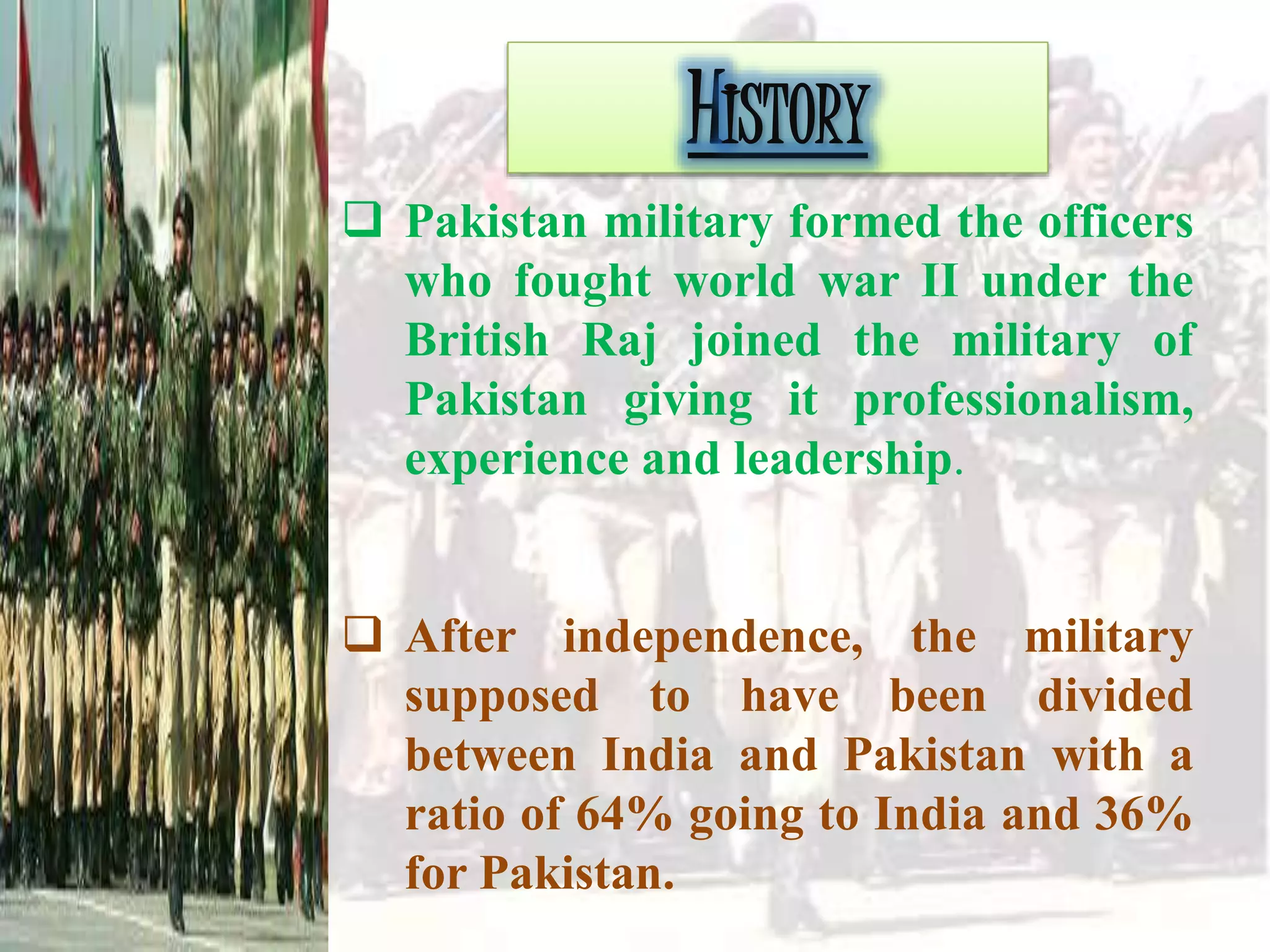
 Pakistan military formed the officers
who fought world war II under the
British Raj joined the military of
Pakistan giving it professionalism,
experience and leadership.
 After independence, the military
supposed to have been divided
between India and Pakistan with a
ratio of 64% going to India and 36%
for Pakistan.
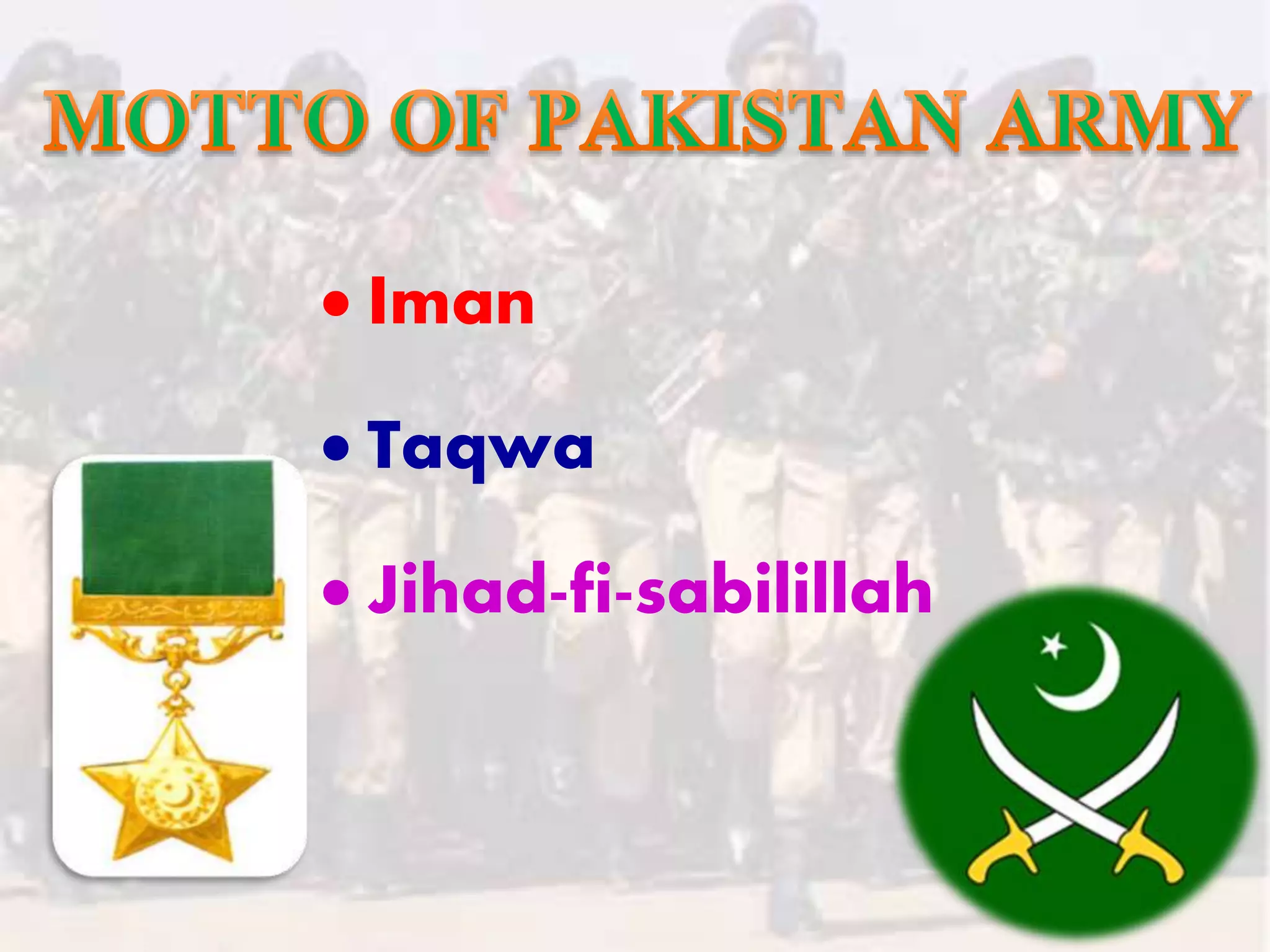
 Iman
 Taqwa
 Jihad-fi-sabilillah
• IMAN
 To have faith and trust in
Allah and consider oneself
A follower of none but Allah
And a follower of none but his
messenger
• Taqwa
The fear of Allah Almighty.
Guarding ones tongue, hands
and heart from evil.
Righteous, piety and good
conduct.
• Jihad-fi-Sabilillah
 Jihad means ‘to struggle’ or ‘to strive’
 Shift the lordship of man over man to the
lordship of Allah on the Earth
 To stake one’s life and everything else to
achieve this scared purpose.
NUZHAT PARVEEN
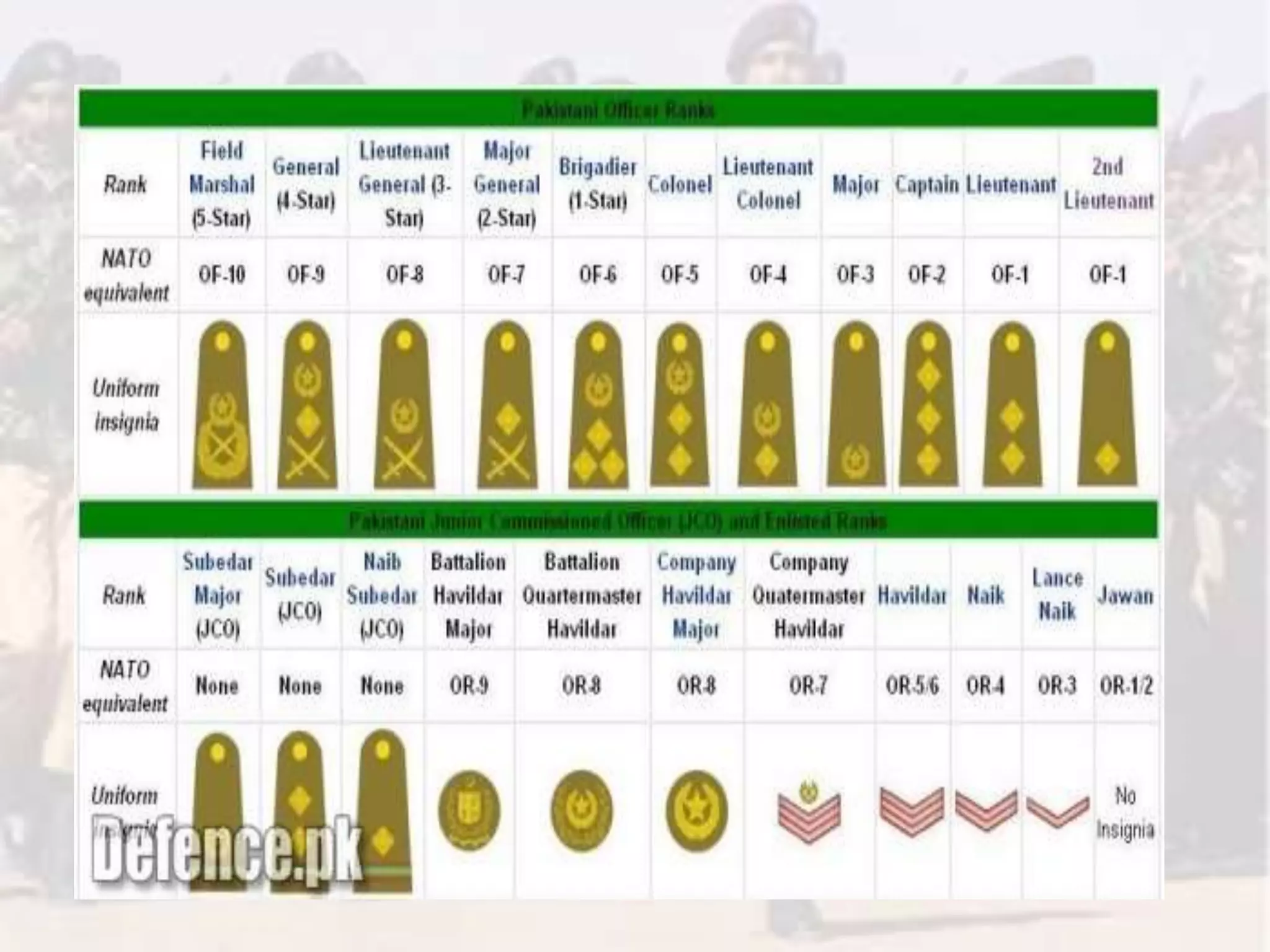
Pakistan Army Hierarchy
 Officers
Field Marshal
General
Lieutenant General
Major General
Brigadier
Colonel
Lieutenant Colonel
Major
Captain
Lieutenant
Second Lieutenant
Pakistan Army Hierarchy
• Junior Commissioned Officers
Subedar Major
Subedar
Naib Subedar
• Non-Commissioned Officers
Battalion Havildar Major
Battalion Quartermaster Havildar
Company Havildar Major
Company Quartermaster Havildar
Havildar
Naik
Lance Naik
UNIFORMS
• The standard uniform for the
Pakistan Army was a traditional old
British Army Khaki.
• Now The colors of the new pattern
uniform depend on the geographical
areas.
MILITARY INTELLIGENCE ACADEMIES
Pakistan's Military Intelligence (MI) is one
of the three main intelligence services in
Pakistan.
Functions involve monitoring high level
military and political leaders and safe
guarding critical facilities such as military
and non-military installations.
1. • Pakistan Air Force Academy
2. • Pakistan Naval Academy
3. • Pakistan Maritime Academy
4. Pakistan Military Academy
Pakistan Army Hierarchy
• Junior Commissioned Officers
* Subedar Major
* Subedar
* Naib Subedar
• Non-Commissioned Officers
* Battalion Havildar Major
* Battalion Quartermaster Havildar
* Company Havildar Major
* Company Quartermaster Havildar
* Havildar
* Naik
* Lance Naik
Performance Appraisal is a process in
which supervisor evaluates his/her
subordinate’s performance
It basically has three steps:
Examines and evaluates an
employee's work behavior by
comparing it with preset standards
Documents the results of the
comparison
Uses the results to provide feedback
to the employee to show where
improvements are needed and why.
SAMINA IJAZ
ACR stands for Annual
Confidential Report.
This is an annual assessment
report of subordinate staffs
maintained by Human
Resources Department of the
concerned institution.
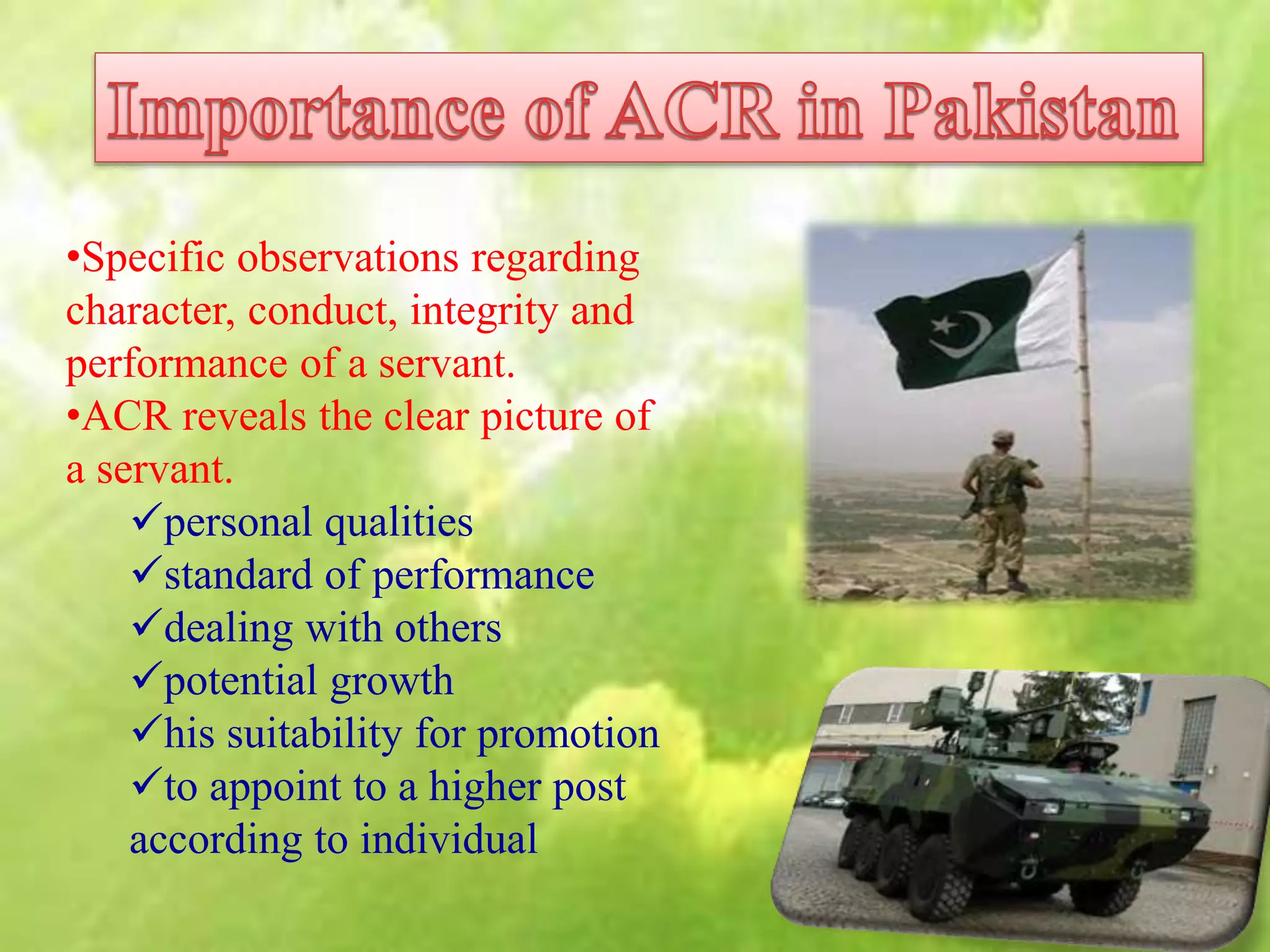
•Specific observations regarding
character, conduct, integrity and
performance of a servant.
•ACR reveals the clear picture of
a servant.
personal qualities
standard of performance
dealing with others
potential growth
his suitability for promotion
to appoint to a higher post
according to individual
 The system of writing confidential reports
has two main objectives.
• Improve performance of the
subordinates in their present job.
• Assess their potentialities and to
prepare them for the jobs suitable to
their personality
 A.C.R. should be discreet, judicious,
precise, detached, disinterested,
dispassionate, equitable and fair minded
without being partial.
 The measurement of
performance in military
organizations is more complex
and difficult process compared
to the performance evaluation
in the private sector.
 More measurements in
various levels are made
compared to those in the
private sector.
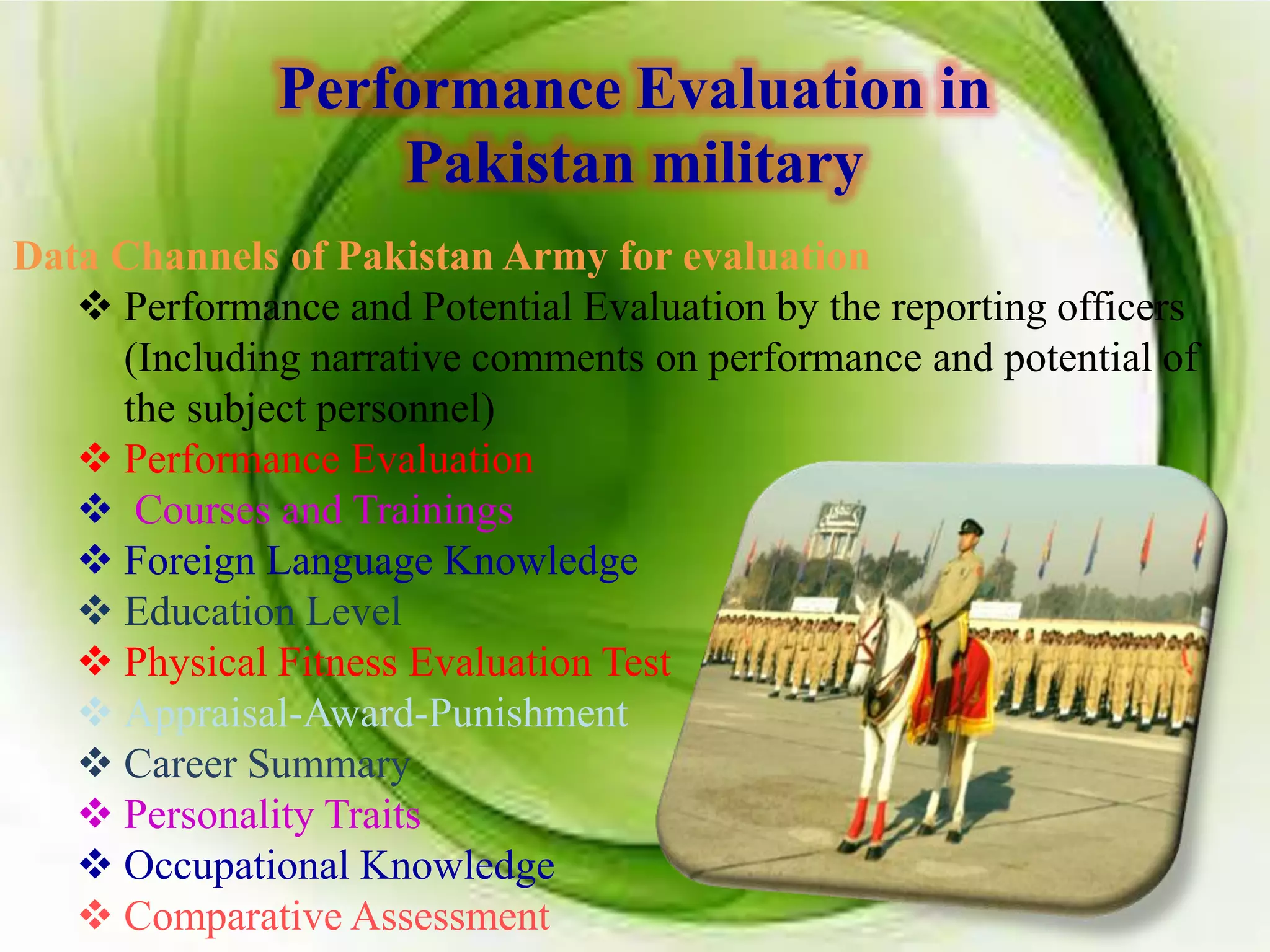
Data Channels of Pakistan Army for evaluation
 Performance and Potential Evaluation by the reporting officers
(Including narrative comments on performance and potential of
the subject personnel)
 Performance Evaluation
 Courses and Trainings
 Foreign Language Knowledge
 Education Level
 Physical Fitness Evaluation Test
 Appraisal-Award-Punishment
 Career Summary
 Personality Traits
 Occupational Knowledge
 Comparative Assessment
Performance Evaluation in
Pakistan military
Dimensions of Performance Evaluation
System in Pakistan Army
Validity
Directness
Objectivity
Adequacy
Quantitative
Practicality
Reliability
SANAARSHAD
 Two Categories of
Evaluation System in
Pakistan Army
 Other Rank Evaluation
Report
 Officer’s Evaluation
Report
 Format of Evaluation is
different but criteria is
same for both.
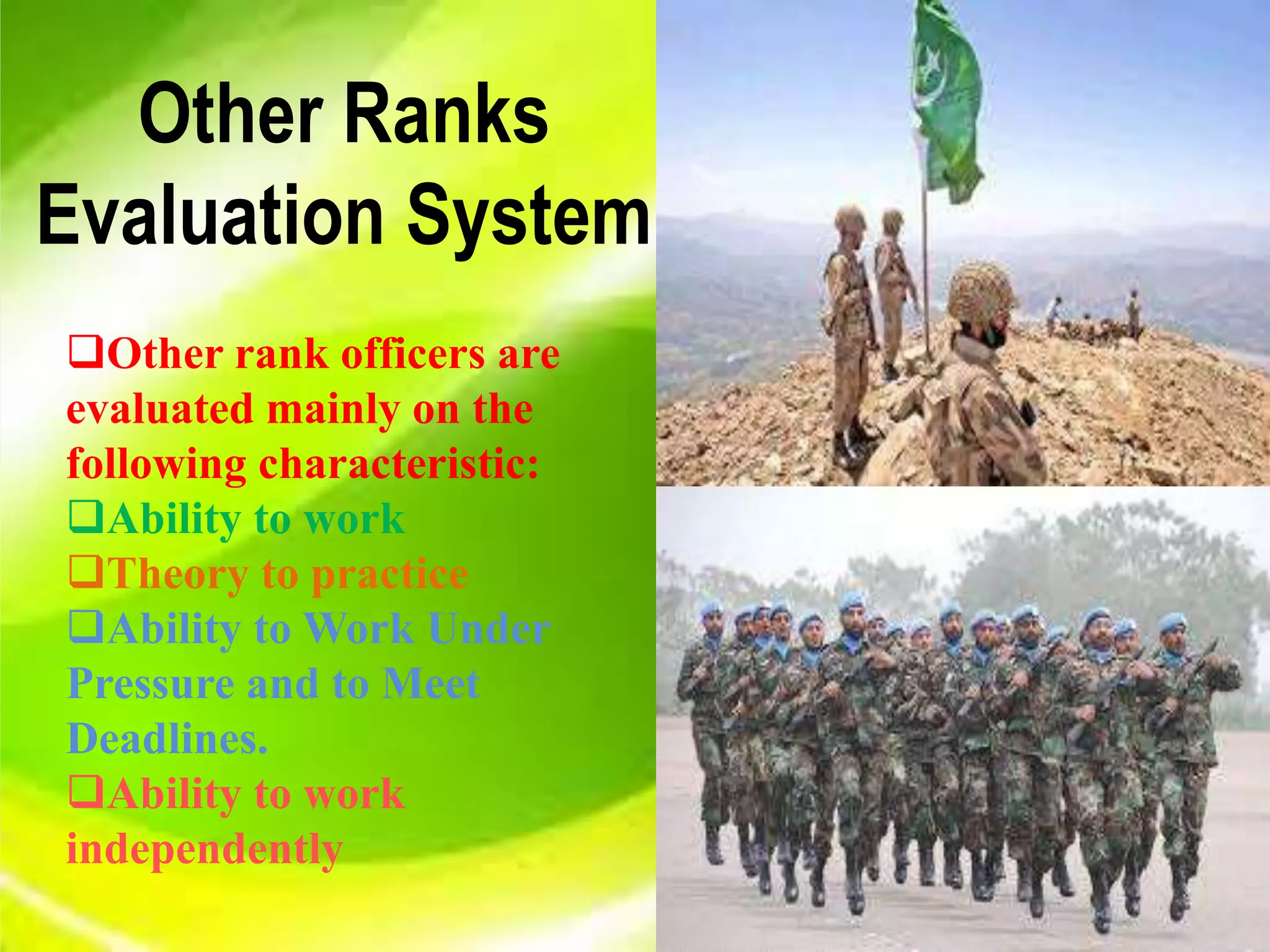
Other rank officers are
evaluated mainly on the
following characteristic:
Ability to work
Theory to practice
Ability to Work Under
Pressure and to Meet
Deadlines.
Ability to work
independently
Other Ranks
Evaluation System
Personal Details of the Evaluating Personnel
 Name and Surname
Rank
Service Number
Current Appointment or Post
Medical Status (Recent medical report disability if exists)
 Promotional Exams
Courses (Military Academy)
Academic Title
Date of Appointment in various Ranks
Marital Status (occupation of her spouse, number of children)
Period of Direct Contact with the Subject Personnel
Dimensions of Officers
Evaluation System
Dimensions of Officers Evaluation
System For the Use Of MS Branch
 Initial Officer Evaluation
 Performance Personality Evaluation
 Demo performance
 Professional competence
 Leadership/Command Ability
 Common Skills
• Brief Pen Pictures
 Strong POINTS
 Weak Areas
 Emp Recommendation (Fit for staff or Command)
 Promotion Recommendation
 Reason for unfit/FME
 GRD Awarded
 Technical reporting Officer’s Evaluation
 Senior Reporting Officer’s Evaluation
 Next Senior Reporting Officer’s Evaluation
Physical Performance is evaluated by
testing running, push-up and sit-up.
 There are also additional parameters, for
example rope climbing, swimming and
pull-up
Physical Performance
Intellectual attributes
behavioral attributes
special qualities
professional qualities
Characteristic features.
MAHUM SANA
SWOT Analysis
• Strengths
• Weaknesses
• Opportunities
• Threats
Strengths
• Low cost , dispensable
• Force multiplier
• Flexible deployment
• Ideal counter for high-high fifth
generation threat
• Adds new dimension to air battle
• Allows for flexibility in strategy
Weaknesses
• Lack of situational awareness of UCAVs
• Poor post-merge comparative
performance vis-à-vis manned fighters
• If enemy finds a weakness it can be exploited
until Software update
• More affected by Electronic warfare (EW)
Opportunities
• Take advantage of rapid changes in
technology
• Ideal utilization of existing industrial
expertise
• Balance fighter force structure which
presently lacks sufficient high-high
platforms
Threats
• Indian strength in IT and UAVs (via
Israel)
• New dimension to arms race against
superior financial and technical resources
• Lack of a greed governance structure
across the ICT and health sectors
Techniques Used In Performance
Evaluation in Pakistan Army
Methods used by Pakistan army
Graphic Rating Scale
Pen Picture
Bars
Techniques Used In Performance
Evaluation in Pakistan Army
• Graphic Rating Scale
Army officers are evaluated
on different traits
Each trait is listed down and
the reporting officer rank each
traits
sum up the total and evaluate
the officer
Techniques Used In Performance
Evaluation in Pakistan Army
• Behaviorally anchored rating scale
In part III of OER, performance/personality
evaluation BARS are used to evaluate the
personality factors.
• Pen picture
Reporting officer give his remarks about
evaluating officer
Paragraph is return on his leader ship and
command quality
.
Techniques Used In Performance
Evaluation in Pakistan Army
Quantitative and Qualitative Ranking Scale
• Quantitative scale
Quantitative scale ranks from 1-6 is ranked where
1 is the least on the scale and 6 being the highest.
• Qualitative scale
Qualitative scale includes scales, such as
Outstanding Well
Above Average
Above Average High Average
Average Below Average
Man Power
Military Age 16-49 years old
Available for Military Service 48,453,305 males,
44,898,096 females,
Fit for
Military Service
37,945,440 males, (2010 est.)
37,381,549 females, (2010 est.)
ASIF IQBAL
WOMEN AND MINORITIES
IN THE FORCES
Women have served in
the Pakistani Army since
its foundation.
Currently, there is a
sizable number of
Women serving in the
army.
Most women are
recruited in the regular
Army to perform
medical and educational
work.
 Also minorities served in
forces
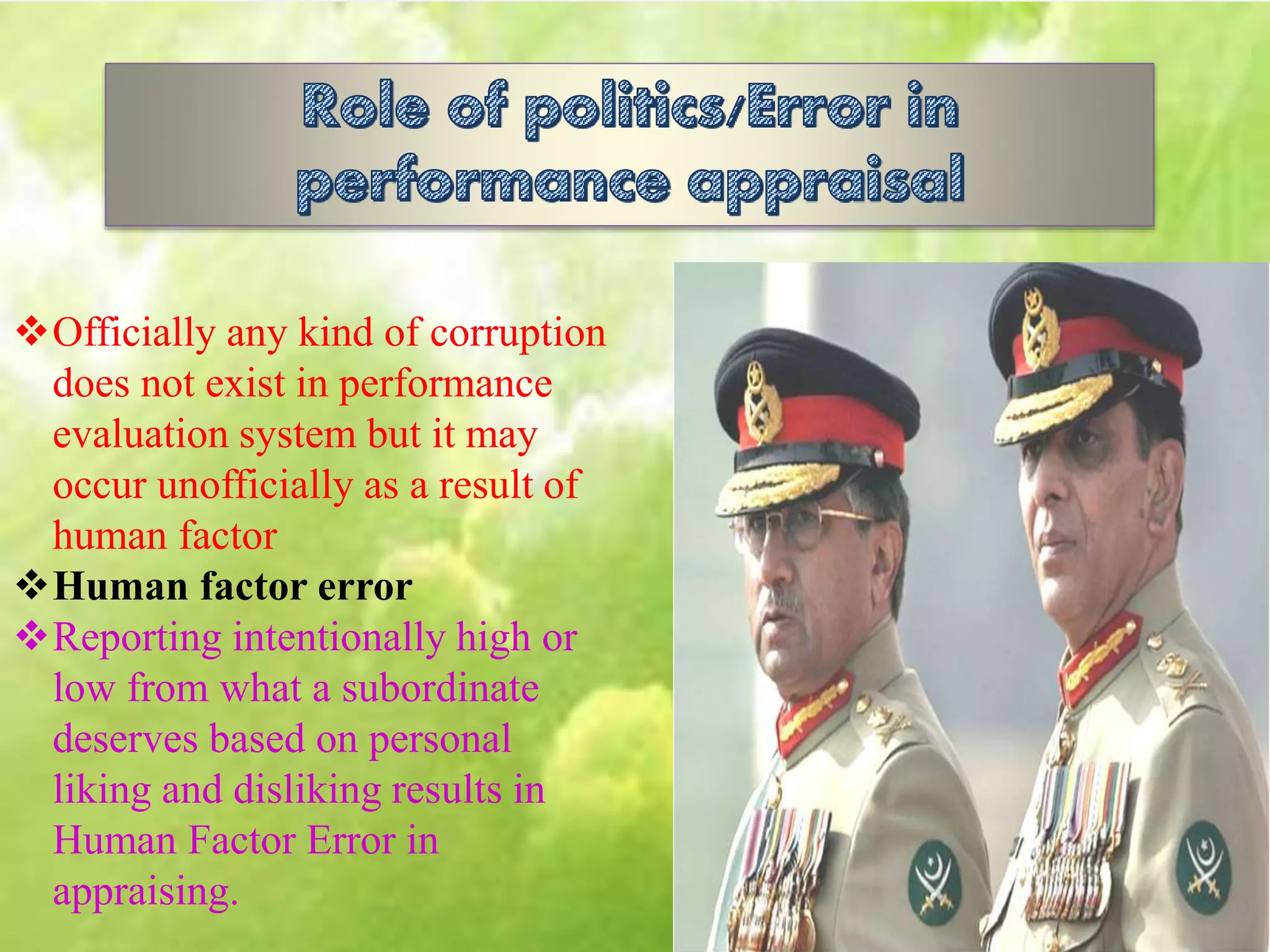
Officially any kind of corruption
does not exist in performance
evaluation system but it may
occur unofficially as a result of
human factor
Human factor error
Reporting intentionally high or
low from what a subordinate
deserves based on personal
liking and disliking results in
Human Factor Error in
appraising.
Personal Liking
Reporting Officer may over
rate the subordinate on the
basis of his personal liking for
the officer
Personal Disliking
Supervisor may rate any officer
adverse from what he deserves
on his personal grudges with
the evaluate office
Performance Appraisal and Base Pay
 There is no relation between Officer’s Evaluation
Report and base Pay
 The evaluation of an individual does not affect either
positively or negatively on the base pay
Performance Appraisal and Compensation
Performance evaluation report is not directly linked with
compensation.
Linking Performance Evaluation
System with Compensation and
Base Pay
. .
If poor performance is
evaluated, no detention
is given to the officer.
 He is transferred to
some other unit or
fired from the job, if
two consecutive
negative appraisals
are reported.
In Pakistan Military Performance Evaluation is very
important for transfer or promotion decisions.
Performance Evaluation and Transfer Decisions
 If the result of an officer’s performance evaluation is
below the prescribed standards in this case he is
transferred to some other unit
Performance Evaluation
and Promotion Decision
 Officer’s Evaluating Report is majorly
important for promotional decisions of
an officer
 On bad performance reported an officer
is not recommended for the promotion
 . On Good evaluation reported an officer
is recommended for promotion by the
senior reporting officer and then the
officer under goes in a procedure for the
promotion.
The performance evaluation
system of Pakistan army is well
designed as has fewer errors in
the system
Pakistan Army should introduce
incentive pays or bonuses to
encourage good performance of
the officer and motivate other
officers to work with passion for
the Pakistan army
. The reporting officer should
avoid personal interests while
evaluating the officer so he may
get the evaluation what he
deserves
Critical Analysis
PAKIISTAN ARMY

PAKIISTAN ARMY

  • 2.
  • 3.
  • 4.
    Group Members • FIZBARAZAQ • NUZHAT PARVEEN • SAMINA IJAZ • SANA ARSHAD • MAHAM SANA • ASIF IQBAL
  • 6.
    Army Introduction  PakistanArmy is the largest branch of military.  It is mainly responsible for protecting state border.  The security of administration and defending the national interests of Pakistan.  It is also to be utilized for internal security
  • 7.
    HISTORY  Pakistan militaryformed the officers who fought world war II under the British Raj joined the military of Pakistan giving it professionalism, experience and leadership.  After independence, the military supposed to have been divided between India and Pakistan with a ratio of 64% going to India and 36% for Pakistan.
  • 8.
     Iman  Taqwa Jihad-fi-sabilillah
  • 9.
    • IMAN  Tohave faith and trust in Allah and consider oneself A follower of none but Allah And a follower of none but his messenger • Taqwa The fear of Allah Almighty. Guarding ones tongue, hands and heart from evil. Righteous, piety and good conduct.
  • 10.
    • Jihad-fi-Sabilillah  Jihadmeans ‘to struggle’ or ‘to strive’  Shift the lordship of man over man to the lordship of Allah on the Earth  To stake one’s life and everything else to achieve this scared purpose.
  • 11.
  • 12.
    Pakistan Army Hierarchy Officers Field Marshal General Lieutenant General Major General Brigadier Colonel Lieutenant Colonel Major Captain Lieutenant Second Lieutenant
  • 13.
    Pakistan Army Hierarchy •Junior Commissioned Officers Subedar Major Subedar Naib Subedar • Non-Commissioned Officers Battalion Havildar Major Battalion Quartermaster Havildar Company Havildar Major Company Quartermaster Havildar Havildar Naik Lance Naik
  • 15.
    UNIFORMS • The standarduniform for the Pakistan Army was a traditional old British Army Khaki. • Now The colors of the new pattern uniform depend on the geographical areas.
  • 16.
    MILITARY INTELLIGENCE ACADEMIES Pakistan'sMilitary Intelligence (MI) is one of the three main intelligence services in Pakistan. Functions involve monitoring high level military and political leaders and safe guarding critical facilities such as military and non-military installations.
  • 17.
    1. • PakistanAir Force Academy 2. • Pakistan Naval Academy 3. • Pakistan Maritime Academy 4. Pakistan Military Academy
  • 18.
    Pakistan Army Hierarchy •Junior Commissioned Officers * Subedar Major * Subedar * Naib Subedar • Non-Commissioned Officers * Battalion Havildar Major * Battalion Quartermaster Havildar * Company Havildar Major * Company Quartermaster Havildar * Havildar * Naik * Lance Naik Performance Appraisal is a process in which supervisor evaluates his/her subordinate’s performance It basically has three steps: Examines and evaluates an employee's work behavior by comparing it with preset standards Documents the results of the comparison Uses the results to provide feedback to the employee to show where improvements are needed and why.
  • 19.
  • 20.
    ACR stands forAnnual Confidential Report. This is an annual assessment report of subordinate staffs maintained by Human Resources Department of the concerned institution.
  • 21.
    •Specific observations regarding character,conduct, integrity and performance of a servant. •ACR reveals the clear picture of a servant. personal qualities standard of performance dealing with others potential growth his suitability for promotion to appoint to a higher post according to individual
  • 22.
     The systemof writing confidential reports has two main objectives. • Improve performance of the subordinates in their present job. • Assess their potentialities and to prepare them for the jobs suitable to their personality  A.C.R. should be discreet, judicious, precise, detached, disinterested, dispassionate, equitable and fair minded without being partial.
  • 23.
     The measurementof performance in military organizations is more complex and difficult process compared to the performance evaluation in the private sector.  More measurements in various levels are made compared to those in the private sector.
  • 24.
    Data Channels ofPakistan Army for evaluation  Performance and Potential Evaluation by the reporting officers (Including narrative comments on performance and potential of the subject personnel)  Performance Evaluation  Courses and Trainings  Foreign Language Knowledge  Education Level  Physical Fitness Evaluation Test  Appraisal-Award-Punishment  Career Summary  Personality Traits  Occupational Knowledge  Comparative Assessment Performance Evaluation in Pakistan military
  • 25.
    Dimensions of PerformanceEvaluation System in Pakistan Army Validity Directness Objectivity Adequacy Quantitative Practicality Reliability
  • 26.
  • 27.
     Two Categoriesof Evaluation System in Pakistan Army  Other Rank Evaluation Report  Officer’s Evaluation Report  Format of Evaluation is different but criteria is same for both.
  • 28.
    Other rank officersare evaluated mainly on the following characteristic: Ability to work Theory to practice Ability to Work Under Pressure and to Meet Deadlines. Ability to work independently Other Ranks Evaluation System
  • 29.
    Personal Details ofthe Evaluating Personnel  Name and Surname Rank Service Number Current Appointment or Post Medical Status (Recent medical report disability if exists)  Promotional Exams Courses (Military Academy) Academic Title Date of Appointment in various Ranks Marital Status (occupation of her spouse, number of children) Period of Direct Contact with the Subject Personnel Dimensions of Officers Evaluation System
  • 30.
    Dimensions of OfficersEvaluation System For the Use Of MS Branch  Initial Officer Evaluation  Performance Personality Evaluation  Demo performance  Professional competence  Leadership/Command Ability  Common Skills • Brief Pen Pictures  Strong POINTS  Weak Areas  Emp Recommendation (Fit for staff or Command)  Promotion Recommendation  Reason for unfit/FME  GRD Awarded  Technical reporting Officer’s Evaluation  Senior Reporting Officer’s Evaluation  Next Senior Reporting Officer’s Evaluation
  • 31.
    Physical Performance isevaluated by testing running, push-up and sit-up.  There are also additional parameters, for example rope climbing, swimming and pull-up Physical Performance
  • 32.
    Intellectual attributes behavioral attributes specialqualities professional qualities Characteristic features.
  • 33.
  • 34.
    SWOT Analysis • Strengths •Weaknesses • Opportunities • Threats
  • 35.
    Strengths • Low cost, dispensable • Force multiplier • Flexible deployment • Ideal counter for high-high fifth generation threat • Adds new dimension to air battle • Allows for flexibility in strategy
  • 36.
    Weaknesses • Lack ofsituational awareness of UCAVs • Poor post-merge comparative performance vis-à-vis manned fighters • If enemy finds a weakness it can be exploited until Software update • More affected by Electronic warfare (EW)
  • 37.
    Opportunities • Take advantageof rapid changes in technology • Ideal utilization of existing industrial expertise • Balance fighter force structure which presently lacks sufficient high-high platforms
  • 38.
    Threats • Indian strengthin IT and UAVs (via Israel) • New dimension to arms race against superior financial and technical resources • Lack of a greed governance structure across the ICT and health sectors
  • 39.
    Techniques Used InPerformance Evaluation in Pakistan Army Methods used by Pakistan army Graphic Rating Scale Pen Picture Bars
  • 40.
    Techniques Used InPerformance Evaluation in Pakistan Army • Graphic Rating Scale Army officers are evaluated on different traits Each trait is listed down and the reporting officer rank each traits sum up the total and evaluate the officer
  • 41.
    Techniques Used InPerformance Evaluation in Pakistan Army • Behaviorally anchored rating scale In part III of OER, performance/personality evaluation BARS are used to evaluate the personality factors. • Pen picture Reporting officer give his remarks about evaluating officer Paragraph is return on his leader ship and command quality .
  • 42.
    Techniques Used InPerformance Evaluation in Pakistan Army Quantitative and Qualitative Ranking Scale • Quantitative scale Quantitative scale ranks from 1-6 is ranked where 1 is the least on the scale and 6 being the highest. • Qualitative scale Qualitative scale includes scales, such as Outstanding Well Above Average Above Average High Average Average Below Average
  • 43.
    Man Power Military Age16-49 years old Available for Military Service 48,453,305 males, 44,898,096 females, Fit for Military Service 37,945,440 males, (2010 est.) 37,381,549 females, (2010 est.)
  • 44.
  • 45.
    WOMEN AND MINORITIES INTHE FORCES Women have served in the Pakistani Army since its foundation. Currently, there is a sizable number of Women serving in the army. Most women are recruited in the regular Army to perform medical and educational work.  Also minorities served in forces
  • 46.
    Officially any kindof corruption does not exist in performance evaluation system but it may occur unofficially as a result of human factor Human factor error Reporting intentionally high or low from what a subordinate deserves based on personal liking and disliking results in Human Factor Error in appraising.
  • 47.
    Personal Liking Reporting Officermay over rate the subordinate on the basis of his personal liking for the officer Personal Disliking Supervisor may rate any officer adverse from what he deserves on his personal grudges with the evaluate office
  • 48.
    Performance Appraisal andBase Pay  There is no relation between Officer’s Evaluation Report and base Pay  The evaluation of an individual does not affect either positively or negatively on the base pay Performance Appraisal and Compensation Performance evaluation report is not directly linked with compensation. Linking Performance Evaluation System with Compensation and Base Pay
  • 49.
    . . If poorperformance is evaluated, no detention is given to the officer.  He is transferred to some other unit or fired from the job, if two consecutive negative appraisals are reported.
  • 50.
    In Pakistan MilitaryPerformance Evaluation is very important for transfer or promotion decisions. Performance Evaluation and Transfer Decisions  If the result of an officer’s performance evaluation is below the prescribed standards in this case he is transferred to some other unit
  • 51.
    Performance Evaluation and PromotionDecision  Officer’s Evaluating Report is majorly important for promotional decisions of an officer  On bad performance reported an officer is not recommended for the promotion  . On Good evaluation reported an officer is recommended for promotion by the senior reporting officer and then the officer under goes in a procedure for the promotion.
  • 52.
    The performance evaluation systemof Pakistan army is well designed as has fewer errors in the system Pakistan Army should introduce incentive pays or bonuses to encourage good performance of the officer and motivate other officers to work with passion for the Pakistan army . The reporting officer should avoid personal interests while evaluating the officer so he may get the evaluation what he deserves Critical Analysis