By
KHADIJAH ZAMAN
Reg. #:1429-314001
BS BIOTECHNOLOGY
BIOLOGY-II
PRESENTEDTO:
DR.NADEEM KHALID

Contents
 ABSTRACT
 INTRODUCTION
 NANOSCALE
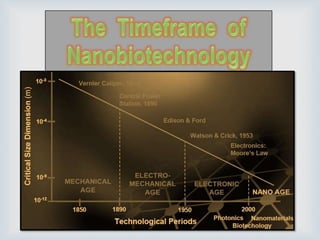
 TIMEFRAME OF NANOBIOTECH
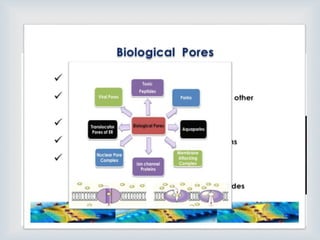
 BIOLOGICAL PORES
 NANOMEDICINE
 NANOPARTICLES AND MATERIALS
 NANO BENEFITS
 NANO SAFETY

Abstract
• NanoBiotechnology is a division of
nanotechnology which uses (nanoscale) biological
starting materials, and it keeps exciting opportunities
to bring high-impact advances in the field of
bioengineering and medicine.
• Hence it is the combination of two most progressive
fields: Nanotechnology and Biotechnology

Continued…
• Bionanotechnology offers the ability to provide insight
into the structural features of biological systems such as cell or
tissue as well as to develop nanobiomaterials/ medical units for
diagnostics, therapeutics and tissue regeneration.
• Ongoing work on bionanotechnology includes development of
Nanoprobes that can characterize the nanoscale structure
and function of cells.
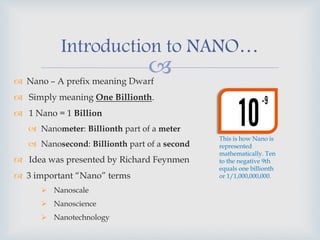
 Nano – A prefix meaning Dwarf
 Simply meaning One Billionth.
 1 Nano = 1 Billion
 Nanometer: Billionth part of a meter
 Nanosecond: Billionth part of a second
 Idea was presented by Richard Feynmen
 3 important “Nano” terms
 Nanoscale
 Nanoscience
 Nanotechnology
Introduction to NANO…
This is how Nano is
represented
mathematically. Ten
to the negative 9th
equals one billionth
or 1/1,000,000,000.
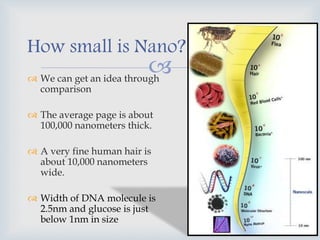
 We can get an idea through
comparison
 The average page is about
100,000 nanometers thick.
 A very fine human hair is
about 10,000 nanometers
wide.
 Width of DNA molecule is
2.5nm and glucose is just
below 1nm in size
How small is Nano?…

 So what should be the proper range of the
“Nanoscale”??
 1-100 nanometers, The Nanoscale.
 Anything below 100nm is part of the Nanoscale.
The Nanoscale
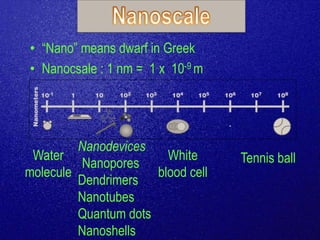
• “Nano” means dwarf in Greek
• Nanocsale : 1 nm = 1 x 10⁻⁹ m
Water
molecule
Nanodevices
Nanopores
Dendrimers
Nanotubes
Quantum dots
Nanoshells
White
blood cell
Tennis ball

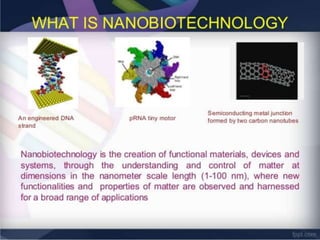
 Working with materials, devices, and other
structures with at least one dimension lying between
the Nanoscale range.
 It is the understanding and control of matter at
dimensions of roughly 1 to 100 nanometers.
Nanotechnology

Nanobiotechnology
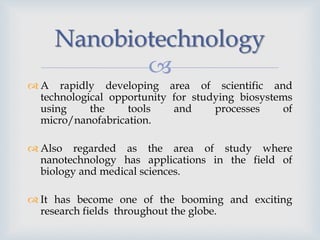
 A rapidly developing area of scientific and
technological opportunity for studying biosystems
using the tools and processes of
micro/nanofabrication.
 Also regarded as the area of study where
nanotechnology has applications in the field of
biology and medical sciences.
 It has become one of the booming and exciting
research fields throughout the globe.

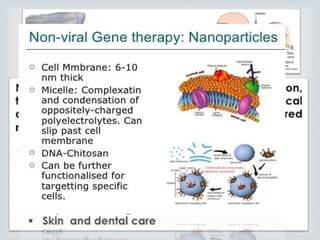
 Nanopore Technology:
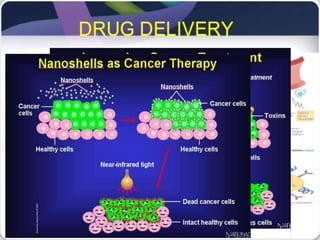
Applications of Nanobiotechnology
a)

Continued…


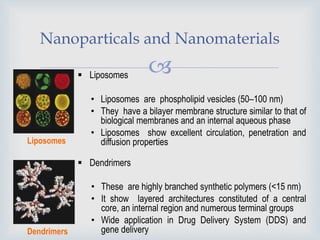
Nanoparticals and Nanomaterials
 Liposomes
• Liposomes are phospholipid vesicles (50–100 nm)
• They have a bilayer membrane structure similar to that of
biological membranes and an internal aqueous phase
• Liposomes show excellent circulation, penetration and
diffusion properties
 Dendrimers
• These are highly branched synthetic polymers (<15 nm)
• It show layered architectures constituted of a central
core, an internal region and numerous terminal groups
• Wide application in Drug Delivery System (DDS) and
gene delivery
Liposomes
Dendrimers
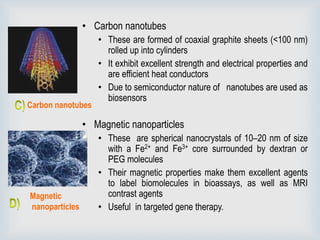
• Carbon nanotubes
• These are formed of coaxial graphite sheets (<100 nm)
rolled up into cylinders
• It exhibit excellent strength and electrical properties and
are efficient heat conductors
• Due to semiconductor nature of nanotubes are used as
biosensors
• Magnetic nanoparticles
• These are spherical nanocrystals of 10–20 nm of size
with a Fe2+ and Fe3+ core surrounded by dextran or
PEG molecules
• Their magnetic properties make them excellent agents
to label biomolecules in bioassays, as well as MRI
contrast agents
• Useful in targeted gene therapy.
Carbon nanotubes
Magnetic
nanoparticles
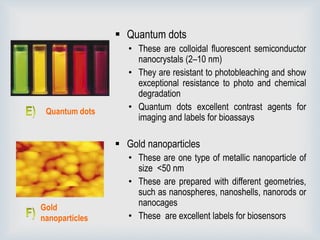
 Quantum dots
• These are colloidal fluorescent semiconductor
nanocrystals (2–10 nm)
• They are resistant to photobleaching and show
exceptional resistance to photo and chemical
degradation
• Quantum dots excellent contrast agents for
imaging and labels for bioassays
 Gold nanoparticles
• These are one type of metallic nanoparticle of
size <50 nm
• These are prepared with different geometries,
such as nanospheres, nanoshells, nanorods or
nanocages
• These are excellent labels for biosensors
Quantum dots
Gold
nanoparticles

Why Nano?

Is Nano SAFE?
BIONANOTECHNOLOGY
BIONANOTECHNOLOGY
BIONANOTECHNOLOGY
BIONANOTECHNOLOGY

BIONANOTECHNOLOGY

  • 2.
    By KHADIJAH ZAMAN Reg. #:1429-314001 BSBIOTECHNOLOGY BIOLOGY-II PRESENTEDTO: DR.NADEEM KHALID
  • 3.
     Contents  ABSTRACT  INTRODUCTION NANOSCALE  TIMEFRAME OF NANOBIOTECH  BIOLOGICAL PORES  NANOMEDICINE  NANOPARTICLES AND MATERIALS  NANO BENEFITS  NANO SAFETY
  • 4.
     Abstract • NanoBiotechnology isa division of nanotechnology which uses (nanoscale) biological starting materials, and it keeps exciting opportunities to bring high-impact advances in the field of bioengineering and medicine. • Hence it is the combination of two most progressive fields: Nanotechnology and Biotechnology
  • 5.
     Continued… • Bionanotechnology offersthe ability to provide insight into the structural features of biological systems such as cell or tissue as well as to develop nanobiomaterials/ medical units for diagnostics, therapeutics and tissue regeneration. • Ongoing work on bionanotechnology includes development of Nanoprobes that can characterize the nanoscale structure and function of cells.
  • 6.
     Nano –A prefix meaning Dwarf  Simply meaning One Billionth.  1 Nano = 1 Billion  Nanometer: Billionth part of a meter  Nanosecond: Billionth part of a second  Idea was presented by Richard Feynmen  3 important “Nano” terms  Nanoscale  Nanoscience  Nanotechnology Introduction to NANO… This is how Nano is represented mathematically. Ten to the negative 9th equals one billionth or 1/1,000,000,000.
  • 7.
     We canget an idea through comparison  The average page is about 100,000 nanometers thick.  A very fine human hair is about 10,000 nanometers wide.  Width of DNA molecule is 2.5nm and glucose is just below 1nm in size How small is Nano?…
  • 8.
      So whatshould be the proper range of the “Nanoscale”??  1-100 nanometers, The Nanoscale.  Anything below 100nm is part of the Nanoscale. The Nanoscale
  • 9.
    • “Nano” meansdwarf in Greek • Nanocsale : 1 nm = 1 x 10⁻⁹ m Water molecule Nanodevices Nanopores Dendrimers Nanotubes Quantum dots Nanoshells White blood cell Tennis ball
  • 10.
      Working withmaterials, devices, and other structures with at least one dimension lying between the Nanoscale range.  It is the understanding and control of matter at dimensions of roughly 1 to 100 nanometers. Nanotechnology
  • 12.
     Nanobiotechnology  A rapidlydeveloping area of scientific and technological opportunity for studying biosystems using the tools and processes of micro/nanofabrication.  Also regarded as the area of study where nanotechnology has applications in the field of biology and medical sciences.  It has become one of the booming and exciting research fields throughout the globe.
  • 14.
  • 15.
  • 16.
  • 17.
     Nanoparticals and Nanomaterials Liposomes • Liposomes are phospholipid vesicles (50–100 nm) • They have a bilayer membrane structure similar to that of biological membranes and an internal aqueous phase • Liposomes show excellent circulation, penetration and diffusion properties  Dendrimers • These are highly branched synthetic polymers (<15 nm) • It show layered architectures constituted of a central core, an internal region and numerous terminal groups • Wide application in Drug Delivery System (DDS) and gene delivery Liposomes Dendrimers
  • 18.
    • Carbon nanotubes •These are formed of coaxial graphite sheets (<100 nm) rolled up into cylinders • It exhibit excellent strength and electrical properties and are efficient heat conductors • Due to semiconductor nature of nanotubes are used as biosensors • Magnetic nanoparticles • These are spherical nanocrystals of 10–20 nm of size with a Fe2+ and Fe3+ core surrounded by dextran or PEG molecules • Their magnetic properties make them excellent agents to label biomolecules in bioassays, as well as MRI contrast agents • Useful in targeted gene therapy. Carbon nanotubes Magnetic nanoparticles
  • 19.
     Quantum dots •These are colloidal fluorescent semiconductor nanocrystals (2–10 nm) • They are resistant to photobleaching and show exceptional resistance to photo and chemical degradation • Quantum dots excellent contrast agents for imaging and labels for bioassays  Gold nanoparticles • These are one type of metallic nanoparticle of size <50 nm • These are prepared with different geometries, such as nanospheres, nanoshells, nanorods or nanocages • These are excellent labels for biosensors Quantum dots Gold nanoparticles
  • 20.
  • 23.