NanoTECHNOLOGY IN TEXTILES
INTRODUCTIONnanos (greek) means dwarf
technologies dealing with structures less than 100 nm
1 nm is a trillionth of 1 m (10-9m)
surface properties play a more important role compared to
the volume properties - therefore:
Richard Phillips Feynman “There is plenty of room at the
Bottom” is considered to be the “father” of nanotechnolgy
interdisciplinary interaction of sciences (physics, chemistry)
therefore nanotechnology is called a convergent technology
nano materials are already of significance todayNano Products Available in the Marketpigments (most important)
up-to-date computer chips (nano lithography)
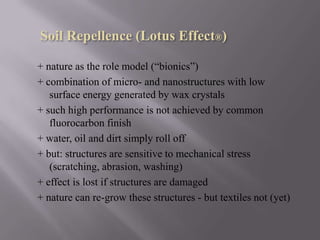
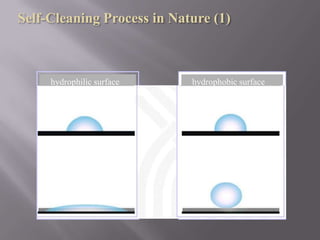
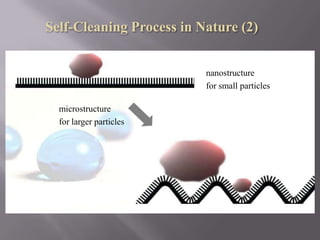
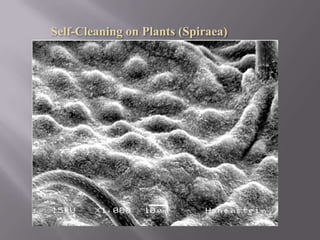
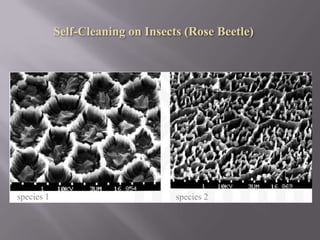
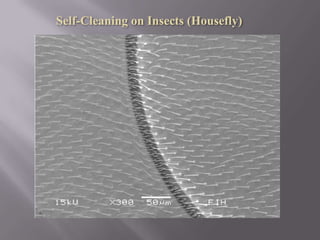
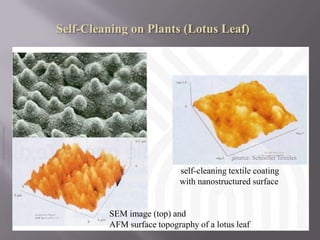
surface functionalisation with nano layers or composites“self-cleaning” surfaces (“lotus-leaf effect”)optically functional surfaces for antireflective coatings of displays (“moth-eye effect”)chemical nano-products already exist for a long time:like TiO2 or ZnOnanoparticles in sunscreenstextile research focuses on new functional properties:soil-repellence, UV-protection, abrasion resistance, drug delivery...
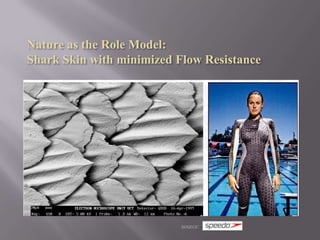
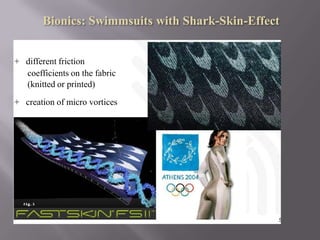
SOME APPLICATIONS OF NANOTECHNOLOGY IN TEXTILES1) Ag (antimicrobial activity)2) SiO2 (sol-gel, ceramic layers)3) TiO2 (UV-protection, photocatalysis)4) bionics: shark-skin effect, self-cleaning surfaces
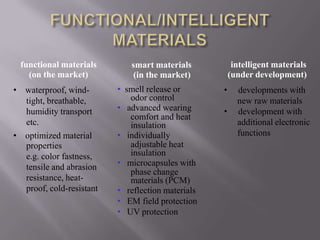
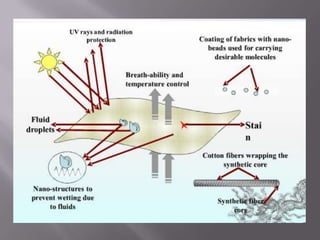
FUNCTIONAL/INTELLIGENT MATERIALSfunctional materials			(on the market)    waterproof, wind-		tight, breathable,		humidity transport		etc.    optimized material		properties		e.g. color fastness,		tensile and abrasion		resistance, heat-		proof, cold-resistantintelligent materials	(under development)     developments with			new raw materials    development with			additional electronic			functionssmart materials			(in the market)smell release or	odor controladvanced wearing	comfort and heat	insulationindividually	adjustable heat	insulationmicrocapsules with	phase change	materials (PCM)reflection materials
EM field protection
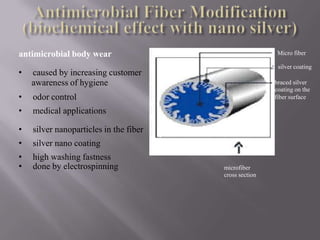
UV protectionAntimicrobial Fiber Modification(biochemical effect with nano silver)antimicrobial body wear     caused by increasing customer	awareness of hygiene     odor control
     medical applications
     silver nanoparticles in the fiber
     silver nano coating
     high washing fastness
    done by electrospinningMicro fiber	silver coatingbraced silvercoating on thefiber surfacemicrofibercross section
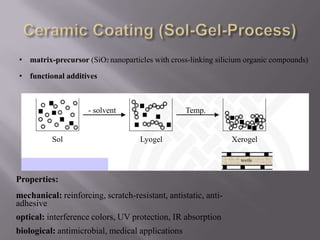
Ceramic Coating (Sol-Gel-Process)    matrix-precursor (SiO2 nanoparticles with cross-linking silicium organic compounds)
    functional additives- solventTemp.LyogelSolXerogeltextileProperties:mechanical: reinforcing, scratch-resistant, antistatic, anti-adhesiveoptical: interference colors, UV protection, IR absorptionbiological: antimicrobial, medical applications
How to improve the UPF of Textiles(ultraviolet protection factor)+ fabric design+ tighter weaving or knitting+ higher weight+ textile finishing+ organic dyes absorbing UV light+ optical brighteners (in detergents)+ dark coloration+ fiber modification+ TiO2, ZnOnano pigments for dulling of chemical fibers+ coating is essential to prevent photocatalytic reactions
Fiber Raw Materials and UV ProtectionPolyester (PET, PPT, PBT)+   terephthalic acid absorbs in the spectral UV range+   protection is increased by additional dulling (µ/n-TiO2)+   best protection possiblePolyamide (PA 6, PA 6,6) - nylon+   only „full dull“ types provide good protectionnatural fibers (cotton, wool, linen)) & regen. cellulose fibers (CV, CLY)+   little to no protection at all (especially when wet)+   full dull viscose (TiO2) was available a few years ago
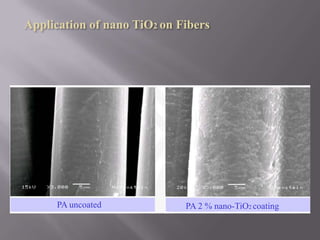
Application of nano TiO2 on FibersPA uncoatedPA 2 % nano-TiO2 coating
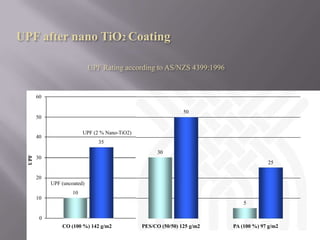
UPF after nano TiO2 CoatingUPF Rating according to AS/NZS 4399:199660					505040			35				3030							2520		1010						5	0UPF (2 % Nano-TiO2)UPFUPF (uncoated)CO (100 %) 142 g/m2PES/CO (50/50) 125 g/m2PA (100 %) 97 g/m2
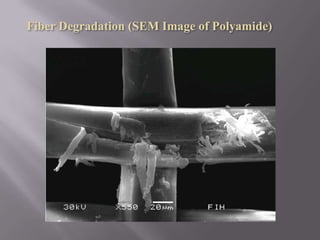
Photocatalytic Degradation of Matterwith TiO2 (Anatase Crystal-Modification)+ photocatalytic TiO2 nanoparticles in anatase crystalmodification in presence with UV-radiation, water andoxygen generate free radicals+ radicals destroy organic substances+ catalytic process, therefore large and free accessiblesurface area (e.g. nano) is required
PhotocatalysisWhen a semiconductor material is illuminated with ultra band gap light it becomes a powerful redox catalyst capable of killing bacteria, cleaning water, and even splitting water to give hydrogen and oxygen.
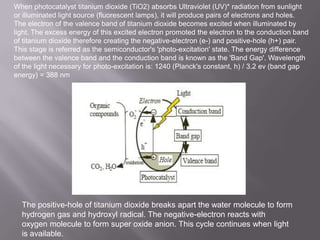
When photocatalyst titanium dioxide (TiO2) absorbs Ultraviolet (UV)* radiation from sunlight or illuminated light source (fluorescent lamps), it will produce pairs of electrons and holes. The electron of the valence band of titanium dioxide becomes excited when illuminated by light. The excess energy of this excited electron promoted the electron to the conduction band of titanium dioxide therefore creating the negative-electron (e-) and positive-hole (h+) pair. This stage is referred as the semiconductor's 'photo-excitation' state. The energy difference between the valence band and the conduction band is known as the 'Band Gap'. Wavelength of the light necessary for photo-excitation is: 1240 (Planck's constant, h) / 3.2 ev (band gap energy) = 388 nmThe positive-hole of titanium dioxide breaks apart the water molecule to form hydrogen gas and hydroxyl radical. The negative-electron reacts with oxygen molecule to form super oxide anion. This cycle continues when light is available.

Textiles 1

  • 1.
  • 2.
  • 3.
    technologies dealing withstructures less than 100 nm
  • 4.
    1 nm isa trillionth of 1 m (10-9m)
  • 5.
    surface properties playa more important role compared to
  • 6.
  • 7.
    Richard Phillips Feynman“There is plenty of room at the
  • 8.
    Bottom” is consideredto be the “father” of nanotechnolgy
  • 9.
    interdisciplinary interaction ofsciences (physics, chemistry)
  • 10.
    therefore nanotechnology iscalled a convergent technology
  • 11.
    nano materials arealready of significance todayNano Products Available in the Marketpigments (most important)
  • 12.
    up-to-date computer chips(nano lithography)
  • 13.
    surface functionalisation withnano layers or composites“self-cleaning” surfaces (“lotus-leaf effect”)optically functional surfaces for antireflective coatings of displays (“moth-eye effect”)chemical nano-products already exist for a long time:like TiO2 or ZnOnanoparticles in sunscreenstextile research focuses on new functional properties:soil-repellence, UV-protection, abrasion resistance, drug delivery...
  • 14.
    SOME APPLICATIONS OFNANOTECHNOLOGY IN TEXTILES1) Ag (antimicrobial activity)2) SiO2 (sol-gel, ceramic layers)3) TiO2 (UV-protection, photocatalysis)4) bionics: shark-skin effect, self-cleaning surfaces
  • 15.
    FUNCTIONAL/INTELLIGENT MATERIALSfunctional materials (onthe market) waterproof, wind- tight, breathable, humidity transport etc. optimized material properties e.g. color fastness, tensile and abrasion resistance, heat- proof, cold-resistantintelligent materials (under development) developments with new raw materials development with additional electronic functionssmart materials (in the market)smell release or odor controladvanced wearing comfort and heat insulationindividually adjustable heat insulationmicrocapsules with phase change materials (PCM)reflection materials
  • 16.
  • 17.
    UV protectionAntimicrobial FiberModification(biochemical effect with nano silver)antimicrobial body wear caused by increasing customer awareness of hygiene odor control
  • 18.
    medical applications
  • 19.
    silver nanoparticles in the fiber
  • 20.
    silver nano coating
  • 21.
    high washing fastness
  • 22.
    done by electrospinningMicro fiber silver coatingbraced silvercoating on thefiber surfacemicrofibercross section
  • 23.
    Ceramic Coating (Sol-Gel-Process) matrix-precursor (SiO2 nanoparticles with cross-linking silicium organic compounds)
  • 24.
    functional additives- solventTemp.LyogelSolXerogeltextileProperties:mechanical: reinforcing, scratch-resistant, antistatic, anti-adhesiveoptical: interference colors, UV protection, IR absorptionbiological: antimicrobial, medical applications
  • 25.
    How to improvethe UPF of Textiles(ultraviolet protection factor)+ fabric design+ tighter weaving or knitting+ higher weight+ textile finishing+ organic dyes absorbing UV light+ optical brighteners (in detergents)+ dark coloration+ fiber modification+ TiO2, ZnOnano pigments for dulling of chemical fibers+ coating is essential to prevent photocatalytic reactions
  • 26.
    Fiber Raw Materialsand UV ProtectionPolyester (PET, PPT, PBT)+ terephthalic acid absorbs in the spectral UV range+ protection is increased by additional dulling (µ/n-TiO2)+ best protection possiblePolyamide (PA 6, PA 6,6) - nylon+ only „full dull“ types provide good protectionnatural fibers (cotton, wool, linen)) & regen. cellulose fibers (CV, CLY)+ little to no protection at all (especially when wet)+ full dull viscose (TiO2) was available a few years ago
  • 27.
    Application of nanoTiO2 on FibersPA uncoatedPA 2 % nano-TiO2 coating
  • 28.
    UPF after nanoTiO2 CoatingUPF Rating according to AS/NZS 4399:199660 505040 35 3030 2520 1010 5 0UPF (2 % Nano-TiO2)UPFUPF (uncoated)CO (100 %) 142 g/m2PES/CO (50/50) 125 g/m2PA (100 %) 97 g/m2
  • 29.
    Photocatalytic Degradation ofMatterwith TiO2 (Anatase Crystal-Modification)+ photocatalytic TiO2 nanoparticles in anatase crystalmodification in presence with UV-radiation, water andoxygen generate free radicals+ radicals destroy organic substances+ catalytic process, therefore large and free accessiblesurface area (e.g. nano) is required
  • 30.
    PhotocatalysisWhen a semiconductormaterial is illuminated with ultra band gap light it becomes a powerful redox catalyst capable of killing bacteria, cleaning water, and even splitting water to give hydrogen and oxygen.
  • 31.
    When photocatalyst titaniumdioxide (TiO2) absorbs Ultraviolet (UV)* radiation from sunlight or illuminated light source (fluorescent lamps), it will produce pairs of electrons and holes. The electron of the valence band of titanium dioxide becomes excited when illuminated by light. The excess energy of this excited electron promoted the electron to the conduction band of titanium dioxide therefore creating the negative-electron (e-) and positive-hole (h+) pair. This stage is referred as the semiconductor's 'photo-excitation' state. The energy difference between the valence band and the conduction band is known as the 'Band Gap'. Wavelength of the light necessary for photo-excitation is: 1240 (Planck's constant, h) / 3.2 ev (band gap energy) = 388 nmThe positive-hole of titanium dioxide breaks apart the water molecule to form hydrogen gas and hydroxyl radical. The negative-electron reacts with oxygen molecule to form super oxide anion. This cycle continues when light is available.