NANOTECHNOLOGY
IN TEXTILES
RAGHUNATHAN.V
CHEZLIYAN.N.L
B.Sc. textiles
WHAT IS
NANOTECHNOLOGY
•the term nano in nanotechnology
comes from a Greek word “nanos” which
mean ‘dwarf’. (abnormally small)
•one nanometer is one billionth of a
meter or 10-9meters. one nanometer is
about 100000 times smaller than the
diameter of human hair.
•Nanotechnology is design
characterization production and
application structures ,devices and
systems by controlling shape and size at
the nano scale
Nanotechnology is defined as the study and
use of structures between 1 nanometer and
100 nanometers in size. To give you an idea
of how small that is, it would take eight
hundred 100 nanometer particles side by
side to match the width of a human hair.
WHAT IS
NANOTECHNOLOGY
WHY
NANOTECHNOLOGY
IN TEXTILE ?
It can define nanotechnology in textile as the
understanding, manipulation, and control of
matter at the nano level, such that the
physical, chemical, and biological properties of
the materials (individual atoms, molecules,
and bulk matter) can be engineered,
synthesized, and altered to develop the next
generation of improved materials, devices,
structures, and systems. It is used to develop
desired textile characteristics, such as high
tensile strength, unique surface structure, soft
hand, durability, water repellency, fire
retardancy, antimicrobial properties, etc
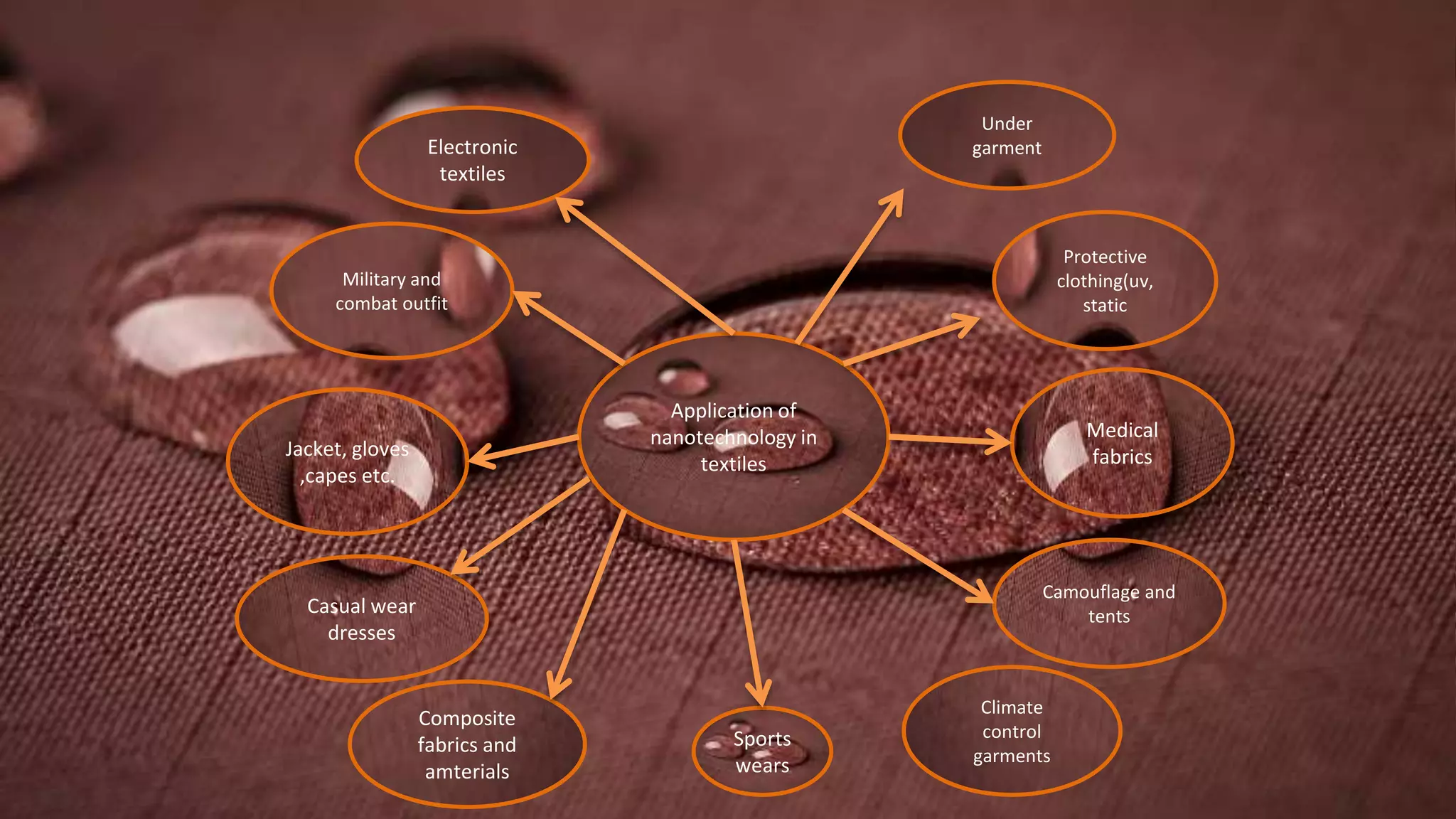
Climate
control
garments
Camouflage and
tents
Medical
fabrics
Protective
clothing(uv,
static
Under
garment
Application of
nanotechnology in
textiles
Composite
fabrics and
amterials
Casual wear
dresses
Jacket, gloves
,capes etc.
Military and
combat outfit
Electronic
textiles
Sports
wears
Types Of Nano Textiles
I. Nano finished textiles
II. Nano composite textiles
III. Nano fibrous textiles
IV. Nano enabled non woven
KEY NANOTECHNOLOGIES
• Nano particles
• Nano composites
• Nano capsules
• Nano fibers
• Carbon nanotubes
• Nano coatings
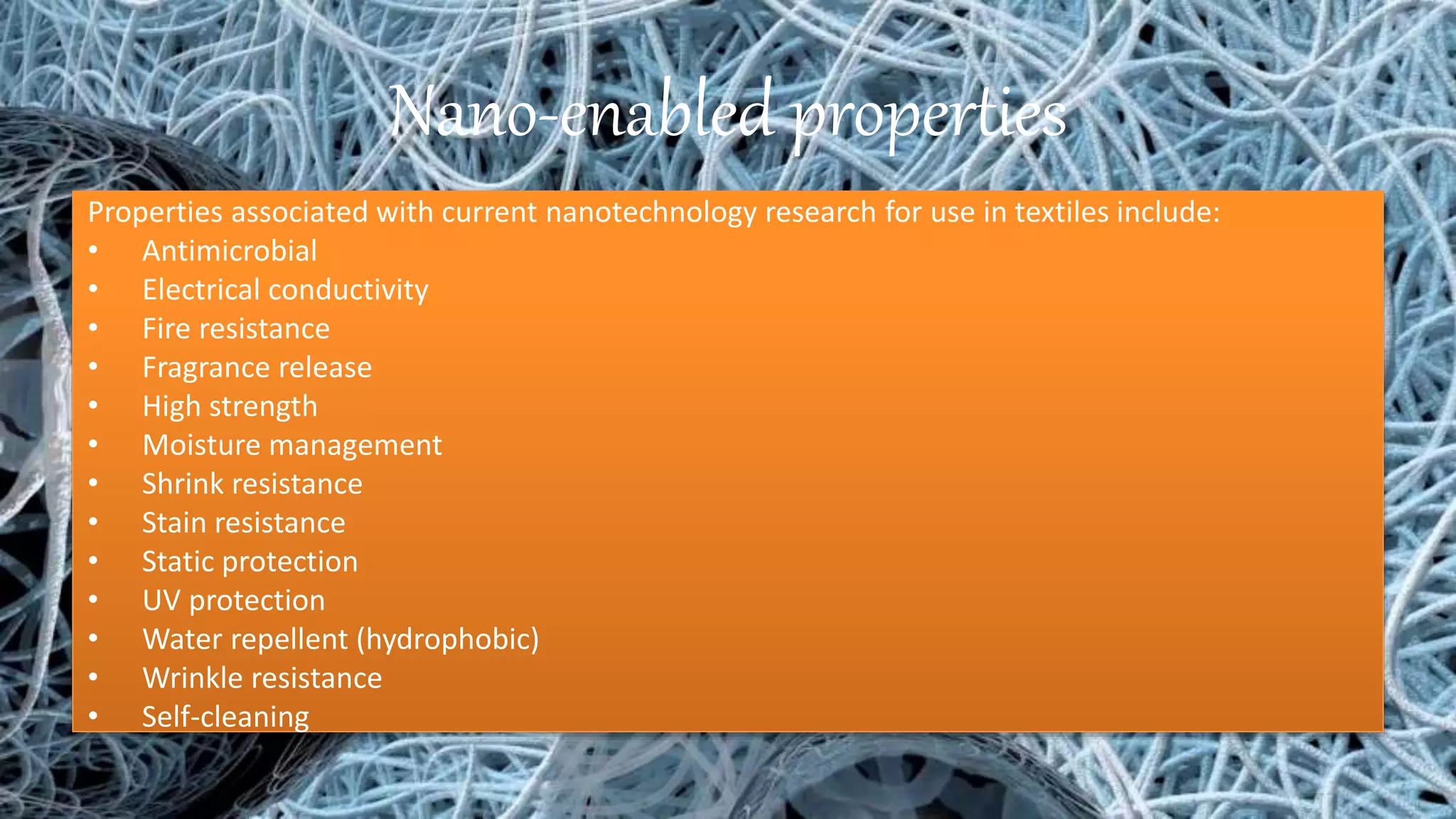
Nano-enabled properties
Properties associated with current nanotechnology research for use in textiles include:
• Antimicrobial
• Electrical conductivity
• Fire resistance
• Fragrance release
• High strength
• Moisture management
• Shrink resistance
• Stain resistance
• Static protection
• UV protection
• Water repellent (hydrophobic)
• Wrinkle resistance
• Self-cleaning
• A nano fiber is a continuous fiber which
has diameter in range of billionths of a
meter
• The smallest nano fibers made today are
between 1.5 and 1.75 nanometers
• Nano scale materials cam be rationally
designed to exhibit novel and significant
improved physical, chemical and
biological properties , because of their
size
WHAT IS A NANO
FIBERS
Whiskers
Net
warp
• Water repellent plant gives
us the idea to make water
repellent fabric. Complex
molecule called polymer is
coated over normal fabric
and heated until the
polymer bonded with the
fabric. This coating implants
Nano whiskers over the
fabric so liquid cannot touch
it.
• Nano whiskers can make the
fabrics stain and water
repellent
effect of Nano whiskers in fabric
Nets • Nano nets can alter the
property of synthetic fibers
like polyester to give fee l of
cotton and linen
• Wicks body moisture fast
• Dries quickly and give the
cooling effect
Warps
• increases strength and
durability
• Improve in colour fastness
• Static resistance
• Crease retention
Nano Finishes Nano finished textiles are those that a
paly a Nano scale property added after the
base textile has been fabricated. This
includes post-manufacture treatments and
coatings to apply nanomaterial's or create
nanostructured surfaces on fiber media.
Present Scenario In Textile Finishing Innovation
 Luke worm in spite of fast changing fashion cycle .
 Technical advancement and art of finishing technology is
quit old
 Fabric and garment finishing basically by covering the
texture of the fabric by resins
 Common problems like spills ,strains ,wear and tear
remains and salts.
 Lack of innovation to texturize the fabric on the molecular
level.
SOME USEFUL
NANOPARTICALS IN
TEXTILE
Clay nano particles
ZnO nano particles
TiO2 nano particls
MgO nano particles
Silver nano particles
Clay Nano Particles- Uv Protection
Clay nano particles (e.g. clay nano particles of
montmoriblonite) or nano flakes are used for the purpose.
These types of substances contain hydrogen aluminosilicates,
having difference in the chemical composition & crystal
structures. The clay nano particles have a property of locking
UV light. It also has electrical, chemical & heat resistance.
Hence the UV rays can be removed by the fabric having a finish
of clay nano particles.
The antimony pent oxide nano particles - Flame retardant
finishing
The antimony pent oxide nano particles along with Halogenated
flame-retardants are used for the flame retardant finishing. The
antimony has a characteristic of flame retardency. Hence the presence of
antimony particles along with halogenated flame retardant in the fabric
increases a flame retardant property of the fabric.
Tio₂ Nano Particals -Photo Catalytic Self-cleaning
The TiO₂ is a recognized catalytic compound. it shows it`s catalytic
property by the absorption of a photon and jumped to the
conduction band from the valance band. That is able to remove the
organic pollutants and xenobiotics from the textile materials. Hence
by treating the fabric or yarn by the particles, the fabric or yarn can
be brought into photo catalytic self cleaning property
Silver Nano Particles – Anti Microbial
It is an old concept that “silver” molecules have a power to resist
bacteria and microorganism. Hence the food, water, any other
substance have great weakness to bacteria or microorganism were
kept in the utensils of silver metal. This antibacterial property of
silver particles has been proved scientifically. This finishing
procedure is carried out by the encapsulation of the silver compounds
i.e. the nano particles of silver are encapsulated in the fiber reactive
polymer.
Thank you

Nano textiles

  • 1.
  • 2.
    WHAT IS NANOTECHNOLOGY •the termnano in nanotechnology comes from a Greek word “nanos” which mean ‘dwarf’. (abnormally small) •one nanometer is one billionth of a meter or 10-9meters. one nanometer is about 100000 times smaller than the diameter of human hair. •Nanotechnology is design characterization production and application structures ,devices and systems by controlling shape and size at the nano scale
  • 3.
    Nanotechnology is definedas the study and use of structures between 1 nanometer and 100 nanometers in size. To give you an idea of how small that is, it would take eight hundred 100 nanometer particles side by side to match the width of a human hair. WHAT IS NANOTECHNOLOGY
  • 4.
    WHY NANOTECHNOLOGY IN TEXTILE ? Itcan define nanotechnology in textile as the understanding, manipulation, and control of matter at the nano level, such that the physical, chemical, and biological properties of the materials (individual atoms, molecules, and bulk matter) can be engineered, synthesized, and altered to develop the next generation of improved materials, devices, structures, and systems. It is used to develop desired textile characteristics, such as high tensile strength, unique surface structure, soft hand, durability, water repellency, fire retardancy, antimicrobial properties, etc
  • 5.
    Climate control garments Camouflage and tents Medical fabrics Protective clothing(uv, static Under garment Application of nanotechnologyin textiles Composite fabrics and amterials Casual wear dresses Jacket, gloves ,capes etc. Military and combat outfit Electronic textiles Sports wears
  • 6.
    Types Of NanoTextiles I. Nano finished textiles II. Nano composite textiles III. Nano fibrous textiles IV. Nano enabled non woven
  • 7.
    KEY NANOTECHNOLOGIES • Nanoparticles • Nano composites • Nano capsules • Nano fibers • Carbon nanotubes • Nano coatings
  • 8.
    Nano-enabled properties Properties associatedwith current nanotechnology research for use in textiles include: • Antimicrobial • Electrical conductivity • Fire resistance • Fragrance release • High strength • Moisture management • Shrink resistance • Stain resistance • Static protection • UV protection • Water repellent (hydrophobic) • Wrinkle resistance • Self-cleaning
  • 9.
    • A nanofiber is a continuous fiber which has diameter in range of billionths of a meter • The smallest nano fibers made today are between 1.5 and 1.75 nanometers • Nano scale materials cam be rationally designed to exhibit novel and significant improved physical, chemical and biological properties , because of their size WHAT IS A NANO FIBERS
  • 10.
  • 11.
    • Water repellentplant gives us the idea to make water repellent fabric. Complex molecule called polymer is coated over normal fabric and heated until the polymer bonded with the fabric. This coating implants Nano whiskers over the fabric so liquid cannot touch it. • Nano whiskers can make the fabrics stain and water repellent
  • 12.
    effect of Nanowhiskers in fabric
  • 13.
    Nets • Nanonets can alter the property of synthetic fibers like polyester to give fee l of cotton and linen • Wicks body moisture fast • Dries quickly and give the cooling effect
  • 14.
    Warps • increases strengthand durability • Improve in colour fastness • Static resistance • Crease retention
  • 15.
    Nano Finishes Nanofinished textiles are those that a paly a Nano scale property added after the base textile has been fabricated. This includes post-manufacture treatments and coatings to apply nanomaterial's or create nanostructured surfaces on fiber media.
  • 16.
    Present Scenario InTextile Finishing Innovation  Luke worm in spite of fast changing fashion cycle .  Technical advancement and art of finishing technology is quit old  Fabric and garment finishing basically by covering the texture of the fabric by resins  Common problems like spills ,strains ,wear and tear remains and salts.  Lack of innovation to texturize the fabric on the molecular level.
  • 17.
    SOME USEFUL NANOPARTICALS IN TEXTILE Claynano particles ZnO nano particles TiO2 nano particls MgO nano particles Silver nano particles
  • 18.
    Clay Nano Particles-Uv Protection Clay nano particles (e.g. clay nano particles of montmoriblonite) or nano flakes are used for the purpose. These types of substances contain hydrogen aluminosilicates, having difference in the chemical composition & crystal structures. The clay nano particles have a property of locking UV light. It also has electrical, chemical & heat resistance. Hence the UV rays can be removed by the fabric having a finish of clay nano particles.
  • 19.
    The antimony pentoxide nano particles - Flame retardant finishing The antimony pent oxide nano particles along with Halogenated flame-retardants are used for the flame retardant finishing. The antimony has a characteristic of flame retardency. Hence the presence of antimony particles along with halogenated flame retardant in the fabric increases a flame retardant property of the fabric.
  • 20.
    Tio₂ Nano Particals-Photo Catalytic Self-cleaning The TiO₂ is a recognized catalytic compound. it shows it`s catalytic property by the absorption of a photon and jumped to the conduction band from the valance band. That is able to remove the organic pollutants and xenobiotics from the textile materials. Hence by treating the fabric or yarn by the particles, the fabric or yarn can be brought into photo catalytic self cleaning property
  • 21.
    Silver Nano Particles– Anti Microbial It is an old concept that “silver” molecules have a power to resist bacteria and microorganism. Hence the food, water, any other substance have great weakness to bacteria or microorganism were kept in the utensils of silver metal. This antibacterial property of silver particles has been proved scientifically. This finishing procedure is carried out by the encapsulation of the silver compounds i.e. the nano particles of silver are encapsulated in the fiber reactive polymer.
  • 22.