Zhejiang Sci-Tec University
Department of Textile Science & Engineering
Course Name: Principle of Dyeing & Finishing New Technique.
course Code: MT 11036
Assignment On: Nano-Technology Related to Textile.
Submitted To:
Professor Ji Ping Wang
Submitted By:
Muzammel Hossen Ananda
Id: L20172030208
Submission Date:
05-December-2017
Introduction:
Textile manufacturers have begun to use nanomaterials in their products. The unique
properties of nanoparticles and Nano fibers mean that they can be used to design fabrics with
excellent mechanical strength, chemical resistance, water repellence, antibacterial properties,
and a wealth of other properties which are unattainable by any other means.
There is still a lot of research still to be done in this area, however. The different techniques
needed to produce Nano-enhanced textiles do not always fit well with existing manufacturing
processes, leading to increased development costs. This can also affect issues like quality
control, and homogeneity of nanoparticle dispersion through the fabric.
There are also issues around the implications of nanoparticle exposure, for human health and
for the environment. A great deal of recent research has focused on this issue, but we are still
some way away from a full understanding of the toxicological effects of the various kinds of
nanoparticles which are already appearing in consumer products.
What is Nano Technology (NT)?
Nanotechnology is a growing interdisciplinary technology often seen as a new industrial
revolution. Nanotechnology (NT) deals with materials 1 to 100 nm in length. The
fundamentals of nanotechnology lie in the fact that the properties of materials drastically
change when their dimensions are reduced to nanometer scale. Nowadays also the textile
industry has discovered the possibilities of nanotechnology. So, we can define
nanotechnology in textile as the understanding, manipulation, and control of matter at the
above-stated length, such that the physical, chemical, and biological properties of the
materials (individual atoms, molecules, and bulk matter) can be engineered, synthesized, and
altered to develop the next generation of improved materials, devices, structures, and
systems. It is used to develop desired textile characteristics, such as high tensile strength,
unique surface structure, soft hand, durability, water repellency, fire retardancy,
antimicrobial properties, and the like.
Why Nano Technology (NT)?
After more than 20 years of basic nanoscience research and more than fifteen years of
focused R&D under the NNI, applications of nanotechnology are delivering in both expected
and unexpected ways on nanotechnology’s promise to benefit society.
Nano technology is helping to considerably improve, even revolutionize, many technology
and industry sectors: information technology, homeland security, medicine, transportation,
energy, food safety, and environmental science, and among many others.
How Nano Technology (NT) Works?
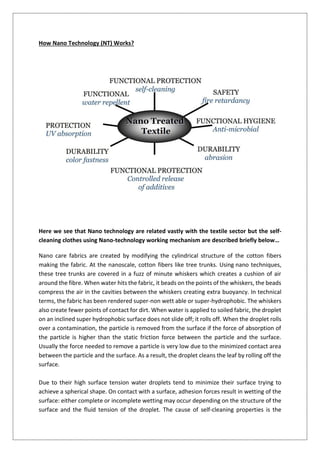
Here we see that Nano technology are related vastly with the textile sector but the self-
cleaning clothes using Nano-technology working mechanism are described briefly below…
Nano care fabrics are created by modifying the cylindrical structure of the cotton fibers
making the fabric. At the nanoscale, cotton fibers like tree trunks. Using nano techniques,
these tree trunks are covered in a fuzz of minute whiskers which creates a cushion of air
around the fibre. When water hits the fabric, it beads on the points of the whiskers, the beads
compress the air in the cavities between the whiskers creating extra buoyancy. In technical
terms, the fabric has been rendered super-non wett able or super-hydrophobic. The whiskers
also create fewer points of contact for dirt. When water is applied to soiled fabric, the droplet
on an inclined super hydrophobic surface does not slide off; it rolls off. When the droplet rolls
over a contamination, the particle is removed from the surface if the force of absorption of
the particle is higher than the static friction force between the particle and the surface.
Usually the force needed to remove a particle is very low due to the minimized contact area
between the particle and the surface. As a result, the droplet cleans the leaf by rolling off the
surface.
Due to their high surface tension water droplets tend to minimize their surface trying to
achieve a spherical shape. On contact with a surface, adhesion forces result in wetting of the
surface: either complete or incomplete wetting may occur depending on the structure of the
surface and the fluid tension of the droplet. The cause of self-cleaning properties is the
hydrophobic water- repellent double structure of the surface. This enables the contact area
and the adhesion force between surface and droplet to be significantly reduced resulting in a
self-cleaning process.
Bacteria killing:
2-anthraquinone carboxylic acid (2-AQC) used into fabrics. The chemical bonds become very
sturdily to the cellulose in the cotton, which makes it very hard to wash off. When it’s
exposed to light, the 2-AQC produces “reactive oxygen species” like hydrogen peroxide that
kills bacteria and can also break down other toxic chemicals like pesticides.
Key Features of self-cleaning cloths:
1. Superior Stain, Water and Oil Repellency
2. Resists Wrinkles
3. Breathable Fabric & Easy Care
Application of Technology:
Application of Nanotechnology we can explain in three ways:
i. Application in department wise
ii. Application in properties of textile material-
iii. Application in apparel industry
Nanotechnology in manufacturing composite fibers include the following topics,
1. Carbon nano fibers and carbon nano particles
2. Clay Nano particles
3. Metal Oxide Nano particles
4. Carbon nano tubes
5. Nano cellular foam structures
Nanotechnology in textile finishing includes,
1. Upgrade of chemical finishes and resultant functions
2. Nano particles in finishing
3. Self-assembled nano layer
Swimming Suit:
The suit, which includes a plasma layer enhanced by nanotechnology to repel water molecules,
is designed to help the swimmer glide through the water and has become a common feature
of major swimming events as all competitors attempt to enhance their chances of winning
Sporting Goods:
Running shoes, tennis racquets, golf balls, skin creams, and a range other sporting goods have
also been enhanced by nanotechnology. A garment that senses their surroundings and
interacts with the wearer is an area of considerable interest. Such textile-based nano sensors
could provide a personalized healthcare system, monitoring your vital signs as you run up a
hill or responding to changes in the weather.
Flexible Electronic Circuits:
Nano ribbons form the basis for the chips which are so flexible they can wrap around the edge
of a microscope cover slip and so stretchable they can be twisted into a corkscrew.
Lifestyle Applications:
Textile and cosmetics are among the first products to use nano materials. The examples of
nanotechnology materials and technologies in lifestyle application are bullet proof vests.
Nanotube fibers are used to make a material seventeen times tougher than the Kevlar
Water Repellence:
Nano-Tex improves the water-repellent property of fabric by creating nano-whiskers, which
are hydrocarbons and 1/1000 of the size of a typical cotton fiber, that are added to the fabric
to create a peach fuzz effect without lowering the strength of cotton. The spaces between
the whiskers on the fabric are smaller than the typical drop of water, but still larger than water
molecules; water thus remains on the top of the whiskers and above the surface of the fabric
UV Protective Finish:
The most important functions performed by the garment are to protect the wearer from the
weather. However, it is also to protect the wearer from harmful rays of the sun. The rays in
the wavelength region of 150 to 400 nm are known as ultraviolet radiations. The UV-blocking
property of a fabric is enhanced when a dye, pigment, delustrant, or ultraviolet absorber
finish is present that absorbs ultraviolet radiation and blocks its transmission through a fabric
to the skin.
Self-cleaning Fabrics:
A self-cleaning cotton fabric known as nano-care was developed and is marketed by an
American Company, Nano-tex and stain-resistant jeans and khakis are available since 1990.
Nano care fabrics are created by modifying the cylindrical structure of the cotton fibres
making up the fabric.
Anti-static Finishes:
Static charge usually builds up in synthetic fibers such as nylon and polyester because they
absorb little water. Cellulosic fibers have higher moisture content to carry away static charges,
so that no static charge will accumulate. As synthetic fibers provide poor anti-static properties,
research work concerning the improvement of the anti-static properties of textiles by using
nanotechnology were conducted.
Nano Technology for Wrinkle Free Treatment:
Nano-Tex has launched a new nanotechnology-based wrinkle-free treatment that is said to
offer an improved performance while preserving fabric strength and integrity providing an
alternative to harsh traditional processes. Chemicals and processing methods reduce a fabrics
tear and tensile strength
Anti-bacterial Finishes:
For imparting anti-bacterial properties, Nano-sized silver, titanium dioxide and zinc oxide are
used. Metallic ions and metallic compounds display a certain degree of sterilizing effect.
Economic and Environmental Aspects:
The unique properties of non-materials have attracted not only scientists and research
workers but also businesses, because of their huge economic potential. The national science
foundation reports that Nano-related goods and services will increase to a US$ 1 trillion
market by 2015.
References:
1. https://www.nano.gov/you/nanotechnology-benefits
2. https://www.azonano.com/article.aspx?ArticleID=3058
3. http://www.fibre2fashion.com/industry-article/7135/application-of-
nanotechnology-in-textile-industry?page=6
4. http://textilelearner.blogspot.com/2013/08/self-cleaning-cloths-based-on-
nano_19.html
5. http://www.nanoandme.org/nano-products/

Nano technology related to textile

  • 1.
    Zhejiang Sci-Tec University Departmentof Textile Science & Engineering Course Name: Principle of Dyeing & Finishing New Technique. course Code: MT 11036 Assignment On: Nano-Technology Related to Textile. Submitted To: Professor Ji Ping Wang Submitted By: Muzammel Hossen Ananda Id: L20172030208 Submission Date: 05-December-2017
  • 2.
    Introduction: Textile manufacturers havebegun to use nanomaterials in their products. The unique properties of nanoparticles and Nano fibers mean that they can be used to design fabrics with excellent mechanical strength, chemical resistance, water repellence, antibacterial properties, and a wealth of other properties which are unattainable by any other means. There is still a lot of research still to be done in this area, however. The different techniques needed to produce Nano-enhanced textiles do not always fit well with existing manufacturing processes, leading to increased development costs. This can also affect issues like quality control, and homogeneity of nanoparticle dispersion through the fabric. There are also issues around the implications of nanoparticle exposure, for human health and for the environment. A great deal of recent research has focused on this issue, but we are still some way away from a full understanding of the toxicological effects of the various kinds of nanoparticles which are already appearing in consumer products. What is Nano Technology (NT)? Nanotechnology is a growing interdisciplinary technology often seen as a new industrial revolution. Nanotechnology (NT) deals with materials 1 to 100 nm in length. The fundamentals of nanotechnology lie in the fact that the properties of materials drastically change when their dimensions are reduced to nanometer scale. Nowadays also the textile industry has discovered the possibilities of nanotechnology. So, we can define nanotechnology in textile as the understanding, manipulation, and control of matter at the above-stated length, such that the physical, chemical, and biological properties of the materials (individual atoms, molecules, and bulk matter) can be engineered, synthesized, and altered to develop the next generation of improved materials, devices, structures, and systems. It is used to develop desired textile characteristics, such as high tensile strength, unique surface structure, soft hand, durability, water repellency, fire retardancy, antimicrobial properties, and the like. Why Nano Technology (NT)? After more than 20 years of basic nanoscience research and more than fifteen years of focused R&D under the NNI, applications of nanotechnology are delivering in both expected and unexpected ways on nanotechnology’s promise to benefit society. Nano technology is helping to considerably improve, even revolutionize, many technology and industry sectors: information technology, homeland security, medicine, transportation, energy, food safety, and environmental science, and among many others.
  • 3.
    How Nano Technology(NT) Works? Here we see that Nano technology are related vastly with the textile sector but the self- cleaning clothes using Nano-technology working mechanism are described briefly below… Nano care fabrics are created by modifying the cylindrical structure of the cotton fibers making the fabric. At the nanoscale, cotton fibers like tree trunks. Using nano techniques, these tree trunks are covered in a fuzz of minute whiskers which creates a cushion of air around the fibre. When water hits the fabric, it beads on the points of the whiskers, the beads compress the air in the cavities between the whiskers creating extra buoyancy. In technical terms, the fabric has been rendered super-non wett able or super-hydrophobic. The whiskers also create fewer points of contact for dirt. When water is applied to soiled fabric, the droplet on an inclined super hydrophobic surface does not slide off; it rolls off. When the droplet rolls over a contamination, the particle is removed from the surface if the force of absorption of the particle is higher than the static friction force between the particle and the surface. Usually the force needed to remove a particle is very low due to the minimized contact area between the particle and the surface. As a result, the droplet cleans the leaf by rolling off the surface. Due to their high surface tension water droplets tend to minimize their surface trying to achieve a spherical shape. On contact with a surface, adhesion forces result in wetting of the surface: either complete or incomplete wetting may occur depending on the structure of the surface and the fluid tension of the droplet. The cause of self-cleaning properties is the
  • 4.
    hydrophobic water- repellentdouble structure of the surface. This enables the contact area and the adhesion force between surface and droplet to be significantly reduced resulting in a self-cleaning process. Bacteria killing: 2-anthraquinone carboxylic acid (2-AQC) used into fabrics. The chemical bonds become very sturdily to the cellulose in the cotton, which makes it very hard to wash off. When it’s exposed to light, the 2-AQC produces “reactive oxygen species” like hydrogen peroxide that kills bacteria and can also break down other toxic chemicals like pesticides. Key Features of self-cleaning cloths: 1. Superior Stain, Water and Oil Repellency 2. Resists Wrinkles 3. Breathable Fabric & Easy Care Application of Technology: Application of Nanotechnology we can explain in three ways: i. Application in department wise ii. Application in properties of textile material- iii. Application in apparel industry Nanotechnology in manufacturing composite fibers include the following topics, 1. Carbon nano fibers and carbon nano particles 2. Clay Nano particles 3. Metal Oxide Nano particles 4. Carbon nano tubes 5. Nano cellular foam structures Nanotechnology in textile finishing includes, 1. Upgrade of chemical finishes and resultant functions 2. Nano particles in finishing 3. Self-assembled nano layer
  • 5.
    Swimming Suit: The suit,which includes a plasma layer enhanced by nanotechnology to repel water molecules, is designed to help the swimmer glide through the water and has become a common feature of major swimming events as all competitors attempt to enhance their chances of winning Sporting Goods: Running shoes, tennis racquets, golf balls, skin creams, and a range other sporting goods have also been enhanced by nanotechnology. A garment that senses their surroundings and interacts with the wearer is an area of considerable interest. Such textile-based nano sensors could provide a personalized healthcare system, monitoring your vital signs as you run up a hill or responding to changes in the weather. Flexible Electronic Circuits: Nano ribbons form the basis for the chips which are so flexible they can wrap around the edge of a microscope cover slip and so stretchable they can be twisted into a corkscrew. Lifestyle Applications: Textile and cosmetics are among the first products to use nano materials. The examples of nanotechnology materials and technologies in lifestyle application are bullet proof vests. Nanotube fibers are used to make a material seventeen times tougher than the Kevlar Water Repellence: Nano-Tex improves the water-repellent property of fabric by creating nano-whiskers, which are hydrocarbons and 1/1000 of the size of a typical cotton fiber, that are added to the fabric to create a peach fuzz effect without lowering the strength of cotton. The spaces between the whiskers on the fabric are smaller than the typical drop of water, but still larger than water molecules; water thus remains on the top of the whiskers and above the surface of the fabric UV Protective Finish: The most important functions performed by the garment are to protect the wearer from the weather. However, it is also to protect the wearer from harmful rays of the sun. The rays in the wavelength region of 150 to 400 nm are known as ultraviolet radiations. The UV-blocking property of a fabric is enhanced when a dye, pigment, delustrant, or ultraviolet absorber finish is present that absorbs ultraviolet radiation and blocks its transmission through a fabric to the skin.
  • 6.
    Self-cleaning Fabrics: A self-cleaningcotton fabric known as nano-care was developed and is marketed by an American Company, Nano-tex and stain-resistant jeans and khakis are available since 1990. Nano care fabrics are created by modifying the cylindrical structure of the cotton fibres making up the fabric. Anti-static Finishes: Static charge usually builds up in synthetic fibers such as nylon and polyester because they absorb little water. Cellulosic fibers have higher moisture content to carry away static charges, so that no static charge will accumulate. As synthetic fibers provide poor anti-static properties, research work concerning the improvement of the anti-static properties of textiles by using nanotechnology were conducted. Nano Technology for Wrinkle Free Treatment: Nano-Tex has launched a new nanotechnology-based wrinkle-free treatment that is said to offer an improved performance while preserving fabric strength and integrity providing an alternative to harsh traditional processes. Chemicals and processing methods reduce a fabrics tear and tensile strength Anti-bacterial Finishes: For imparting anti-bacterial properties, Nano-sized silver, titanium dioxide and zinc oxide are used. Metallic ions and metallic compounds display a certain degree of sterilizing effect. Economic and Environmental Aspects: The unique properties of non-materials have attracted not only scientists and research workers but also businesses, because of their huge economic potential. The national science foundation reports that Nano-related goods and services will increase to a US$ 1 trillion market by 2015. References: 1. https://www.nano.gov/you/nanotechnology-benefits 2. https://www.azonano.com/article.aspx?ArticleID=3058 3. http://www.fibre2fashion.com/industry-article/7135/application-of- nanotechnology-in-textile-industry?page=6 4. http://textilelearner.blogspot.com/2013/08/self-cleaning-cloths-based-on- nano_19.html 5. http://www.nanoandme.org/nano-products/