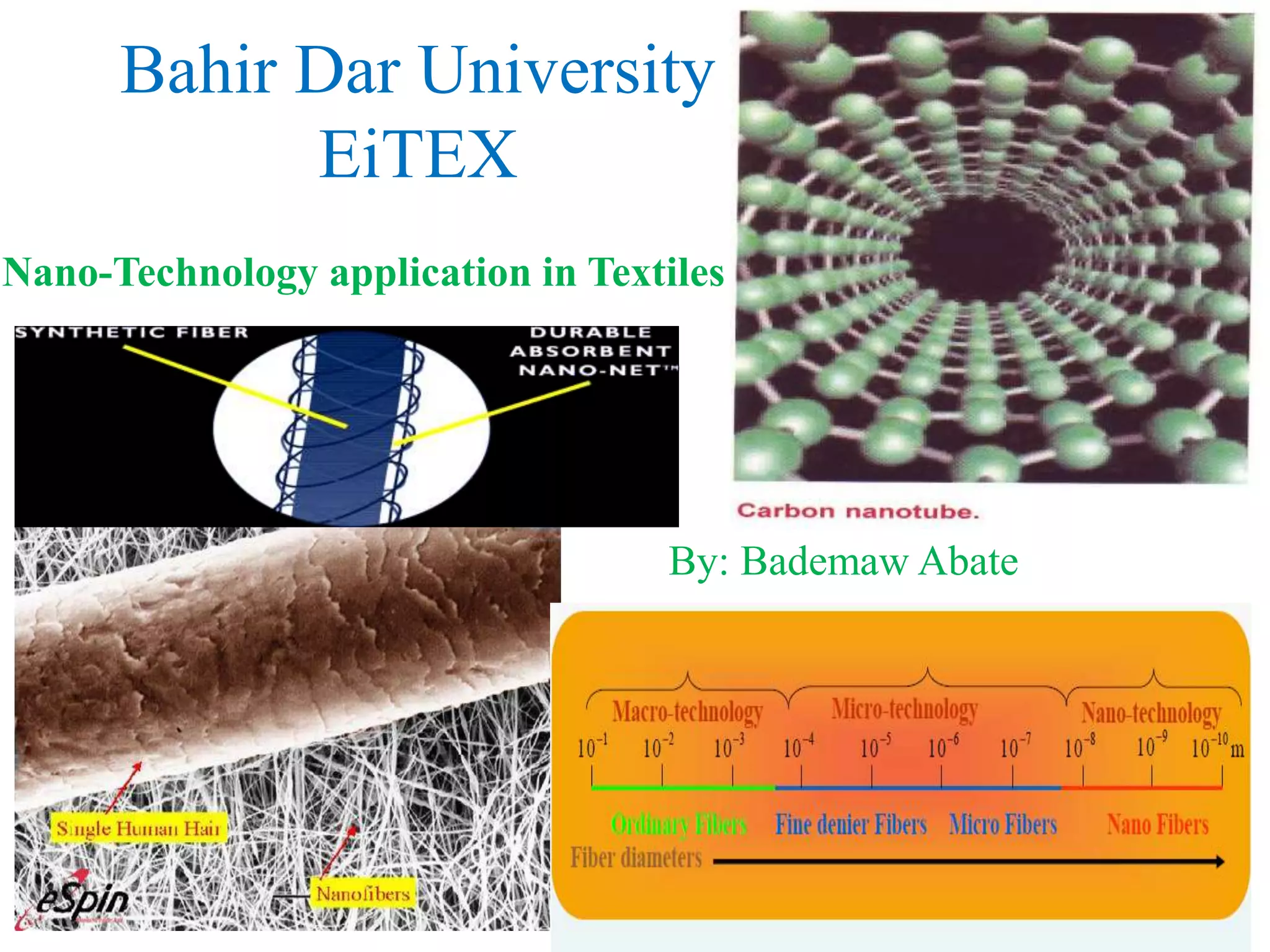
Bahir Dar University
EiTEX
Nano-Technology application in Textiles
By: Bademaw Abate
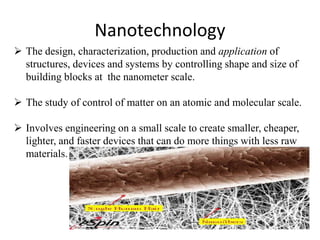
Nanotechnology
 The design, characterization, production and application of
structures, devices and systems by controlling shape and size of
building blocks at the nanometer scale.
 The study of control of matter on an atomic and molecular scale.
 Involves engineering on a small scale to create smaller, cheaper,
lighter, and faster devices that can do more things with less raw
materials.
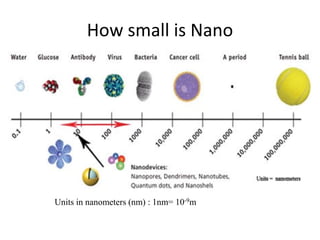
How small is Nano
Units in nanometers (nm) : 1nm= 10-9m
3 types of nanotechnology in textiles can be
distinguished:
Nanotechnology in fibres and yarns (fabrics)
Nanotechnology in coatings (textile finishing)
 E-textiles
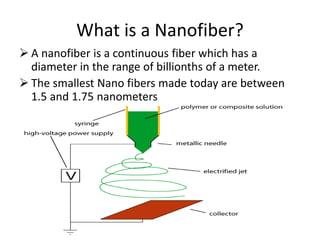
What is a Nanofiber?
 A nanofiber is a continuous fiber which has a
diameter in the range of billionths of a meter.
 The smallest Nano fibers made today are between
1.5 and 1.75 nanometers
Cont..
Nanoscale materials can be rationally designed to
exhibit novel and significantly improved physical,
chemical and biological properties, because of their
size.
Nonwoven fabrics composed of electro spun
nanofibres have :
a large specific surface area,
a high porosity
 a small pore size in comparison with commercial
textiles making them excellent candidates for use in
filtration, medical and membrane applications.
Nano particle
Properties
Dramatic change in properties of a substance when
particle size reduced to nanometer range
Normal ceramic particle Brittle
Nano ceramic particle Deformable, flexible
Normal Gold Yellow
Nano gold Red
Nanotechnology has real commercial potential for the
textile industry. Why?
 conventional methods used to impart different properties to
fabrics
 will lose their functions after several laundering or wearing.
 Reduce breathability
 Comfort
 Nanotechnology can provide high durability for fabrics
because:
 nano-particles have a large surface area-to-volume ratio
 high surface energy.
 Coating of nano-particles on fabrics will not affect their
breathability or hand feel.
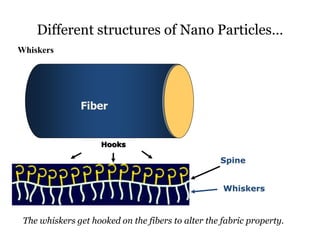
Different structures of Nano Particles…
Whiskers
Fiber
Spine
Hooks
Whiskers
Fiber
The whiskers get hooked on the fibers to alter the fabric property.
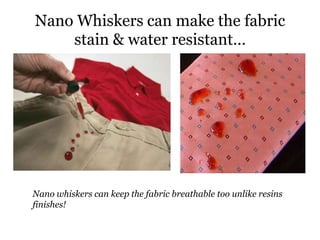
Nano Whiskers can make the fabric
stain & water resistant…
Nano whiskers can keep the fabric breathable too unlike resins
finishes!
Value addition due to Nano Whiskers…
Water and oil repellency
 Superior durability
 Breathable
 Fabric remains soft, natural
 Wrinkle resistance
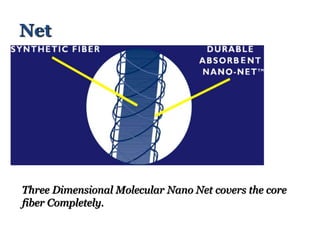
Net
Three Dimensional Molecular Nano Net covers the core
fiber Completely.
Value addition due to Nano Net…
• Alters the property of synthetic fibers like
Polyester to give a feel of cotton & linen.
• Wicks body moisture fast
• Dries quickly & gives the cooling effect.
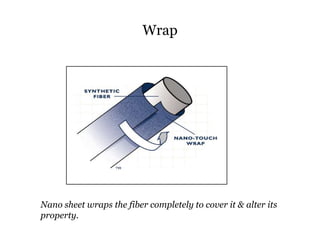
Wrap
Nano sheet wraps the fiber completely to cover it & alter its
property.
Nano wraps can enhance the fabric Wash
fastness…
Normal fabric trouser with out nano
wrap on the fibers after 50 washes!
Trouser made up fabric with nano
wrap fibers after 50 washes!
Value addition due to Nano Wrap
 Strength and Durability
 Improvement in colorfastness
 Crease Retention
 Static Resistance
Some Magic Nano Particles…
 Clay Nano Particles
 ZnO Nano Particles
 TiO2 Nano Particles
 MgO Nano Particles
 Silver Nano Particles
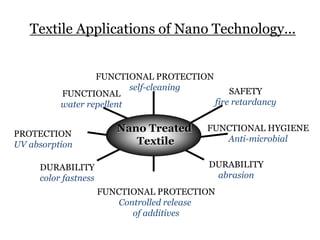
Textile Applications of Nano Technology...
FUNCTIONAL
water repellent
PROTECTION
UV absorption
DURABILITY
color fastness
DURABILITY
abrasion
SAFETY
fire retardancy
FUNCTIONAL HYGIENE
Anti-microbial
FUNCTIONAL PROTECTION
Controlled release
of additives
Nano Treated
Textile
FUNCTIONAL PROTECTION
self-cleaning
Integration of nanoparticles in textiles
Nanoparticles can be introduced in the textile
production process at two levels :
 during the melt extrusion of yarns
nanoparticles based on clay, metal oxides or carbon nanotubes (CNTs) can be
mixed in the polymer before the extrusion step.
This allows new functionalities to be incorporated
 during the coating.
Application
 The fabric is padded and dried.
 During drying water evaporates.
 During subsequent curing operation the polymers
melt and spread giving uniform coating of fibres
due to nano size of the finishing agent.
Antibacterial and Deodorant finishes
based on nanotechnology
'Ag fresh'
 Typical example: when human body perspire the
clothing in contact with skin such as socks, shirts etc
smell due to growth of bacteria.
 This drawback is eliminated by Ag fresh finish
 incorporate silver particles in a size of around 4nm
into fiber
 A material of superior antibacterial, deodorant
properties with good laundering fastness has been
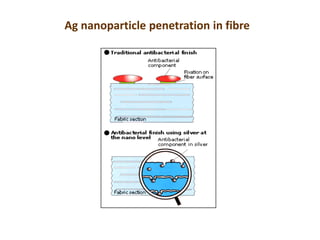
brought about by letting silver particles penetrate
into the fiber itself.
Ag nanoparticle penetration in fibre
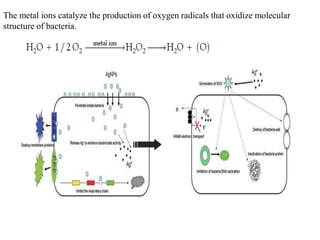
The metal ions catalyze the production of oxygen radicals that oxidize molecular
structure of bacteria.
'Ag fresh'
 The 'Ag fresh' antibacterial, deodorant finish has
been developed for use mainly in
 garments worn close to the skin,
 Further applications of this technology are being
planned for use in uniforms, casual wear, shirts,
bedding, nightwear, underwear, polo shirts.
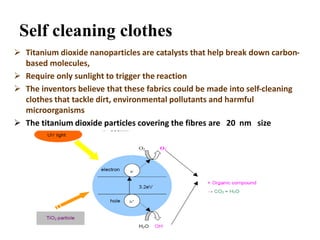
Self cleaning clothes
 Titanium dioxide nanoparticles are catalysts that help break down carbon-
based molecules,
 Require only sunlight to trigger the reaction
 The inventors believe that these fabrics could be made into self-cleaning
clothes that tackle dirt, environmental pollutants and harmful
microorganisms
 The titanium dioxide particles covering the fibres are 20 nm size
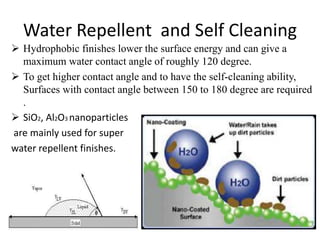
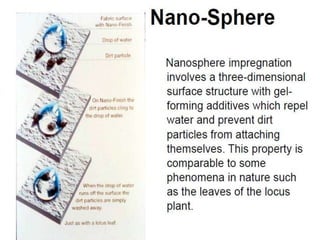
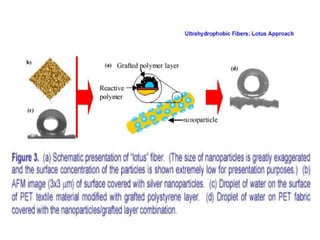
Water Repellent and Self Cleaning
 Hydrophobic finishes lower the surface energy and can give a
maximum water contact angle of roughly 120 degree.
 To get higher contact angle and to have the self-cleaning ability,
Surfaces with contact angle between 150 to 180 degree are required
.
 SiO2, Al2O3 nanoparticles
are mainly used for super
water repellent finishes.
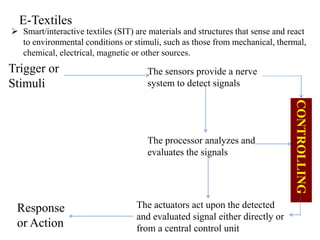
E-Textiles
 Smart/interactive textiles (SIT) are materials and structures that sense and react
to environmental conditions or stimuli, such as those from mechanical, thermal,
chemical, electrical, magnetic or other sources.
Trigger or
Stimuli
Response
or Action
CONTROLLING
The sensors provide a nerve
system to detect signals
The processor analyzes and
evaluates the signals
The actuators act upon the detected
and evaluated signal either directly or
from a central control unit
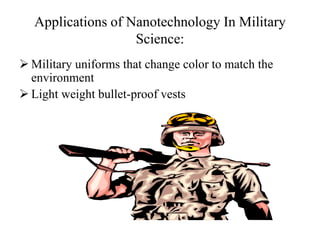
Applications of Nanotechnology In Military
Science:
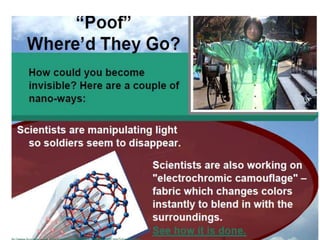
 Military uniforms that change color to match the
environment
 Light weight bullet-proof vests
Applications of Nanotechnology
• Stain/odor-free clothing & carpet
• Bug-repellant clothing
• Military uniforms that change color to match
the environment
• Light weight bullet-proof vests
• Clothing that scans your body for a perfect fit
Etc....
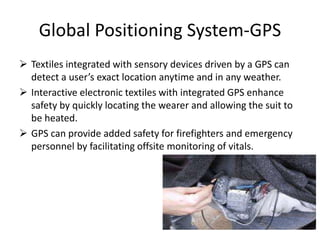
Global Positioning System-GPS
 Textiles integrated with sensory devices driven by a GPS can
detect a user’s exact location anytime and in any weather.
 Interactive electronic textiles with integrated GPS enhance
safety by quickly locating the wearer and allowing the suit to
be heated.
 GPS can provide added safety for firefighters and emergency
personnel by facilitating offsite monitoring of vitals.
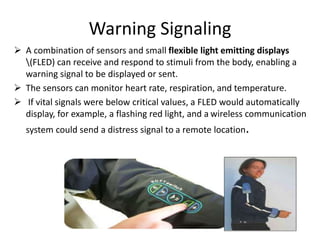
Warning Signaling
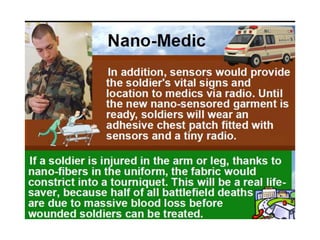
 A combination of sensors and small flexible light emitting displays
(FLED) can receive and respond to stimuli from the body, enabling a
warning signal to be displayed or sent.
 The sensors can monitor heart rate, respiration, and temperature.
 If vital signals were below critical values, a FLED would automatically
display, for example, a flashing red light, and a wireless communication
system could send a distress signal to a remote location.
Thanks !
With a hope for great success of Nano
Technology in Textiles …

Nano technology in textiles. seminar. pptx

  • 1.
    Bahir Dar University EiTEX Nano-Technologyapplication in Textiles By: Bademaw Abate
  • 2.
    Nanotechnology  The design,characterization, production and application of structures, devices and systems by controlling shape and size of building blocks at the nanometer scale.  The study of control of matter on an atomic and molecular scale.  Involves engineering on a small scale to create smaller, cheaper, lighter, and faster devices that can do more things with less raw materials.
  • 3.
    How small isNano Units in nanometers (nm) : 1nm= 10-9m
  • 4.
    3 types ofnanotechnology in textiles can be distinguished: Nanotechnology in fibres and yarns (fabrics) Nanotechnology in coatings (textile finishing)  E-textiles
  • 5.
    What is aNanofiber?  A nanofiber is a continuous fiber which has a diameter in the range of billionths of a meter.  The smallest Nano fibers made today are between 1.5 and 1.75 nanometers
  • 6.
    Cont.. Nanoscale materials canbe rationally designed to exhibit novel and significantly improved physical, chemical and biological properties, because of their size. Nonwoven fabrics composed of electro spun nanofibres have : a large specific surface area, a high porosity  a small pore size in comparison with commercial textiles making them excellent candidates for use in filtration, medical and membrane applications.
  • 7.
    Nano particle Properties Dramatic changein properties of a substance when particle size reduced to nanometer range Normal ceramic particle Brittle Nano ceramic particle Deformable, flexible Normal Gold Yellow Nano gold Red
  • 8.
    Nanotechnology has realcommercial potential for the textile industry. Why?  conventional methods used to impart different properties to fabrics  will lose their functions after several laundering or wearing.  Reduce breathability  Comfort  Nanotechnology can provide high durability for fabrics because:  nano-particles have a large surface area-to-volume ratio  high surface energy.  Coating of nano-particles on fabrics will not affect their breathability or hand feel.
  • 9.
    Different structures ofNano Particles… Whiskers Fiber Spine Hooks Whiskers Fiber The whiskers get hooked on the fibers to alter the fabric property.
  • 10.
    Nano Whiskers canmake the fabric stain & water resistant… Nano whiskers can keep the fabric breathable too unlike resins finishes!
  • 11.
    Value addition dueto Nano Whiskers… Water and oil repellency  Superior durability  Breathable  Fabric remains soft, natural  Wrinkle resistance
  • 12.
    Net Three Dimensional MolecularNano Net covers the core fiber Completely.
  • 13.
    Value addition dueto Nano Net… • Alters the property of synthetic fibers like Polyester to give a feel of cotton & linen. • Wicks body moisture fast • Dries quickly & gives the cooling effect.
  • 14.
    Wrap Nano sheet wrapsthe fiber completely to cover it & alter its property.
  • 15.
    Nano wraps canenhance the fabric Wash fastness… Normal fabric trouser with out nano wrap on the fibers after 50 washes! Trouser made up fabric with nano wrap fibers after 50 washes!
  • 16.
    Value addition dueto Nano Wrap  Strength and Durability  Improvement in colorfastness  Crease Retention  Static Resistance
  • 17.
    Some Magic NanoParticles…  Clay Nano Particles  ZnO Nano Particles  TiO2 Nano Particles  MgO Nano Particles  Silver Nano Particles
  • 18.
    Textile Applications ofNano Technology... FUNCTIONAL water repellent PROTECTION UV absorption DURABILITY color fastness DURABILITY abrasion SAFETY fire retardancy FUNCTIONAL HYGIENE Anti-microbial FUNCTIONAL PROTECTION Controlled release of additives Nano Treated Textile FUNCTIONAL PROTECTION self-cleaning
  • 19.
    Integration of nanoparticlesin textiles Nanoparticles can be introduced in the textile production process at two levels :  during the melt extrusion of yarns nanoparticles based on clay, metal oxides or carbon nanotubes (CNTs) can be mixed in the polymer before the extrusion step. This allows new functionalities to be incorporated  during the coating.
  • 20.
    Application  The fabricis padded and dried.  During drying water evaporates.  During subsequent curing operation the polymers melt and spread giving uniform coating of fibres due to nano size of the finishing agent.
  • 21.
    Antibacterial and Deodorantfinishes based on nanotechnology 'Ag fresh'  Typical example: when human body perspire the clothing in contact with skin such as socks, shirts etc smell due to growth of bacteria.  This drawback is eliminated by Ag fresh finish  incorporate silver particles in a size of around 4nm into fiber  A material of superior antibacterial, deodorant properties with good laundering fastness has been brought about by letting silver particles penetrate into the fiber itself.
  • 22.
  • 23.
    The metal ionscatalyze the production of oxygen radicals that oxidize molecular structure of bacteria.
  • 24.
    'Ag fresh'  The'Ag fresh' antibacterial, deodorant finish has been developed for use mainly in  garments worn close to the skin,  Further applications of this technology are being planned for use in uniforms, casual wear, shirts, bedding, nightwear, underwear, polo shirts.
  • 25.
    Self cleaning clothes Titanium dioxide nanoparticles are catalysts that help break down carbon- based molecules,  Require only sunlight to trigger the reaction  The inventors believe that these fabrics could be made into self-cleaning clothes that tackle dirt, environmental pollutants and harmful microorganisms  The titanium dioxide particles covering the fibres are 20 nm size
  • 26.
    Water Repellent andSelf Cleaning  Hydrophobic finishes lower the surface energy and can give a maximum water contact angle of roughly 120 degree.  To get higher contact angle and to have the self-cleaning ability, Surfaces with contact angle between 150 to 180 degree are required .  SiO2, Al2O3 nanoparticles are mainly used for super water repellent finishes.
  • 29.
    E-Textiles  Smart/interactive textiles(SIT) are materials and structures that sense and react to environmental conditions or stimuli, such as those from mechanical, thermal, chemical, electrical, magnetic or other sources. Trigger or Stimuli Response or Action CONTROLLING The sensors provide a nerve system to detect signals The processor analyzes and evaluates the signals The actuators act upon the detected and evaluated signal either directly or from a central control unit
  • 30.
    Applications of NanotechnologyIn Military Science:  Military uniforms that change color to match the environment  Light weight bullet-proof vests
  • 31.
    Applications of Nanotechnology •Stain/odor-free clothing & carpet • Bug-repellant clothing • Military uniforms that change color to match the environment • Light weight bullet-proof vests • Clothing that scans your body for a perfect fit Etc....
  • 33.
    Global Positioning System-GPS Textiles integrated with sensory devices driven by a GPS can detect a user’s exact location anytime and in any weather.  Interactive electronic textiles with integrated GPS enhance safety by quickly locating the wearer and allowing the suit to be heated.  GPS can provide added safety for firefighters and emergency personnel by facilitating offsite monitoring of vitals.
  • 34.
    Warning Signaling  Acombination of sensors and small flexible light emitting displays (FLED) can receive and respond to stimuli from the body, enabling a warning signal to be displayed or sent.  The sensors can monitor heart rate, respiration, and temperature.  If vital signals were below critical values, a FLED would automatically display, for example, a flashing red light, and a wireless communication system could send a distress signal to a remote location.
  • 37.
    Thanks ! With ahope for great success of Nano Technology in Textiles …