Name that plant part!
Overall Plant Structure Source: Raven, Evert, and Eichhorn. 1986. Biology of Plants. 4 th  Ed. Worth Publishers, Inc.
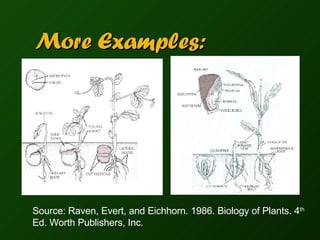
More Examples: Source: Raven, Evert, and Eichhorn. 1986. Biology of Plants. 4 th  Ed. Worth Publishers, Inc.
Final Example: Source: Raven, Evert, and Eichhorn. 1986. Biology of Plants. 4 th  Ed. Worth Publishers, Inc.
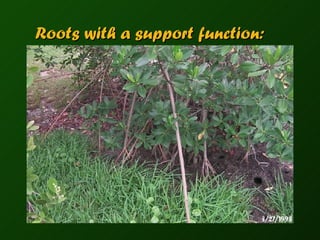
Root Functions: Anchoring the plant (citrus tap root) Absorbing water and minerals from the soil and transporting them to the stem Food Storage (Carrot) Aeration (Black Mangrove and Cypress; pneumatophores) Support (Red Mangrove and Corn; Proproots)
Root Systems Consist of: Primary roots Secondary roots (rootlets) Root Hairs
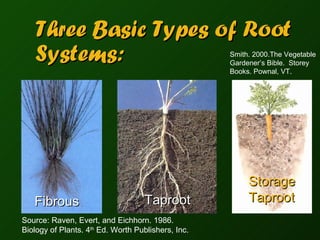
Three Basic Types of Root Systems: Fibrous Taproot Storage Taproot Source: Raven, Evert, and Eichhorn. 1986. Biology of Plants. 4 th  Ed. Worth Publishers, Inc. Smith. 2000.The Vegetable Gardener’s Bible.  Storey Books. Pownal, VT.
Other Important Root Terms: Root Hairs Fleshy Roots Aerial Roots Knees
Root Hairs: Root hairs are tubular extensions of epidermal cells Increase root surface area Greatly increases plants ability to absorb water and minerals from the soil.
Fleshy Roots:
Aerial Roots:
Roots with a support function:
Stems: Parker. 1998. Introduction to Plant Science. Delmar Publishers. New York.
Stem Functions: Attachment point for leaves, flowers, and fruit House the vascular system Storage (tubers, corms, bulbs, rhizomes) Can serve to help plant spread (runners, tendrils, thorns
Crowns Short inconspicuous stems:
Simple Stems without branches:
Other types of stems Branched (many plants) Climbing Creeping Rhizomes (potatoes) Stolons (stem connecting strawberry daughter plants to the mother plant)
Leaves:
Simple  Compound Tip Midrib Axillary Bud Secondary Vein Leaflet Margin Base Petiole
A Sample of Leaf Shapes Scale-like Needle-like Chordate -Ovate Ovate- Chordate Palmately Lobed Pinnately Lobed Lanceolate
Sample Leaf Margins Double serrate Entire Lobed Incised Serrate Crenate
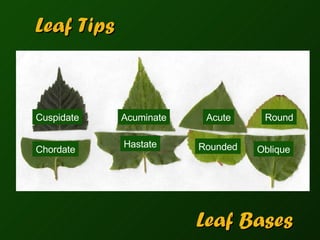
Leaf Tips Leaf Bases Cuspidate Acuminate Acute Round Chordate Hastate Rounded Oblique
Leaf Venation Dichotomous Palmate Pinnate
Leaf Arrangements on the Stem Alternate Opposite
Compound Leaf Arrangements Palmately Pinnately Bipinnately
Flower Parts http://www.csdl.tamu.edu/FLORA/301Manhart/repro/Flower%20diagram/flower_diagram.htm
Source: University of Florida/IFAS Extension
Petal Sepal Pistil Stamen
 
Flower vs. Inflorescence
http://www.cpsc.ucalgary.ca/projects/bmv/vmm-deluxe/Animations.html#cpoundlf
Racemose Inflorescences http://www.gardenwithinsight.com/help100/00000418.htm
Cymose Inflorescences Cyme Scorpiod Cyme Fascicle
Review of Inflorescence Types
 
Monoecious Dioecious
Dry Fruits Achene (sunflower seed) Samara (winged maple seed) Nuts (walnut) Grain Capsule Silique Legume (peas) Follicle (milkweed)
Fleshy Fruits Drupe (peach) Berry tomato Pepo (watermelon) Hesperidium (orange) Pome (apple) Aggregate (strawberry) Multiple (pineapple)
 
Seed Parts you should know: Seed coat Endosperm Cotyledon Epicotyl Hypocotyl embryo http://www.hcs.ohio-state.edu/hcs/TMI/hcs200/seed.html
Source: Raven, Evert, and Eichhorn. 1986. Biology of Plants. 4 th  Ed. Worth Publishers, Inc.

Name That Plant Part

Editor's Notes

  • #2 Common ground on Friday for the Dean’s visit Assign Seats Assign GMO pro or con Tell lab participants to meet at 12:20 on Friday in Room 17