LAKE CHAMPLAIN

     PHOSPHORUS
    CONTAMINATION:

Environmental, Economic, and
    Social Equity Issues
Clean water is valued for many reasons. We depend on
lakes and streams for drinking water and recreation.
Wildlife depends on habitats created by healthy streams,
wetlands and lakes. Water quality has declined in some
parts of Lake Champlain, due to excess entry of
phosphorus into the lake. Our company Being Green
Pays have three priorities for saving the quality of Lake
Champlain:

Protect and restore ecological and cultural
resources of the Basin while maintaining a
       vital economy for the region
Historical Importance of Lake
               Champlain
Lake Champlain is the 6th largest body of water in the
United States

It is home to the oldest known fossil reef in the world. (450-
480 million years old)

It is the birthplace of the American Navy, and but for the
stalling effects of the American fleet lead by Benedict Arnold
in the fall of 1776, the American Revolution probably would
have been lost.
Geographical Facts of Lake Champlain

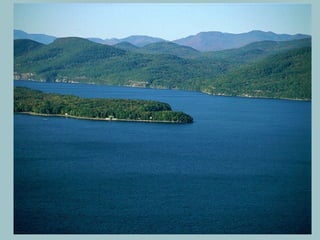
 It is 120 miles long and 12 miles wide at its widest point.

 It has over 70 islands and 600 miles of shoreline.

 Its deepest point is 400 ft. The average depth is 64 ft.

 It is bounded on the west by the Adirondack Mountains of
 New York, and on the east by the Green Mountains of
 Vermont. It flows north from Whitehall, New York to the
 Saint Lawrence River in Quebec.
Animals who call Lake Champlain
             Home
81 species of fish, 318 species of birds, 56 species of
mammals, plus 21 species of amphibians and 20 species of
reptiles also rely on Lake Champlain for their drinking water.

The lake is a major breeding area and a stopping point for
spring and fall birds migrating along the Atlantic flyway.

16 species of birds found in the Champlain Basin are listed
as endangered species.
Economic Geography
The lake caters to various outdoor recreational activities,
including kayaking, hiking, and cross country skiing.

On a typical summer day in 1992, there were 7500 motor
boats, 3000 sailboats, 15 commercial vessels, and countless
swimmers, wind surfers, kayakers, canoers and scuba
divers on or in the lake. 10 years later that number has
increased significantly.
Importance of Lake Champlain to
     people living around the lake


More than 188,000 people rely on
Lake Champlain for their drinking
water.
Why are we worried about Lake
       Champlain's Future?


Excessive levels of phosphorus have lead to
    negative environmental factors such
 as increased algae growth, loss of aquatic
     species living in the lake, and water
  treatment problems, all major threats to
       humans and the environment
Blue Algae
Priorities for saving the quality of Lake
                Champlain
Protect and restore ecological and cultural
resources of the Basin while maintaining a
       vital economy for the region
What is Phosphorus?


Phosphorus is the chemical element that has the symbol P.

A multivalent nonmetal of the nitrogen group, phosphorus is
commonly found in inorganic phosphate rocks. Due to its high
reactivity, phosphorus is never found as a free element in nature
on Earth. It is an essential element for all living cells.

Wikipedia.org:
Why is too much phosphorus bad?


 Too much phosphorus in streams, rivers, and lakes can lead to
accelerated plant growth, algae blooms, low dissolved oxygen,
and the death of certain fish and other aquatic animals. Because
phosphorus is a nutrient, algae thrive on it. Algae can spread
across the water surface in large quantaties which prevents
sunlight from reaching the underlying plants. As a
consequence, plants die and decompose. Micro-organisms that
feed on dying plants also thrive and consume too much of the
oxygen in the water body, leaving fish and other aquatic life to
die.
Where does excess phosphorus come
                  from?
Land run off:

Rain and melting snow carry large amounts of fertilizing chemicals
(primarily phosphorus and nitrogen) off the land into the water from:

   livestock manure;
   dog and cat droppings;
   rich topsoil from exposed gardens and farm fields;
   construction site run-off;
   eroding stream banks trampled by livestock;
   street run-off, including air pollution fallout, lawn fertilizers, and
   home car-washing.
What is the Phosphorus Cycle?


The global circulation of phosphorus from
 the environment to living organisms and
        back to the environment.
The Phosphorus Cycle
How does this pertain to the
    conditions of Lake Champlain?

Phosphorus is a limiting nutrient to plants and algae
in certain aquatic ecosystems. The increasing
phosphorus concentrations in surface waters from
land run-off raises the growth of phosphate-
dependent organisms, such as algae and duckweed.
These organisms use great amounts of oxygen and
prevent sunlight from entering the water. This makes
the water fairly unliveable for other organisms.

This phenonmenon is known as eutrophication .
Lake Champlain is divided into several distinct
 lake segments. Each segment has a different level
  of phosphorus, which determines that segment's
                  trophic level.

  Trophic Level: Each level in a food chain.


The trophic status of a lake segment is a measure of
how much plant growth is supported by phosphorus
                    in the water.
Eutrophic areas have excessive levels of
phosphorus and are highly impacted, whereas
mesotrophic and oligotrophic areas have moderate
and low levels of phosphorus and associated
impacts. Lake Champlain's segments range from
the oligotrophic Mallett's Bay to the highly
eutrophic South Lake.
Other Undesirable Effects of Phosphates

·     Increased algae growth
·     Reduced water clarity
·     Water treatment problems
o Odor and bad taste
o Increased filtration costs
o Disinfectant byproducts with potential human health effects
·     Reduced oxygen in the water
·     Altered fisheries
·     Fish kills
·     Toxins from cyanobacteria (blue-green algae) affecting
human and animal health
Dangers of excess phosphates in
humans:
We know now that too much phosphate in the water can
cause blue-green algae blooms, so how does this affect
our own health. Exposure to blue-green algae can cause
rashes, skin and eye irritation, allergic reactions,
gastrointestinal upset, and other effects such as liver
toxicity and neurotoxicity. At high levels, exposure can
result in serious illness or death.
The basics of what we know about
      excess phosphates:

Water treatment problems
 Reduced water clarity, undesirable for
recreational activities
 Kills Fish
 Toxins from cyanobacteria (blue-green algae)
affects human and animal health
What can we do to reduce the input of excess
      phosphates in Lake Champlain?


      There are several potentially
        successful approaches
Some possible solutions that have been
discussed in recent years:
  an ecosystem approach that stresses management decisions which
  recognize the inter-relationships among the physical, biological and
  chemical components of the Lake Champlain Basin;

  a watershed approach that recognizes that Lake Champlain is affected by
  activities throughout its Basin. Water quality protection and ecosystem
  restoration efforts should be focused along watershed boundaries;

  integration of environmental and economic goals in the decision-making
  process and in selecting the most cost-effective actions to protect and
  enhance the resources of the Basin;
pollution prevention as a cost-effective means to protect the environment
by eliminating pollution before it is generated;

a consensus-based, collaborative approach that strengthens the outcomes
of decisions by facilitating a dialogue among multiple interested parties;

flexibility built into programs and organizations so that they can adapt
according to emerging issues, resources and technology

education of citizens of the underlying problems associated with excess
phosphorus use and ways to reduce overuse, waste, and pollution of
phosphate use
Where is the majority of the excess input of
phosphorus flowing into Lake Champlain
coming from?


    Runoff from roads and developed areas, and from lawns,
   farmlands, and other rural areas (called nonpoint sources)
         contribute more than 90% of the phosphorus.

    A 2007 report for the Lake Champlain Basin Program,
    estimated that 46% of the nonpoint source phosphorus
     load is from urban land uses and about 38% is from
                        agricultural land
Knowing this, where do we start to
eliminate excess phosphorus?


The facts state that the 90% of non-
point phosphorus runoff into Lake Champlain is
equally divided between urban land uses and
agricultural land uses
Local ways to curb urban runoff of
           phosphorus:
In the farming/argricultural community:

   Reduce the use of phosphates in cattle feed by using
   alternative feed methods such as soybean meal.

*Cattle feed contains a large amount of phosphorus, the
excess amount not needed by the cattle is excreted
through their feces and causes the most concern with
respect to environmental pollution from animal manure.

   Better manure management, ie; composting
Local ways to curb urban runoff of
phosphorus:
As a community or citizen:

   Switch to phosphorus free automatic dishwashing detergent

    Wash your car on your lawn so that excess water and detergents can soak
   into the grass

   Use phosphorus-free fertilizers

   Do not rake your yard waste into nearby streams, lakes, or stormwater
   gutters

    Properly maintain your septic system especially by pumping every few
   year

   Become an active member of a local watershed group
Local ways to curb urban runoff of
phosphorus:
As a city or town:

   Prohibit the use of fertilizers, pesticides or herbicides on town
   parks and athletic fields.

    Preserve natural vegetation buffers along river and stream banks
   to help filter stormwater runoff.
   Infiltrate stormwater runoff into the groundwater wherever possible
   and appropriate, since phosphorus is highly absorbable by soils.

   Adopt a stormwater or low impact development (LID) bylaw that
   promotes the use of LIDstormwater best management practices.
Are these local approaches to curbing
urban runoff of phosphorus enough to
solve the current conditions of Lake
Champlain?


                NO
These approaches will greatly impact the reduction
of phosporus in local water systems, but will not put
a dent in solving the problem of the overabundance
of phosphorus already polluting Lake Champlain.

     More goverment funding needs to be
             allocated to the area
     as well as environmental awareness
Proposed Actions to Reduce
Phosphorus in Lake Champlain:

Fund Non-point Control Programs:

Sources for funding non-point control programs:

   EPA administers section 319 of the Clean Water Act, also known as the
   Nonpoint Source Management Program. Under section 319, states,
   territories, and tribes apply for and receive grants from EPA to implement
   NPS pollution controls. As of 1995, EPA had awarded more than $370
   million under section 319 to address NPS pollution problems.
    The USDA administers incentive-based conservation programs through
   the Consolidated Farm Services Agency, the Natural Resources
   Conservation Service, and the U.S. Forest Service to help control NPS
   pollution from agriculture, forestry, and urban sources.
Due to budget cuts funding from theses
agencies is not enough.

Additional funding needs to be subsidized through the
following ways:

   State soil and water conservation agencies

    Grants from local governments, state agencies, and
   conservation non-profits

   Lobbying from local politicians concerned about the water
   quality of Lake Champlain
Raising Public Awareness

In an effort to garner public support for future efforts the
Plattsburgh, NY and Burlinton, VT municipalities will need
to raise public awareness

Raising public awareness will be a unified effort lead by
municipalities, state and federal government agencies
to initiate educational awareness groups for local citizens

Additional groups similar to project WET in Vermont,
which teaches students K-12th grade about various
environmental factors such as climate and water
conservation and the impacts their actions have upon them
It is environmentally imperative that we
improve the overall health of Lake
Champlain
   Research has shown the wide-range of harmful impacts of
    excessive phosphorus input into Lake Champlain. Steps
   taken to improve the quality of the lake will have a positive
     impact on various factors such as better water quality,
 increased tourism, healthier living conditions for both humans
           and animals that live in or around the lake.
Kearney

Kearney

  • 1.
    LAKE CHAMPLAIN PHOSPHORUS CONTAMINATION: Environmental, Economic, and Social Equity Issues
  • 3.
    Clean water isvalued for many reasons. We depend on lakes and streams for drinking water and recreation. Wildlife depends on habitats created by healthy streams, wetlands and lakes. Water quality has declined in some parts of Lake Champlain, due to excess entry of phosphorus into the lake. Our company Being Green Pays have three priorities for saving the quality of Lake Champlain: Protect and restore ecological and cultural resources of the Basin while maintaining a vital economy for the region
  • 4.
    Historical Importance ofLake Champlain Lake Champlain is the 6th largest body of water in the United States It is home to the oldest known fossil reef in the world. (450- 480 million years old) It is the birthplace of the American Navy, and but for the stalling effects of the American fleet lead by Benedict Arnold in the fall of 1776, the American Revolution probably would have been lost.
  • 5.
    Geographical Facts ofLake Champlain It is 120 miles long and 12 miles wide at its widest point. It has over 70 islands and 600 miles of shoreline. Its deepest point is 400 ft. The average depth is 64 ft. It is bounded on the west by the Adirondack Mountains of New York, and on the east by the Green Mountains of Vermont. It flows north from Whitehall, New York to the Saint Lawrence River in Quebec.
  • 6.
    Animals who callLake Champlain Home 81 species of fish, 318 species of birds, 56 species of mammals, plus 21 species of amphibians and 20 species of reptiles also rely on Lake Champlain for their drinking water. The lake is a major breeding area and a stopping point for spring and fall birds migrating along the Atlantic flyway. 16 species of birds found in the Champlain Basin are listed as endangered species.
  • 8.
    Economic Geography The lakecaters to various outdoor recreational activities, including kayaking, hiking, and cross country skiing. On a typical summer day in 1992, there were 7500 motor boats, 3000 sailboats, 15 commercial vessels, and countless swimmers, wind surfers, kayakers, canoers and scuba divers on or in the lake. 10 years later that number has increased significantly.
  • 12.
    Importance of LakeChamplain to people living around the lake More than 188,000 people rely on Lake Champlain for their drinking water.
  • 13.
    Why are weworried about Lake Champlain's Future? Excessive levels of phosphorus have lead to negative environmental factors such as increased algae growth, loss of aquatic species living in the lake, and water treatment problems, all major threats to humans and the environment
  • 15.
  • 16.
    Priorities for savingthe quality of Lake Champlain Protect and restore ecological and cultural resources of the Basin while maintaining a vital economy for the region
  • 17.
    What is Phosphorus? Phosphorusis the chemical element that has the symbol P. A multivalent nonmetal of the nitrogen group, phosphorus is commonly found in inorganic phosphate rocks. Due to its high reactivity, phosphorus is never found as a free element in nature on Earth. It is an essential element for all living cells. Wikipedia.org:
  • 18.
    Why is toomuch phosphorus bad? Too much phosphorus in streams, rivers, and lakes can lead to accelerated plant growth, algae blooms, low dissolved oxygen, and the death of certain fish and other aquatic animals. Because phosphorus is a nutrient, algae thrive on it. Algae can spread across the water surface in large quantaties which prevents sunlight from reaching the underlying plants. As a consequence, plants die and decompose. Micro-organisms that feed on dying plants also thrive and consume too much of the oxygen in the water body, leaving fish and other aquatic life to die.
  • 19.
    Where does excessphosphorus come from? Land run off: Rain and melting snow carry large amounts of fertilizing chemicals (primarily phosphorus and nitrogen) off the land into the water from: livestock manure; dog and cat droppings; rich topsoil from exposed gardens and farm fields; construction site run-off; eroding stream banks trampled by livestock; street run-off, including air pollution fallout, lawn fertilizers, and home car-washing.
  • 20.
    What is thePhosphorus Cycle? The global circulation of phosphorus from the environment to living organisms and back to the environment.
  • 21.
  • 22.
    How does thispertain to the conditions of Lake Champlain? Phosphorus is a limiting nutrient to plants and algae in certain aquatic ecosystems. The increasing phosphorus concentrations in surface waters from land run-off raises the growth of phosphate- dependent organisms, such as algae and duckweed. These organisms use great amounts of oxygen and prevent sunlight from entering the water. This makes the water fairly unliveable for other organisms. This phenonmenon is known as eutrophication .
  • 23.
    Lake Champlain isdivided into several distinct lake segments. Each segment has a different level of phosphorus, which determines that segment's trophic level. Trophic Level: Each level in a food chain. The trophic status of a lake segment is a measure of how much plant growth is supported by phosphorus in the water.
  • 24.
    Eutrophic areas haveexcessive levels of phosphorus and are highly impacted, whereas mesotrophic and oligotrophic areas have moderate and low levels of phosphorus and associated impacts. Lake Champlain's segments range from the oligotrophic Mallett's Bay to the highly eutrophic South Lake.
  • 25.
    Other Undesirable Effectsof Phosphates · Increased algae growth · Reduced water clarity · Water treatment problems o Odor and bad taste o Increased filtration costs o Disinfectant byproducts with potential human health effects · Reduced oxygen in the water · Altered fisheries · Fish kills · Toxins from cyanobacteria (blue-green algae) affecting human and animal health
  • 26.
    Dangers of excessphosphates in humans: We know now that too much phosphate in the water can cause blue-green algae blooms, so how does this affect our own health. Exposure to blue-green algae can cause rashes, skin and eye irritation, allergic reactions, gastrointestinal upset, and other effects such as liver toxicity and neurotoxicity. At high levels, exposure can result in serious illness or death.
  • 27.
    The basics ofwhat we know about excess phosphates: Water treatment problems Reduced water clarity, undesirable for recreational activities Kills Fish Toxins from cyanobacteria (blue-green algae) affects human and animal health
  • 28.
    What can wedo to reduce the input of excess phosphates in Lake Champlain? There are several potentially successful approaches
  • 29.
    Some possible solutionsthat have been discussed in recent years: an ecosystem approach that stresses management decisions which recognize the inter-relationships among the physical, biological and chemical components of the Lake Champlain Basin; a watershed approach that recognizes that Lake Champlain is affected by activities throughout its Basin. Water quality protection and ecosystem restoration efforts should be focused along watershed boundaries; integration of environmental and economic goals in the decision-making process and in selecting the most cost-effective actions to protect and enhance the resources of the Basin;
  • 30.
    pollution prevention asa cost-effective means to protect the environment by eliminating pollution before it is generated; a consensus-based, collaborative approach that strengthens the outcomes of decisions by facilitating a dialogue among multiple interested parties; flexibility built into programs and organizations so that they can adapt according to emerging issues, resources and technology education of citizens of the underlying problems associated with excess phosphorus use and ways to reduce overuse, waste, and pollution of phosphate use
  • 31.
    Where is themajority of the excess input of phosphorus flowing into Lake Champlain coming from? Runoff from roads and developed areas, and from lawns, farmlands, and other rural areas (called nonpoint sources) contribute more than 90% of the phosphorus. A 2007 report for the Lake Champlain Basin Program, estimated that 46% of the nonpoint source phosphorus load is from urban land uses and about 38% is from agricultural land
  • 32.
    Knowing this, wheredo we start to eliminate excess phosphorus? The facts state that the 90% of non- point phosphorus runoff into Lake Champlain is equally divided between urban land uses and agricultural land uses
  • 33.
    Local ways tocurb urban runoff of phosphorus: In the farming/argricultural community: Reduce the use of phosphates in cattle feed by using alternative feed methods such as soybean meal. *Cattle feed contains a large amount of phosphorus, the excess amount not needed by the cattle is excreted through their feces and causes the most concern with respect to environmental pollution from animal manure. Better manure management, ie; composting
  • 34.
    Local ways tocurb urban runoff of phosphorus: As a community or citizen: Switch to phosphorus free automatic dishwashing detergent Wash your car on your lawn so that excess water and detergents can soak into the grass Use phosphorus-free fertilizers Do not rake your yard waste into nearby streams, lakes, or stormwater gutters Properly maintain your septic system especially by pumping every few year Become an active member of a local watershed group
  • 35.
    Local ways tocurb urban runoff of phosphorus: As a city or town: Prohibit the use of fertilizers, pesticides or herbicides on town parks and athletic fields. Preserve natural vegetation buffers along river and stream banks to help filter stormwater runoff. Infiltrate stormwater runoff into the groundwater wherever possible and appropriate, since phosphorus is highly absorbable by soils. Adopt a stormwater or low impact development (LID) bylaw that promotes the use of LIDstormwater best management practices.
  • 36.
    Are these localapproaches to curbing urban runoff of phosphorus enough to solve the current conditions of Lake Champlain? NO
  • 37.
    These approaches willgreatly impact the reduction of phosporus in local water systems, but will not put a dent in solving the problem of the overabundance of phosphorus already polluting Lake Champlain. More goverment funding needs to be allocated to the area as well as environmental awareness
  • 38.
    Proposed Actions toReduce Phosphorus in Lake Champlain: Fund Non-point Control Programs: Sources for funding non-point control programs: EPA administers section 319 of the Clean Water Act, also known as the Nonpoint Source Management Program. Under section 319, states, territories, and tribes apply for and receive grants from EPA to implement NPS pollution controls. As of 1995, EPA had awarded more than $370 million under section 319 to address NPS pollution problems. The USDA administers incentive-based conservation programs through the Consolidated Farm Services Agency, the Natural Resources Conservation Service, and the U.S. Forest Service to help control NPS pollution from agriculture, forestry, and urban sources.
  • 39.
    Due to budgetcuts funding from theses agencies is not enough. Additional funding needs to be subsidized through the following ways: State soil and water conservation agencies Grants from local governments, state agencies, and conservation non-profits Lobbying from local politicians concerned about the water quality of Lake Champlain
  • 40.
    Raising Public Awareness Inan effort to garner public support for future efforts the Plattsburgh, NY and Burlinton, VT municipalities will need to raise public awareness Raising public awareness will be a unified effort lead by municipalities, state and federal government agencies to initiate educational awareness groups for local citizens Additional groups similar to project WET in Vermont, which teaches students K-12th grade about various environmental factors such as climate and water conservation and the impacts their actions have upon them
  • 41.
    It is environmentallyimperative that we improve the overall health of Lake Champlain Research has shown the wide-range of harmful impacts of excessive phosphorus input into Lake Champlain. Steps taken to improve the quality of the lake will have a positive impact on various factors such as better water quality, increased tourism, healthier living conditions for both humans and animals that live in or around the lake.