Week 7
Linearity and
Superposition Principles
2
Learning Outcomes
After completing this module, you will be able to:
1. Apply the principle of linearity to linear circuits containing linear resistors
and independent sources to solve for unknown voltages and currents.
2. Apply the principle of superposition to linear circuits containing linear
resistors and independent sources to solve for unknown voltages and
currents.
3. Compute Thevenin’s and Norton’s equivalent circuits for networks
containing resistors and independent sources.
4. Apply source transformations techniques to circuits containing resistors
and independent sources to solve for unknown voltages and currents
3
In this topic we will learn three techniques for analysing linear resistive
circuits. The circuit analysis techniques are:
i. Linearity principle
ii. Superposition theorem
iii. Source transformations
4
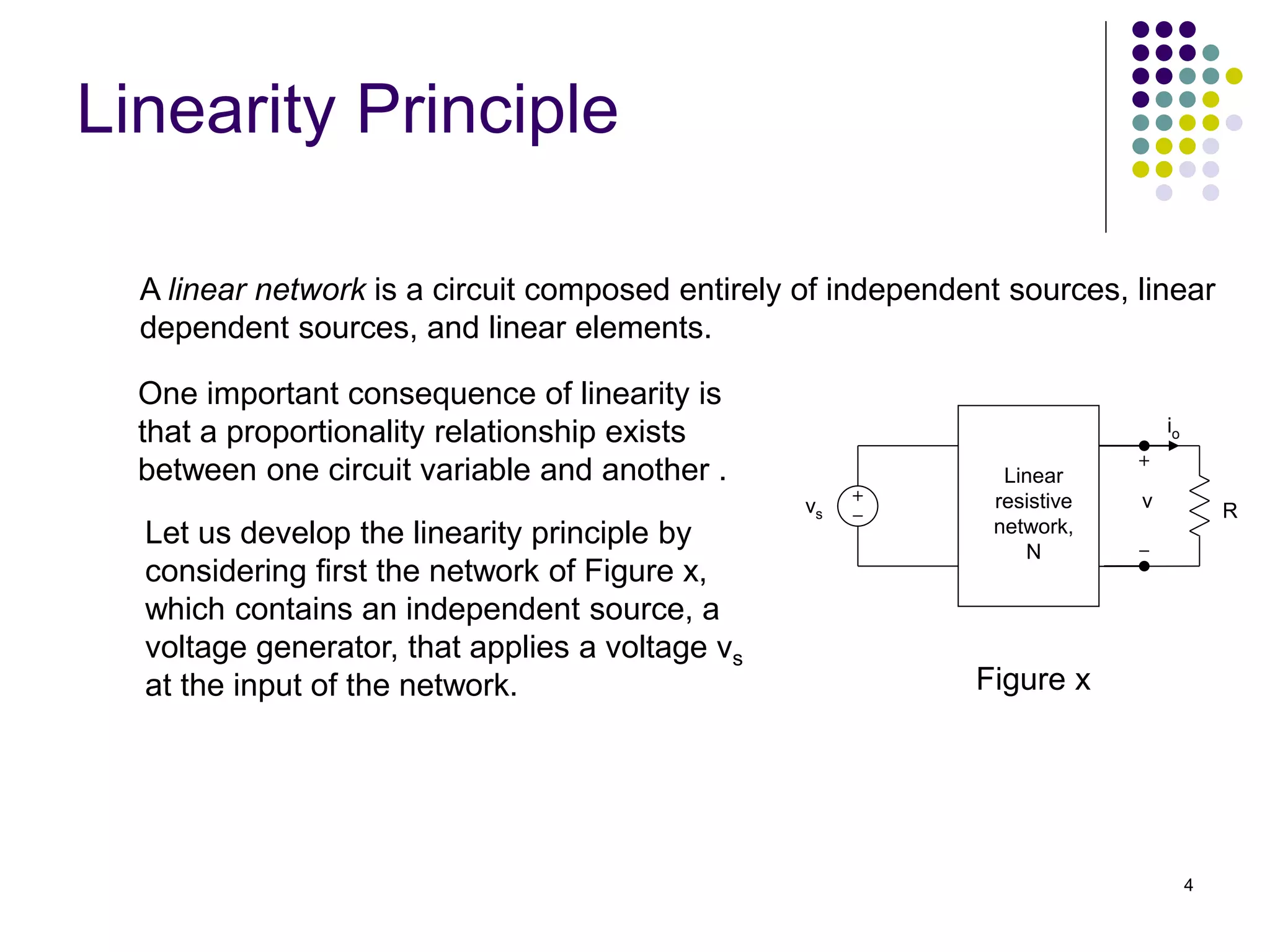
A linear network is a circuit composed entirely of independent sources, linear
dependent sources, and linear elements.
One important consequence of linearity is
that a proportionality relationship exists
between one circuit variable and another . Linear
resistive
network,
N
vs R
io
v
Figure x
Let us develop the linearity principle by
considering first the network of Figure x,
which contains an independent source, a
voltage generator, that applies a voltage vs
at the input of the network.
Linearity Principle
5
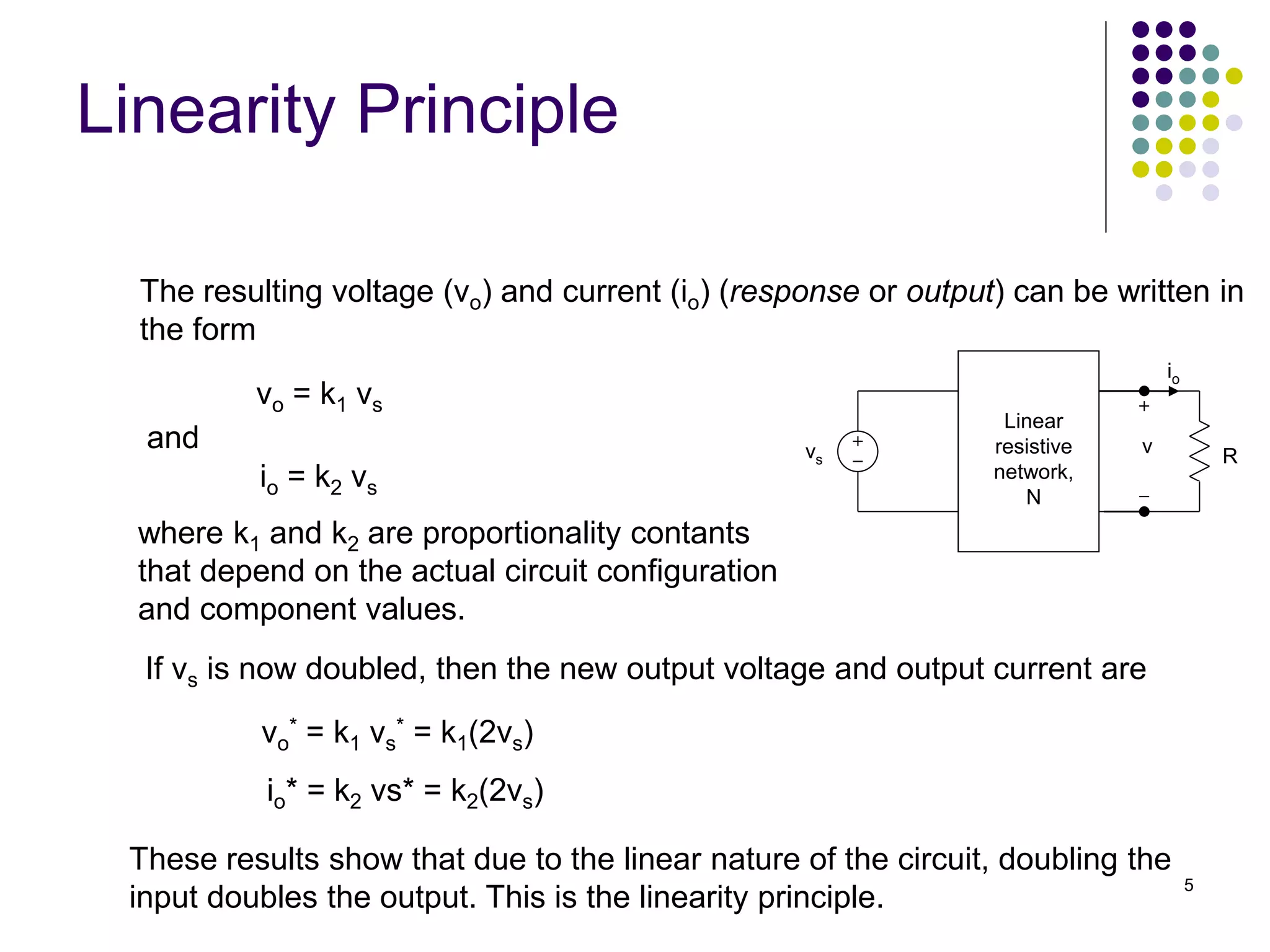
where k1 and k2 are proportionality contants
that depend on the actual circuit configuration
and component values.
vo = k1 vs
The resulting voltage (vo) and current (io) (response or output) can be written in
the form
and
io = k2 vs
If vs is now doubled, then the new output voltage and output current are
vo
* = k1 vs
* = k1(2vs)
io* = k2 vs* = k2(2vs)
These results show that due to the linear nature of the circuit, doubling the
input doubles the output. This is the linearity principle.
Linear
resistive
network,
N
vs R
io
v
Linearity Principle
6
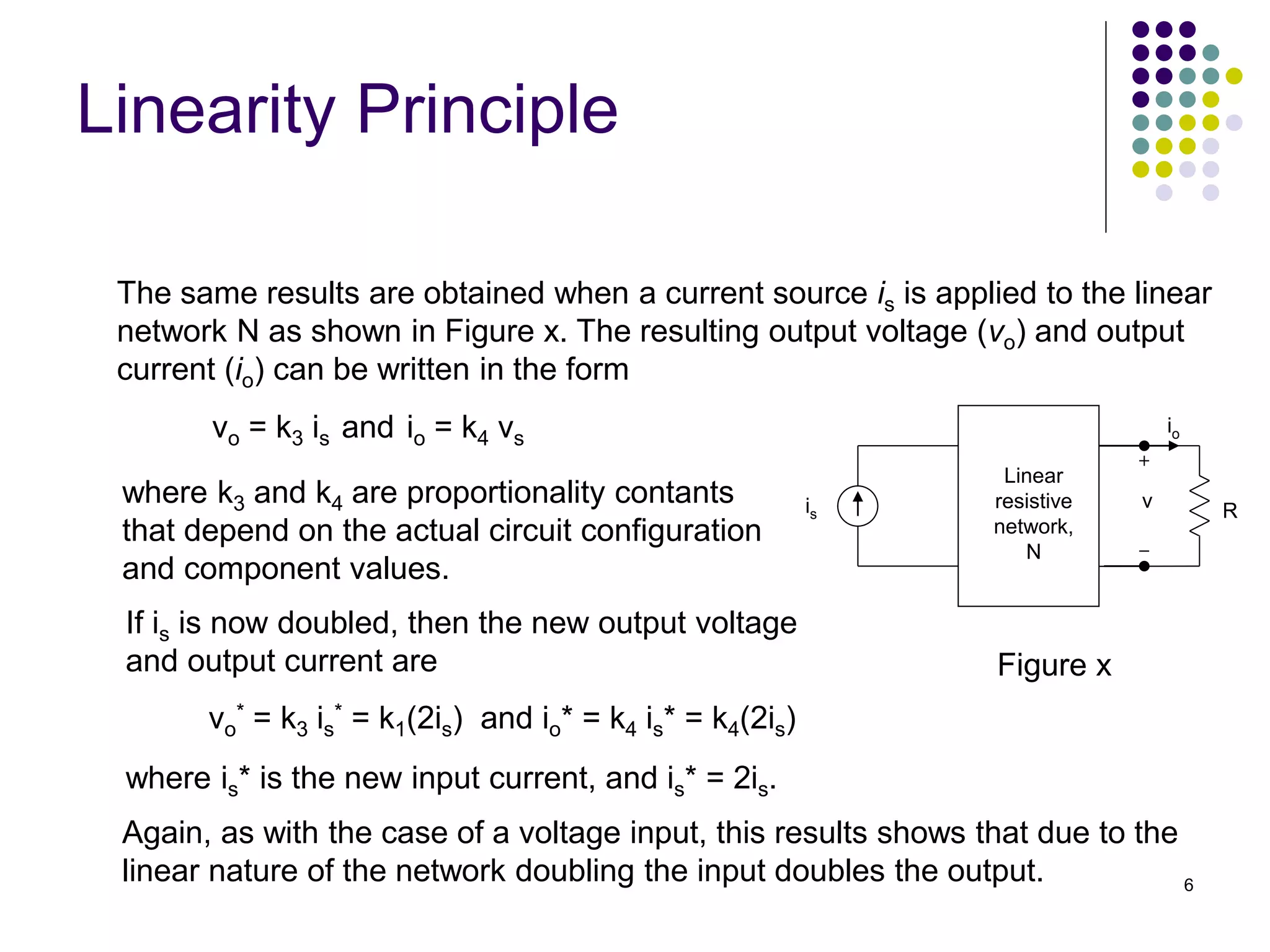
The same results are obtained when a current source is is applied to the linear
network N as shown in Figure x. The resulting output voltage (vo) and output
current (io) can be written in the form
vo = k3 is and io = k4 vs
Linear
resistive
network,
N
is R
io
v
where k3 and k4 are proportionality contants
that depend on the actual circuit configuration
and component values.
If is is now doubled, then the new output voltage
and output current are
vo
* = k3 is
* = k1(2is) and io* = k4 is* = k4(2is)
where is* is the new input current, and is* = 2is.
Again, as with the case of a voltage input, this results shows that due to the
linear nature of the network doubling the input doubles the output.
Figure x
Linearity Principle
7
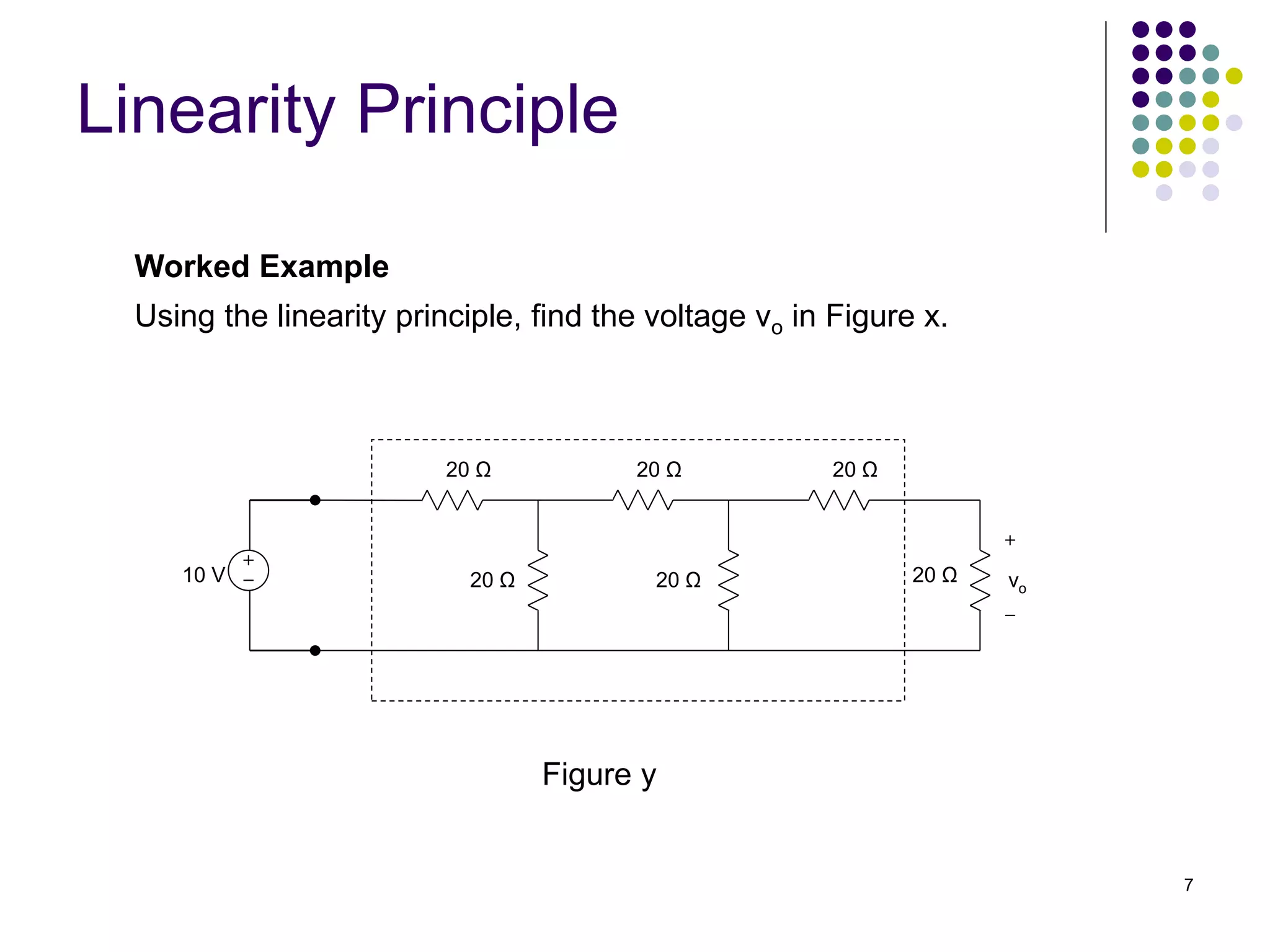
Worked Example
Using the linearity principle, find the voltage vo in Figure x.
Linearity Principle
Figure y
10 V
20 Ω
20 Ω
20 Ω
20 Ω
20 Ω
20 Ω vo
8
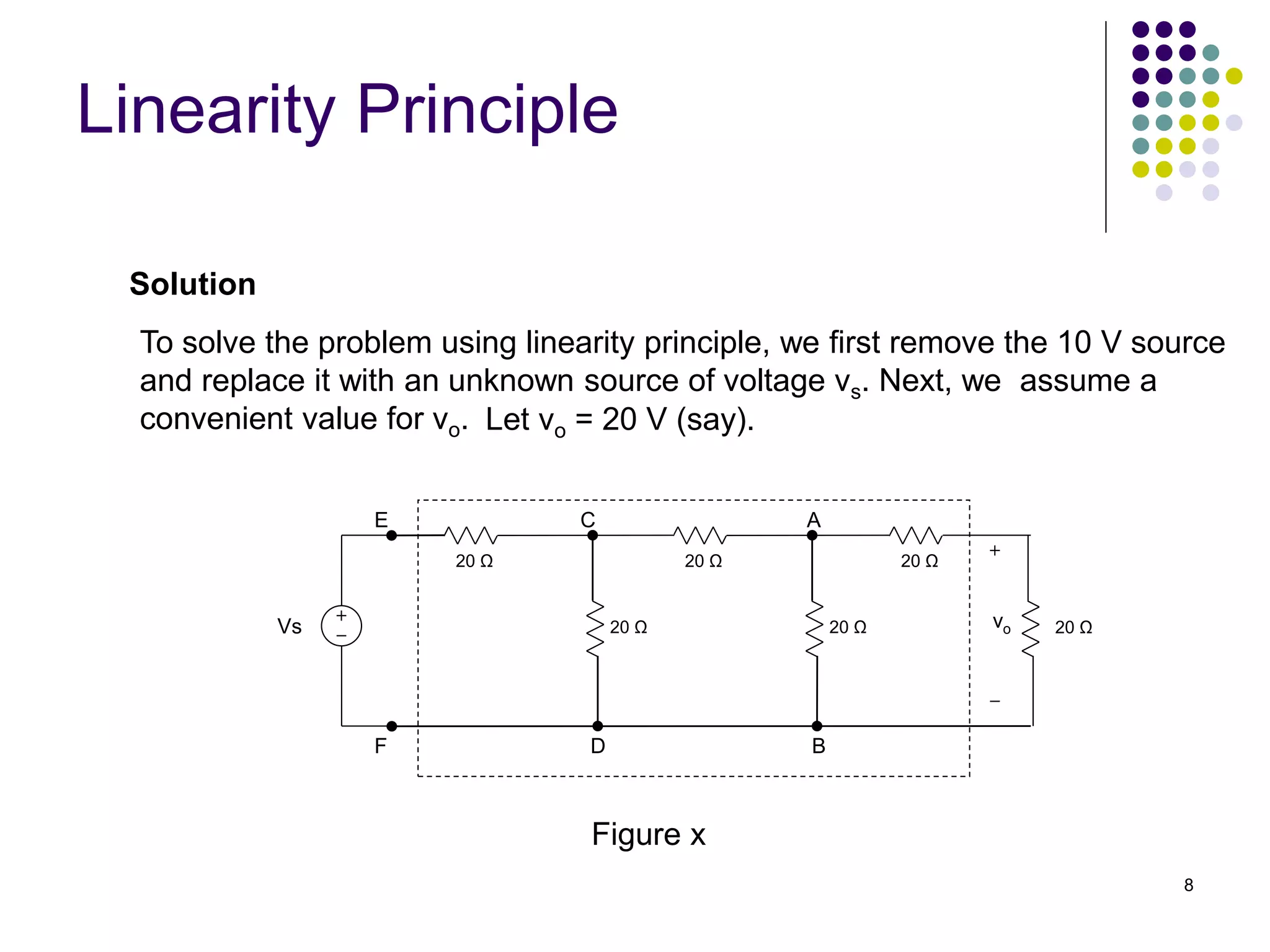
Solution
To solve the problem using linearity principle, we first remove the 10 V source
and replace it with an unknown source of voltage vs. Next, we assume a
convenient value for vo. Let vo = 20 V (say).
Linearity Principle
20 Ω 20 Ω
20 Ω
20 Ω
vo
Vs 20 Ω 20 Ω
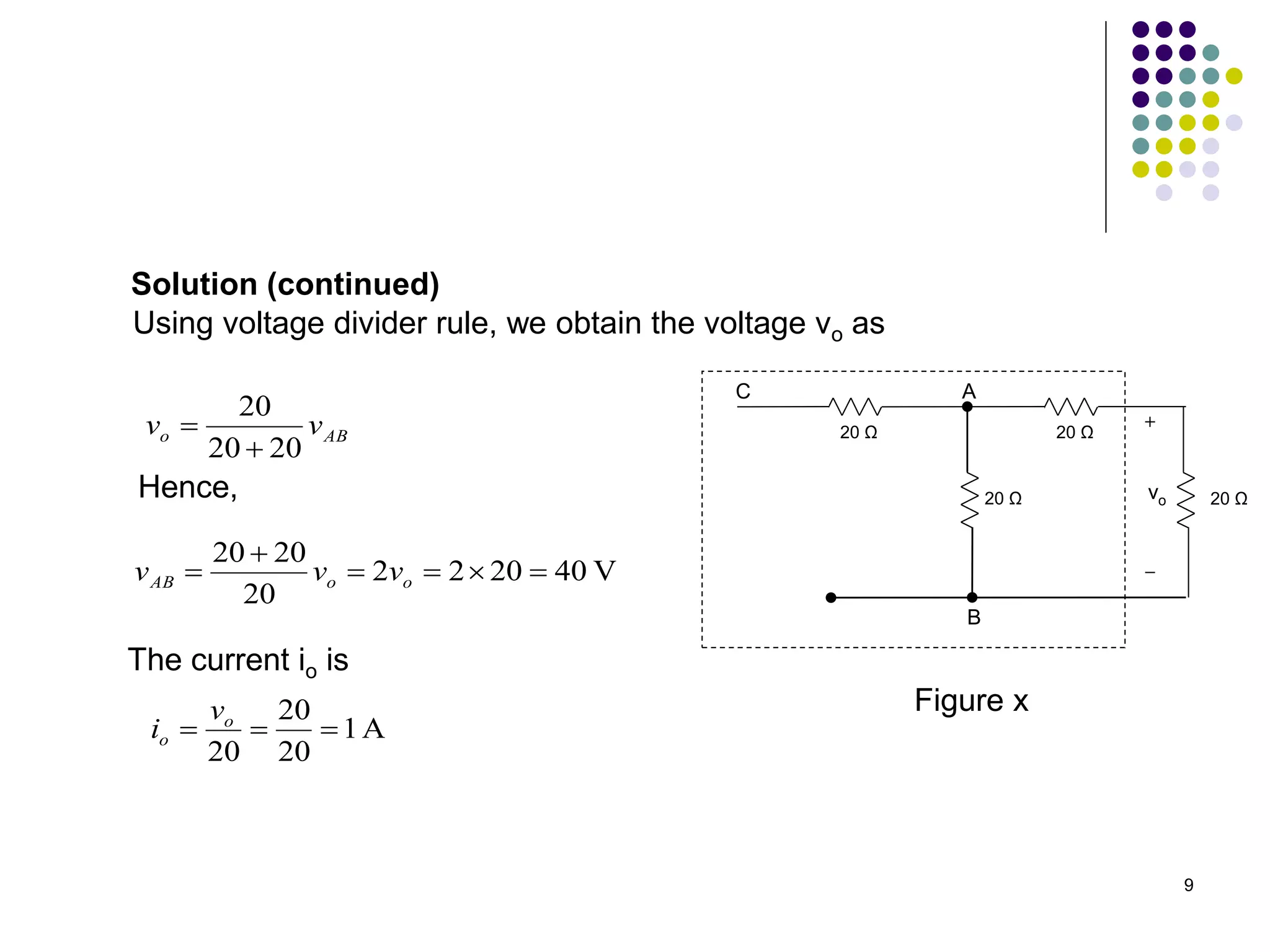
A
B
C
D
E
F
Figure x
9
V
40
20
2
2
20
20
20





 o
o
AB v
v
v
AB
o v
v
20
20
20


Solution (continued)
Using voltage divider rule, we obtain the voltage vo as
Hence,
The current io is
A
1
20
20
20


 o
o
v
i
20 Ω
20 Ω
20 Ω
vo
20 Ω
A
B
C
Figure x
10
Solution (continued)
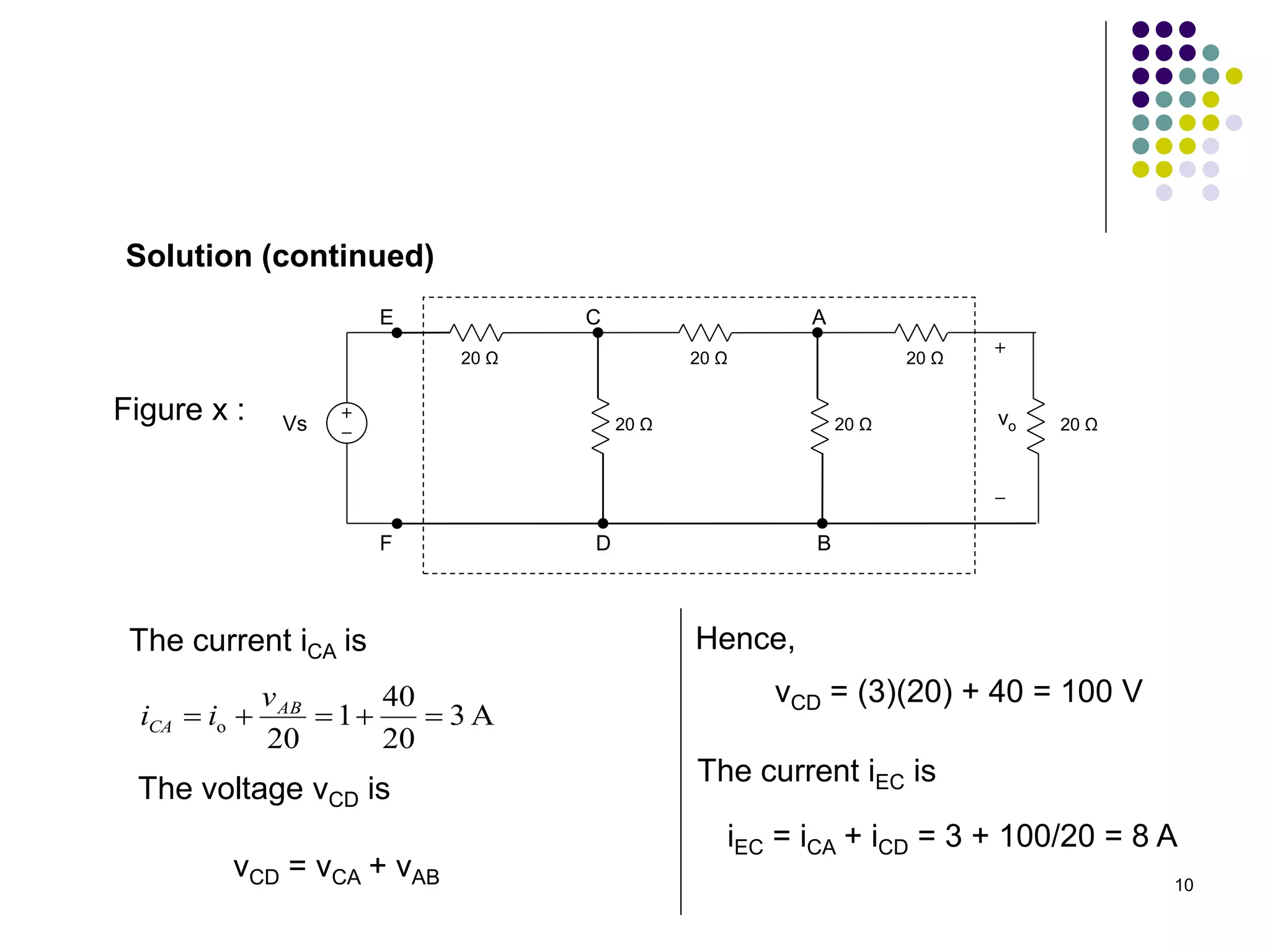
The current iCA is
A
3
20
40
1
20
o 



 AB
CA
v
i
i
20 Ω 20 Ω
20 Ω
20 Ω
vo
Vs 20 Ω 20 Ω
A
B
C
D
E
F
Figure x :
The voltage vCD is
vCD = vCA + vAB
vCD = (3)(20) + 40 = 100 V
Hence,
The current iEC is
iEC = iCA + iCD = 3 + 100/20 = 8 A
11
Solution (continued)
20 Ω 20 Ω
20 Ω
20 Ω
vo
Vs 20 Ω 20 Ω
A
B
C
D
E
F
Figure x:
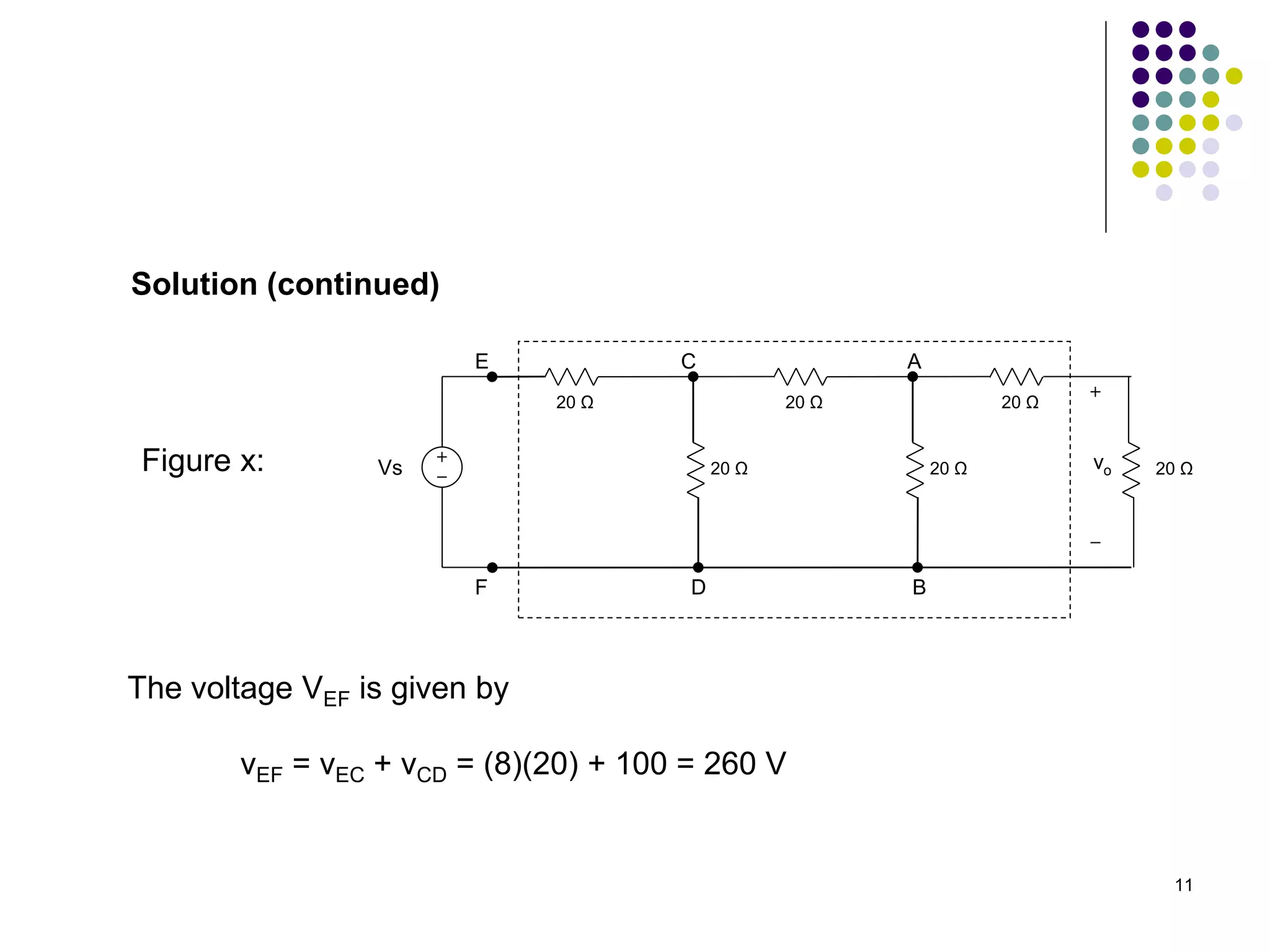
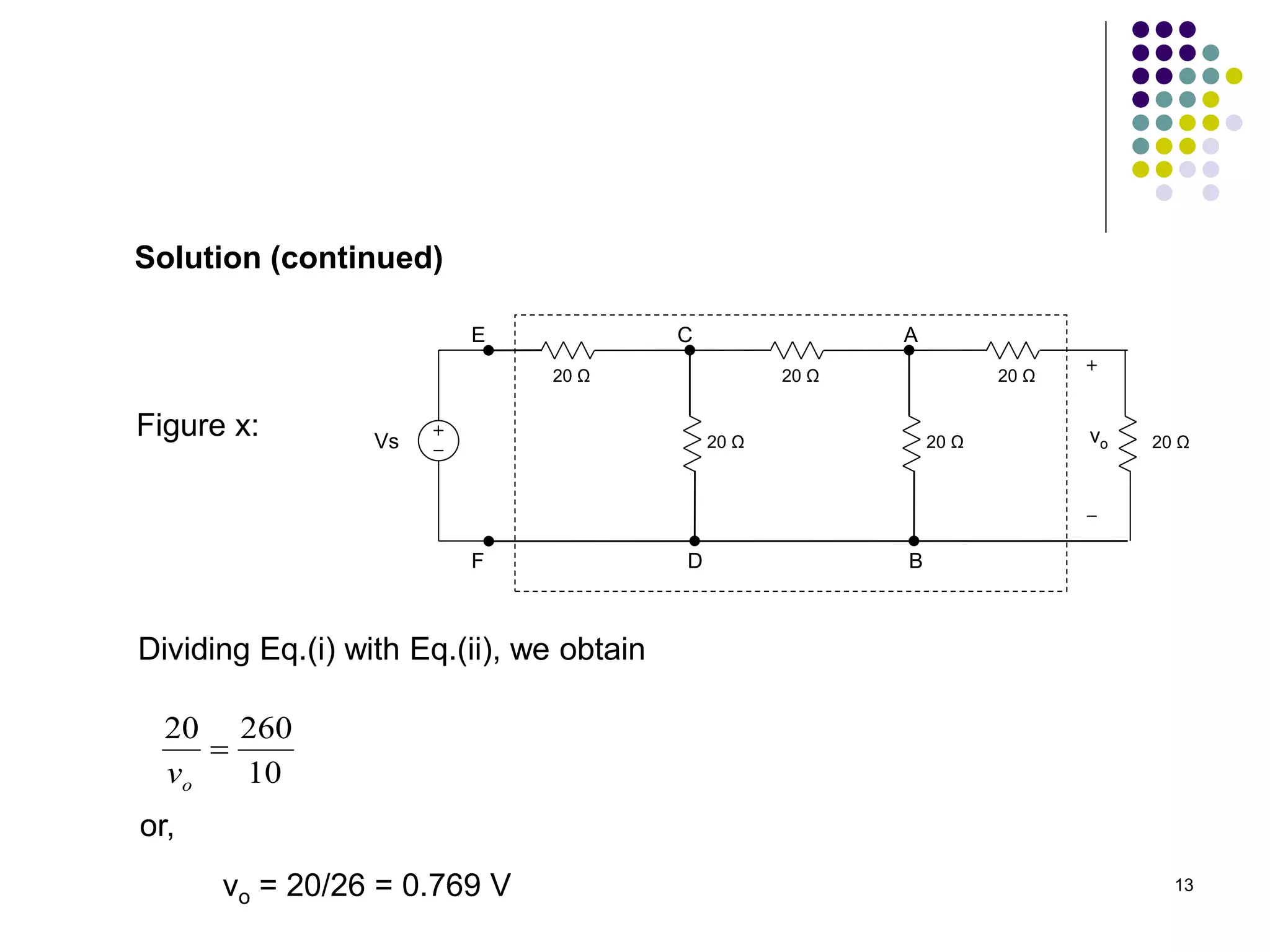
The voltage VEF is given by
vEF = vEC + vCD = (8)(20) + 100 = 260 V
12
Solution (continued)
20 Ω 20 Ω
20 Ω
20 Ω
vo
Vs 20 Ω 20 Ω
A
B
C
D
E
F
Figure x:
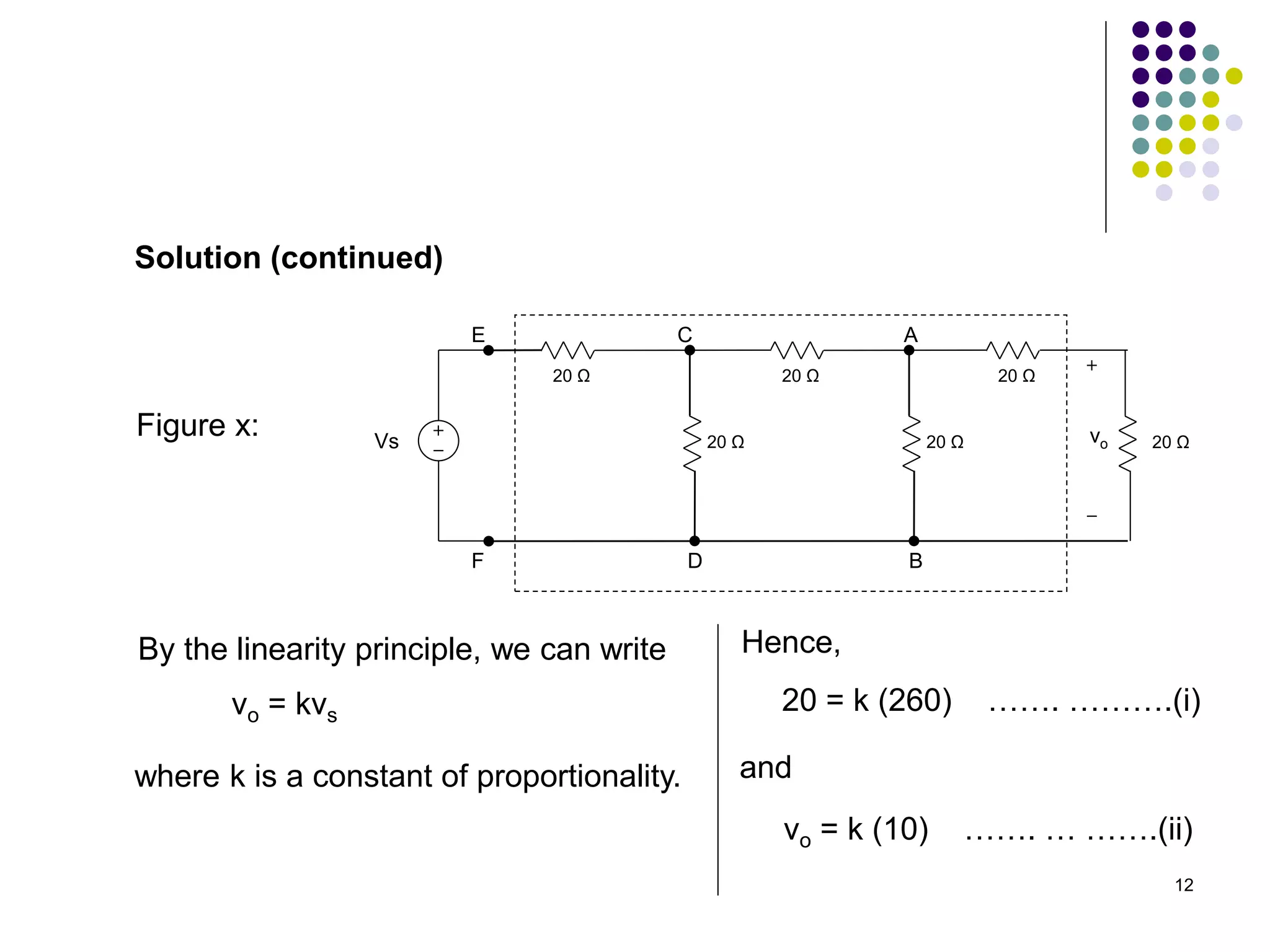
By the linearity principle, we can write
vo = kvs
where k is a constant of proportionality.
Hence,
20 = k (260) ……. ……….(i)
and
vo = k (10) ……. … …….(ii)
13
Solution (continued)
20 Ω 20 Ω
20 Ω
20 Ω
vo
Vs 20 Ω 20 Ω
A
B
C
D
E
F
Figure x:
Dividing Eq.(i) with Eq.(ii), we obtain
10
260
20

o
v
or,
vo = 20/26 = 0.769 V
14
Exercise
Use the proportionality principle to obtain the voltage vo.
1 Ω
0.5 Ω
3 Ω
vo
E = 10 V 5 Ω 1 Ω
A
B
C
D
E
F
Figure x
[ Ans: vo = 3 V ]
15
Superposition Theorem
The superposition theorem is very useful for analysing a linear circuit with
more than one independent source. The superposition theorem helps ease
the solution of a complex circuit by doing away with the need to solve
simultaneous linear equations.
The overall response of a circuit containing several sources is the sum of
the responses to each individual source with the other sources killed.
Current sources are killed, or zeroed out, by replacing them with open circuits
and voltage sources by short circuits.
Note
16
vs1
vs2
is1
R
io
vo
Linear
network
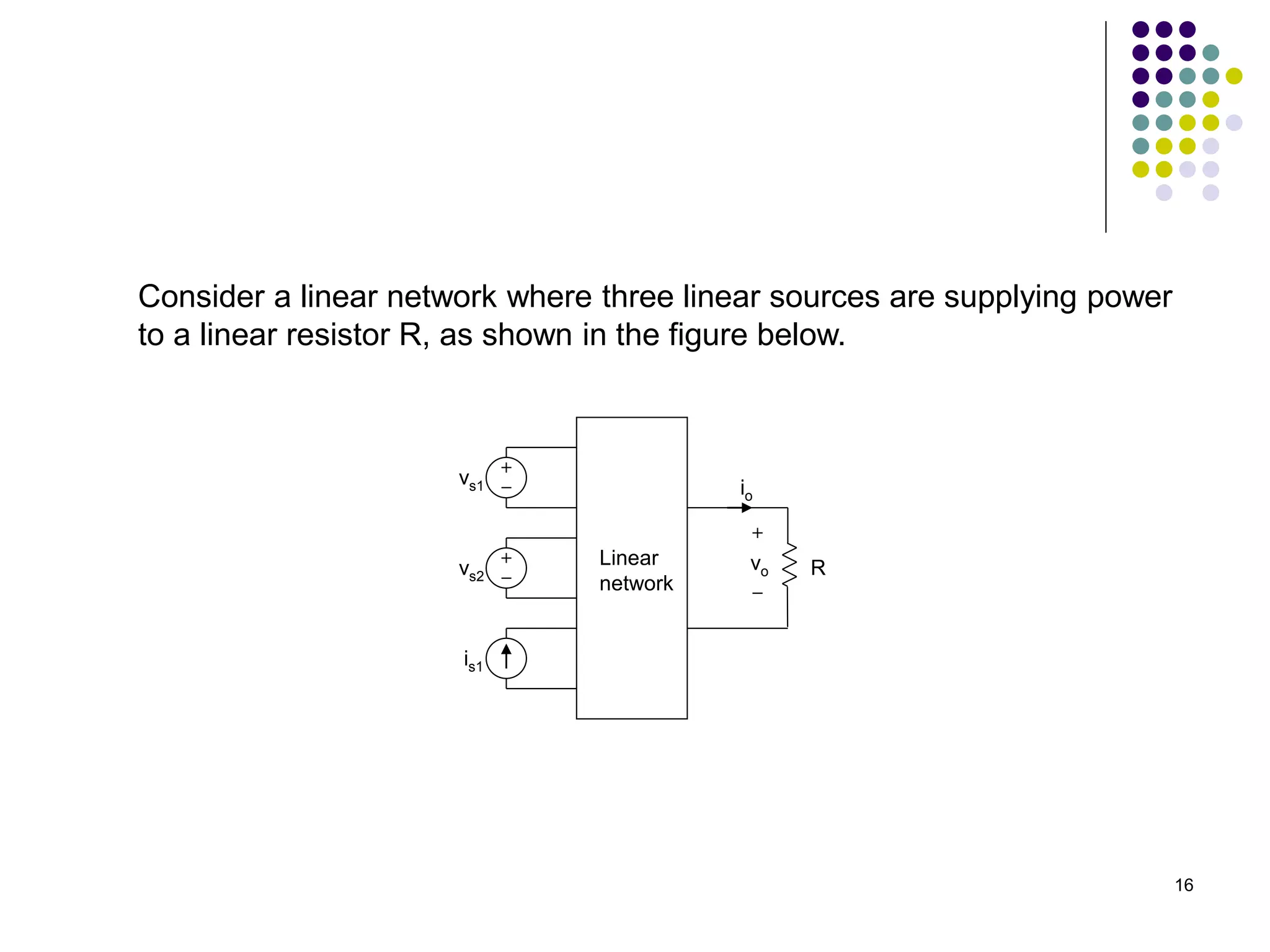
Consider a linear network where three linear sources are supplying power
to a linear resistor R, as shown in the figure below.
17
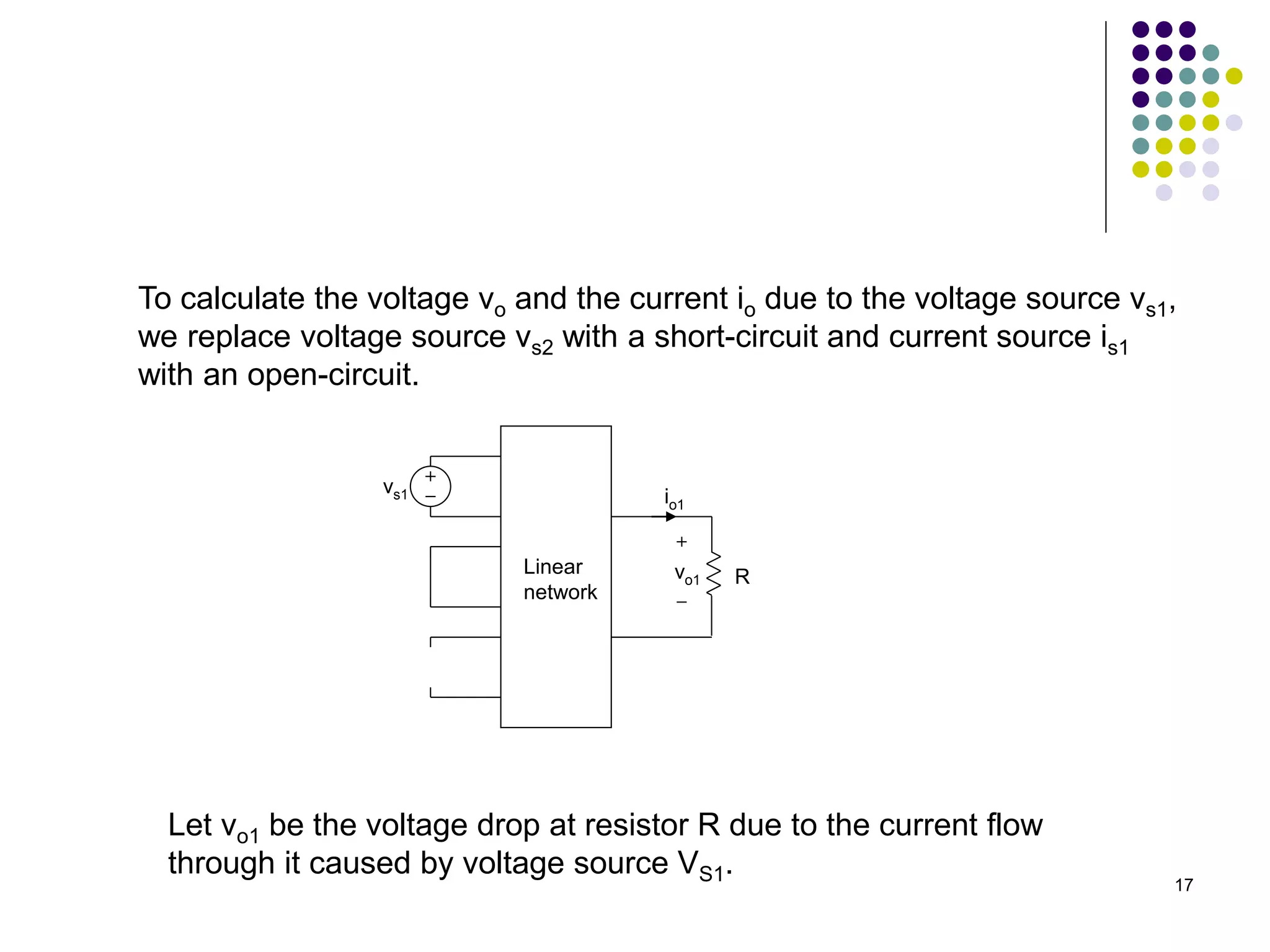
To calculate the voltage vo and the current io due to the voltage source vs1,
we replace voltage source vs2 with a short-circuit and current source is1
with an open-circuit.
vs1
R
io1
vo1
Linear
network
Let vo1 be the voltage drop at resistor R due to the current flow
through it caused by voltage source VS1.
18
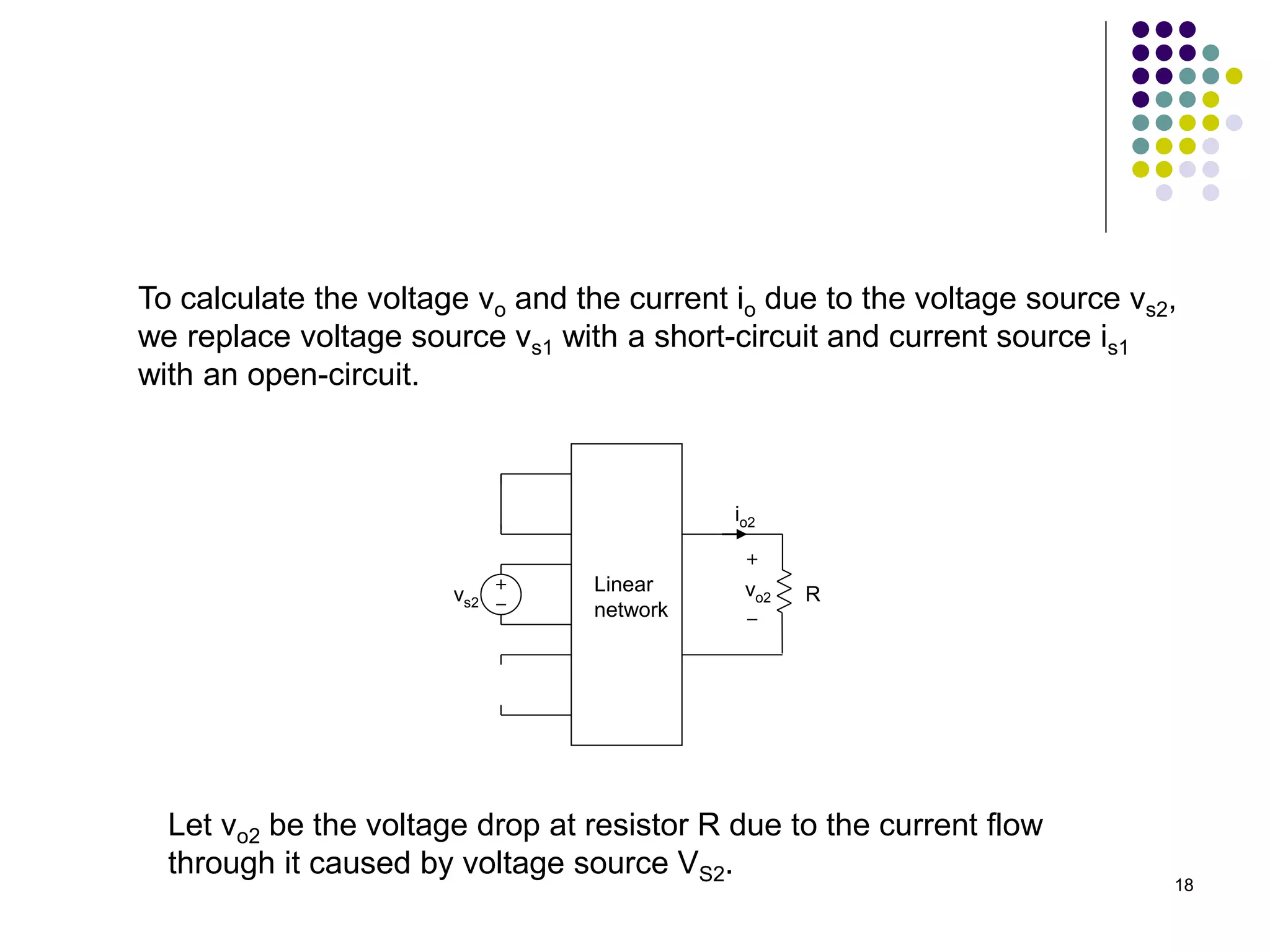
To calculate the voltage vo and the current io due to the voltage source vs2,
we replace voltage source vs1 with a short-circuit and current source is1
with an open-circuit.
vs2 R
io2
vo2
Linear
network
Let vo2 be the voltage drop at resistor R due to the current flow
through it caused by voltage source VS2.
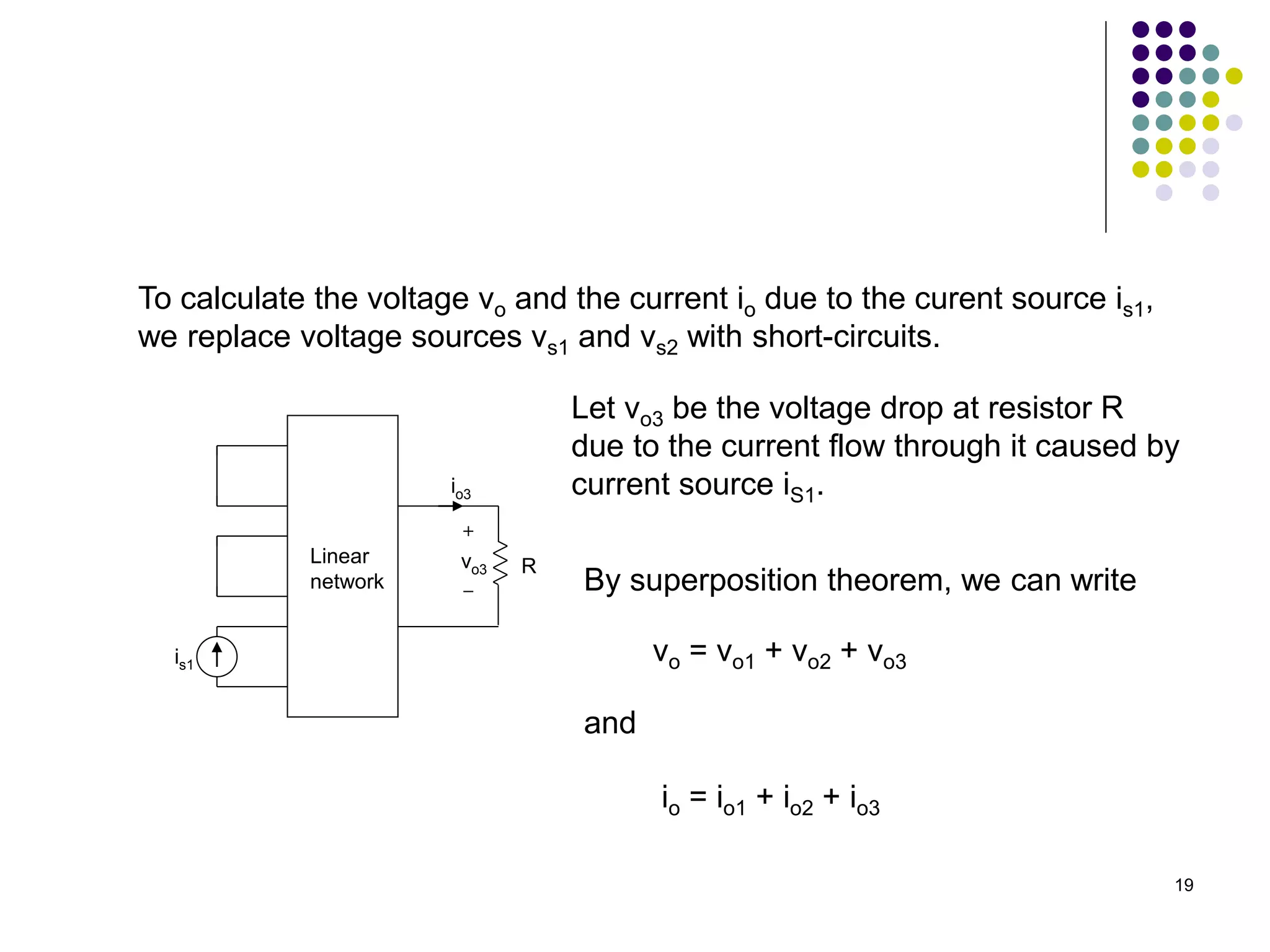
19
To calculate the voltage vo and the current io due to the curent source is1,
we replace voltage sources vs1 and vs2 with short-circuits.
is1
R
io3
vo3
Linear
network By superposition theorem, we can write
vo = vo1 + vo2 + vo3
and
io = io1 + io2 + io3
Let vo3 be the voltage drop at resistor R
due to the current flow through it caused by
current source iS1.
20
Superposition Theorem
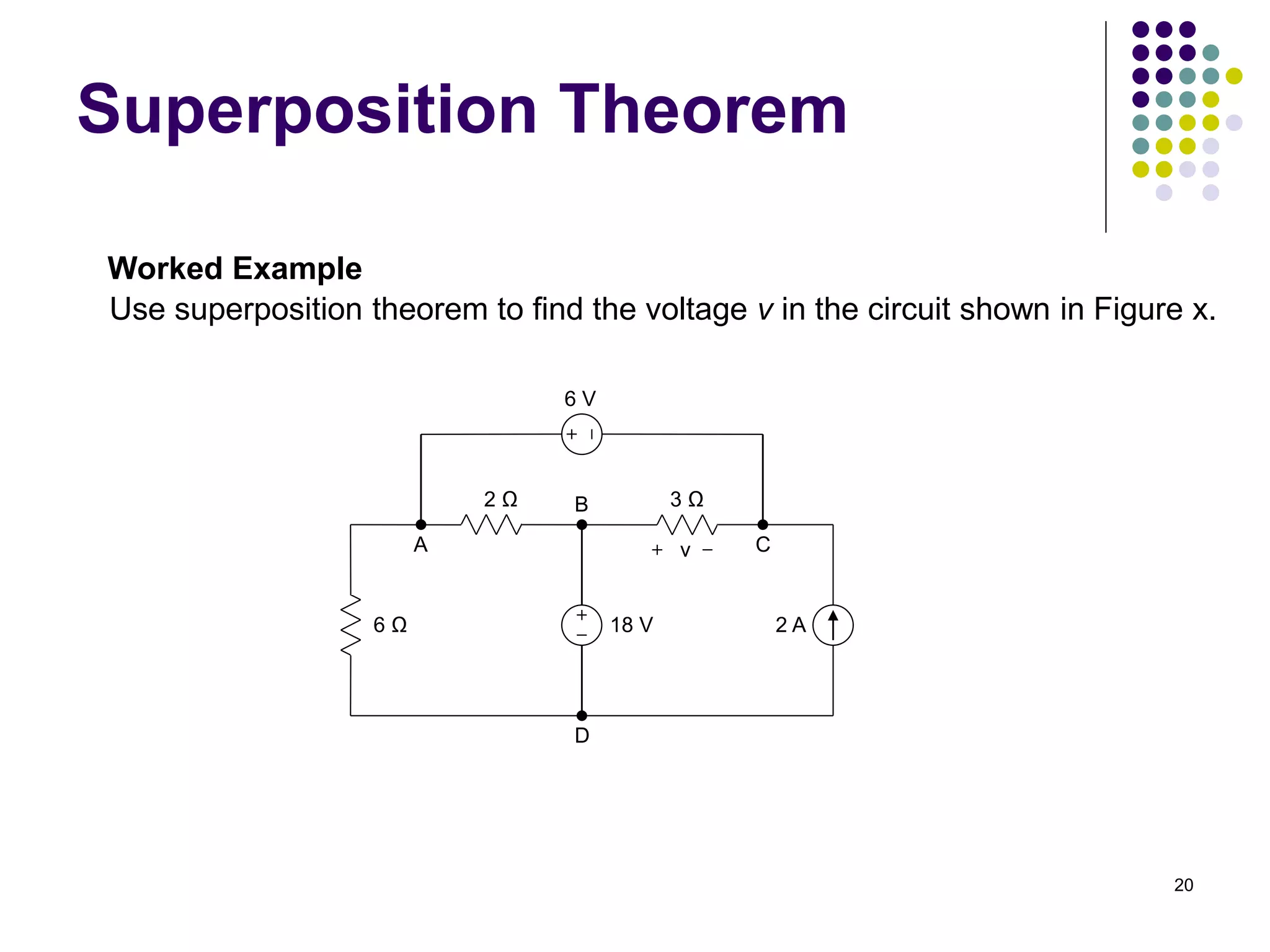
Worked Example
Use superposition theorem to find the voltage v in the circuit shown in Figure x.
18 V
6 Ω
2 Ω 3 Ω
2 A
6 V
A
B
C
D
v
21
Superposition Theorem
Solution
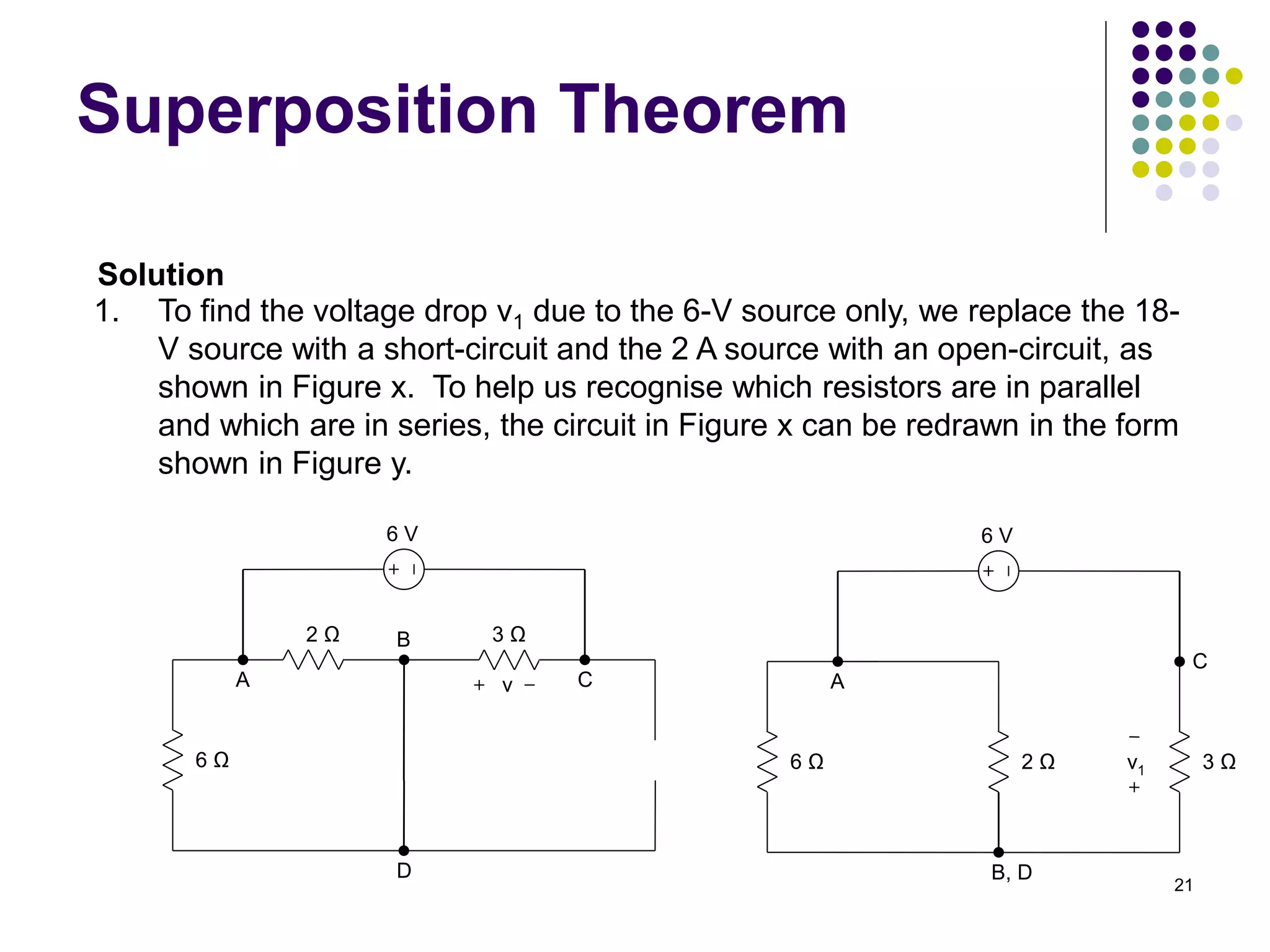
1. To find the voltage drop v1 due to the 6-V source only, we replace the 18-
V source with a short-circuit and the 2 A source with an open-circuit, as
shown in Figure x. To help us recognise which resistors are in parallel
and which are in series, the circuit in Figure x can be redrawn in the form
shown in Figure y.
6 Ω
2 Ω 3 Ω
6 V
A
B
C
D
v
6 Ω
6 V
A
C
B, D
v1
2 Ω 3 Ω
22
Superposition Theorem
By voltage division, we have
Solution
V
4
6
3
2
6
2
6
3
1 





v
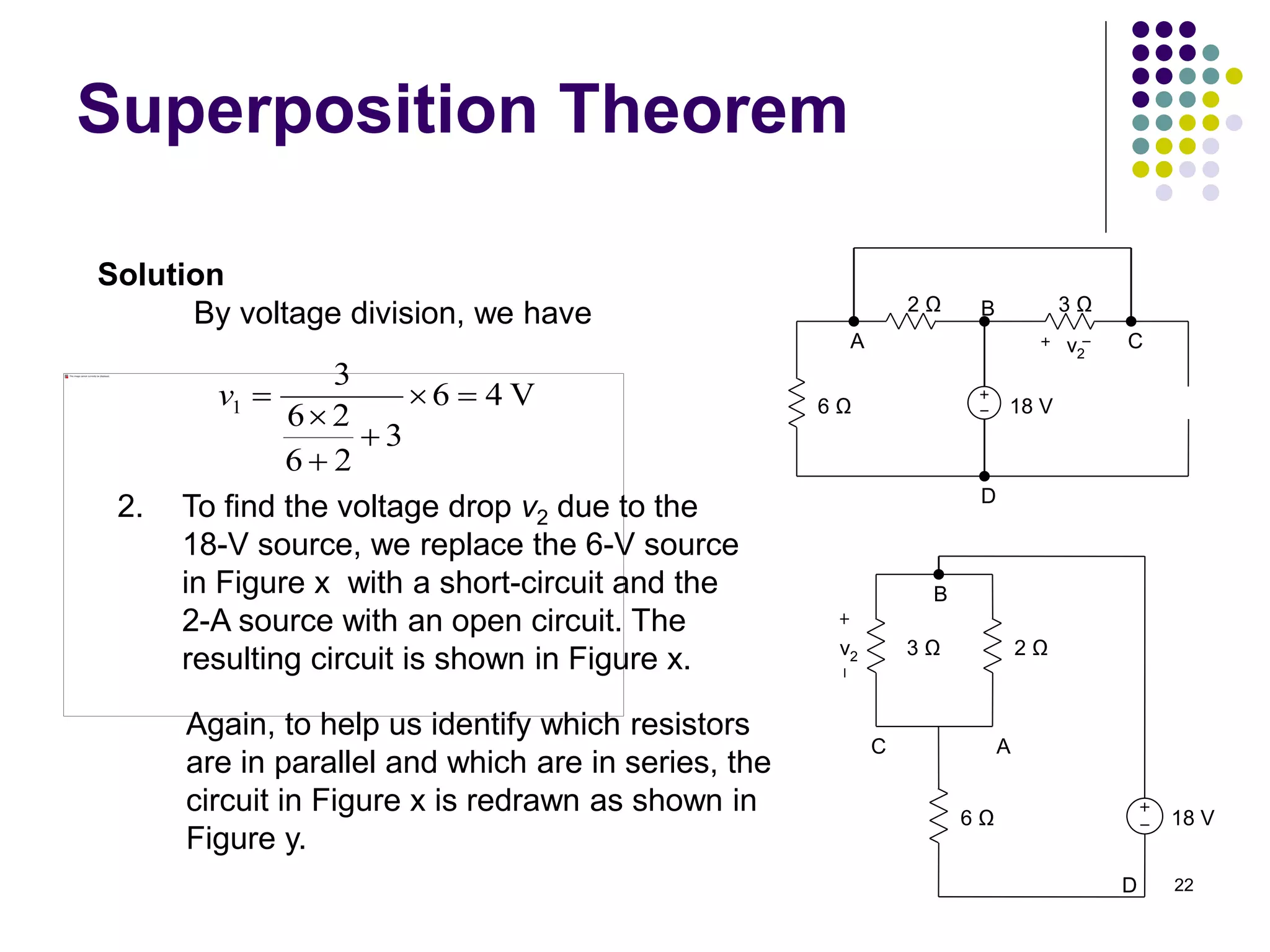
2. To find the voltage drop v2 due to the
18-V source, we replace the 6-V source
in Figure x with a short-circuit and the
2-A source with an open circuit. The
resulting circuit is shown in Figure x.
18 V
6 Ω
2 Ω 3 Ω
A
B
C
D
v2
Again, to help us identify which resistors
are in parallel and which are in series, the
circuit in Figure x is redrawn as shown in
Figure y.
18 V
6 Ω
2 Ω
A
C
D
3 Ω
B
v2
23
Superposition Theorem
Solution (continued)
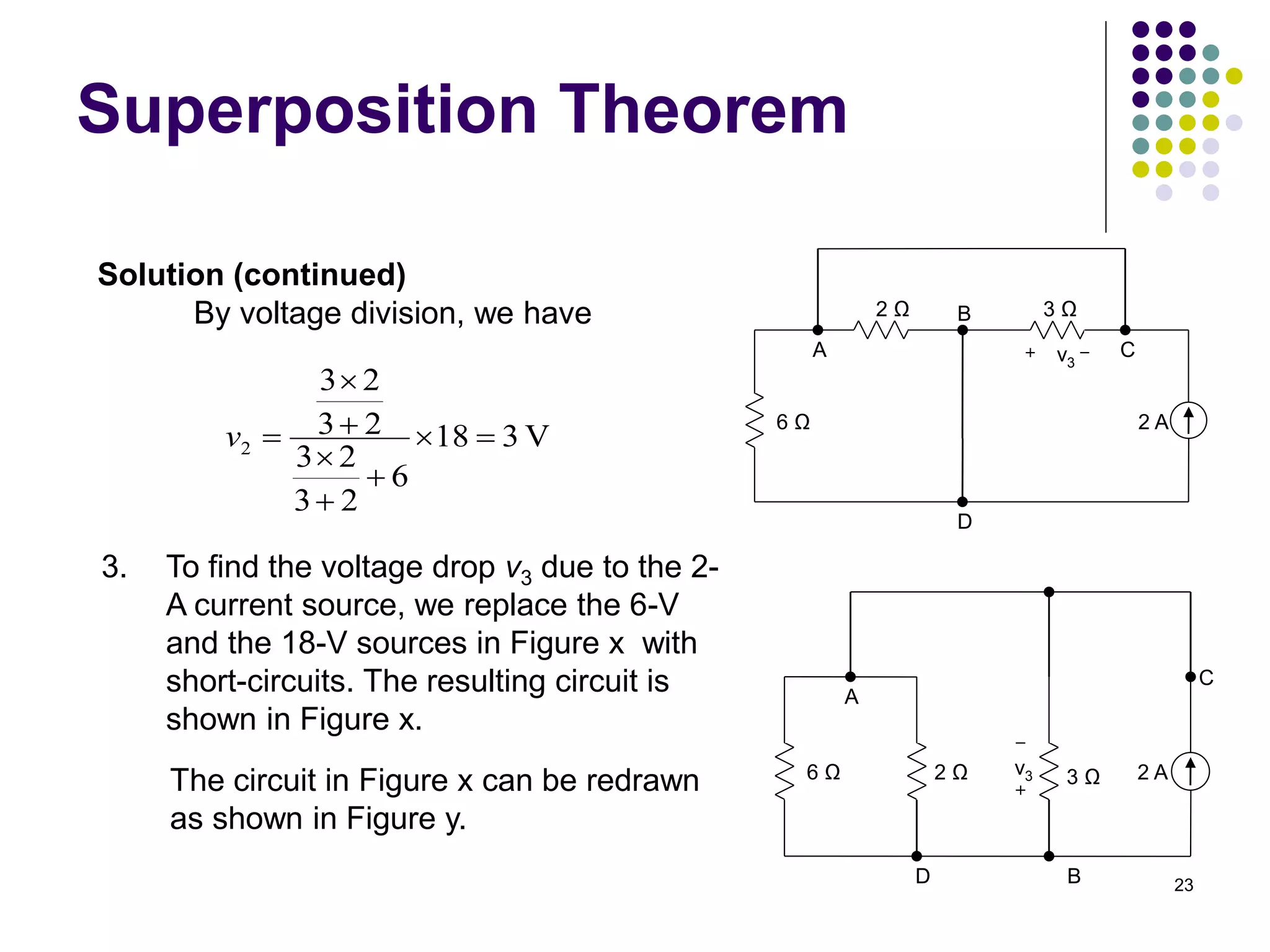
By voltage division, we have
V
3
18
6
2
3
2
3
2
3
2
3
2 







v
3. To find the voltage drop v3 due to the 2-
A current source, we replace the 6-V
and the 18-V sources in Figure x with
short-circuits. The resulting circuit is
shown in Figure x.
6 Ω
2 Ω 3 Ω
2 A
A
B
C
D
v3
The circuit in Figure x can be redrawn
as shown in Figure y.
6 Ω 2 Ω 3 Ω 2 A
A
C
D B
v3
24
Superposition Theorem
Solution (continued)
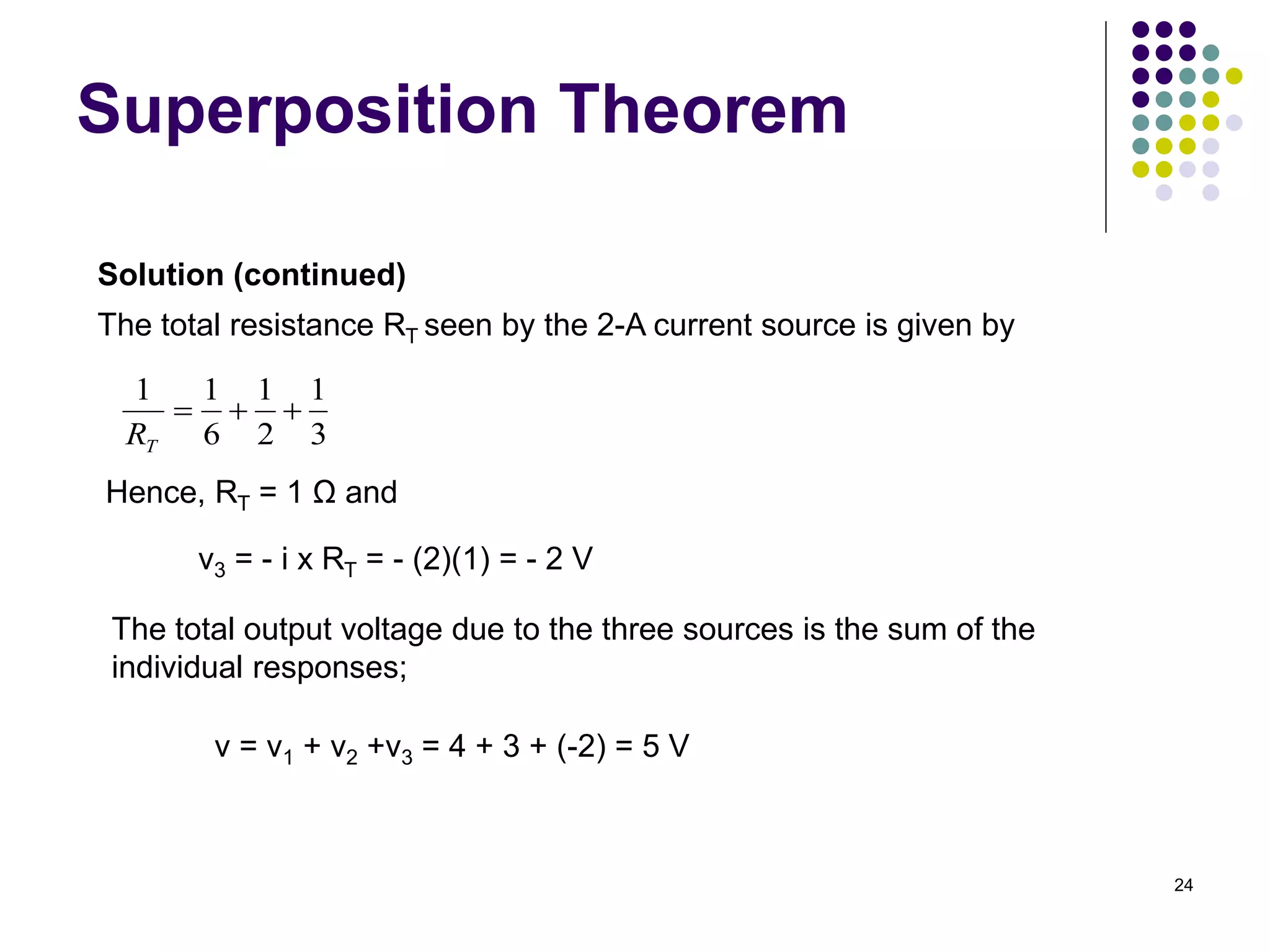
The total resistance RT seen by the 2-A current source is given by
3
1
2
1
6
1
1



T
R
Hence, RT = 1 Ω and
v3 = - i x RT = - (2)(1) = - 2 V
The total output voltage due to the three sources is the sum of the
individual responses;
v = v1 + v2 +v3 = 4 + 3 + (-2) = 5 V
25
Exercise
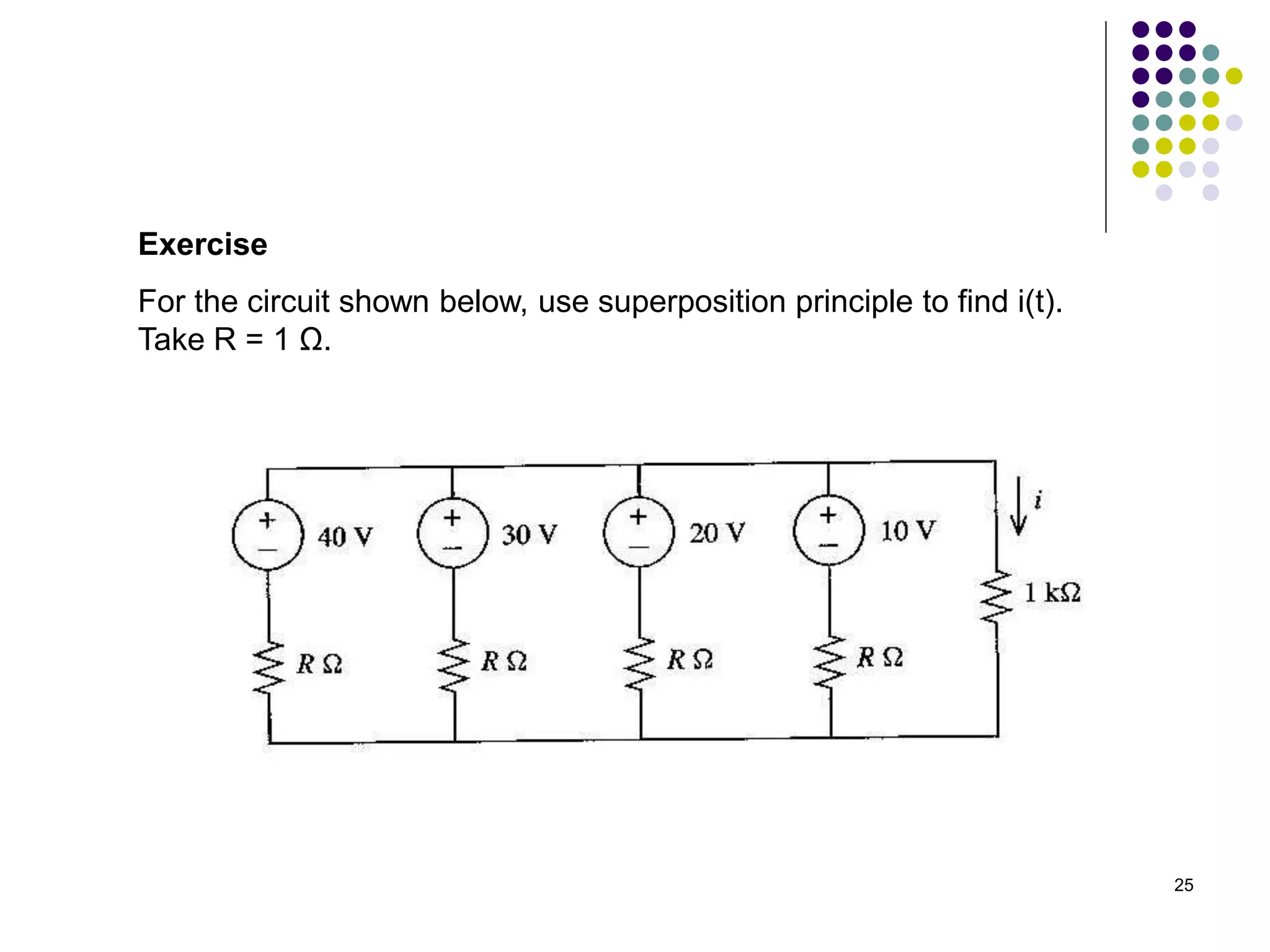
For the circuit shown below, use superposition principle to find i(t).
Take R = 1 Ω.

BEF 12403 - Week 7 - Linearity and Superposition Principles.ppt

  • 1.
  • 2.
    2 Learning Outcomes After completingthis module, you will be able to: 1. Apply the principle of linearity to linear circuits containing linear resistors and independent sources to solve for unknown voltages and currents. 2. Apply the principle of superposition to linear circuits containing linear resistors and independent sources to solve for unknown voltages and currents. 3. Compute Thevenin’s and Norton’s equivalent circuits for networks containing resistors and independent sources. 4. Apply source transformations techniques to circuits containing resistors and independent sources to solve for unknown voltages and currents
  • 3.
    3 In this topicwe will learn three techniques for analysing linear resistive circuits. The circuit analysis techniques are: i. Linearity principle ii. Superposition theorem iii. Source transformations
  • 4.
    4 A linear networkis a circuit composed entirely of independent sources, linear dependent sources, and linear elements. One important consequence of linearity is that a proportionality relationship exists between one circuit variable and another . Linear resistive network, N vs R io v Figure x Let us develop the linearity principle by considering first the network of Figure x, which contains an independent source, a voltage generator, that applies a voltage vs at the input of the network. Linearity Principle
  • 5.
    5 where k1 andk2 are proportionality contants that depend on the actual circuit configuration and component values. vo = k1 vs The resulting voltage (vo) and current (io) (response or output) can be written in the form and io = k2 vs If vs is now doubled, then the new output voltage and output current are vo * = k1 vs * = k1(2vs) io* = k2 vs* = k2(2vs) These results show that due to the linear nature of the circuit, doubling the input doubles the output. This is the linearity principle. Linear resistive network, N vs R io v Linearity Principle
  • 6.
    6 The same resultsare obtained when a current source is is applied to the linear network N as shown in Figure x. The resulting output voltage (vo) and output current (io) can be written in the form vo = k3 is and io = k4 vs Linear resistive network, N is R io v where k3 and k4 are proportionality contants that depend on the actual circuit configuration and component values. If is is now doubled, then the new output voltage and output current are vo * = k3 is * = k1(2is) and io* = k4 is* = k4(2is) where is* is the new input current, and is* = 2is. Again, as with the case of a voltage input, this results shows that due to the linear nature of the network doubling the input doubles the output. Figure x Linearity Principle
  • 7.
    7 Worked Example Using thelinearity principle, find the voltage vo in Figure x. Linearity Principle Figure y 10 V 20 Ω 20 Ω 20 Ω 20 Ω 20 Ω 20 Ω vo
  • 8.
    8 Solution To solve theproblem using linearity principle, we first remove the 10 V source and replace it with an unknown source of voltage vs. Next, we assume a convenient value for vo. Let vo = 20 V (say). Linearity Principle 20 Ω 20 Ω 20 Ω 20 Ω vo Vs 20 Ω 20 Ω A B C D E F Figure x
  • 9.
    9 V 40 20 2 2 20 20 20       o o AB v v v AB ov v 20 20 20   Solution (continued) Using voltage divider rule, we obtain the voltage vo as Hence, The current io is A 1 20 20 20    o o v i 20 Ω 20 Ω 20 Ω vo 20 Ω A B C Figure x
  • 10.
    10 Solution (continued) The currentiCA is A 3 20 40 1 20 o      AB CA v i i 20 Ω 20 Ω 20 Ω 20 Ω vo Vs 20 Ω 20 Ω A B C D E F Figure x : The voltage vCD is vCD = vCA + vAB vCD = (3)(20) + 40 = 100 V Hence, The current iEC is iEC = iCA + iCD = 3 + 100/20 = 8 A
  • 11.
    11 Solution (continued) 20 Ω20 Ω 20 Ω 20 Ω vo Vs 20 Ω 20 Ω A B C D E F Figure x: The voltage VEF is given by vEF = vEC + vCD = (8)(20) + 100 = 260 V
  • 12.
    12 Solution (continued) 20 Ω20 Ω 20 Ω 20 Ω vo Vs 20 Ω 20 Ω A B C D E F Figure x: By the linearity principle, we can write vo = kvs where k is a constant of proportionality. Hence, 20 = k (260) ……. ……….(i) and vo = k (10) ……. … …….(ii)
  • 13.
    13 Solution (continued) 20 Ω20 Ω 20 Ω 20 Ω vo Vs 20 Ω 20 Ω A B C D E F Figure x: Dividing Eq.(i) with Eq.(ii), we obtain 10 260 20  o v or, vo = 20/26 = 0.769 V
  • 14.
    14 Exercise Use the proportionalityprinciple to obtain the voltage vo. 1 Ω 0.5 Ω 3 Ω vo E = 10 V 5 Ω 1 Ω A B C D E F Figure x [ Ans: vo = 3 V ]
  • 15.
    15 Superposition Theorem Superposition Theorem Thesuperposition theorem is very useful for analysing a linear circuit with more than one independent source. The superposition theorem helps ease the solution of a complex circuit by doing away with the need to solve simultaneous linear equations. The overall response of a circuit containing several sources is the sum of the responses to each individual source with the other sources killed. Current sources are killed, or zeroed out, by replacing them with open circuits and voltage sources by short circuits. Note
  • 16.
    16 vs1 vs2 is1 R io vo Linear network Consider a linearnetwork where three linear sources are supplying power to a linear resistor R, as shown in the figure below.
  • 17.
    17 To calculate thevoltage vo and the current io due to the voltage source vs1, we replace voltage source vs2 with a short-circuit and current source is1 with an open-circuit. vs1 R io1 vo1 Linear network Let vo1 be the voltage drop at resistor R due to the current flow through it caused by voltage source VS1.
  • 18.
    18 To calculate thevoltage vo and the current io due to the voltage source vs2, we replace voltage source vs1 with a short-circuit and current source is1 with an open-circuit. vs2 R io2 vo2 Linear network Let vo2 be the voltage drop at resistor R due to the current flow through it caused by voltage source VS2.
  • 19.
    19 To calculate thevoltage vo and the current io due to the curent source is1, we replace voltage sources vs1 and vs2 with short-circuits. is1 R io3 vo3 Linear network By superposition theorem, we can write vo = vo1 + vo2 + vo3 and io = io1 + io2 + io3 Let vo3 be the voltage drop at resistor R due to the current flow through it caused by current source iS1.
  • 20.
    20 Superposition Theorem Worked Example Usesuperposition theorem to find the voltage v in the circuit shown in Figure x. 18 V 6 Ω 2 Ω 3 Ω 2 A 6 V A B C D v
  • 21.
    21 Superposition Theorem Solution 1. Tofind the voltage drop v1 due to the 6-V source only, we replace the 18- V source with a short-circuit and the 2 A source with an open-circuit, as shown in Figure x. To help us recognise which resistors are in parallel and which are in series, the circuit in Figure x can be redrawn in the form shown in Figure y. 6 Ω 2 Ω 3 Ω 6 V A B C D v 6 Ω 6 V A C B, D v1 2 Ω 3 Ω
  • 22.
    22 Superposition Theorem By voltagedivision, we have Solution V 4 6 3 2 6 2 6 3 1       v 2. To find the voltage drop v2 due to the 18-V source, we replace the 6-V source in Figure x with a short-circuit and the 2-A source with an open circuit. The resulting circuit is shown in Figure x. 18 V 6 Ω 2 Ω 3 Ω A B C D v2 Again, to help us identify which resistors are in parallel and which are in series, the circuit in Figure x is redrawn as shown in Figure y. 18 V 6 Ω 2 Ω A C D 3 Ω B v2
  • 23.
    23 Superposition Theorem Solution (continued) Byvoltage division, we have V 3 18 6 2 3 2 3 2 3 2 3 2         v 3. To find the voltage drop v3 due to the 2- A current source, we replace the 6-V and the 18-V sources in Figure x with short-circuits. The resulting circuit is shown in Figure x. 6 Ω 2 Ω 3 Ω 2 A A B C D v3 The circuit in Figure x can be redrawn as shown in Figure y. 6 Ω 2 Ω 3 Ω 2 A A C D B v3
  • 24.
    24 Superposition Theorem Solution (continued) Thetotal resistance RT seen by the 2-A current source is given by 3 1 2 1 6 1 1    T R Hence, RT = 1 Ω and v3 = - i x RT = - (2)(1) = - 2 V The total output voltage due to the three sources is the sum of the individual responses; v = v1 + v2 +v3 = 4 + 3 + (-2) = 5 V
  • 25.
    25 Exercise For the circuitshown below, use superposition principle to find i(t). Take R = 1 Ω.