

LASIK for high myopia: New considerations Dan Z Reinstein MD MA(Cantab) FRCSC FRCOphth 1,2,3,4 1. London Vision Clinic, London, UK 2. St. Thomas’ Hospital - Kings College, London, UK  3. Weill Medical College of Cornell University, New York, USA 4. Centre Hospitalier National d’Ophtalmologie, (Pr. Laroche) , Paris, France
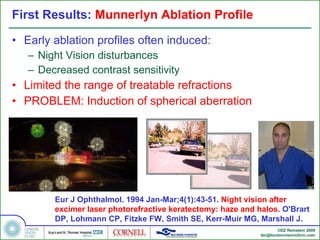
First Results:  Munnerlyn Ablation Profile Early ablation profiles often induced: Night Vision disturbances Decreased contrast sensitivity Limited the range of treatable refractions PROBLEM: Induction of spherical aberration Eur J Ophthalmol. 1994 Jan-Mar;4(1):43-51.  Night vision after excimer laser photorefractive keratectomy: haze and halos.  O'Brart DP, Lohmann CP, Fitzke FW, Smith SE, Kerr-Muir MG, Marshall J.
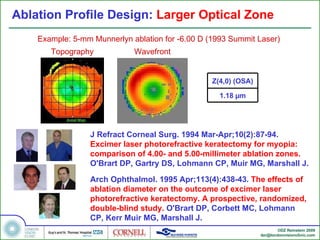
Ablation Profile Design:  Larger Optical Zone Arch Ophthalmol. 1995 Apr;113(4):438-43.  The effects of ablation diameter on the outcome of excimer laser photorefractive keratectomy. A prospective, randomized, double-blind study.  O'Brart DP, Corbett MC, Lohmann CP, Kerr Muir MG, Marshall J. J Refract Corneal Surg. 1994 Mar-Apr;10(2):87-94.  Excimer laser photorefractive keratectomy for myopia: comparison of 4.00- and 5.00-millimeter ablation zones.  O'Brart DP, Gartry DS, Lohmann CP, Muir MG, Marshall J. Topography Wavefront Example: 5-mm Munnerlyn ablation for -6.00 D (1993 Summit Laser) Z(4,0) (OSA) 1.18  µm
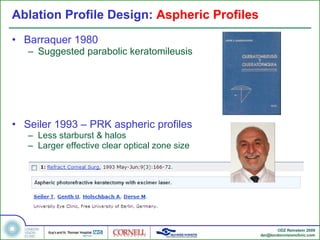
Ablation Profile Design:  Aspheric Profiles Barraquer 1980 Suggested parabolic keratomileusis Seiler 1993 – PRK aspheric profiles Less starburst & halos Larger effective clear optical zone size
Why was spherical aberration increasing?
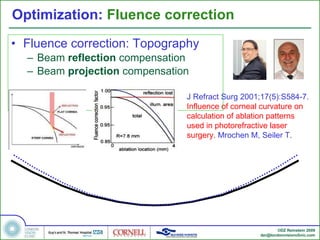
Fluence correction: Topography Beam  reflection  compensation Beam  projection  compensation Optimization:  Fluence correction J Refract Surg 2001;17(5):S584-7.  Influence of corneal curvature on calculation of ablation patterns used in photorefractive laser surgery.  Mrochen M, Seiler T.
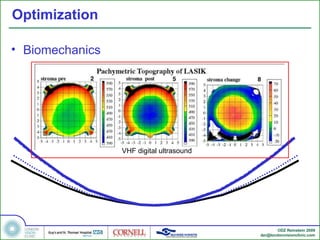
Optimization Biomechanics VHF digital ultrasound
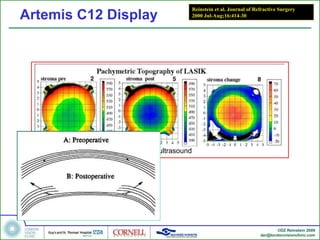
Artemis C12 Display Reinstein et al. Journal of Refractive Surgery 2000 Jul-Aug;16:414-30 Roberts C. The cornea is not a piece of plastic. JRS 2000; 16:407-413 VHF digital ultrasound
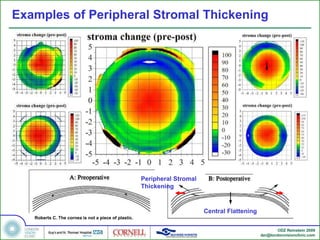
Examples of Peripheral Stromal Thickening Roberts C. The cornea is not a piece of plastic. Peripheral Stromal Thickening Central Flattening
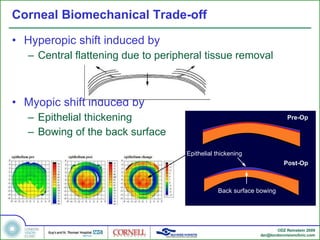
Corneal Biomechanical Trade-off Hyperopic shift induced by Central flattening due to peripheral tissue removal Myopic shift induced by Epithelial thickening Bowing of the back surface Post-Op Pre-Op Back surface bowing Epithelial thickening
Free lunch?
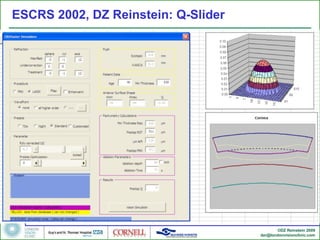
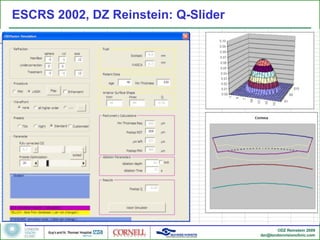
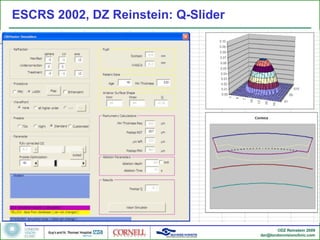
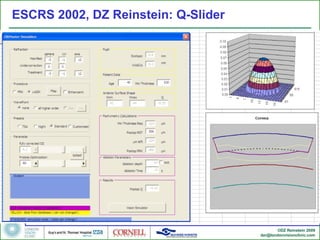
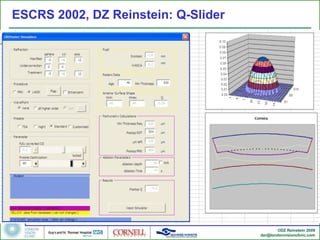
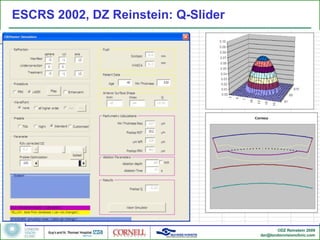
ESCRS 2002, DZ Reinstein: Q-Slider
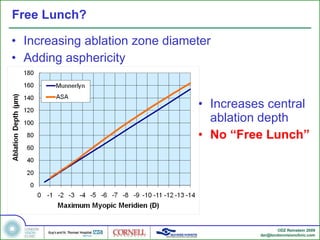
Free Lunch? Increasing ablation zone diameter Adding asphericity Increases central ablation depth No “Free Lunch”
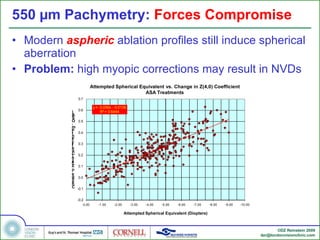
550 µm Pachymetry:  Forces Compromise Modern  aspheric   ablation profiles still induce spherical aberration Problem:  high myopic corrections may result in NVDs
Wavefront-Guided Treatment of Spherical Aberration
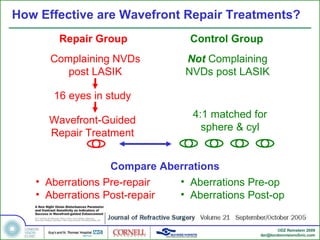
How Effective are Wavefront Repair Treatments? Repair Group Complaining NVDs post LASIK Wavefront-Guided Repair Treatment Control Group Not  Complaining NVDs post LASIK 16 eyes in study 4:1 matched for sphere & cyl Aberrations Pre-op Aberrations Post-op Compare Aberrations Aberrations Pre-repair Aberrations Post-repair
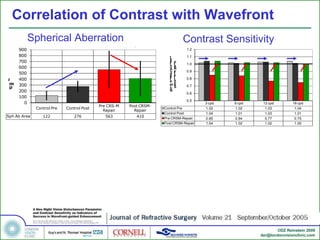
Correlation of Contrast with Wavefront Spherical Aberration Contrast Sensitivity
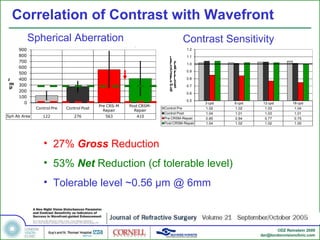
Correlation of Contrast with Wavefront Spherical Aberration Contrast Sensitivity 27%  Gross  Reduction 53%  Net  Reduction (cf tolerable level) Tolerable level ~0.56 µm @ 6mm
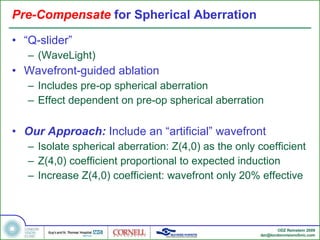
Pre-Compensate  for Spherical Aberration  “ Q-slider” (WaveLight) Wavefront-guided ablation Includes pre-op spherical aberration Effect dependent on pre-op spherical aberration Our Approach:  Include an “artificial” wavefront Isolate spherical aberration: Z(4,0) as the only coefficient Z(4,0) coefficient proportional to expected induction Increase Z(4,0) coefficient: wavefront only 20% effective
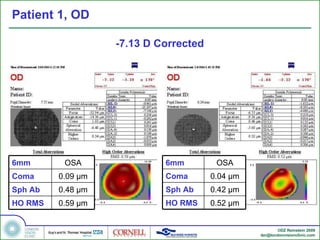
Patient 1, OD -7.13 D Corrected 6mm OSA Coma 0.04  µm Sph Ab 0.42  µm HO RMS 0.52  µm 6mm OSA Coma 0.09  µm Sph Ab 0.48  µm HO RMS 0.59  µm
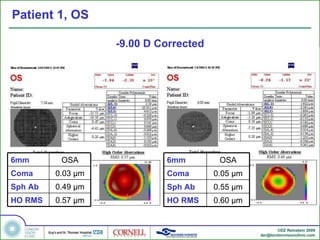
Patient 1, OS -9.00 D Corrected 6mm OSA Coma 0.03  µm Sph Ab 0.49 µm HO RMS 0.57  µm 6mm OSA Coma 0.05  µm Sph Ab 0.55 µm HO RMS 0.60  µm
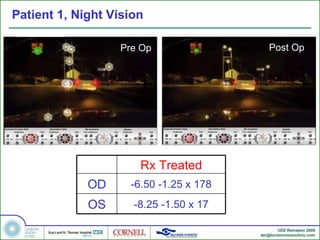
Patient 1, Night Vision Pre Op Post Op Rx Treated OD -6.50 -1.25 x 178 OS -8.25 -1.50 x 17
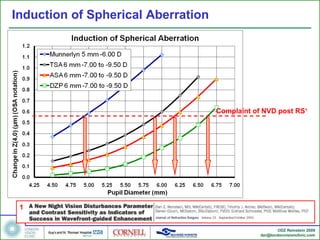
Induction of Spherical Aberration Complaint of NVD post RS 1 1
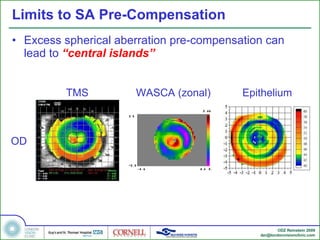
Limits to SA Pre-Compensation Excess spherical aberration pre-compensation can lead to  “central islands” TMS WASCA (zonal) Epithelium OD
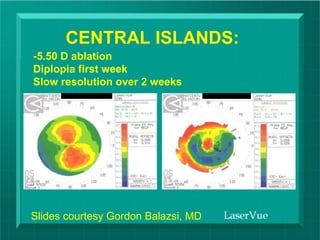
CENTRAL ISLANDS: Slides courtesy Gordon Balazsi, MD -5.50 D ablation Diplopia first week Slow resolution over 2 weeks
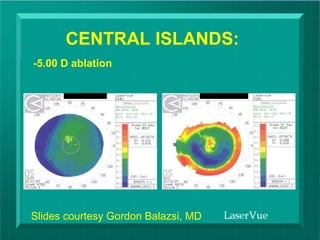
CENTRAL ISLANDS: Slides courtesy Gordon Balazsi, MD -5.00 D ablation
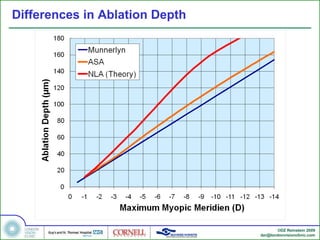
Differences in Ablation Depth
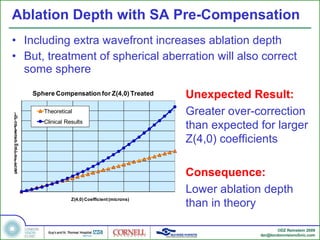
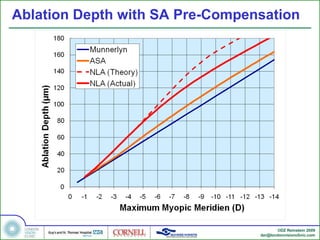
Ablation Depth with SA Pre-Compensation Including extra wavefront increases ablation depth But, treatment of spherical aberration will also correct some sphere Unexpected Result: Greater over-correction than expected for larger Z(4,0) coefficients Consequence: Lower ablation depth than in theory
Ablation Depth with SA Pre-Compensation
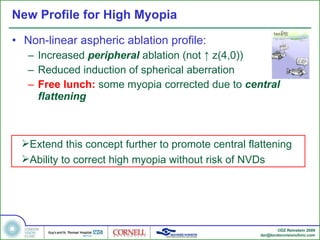
New Profile for High Myopia Non-linear aspheric ablation profile: Increased  peripheral  ablation (not ↑ z(4,0)) Reduced induction of spherical aberration Free lunch:   some myopia corrected due to  central flattening Extend this concept further to promote central flattening Ability to correct high myopia without risk of NVDs
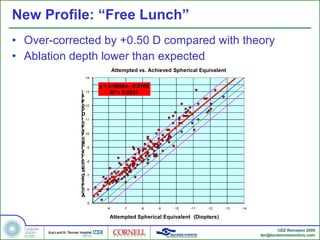
New Profile: “Free Lunch” Over-corrected by +0.50 D compared with theory Ablation depth lower than expected
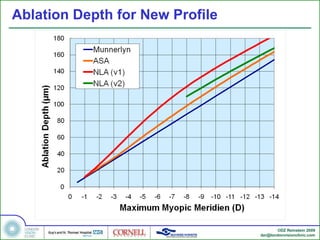
Ablation Depth for New Profile
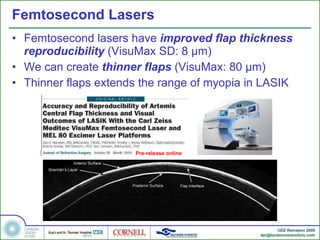
Femtosecond Lasers Femtosecond lasers have  improved flap thickness reproducibility  (VisuMax SD: 8 µm) We can create  thinner flaps  (VisuMax: 80 µm) Thinner flaps extends the range of myopia in LASIK Pre-release online
Outcomes
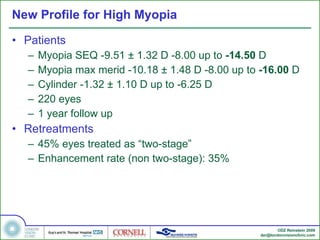
New Profile for High Myopia Patients Myopia SEQ -9.51  ± 1.32 D -8.00 up to  -14.50  D Myopia max merid -10.18  ± 1.48 D -8.00 up to  -16.00  D Cylinder -1.32 ± 1.10 D up to -6.25 D 220 eyes 1 year follow up Retreatments 45% eyes treated as “two-stage” Enhancement rate (non two-stage): 35%
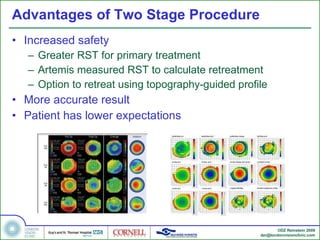
Advantages of Two Stage Procedure Increased safety Greater RST for primary treatment Artemis measured RST to calculate retreatment Option to retreat using topography-guided profile More accurate result Patient has lower expectations
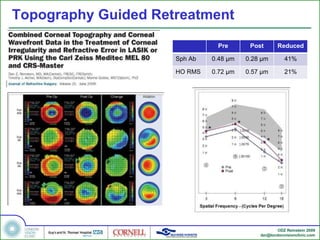
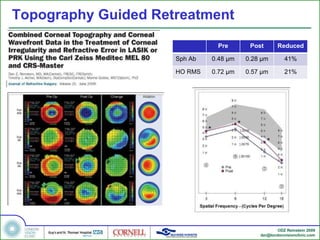
Topography Guided Retreatment Pre Post Reduced Sph Ab 0.48 µm 0.28 µm 41% HO RMS 0.72 µm 0.57 µm 21%
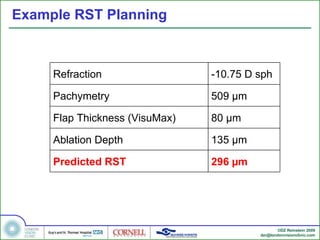
Example RST Planning Refraction -10.75 D sph Pachymetry 509 µm Flap Thickness (VisuMax) 80 µm Ablation Depth 135 µm Predicted RST 296 µm
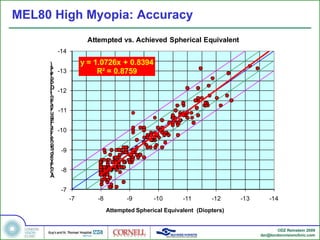
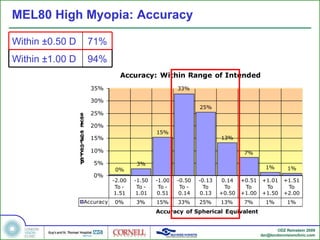
MEL80 High Myopia: Accuracy
MEL80 High Myopia: Accuracy Within  ±0.50 D 71% Within  ±1.00 D 94%
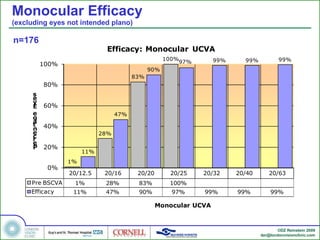
Monocular Efficacy (excluding eyes not intended plano) n=176
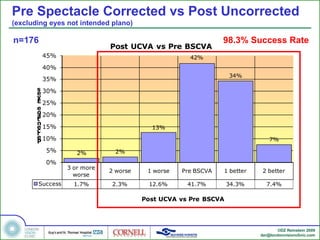
n=176 98.3% Success Rate Pre Spectacle Corrected vs Post Uncorrected  (excluding eyes not intended plano)
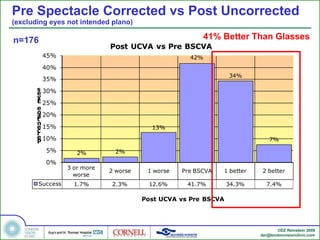
Pre Spectacle Corrected vs Post Uncorrected  (excluding eyes not intended plano) n=176 41% Better Than Glasses
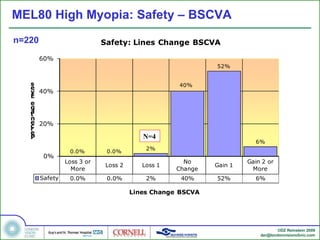
MEL80 High Myopia: Safety – BSCVA N=4 n=220
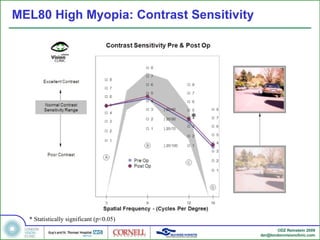
MEL80 High Myopia: Contrast Sensitivity * * Statistically significant (p<0.05)
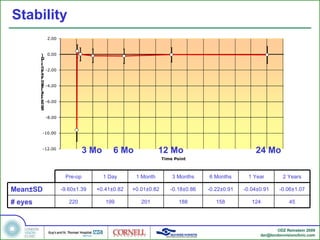
Stability 3 Mo 6 Mo 12 Mo 24 Mo Pre-op 1 Day 1 Month 3 Months 6 Months 1 Year 2 Years Mean ±SD   -9.60 ±1.39 +0.41 ±0.82 +0.01 ±0.82 -0.18 ±0.86 -0.22 ±0.91 -0.04 ±0.91 -0.06 ±1.07 # eyes 220 199 201 188 158 124 45
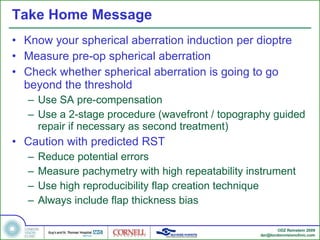
Take Home Message Know your spherical aberration induction per dioptre Measure pre-op spherical aberration Check whether spherical aberration is going to go beyond the threshold Use SA pre-compensation Use a 2-stage procedure (wavefront / topography guided repair if necessary as second treatment) Caution with predicted RST  Reduce potential errors Measure pachymetry with high repeatability instrument Use high reproducibility flap creation technique Always include flap thickness bias
LASIK for high myopia: New considerations Dan Z Reinstein MD MA(Cantab) FRCSC FRCOphth 1,2,3,4 1. London Vision Clinic, London, UK 2. St. Thomas’ Hospital - Kings College, London, UK  3. Weill Medical College of Cornell University, New York, USA 4. Centre Hospitalier National d’Ophtalmologie, (Pr. Laroche) , Paris, France Thank You
Topography Guided Retreatment Pre Post Reduced Sph Ab 0.48 µm 0.28 µm 41% HO RMS 0.72 µm 0.57 µm 21%
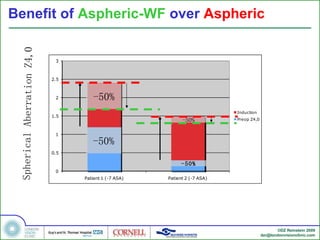
Benefit of  Aspheric-WF  over  Aspheric Spherical Aberration Z4,0 -50% -50% -50% -50%

LASIK for High Myopia: New Considerations

  • 1.
    LASIK for highmyopia: New considerations Dan Z Reinstein MD MA(Cantab) FRCSC FRCOphth 1,2,3,4 1. London Vision Clinic, London, UK 2. St. Thomas’ Hospital - Kings College, London, UK 3. Weill Medical College of Cornell University, New York, USA 4. Centre Hospitalier National d’Ophtalmologie, (Pr. Laroche) , Paris, France
  • 2.
    First Results: Munnerlyn Ablation Profile Early ablation profiles often induced: Night Vision disturbances Decreased contrast sensitivity Limited the range of treatable refractions PROBLEM: Induction of spherical aberration Eur J Ophthalmol. 1994 Jan-Mar;4(1):43-51. Night vision after excimer laser photorefractive keratectomy: haze and halos. O'Brart DP, Lohmann CP, Fitzke FW, Smith SE, Kerr-Muir MG, Marshall J.
  • 3.
    Ablation Profile Design: Larger Optical Zone Arch Ophthalmol. 1995 Apr;113(4):438-43. The effects of ablation diameter on the outcome of excimer laser photorefractive keratectomy. A prospective, randomized, double-blind study. O'Brart DP, Corbett MC, Lohmann CP, Kerr Muir MG, Marshall J. J Refract Corneal Surg. 1994 Mar-Apr;10(2):87-94. Excimer laser photorefractive keratectomy for myopia: comparison of 4.00- and 5.00-millimeter ablation zones. O'Brart DP, Gartry DS, Lohmann CP, Muir MG, Marshall J. Topography Wavefront Example: 5-mm Munnerlyn ablation for -6.00 D (1993 Summit Laser) Z(4,0) (OSA) 1.18 µm
  • 4.
    Ablation Profile Design: Aspheric Profiles Barraquer 1980 Suggested parabolic keratomileusis Seiler 1993 – PRK aspheric profiles Less starburst & halos Larger effective clear optical zone size
  • 5.
    Why was sphericalaberration increasing?
  • 6.
    Fluence correction: TopographyBeam reflection compensation Beam projection compensation Optimization: Fluence correction J Refract Surg 2001;17(5):S584-7. Influence of corneal curvature on calculation of ablation patterns used in photorefractive laser surgery. Mrochen M, Seiler T.
  • 7.
  • 8.
    Artemis C12 DisplayReinstein et al. Journal of Refractive Surgery 2000 Jul-Aug;16:414-30 Roberts C. The cornea is not a piece of plastic. JRS 2000; 16:407-413 VHF digital ultrasound
  • 9.
    Examples of PeripheralStromal Thickening Roberts C. The cornea is not a piece of plastic. Peripheral Stromal Thickening Central Flattening
  • 10.
    Corneal Biomechanical Trade-offHyperopic shift induced by Central flattening due to peripheral tissue removal Myopic shift induced by Epithelial thickening Bowing of the back surface Post-Op Pre-Op Back surface bowing Epithelial thickening
  • 11.
  • 12.
    ESCRS 2002, DZReinstein: Q-Slider
  • 13.
    ESCRS 2002, DZReinstein: Q-Slider
  • 14.
    ESCRS 2002, DZReinstein: Q-Slider
  • 15.
    ESCRS 2002, DZReinstein: Q-Slider
  • 16.
    ESCRS 2002, DZReinstein: Q-Slider
  • 17.
    ESCRS 2002, DZReinstein: Q-Slider
  • 18.
    Free Lunch? Increasingablation zone diameter Adding asphericity Increases central ablation depth No “Free Lunch”
  • 19.
    550 µm Pachymetry: Forces Compromise Modern aspheric ablation profiles still induce spherical aberration Problem: high myopic corrections may result in NVDs
  • 20.
    Wavefront-Guided Treatment ofSpherical Aberration
  • 21.
    How Effective areWavefront Repair Treatments? Repair Group Complaining NVDs post LASIK Wavefront-Guided Repair Treatment Control Group Not Complaining NVDs post LASIK 16 eyes in study 4:1 matched for sphere & cyl Aberrations Pre-op Aberrations Post-op Compare Aberrations Aberrations Pre-repair Aberrations Post-repair
  • 22.
    Correlation of Contrastwith Wavefront Spherical Aberration Contrast Sensitivity
  • 23.
    Correlation of Contrastwith Wavefront Spherical Aberration Contrast Sensitivity 27% Gross Reduction 53% Net Reduction (cf tolerable level) Tolerable level ~0.56 µm @ 6mm
  • 24.
    Pre-Compensate forSpherical Aberration “ Q-slider” (WaveLight) Wavefront-guided ablation Includes pre-op spherical aberration Effect dependent on pre-op spherical aberration Our Approach: Include an “artificial” wavefront Isolate spherical aberration: Z(4,0) as the only coefficient Z(4,0) coefficient proportional to expected induction Increase Z(4,0) coefficient: wavefront only 20% effective
  • 25.
    Patient 1, OD-7.13 D Corrected 6mm OSA Coma 0.04 µm Sph Ab 0.42 µm HO RMS 0.52 µm 6mm OSA Coma 0.09 µm Sph Ab 0.48 µm HO RMS 0.59 µm
  • 26.
    Patient 1, OS-9.00 D Corrected 6mm OSA Coma 0.03 µm Sph Ab 0.49 µm HO RMS 0.57 µm 6mm OSA Coma 0.05 µm Sph Ab 0.55 µm HO RMS 0.60 µm
  • 27.
    Patient 1, NightVision Pre Op Post Op Rx Treated OD -6.50 -1.25 x 178 OS -8.25 -1.50 x 17
  • 28.
    Induction of SphericalAberration Complaint of NVD post RS 1 1
  • 29.
    Limits to SAPre-Compensation Excess spherical aberration pre-compensation can lead to “central islands” TMS WASCA (zonal) Epithelium OD
  • 30.
    CENTRAL ISLANDS: Slidescourtesy Gordon Balazsi, MD -5.50 D ablation Diplopia first week Slow resolution over 2 weeks
  • 31.
    CENTRAL ISLANDS: Slidescourtesy Gordon Balazsi, MD -5.00 D ablation
  • 32.
  • 33.
    Ablation Depth withSA Pre-Compensation Including extra wavefront increases ablation depth But, treatment of spherical aberration will also correct some sphere Unexpected Result: Greater over-correction than expected for larger Z(4,0) coefficients Consequence: Lower ablation depth than in theory
  • 34.
    Ablation Depth withSA Pre-Compensation
  • 35.
    New Profile forHigh Myopia Non-linear aspheric ablation profile: Increased peripheral ablation (not ↑ z(4,0)) Reduced induction of spherical aberration Free lunch: some myopia corrected due to central flattening Extend this concept further to promote central flattening Ability to correct high myopia without risk of NVDs
  • 36.
    New Profile: “FreeLunch” Over-corrected by +0.50 D compared with theory Ablation depth lower than expected
  • 37.
    Ablation Depth forNew Profile
  • 38.
    Femtosecond Lasers Femtosecondlasers have improved flap thickness reproducibility (VisuMax SD: 8 µm) We can create thinner flaps (VisuMax: 80 µm) Thinner flaps extends the range of myopia in LASIK Pre-release online
  • 39.
  • 40.
    New Profile forHigh Myopia Patients Myopia SEQ -9.51 ± 1.32 D -8.00 up to -14.50 D Myopia max merid -10.18 ± 1.48 D -8.00 up to -16.00 D Cylinder -1.32 ± 1.10 D up to -6.25 D 220 eyes 1 year follow up Retreatments 45% eyes treated as “two-stage” Enhancement rate (non two-stage): 35%
  • 41.
    Advantages of TwoStage Procedure Increased safety Greater RST for primary treatment Artemis measured RST to calculate retreatment Option to retreat using topography-guided profile More accurate result Patient has lower expectations
  • 42.
    Topography Guided RetreatmentPre Post Reduced Sph Ab 0.48 µm 0.28 µm 41% HO RMS 0.72 µm 0.57 µm 21%
  • 43.
    Example RST PlanningRefraction -10.75 D sph Pachymetry 509 µm Flap Thickness (VisuMax) 80 µm Ablation Depth 135 µm Predicted RST 296 µm
  • 44.
  • 45.
    MEL80 High Myopia:Accuracy Within ±0.50 D 71% Within ±1.00 D 94%
  • 46.
    Monocular Efficacy (excludingeyes not intended plano) n=176
  • 47.
    n=176 98.3% SuccessRate Pre Spectacle Corrected vs Post Uncorrected (excluding eyes not intended plano)
  • 48.
    Pre Spectacle Correctedvs Post Uncorrected (excluding eyes not intended plano) n=176 41% Better Than Glasses
  • 49.
    MEL80 High Myopia:Safety – BSCVA N=4 n=220
  • 50.
    MEL80 High Myopia:Contrast Sensitivity * * Statistically significant (p<0.05)
  • 51.
    Stability 3 Mo6 Mo 12 Mo 24 Mo Pre-op 1 Day 1 Month 3 Months 6 Months 1 Year 2 Years Mean ±SD -9.60 ±1.39 +0.41 ±0.82 +0.01 ±0.82 -0.18 ±0.86 -0.22 ±0.91 -0.04 ±0.91 -0.06 ±1.07 # eyes 220 199 201 188 158 124 45
  • 52.
    Take Home MessageKnow your spherical aberration induction per dioptre Measure pre-op spherical aberration Check whether spherical aberration is going to go beyond the threshold Use SA pre-compensation Use a 2-stage procedure (wavefront / topography guided repair if necessary as second treatment) Caution with predicted RST Reduce potential errors Measure pachymetry with high repeatability instrument Use high reproducibility flap creation technique Always include flap thickness bias
  • 53.
    LASIK for highmyopia: New considerations Dan Z Reinstein MD MA(Cantab) FRCSC FRCOphth 1,2,3,4 1. London Vision Clinic, London, UK 2. St. Thomas’ Hospital - Kings College, London, UK 3. Weill Medical College of Cornell University, New York, USA 4. Centre Hospitalier National d’Ophtalmologie, (Pr. Laroche) , Paris, France Thank You
  • 54.
    Topography Guided RetreatmentPre Post Reduced Sph Ab 0.48 µm 0.28 µm 41% HO RMS 0.72 µm 0.57 µm 21%
  • 55.
    Benefit of Aspheric-WF over Aspheric Spherical Aberration Z4,0 -50% -50% -50% -50%

Editor's Notes

  • #5 ADD SCAN OF TEXTBOOK COVER
  • #10 Here are eight further examples of peripheral stromal thickening following high myopic LASIK
  • #22 In my study using the MEL80, we compared the results of wavefront-guided treatments in a group of highly aberrated eyes with night vision disturbances against a control group of post refractive surgery eyes that were matched for preop myopia, but had been treated with a more modern aspheric ablation profile and were free of night vision problems.
  • #23 In the control group, the spherical aberration was increased post-op, but the normalized contrast sensitivity was unchanged The repair group started with much higher levels of spherical aberration and significantly reduced contrast sensitivity. The wavefont-guided repair reduced spherical aberration enough to improve contrast sensitivity to normal levels….
  • #24 … the fact that there was only a 27% reduction in the total spherical aberration. Assuming that the target would have been the level of spherical aberration in the control group, the wavefront-guided treatment achieved about a 50% reduction toward this level. Nevertheless, normalized contrast sensitivity returned to normal, implying that neural processing was doing the rest of the work for us. This study suggested that the threshold level for night vision disturbances to crop up was around 0.56 microns (analysed in a 6mm zone).
  • #25 But, we were only getting about 20% effective correction for the amount of spherical aberration included in the repair treatment So, we knew that we would have to use a higher Z(4,0) value to get the desired effect of reducing the induction of spherical aberration in regular treatments
  • #26 Riccar OSA
  • #27 riccar
  • #28 catbra
  • #29 Munnerlyn 5 mm -6.00 For comparison, Aspheric 6 mm high myopic ablation (-7 to -9) – significantly less SA induction DZP 6 mm high myopic ablation (-7 to -9) – further reduction in SA induction In our study, found patients referred with NVDs had SA above 0.56 microns Ie -6 D Munnerlyn ablation induced this much SA for 4.9 mm pupil – so majority of patients would get NVDs Whereas, a -8 D ASA doesn’t reach this SA limit until a 6.15 mm pupil – so low myopes won’t get NVDs and high myopes will only get them if pupils &gt;6.15 mm DZP has further increased the zone to a 6.60 mm pupil for a -8 D correction – so low myopes won’t get NVDs and high myopes will only get them if pupils &gt;6.60 mm
  • #31 Preop myopia -5.50 ou, Patient complains of diplopia in first week. Slow resolution over 2 weeks.
  • #32 Preop myopia -5.00 ou. Note deep peripheral ablation. (dark blue inferior crescent)