Myopathies
SLOs
• Basics of muscle histology / ultrastructure
• Inherited / Acquired
• Characteristics
• Clinical significance
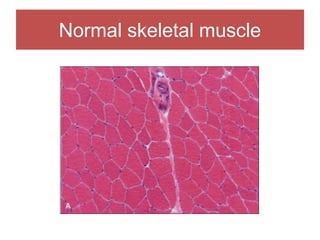
Normal skeletal muscle
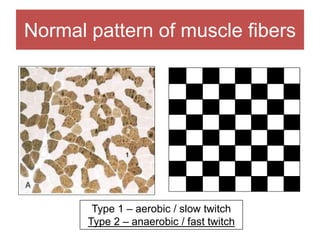
Normal pattern of muscle fibers
Type 1 – aerobic / slow twitch
Type 2 – anaerobic / fast twitch
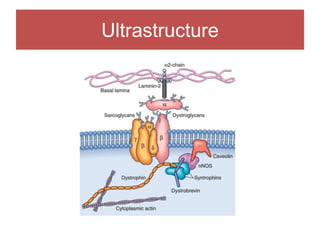
Ultrastructure
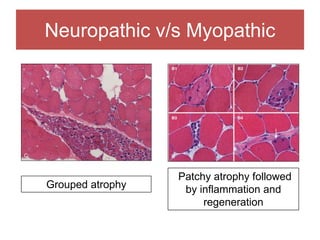
Neuropathic v/s Myopathic
Grouped atrophy
Patchy atrophy followed
by inflammation and
regeneration
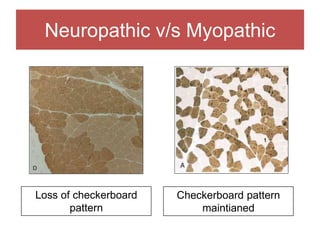
Neuropathic v/s Myopathic
Loss of checkerboard
pattern
Checkerboard pattern
maintianed
Classification of Myopathies
• Inherited
– Dystrophinopathies
– Myotonic dystrophy
– Limb-girdle muscular
– Emery-Dreifuss
– Fascioscapulohumeral
dystrophy
– Channelopathies
– Metabolic
– Mitochondrial
• Acquired
– Inflammatory
– Toxic
Inherited myopathies
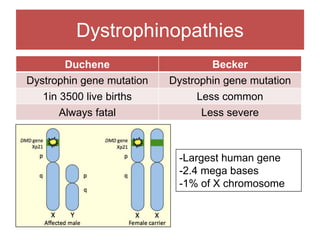
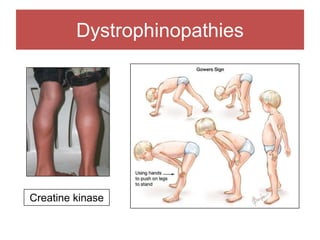
Dystrophinopathies
Duchene Becker
Dystrophin gene mutation Dystrophin gene mutation
1in 3500 live births Less common
Always fatal Less severe
-Largest human gene
-2.4 mega bases
-1% of X chromosome
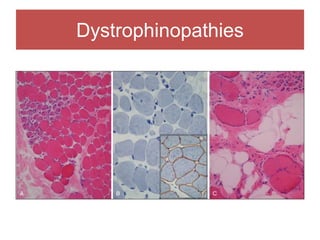
Dystrophinopathies
Dystrophinopathies
• Pathogenesis
– Dystrophin-glycoprotein complex stabilizes
the muscle cell
– Involved in cell signaling
– Defects make muscle cells vulnerable to
membrane tears
– Lead to calcium influx, and disrupt
intracellular signaling
– Results in myofiber degenerationents.
Dystrophinopathies
Creatine kinase
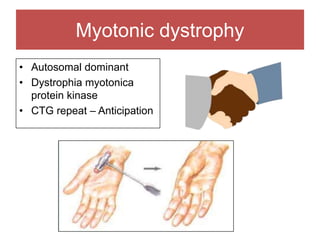
Myotonic dystrophy
• Autosomal dominant
• Dystrophia myotonica
protein kinase
• CTG repeat – Anticipation
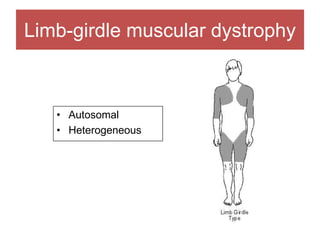
Limb-girdle muscular dystrophy
• Autosomal
• Heterogeneous
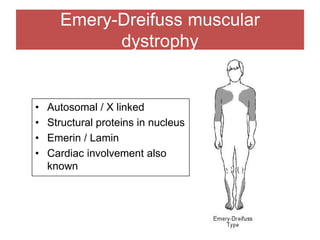
Emery-Dreifuss muscular
dystrophy
• Autosomal / X linked
• Structural proteins in nucleus
• Emerin / Lamin
• Cardiac involvement also
known
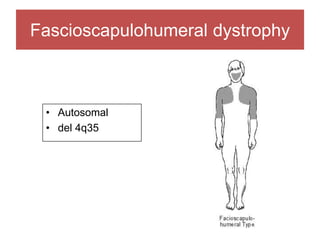
Fascioscapulohumeral dystrophy
• Autosomal
• del 4q35
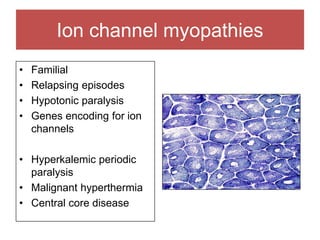
Ion channel myopathies
• Familial
• Relapsing episodes
• Hypotonic paralysis
• Genes encoding for ion
channels
• Hyperkalemic periodic
paralysis
• Malignant hyperthermia
• Central core disease
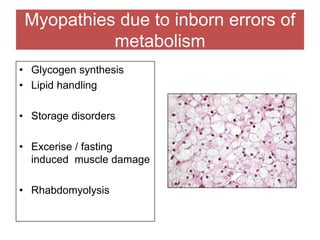
Myopathies due to inborn errors of
metabolism
• Glycogen synthesis
• Lipid handling
• Storage disorders
• Excerise / fasting
induced muscle damage
• Rhabdomyolysis
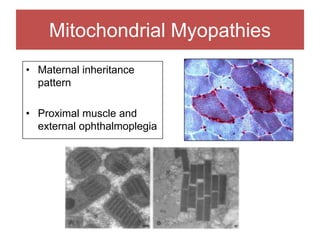
Mitochondrial Myopathies
• Maternal inheritance
pattern
• Proximal muscle and
external ophthalmoplegia
Acquired myopathies
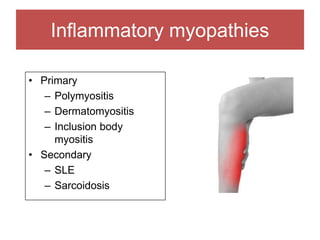
Inflammatory myopathies
• Primary
– Polymyositis
– Dermatomyositis
– Inclusion body
myositis
• Secondary
– SLE
– Sarcoidosis
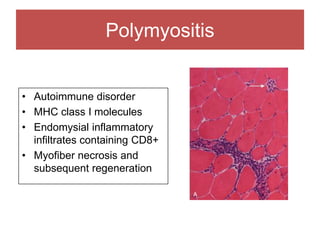
Polymyositis
• Autoimmune disorder
• MHC class I molecules
• Endomysial inflammatory
infiltrates containing CD8+
• Myofiber necrosis and
subsequent regeneration
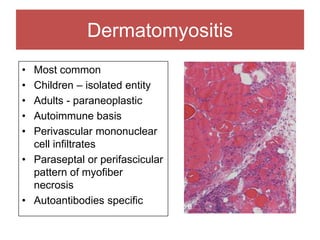
Dermatomyositis
• Most common
• Children – isolated entity
• Adults - paraneoplastic
• Autoimmune basis
• Perivascular mononuclear
cell infiltrates
• Paraseptal or perifascicular
pattern of myofiber
necrosis
• Autoantibodies specific
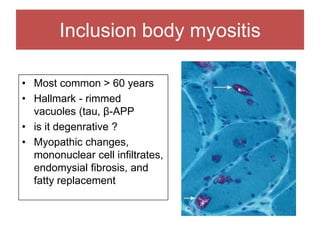
Inclusion body myositis
• Most common > 60 years
• Hallmark - rimmed
vacuoles (tau, β-APP
• is it degenrative ?
• Myopathic changes,
mononuclear cell infiltrates,
endomysial fibrosis, and
fatty replacement
Toxic myopathy
• Thyrotoxic myopathy
– acute or chronic proximal muscle weakness
– myofiber necrosis and regeneration
• Ethanol myopathy
– after binge drinking
– rhabdomyolysis with acute muscle pain
– Myocyte swelling, necrosis, and regeneration
• Drug myopathy
– Statins
– myopathic injury, without an inflammatory
component.
Summarise
Questions ?

Myopathies