Skeletal muscle disorder
Dr Tushar
Organization of Skeletal Muscle Including
Connective Tissue (CT) Compartments
EPIMYSIU
M
•Loose CT
•Blood vessels
PERIMYSIUM
•Septa
•Nerve branches
•Muscle spindles
•Fat
•Blood vessels
ENDOMYSIUM
•Muscle fibers
•Capillaries
•Small nerve fibers
Perimyseal
connective tissue
Endomyseal
connective tissue
Normal H&E-Stained Frozen Cross-Section of Skeletal Muscle
 Note uniform sizes, polygonal shapes, and eccentric nuclei.
Normal H&E-Stained
Longitudinal Paraffin Section
• Note the banding pattern.
• Nuclei are eccentrically placed.
 Can be identified by the esterase
reaction due to the presence of
acetylcholinesterase.
Neuromuscular
Junctions
Normal Structures: Muscle Spindle
and Associated Nerve Fibers
(Gomori trichrome)
 Type I fibers are light
 Type II fibers are dark (pattern reverses at ATPase pH 4.3)
Normal (ATPase pH
9.4)
Skeletal Muscle atrophy
• common features of many
disorders
• causes:- loss of innervation ,
disuse, cachexia, old age, and
primary myopathies
• patterns:-
– clusters or groups of atrophic
fibers are seen in neurogenic
disease
– perifascicular atrophy is seen
in dermatomyositis
– type ii fiber atrophy with
sparing of type i fibers is seen
with prolonged corticosteroid
therapy or disuse.
Classification of
Myopathies
ACQUIRED INHERITED
Inflammatory Myopathies Dystrophies
Polymyositis (PM) Dystrophinopathies
Dermatomyositis (DM) Limb-Girdle
Inclusion body myositis (IBM) Myotonic
Granulomatous myositis Facioscapulohumeral (FSHD)
Infectious myositis Oculopharyngeal (OPD)
Toxic Distal
Endocrine Congenital
Metabolic
Mitochondrial
Glycogen & lipid storage
Muscle Biopsy
• Often necessary for final diagnosis of myopathy
• Choose site based on clinical, electrodiagnostic, or
imaging features
• avoid “end-stage” fatty muscle
• Frozen sections most useful
• routine stains
• histochemistry
• immunohistochemistry
ACQUIRED
Inflammatory Myopathies
Polymyositis
• Adult-onset inflammatory myopathy that shares myalgia and weakness
with dermatomyositis but lacks its distinctive cutaneous features.
• Pathogenesis:
– Believed to have an immunologic basis.
– CD8-positve cytotoxic T cells are a prominent part of the
inflammatory infiltrate in affected muscle (mediators of tissue
damage)
– Vascular injury does not play major role (unlike dermatomyositis)
• Morphology:
– Endomysial mononuclear inflammatory cell infiltrates
– Degenerating necrotic, regenerating and atrophic myofibers are
typically found in a random or patchy distribution
– Absent perifascicular pattern of atrophy (characteristic of
Polymyositis
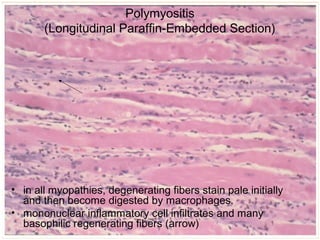
(Longitudinal Paraffin-Embedded Section)
• in all myopathies, degenerating fibers stain pale initially
and then become digested by macrophages.
• mononuclear inflammatory cell infiltrates and many
basophilic regenerating fibers (arrow)
Polymyositis
(Longitudinal Paraffin-Embedded Section-Higher Power)
• regenerating fiber (non-specific)
• fiber is basophilic due to presence of increased
RNA and RNA.
• activated plump nuclei and prominent nucleoli
Invasion of a Non-necrotic Fiber by
Inflammatory Cells
• Seen in polymyositis, inclusion body myositis, and a
few dystrophies.
Myophagocytosis
(Esterase Stain)
• macrophages are ingesting the remnants of a degenerating
fiber. this is a non-specific myopathic finding.
Dermatomyositis
• Immunologic disease in which damage to small blood vessels contributes to muscle
injury.
• Vasculopathic changes – Telangiectasias
• Pathogenesis :
– Inflammatory signature enriched for genes that are unregulated by type I
interferons is seen in muscle and in leukocytes (prominence – disease activity)
– Autoantibodies:
• Anti-Mi2 antibodies – Directed against a helicase implicated in nucleosome
remodeling. Strong association with prominent Gottron papules and heliotrope
rash.
• Anti-Jo1 antibodies – Directed against the enzyme histidyl t-RNA synthetase,
associated with interstitial lung disease, nonerosive arthritis and a skin rash
(Mechanic’s hand)
• Anti-P155/P140 antibodies – Directed against several transcriptional
• Morphology:
– Perimysial mononuclear inflammatory infiltrates in connective
tissue and around blood vessels.
– Myofiber atrophy is accentuated at the edges of the fascicles –
Perifascicular atrophy
– Segmental fiber necrosis and regeneration.
– Deposition of CD4+ T-helper cells and C5b-9 (MAC) in capillary
vessels.
– EM: tubuloreticular endothelial cell inclusion
Dermatomyositis
• perifascicular atrophy & degeneration
• perimysial nflammatory cells surround a blood vessel.
• inflammatory cells tend to be b-cells.
• vasculitis with bowel infarction and subcutaneous
calcifications sometimes occur in the childhood form.
Perifascicular Atrophy
(NADH-Reacted Section)
Membrane Attack Complex
(MAC)
(Immunohistochemical Stain)
• MAC is the terminal component of the complement
pathway.
• It is often deposited in capillaries in dermatomyositis.
INCLUSION BODY MYOSITIS
• Disease of late adulthood that typically affects patients older than 50
years and is the most common inflammatory myopathy in patients older
than age 65 years.
• Slowly progressive muscle weakness – m/c feature
– Most severe in quadriceps and distal upper extremity muscles.
– Dysphasia from esophageal and pharyngeal muscle involvement
• Lab investigation:
– S. creatine kinase level increased
– Myositis associated autoantibodies are absent.
• Morphology:
– Patchy often endomysial mononuclear inflammatory cell infiltrate rich in
CD8+ T- cells
– Increased sarcolemmal expression of MHC class I antigens
– Focal invasion of normal appearing myofibers by inflammatory cells
– Admixed degenerating and regenrating myofibers
– Abnormal cytoplasmic inclusions described as “rimmed vacuoles”
– Tubolofilamentous inclusions in myofibers – EM
– Cytoplasmic inclusions containing proteins typically associated with
neurodegenerative disease, like beta-amyloid, TDP-43, and ubiquintin
– Endomysial fibrosis and fatty replacement, reflective of a chronic disease
course.
Inclusion Body Myositis (IBM)
• Features of chronic myopathy with endomysial inflammation and
rimmed vacuoles are characteristic.
Vacuole
Invaded fiber
Lymphocytic inflammation
“Rimmed vacuoles”
• IBM: Vacuoles contain amyloid.
(Congo Red)
IBM Intracytoplasmic (within Vacuoles) or
Intranuclear Filamentous Inclusions
Giant cell
 Granulomas tend not to cause significant damage to adjacent
myofibers.
Granulomatous Myositis in a Patient with
Sarcoidosis
Endocrine Disturbance Type II Fiber Atrophy
(ATPase pH9.4)
• Characteristic of most endocrine myopathies and steroid
myopathy
Toxic myopathies
• Statin induced
• Chloroquine & hydroxychloroquine (Drug induced lysosomal storage
myopathy)
• ICU myopathy (corticosteroid therapy)
– Degradation of sarcomeric myosin thick filaments leading
to profound weakness
• Thyrotoxic myopathy
– Proximal muscle weakness, exophthalamic
ophthalmoplegia
• Alcohol
INHERITED
Congenital Myopathies
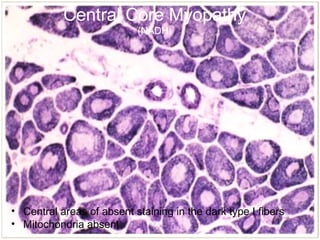
Central Core Myopathy
(NADH)
• Central areas of absent staining in the dark type I fibers
• Mitochondria absent
Congenital Myopathies: Central Core Myopathy
(NADH)
 The core consists of disorganized myofibrils and the area is devoid
of mitochondria.
 Eosinophilic inclusions present.
Nemaline Myopathy
Nemaline Myopathy
(Gomori Trichrome)
• Eosinophilic inclusions stain
darkly.
Nemaline Myopathy
(Electron Microscopy)
• Named for thread-like appearance
• Inclusions extend from Z-band to Z-band
Centronuclear myopathy
 Internalized nuclei predominant.
 Consistent with centronuclear myopathy.
 Can be seen in other disorders such as myotonic dystrophy with
congenital onset.
Muscle Biopsy from an Infant:
Centronuclear Myopathy
• Central position of the nucleus
resembling an embryonic
Congenital Fiber Type
Disproportion
(H&E)
• Bimodal size
population
Muscular
Dystrophies
X linked muscular dystrophy
with dystrophin mutation
Duchenne and Becker musclar
dystrophy
• Most common muscular dystrophies x-linked and stem from mutations that disrupt the
function of a large structural protein called dystrophin.
• Early onset form – Duchenne muscular dystrophy
– Severe progressive phenotype
• Late onset form - Becker muscular dystrophy
– Isolated cardiomyopathy, asymptomatic elevation of creatine kinase, exercise
intolerance
• Pathogenesis:
– Loss of function mutations in the dystrophin gene on X- chormosome
– Dystrophin provide mechanical stability to the myofiber and its cell complex
• Morphology:
– Chnages in Duchenne and Becker muscular dystrophy are similar, but differ in
degree.
– Chronic muscle damage that outpaces the capacity for repair.
– Segmental myofiber degeneration and regeneration with an admixture of atrophic
myofirbers.
– Fatty replacement as disease progress
– IHC studies show absence of the normal sarcolemmal staining pattern in
Duchenne muscular dystrophin and reduced stationing in Becker muscular
• Clinical Feature
– Duchenne muscular dystrphy
• Normal at birth
• Early motor milestones
• Walking is delayed
• Clumsiness & inability to keep up with peers
• Pseudohyperthrophy of muscle
• Mean age of wheel chair dependence around 9.5 years
• Cardiomyopathy & arrhythmias
• Frank mental retardation
• Mean age of death 25 to 30 years
– Becker muscular dystrophy
• Later onset and slowly progressive
Frozen Section from a Patient with
Duchenne Muscular Dystrophy
• Opaque or hyaline fibers (arrows)
• Increase in endomysial connective tissue
Group of basophilic regenerating fibers
Normal Immunohistochemical Stain for
Dystrophin
(Subsarcolemmal Staining)
Duchenne Muscular Dystrophy
(Absent Staining for Dystrophin)
split fiber
(non-specific chronic change)
Becker Muscular Dystrophy
(Reduced but Present Staining)
Female Carrier of Duchenne Muscular
Dystrophy
(A Mosaic Staining Pattern)
Myotonic Dystrophy
• Autosomal dominant multisystem disorder associated with skeletal
muscle weakness, cataracts, endocrinopathy, and cardiomyopathy.
• Myotonia key feature
• Pathogenesis
– Expansions of CTG triplet repeats in 3’-noncoding region of
myotonic dystrophy protein kinase (DMPK)
– Toxic gain of function
– CUG-repeats in the DMPK mRNA transcript appear to bind and
sequester a protein called muscleblind-like1 – Important role in
RNA splicing.
– This inhibits muscleblind-like-1function leading to missplicing of
other RNA transcripts including transcript for a chloride channel
called CLC1and is responsible for characteristic myotonia.
Myotonic Dystrophy
• Chronic changes
• Marked excess in internalized nuclei
• Variation in fiber sizes
• Nuclear clumps (not shown)
(H & E, Paraffin)
 The excess of internalized nuclei can lead to nuclear
chains.
Myotonic Dystrophy
(NADH-Reacted Section)
• Ring fibers in which myofilaments are organized
in different directions
Emery-Dreifuss Muscular
Dystrophy
• Caused by mutation in genes that encode nuclear lamina proteins.
• Triad
– Slowly progressive humeroperoneal weakness
– Cardiomyopathy
– Early contractures of the Achilles tendon, spine & elbow
• X-linked form [EMD1]– mutation in genes encoding emerin
• Autosomal form [EMD2] – mutation in genes encoding lamin
• These protein helps in maintaining the shape and mechanical stability of the
nucleus during muscle contraction.
Emery-Dreifuss Muscular Dystrophy
(Gomori Trichrome-Stained Frozen Section)
Necrotic fiber
 Variation in fiber size with many hypertrophic fibers
 Increase in endomysial connective tissue
 Nonspecific so-called dystrophic changes seen in many of the muscular
dystrophies.
 Can also be seen in any chronic myopathic disorder.
 This disorder is due to loss of the protein emerin.
Fascioscapulohumeral
Dystrophy
• Characteristic pattern of muscle involvement that includes prominent
weakness of facial muscles and muscles of the shoulder girdle.
• Autosomal Dominant
• Pathogenesis:
– Overexpression of a gene called DUX4, located in a region of
subtelomeric repeats on the long arm of chromosome 4.
– Deletion in flanking repeats causes changes in chromatin that derepress
the remaining copies of DUX4 thus leading to overexpression.
Fascioscapulohumeral Dystrophy (FSHD)
• The majority of dystrophies do not have a specific histopathologic appearance.
• Clinical features are also very important.
• For example, winging of the scapula is characteristic of FSHD.
FSH Dystrophy
• Variable non-specific changes
• Range from scattered atrophy to “dystrophic” features.
• Inflammation can be present (arrow).
Limb-Girdle Muscular Dystrophy
• Heterogeneous group
– 6 AD
– 15 AT
• Characterized by muscle weakness that preferentially involves proximal
muscle groups.
• Pathogenesis
– Genes encoding structural components (sarcoglycans) of the
dystrophin glycoprotein complex
– Genes encoding enzymes that are responsible for glycosylation of a-
dystroglycan, a component of the dystrophin glycoprotein complex
– Genes encoding proteins that associate with the Z-disks of sarcomeres
– Genes encoding proteins involved in vesicle trafficking and cell
signaling
– Genes that seemingly stand alone, such as those encoding the
protease calpain 3 and laminA/C (which is also mutated in some
patients with Emery-Dreifuss muscular dystrophy)
INHERITANCE
GENETIC
ABNORMALITY
DISORDER
X-linked
Dystrophin
Emerin
Duchenne, Becker MD
Emery-Dreifuss MD
AD
Myotilin
Lamin A/C
Caveolin – 3
PABP2
αβ-crystallin/Desmin
Limb-Girdle MD (LGMD 1A)
LGMD 1B
LGMD 1C
Oculopharyngeal
Myofibrillar Myopathy
AR
Calpain – 3
Dysferlin
g Sarcoglycan
a Sarcoglycan
β Sarcoglycan
Δ Sarcoglycan
Telethonin
LGMD 2A
LGMD 2B
LGMD 2C
LGMD 2D
LGMD 2E
LGMD 2F
LGMD 2G
Mutations in “Limb-Girdle” and Other
Dystrophies
Mitochondrial Myopathies
• Complex systemic conditions that can involve many organ systems,
including skeletal muscle.
• Manifest as weakness, elevations in serum creatine kinase levels, or
rhabdomyolysis.
• Morphology:
– Most consistent pathologic change in skeletal muscle is abnormal
aggregates of mitochondria that are seen preferentially in the
subsarcolemmal area.
– Ragged red fibers appearance.
– Morphologically abnormal mitochondria – EM
• Clinical feature
– Chronic progressive external ophthalmoplegia
– Mitochondrial encephalomyopathy with lactic acidosis and strokelike
episodes
– Kearns-Sayre syndrome
– Myoclonic epilepsy with ragged red fibers
– Leber hereditary optic neuropathy
Metabolic: Inherited – Mitochondrial
Myopathy
 Ragged red fiber present (Gomori trichrome)
 Due to proliferation of abnormal mitochondria
 SDH-rich fibers are seen with mitochondrial proliferation.
 SDH is a respiratory chain enzyme encoded by nuclear DNA.
Mitochondrial Myopathy
(Succinic Dehydrogenase
Reaction)
Cytochrome Oxidase (COX) Respiratory Chain
Enzyme
Normal Fibers
Many COX-Negative
Fibers
 COX-negative fibers are usually seen with mtDNA mutations.
Mitochondrial Disorders
(Electron Microscopy)
Higher power view of paracrystalline inclusion
Disease of Lipid or Glycogen
Metabolism
• Inborn errors of lipid or glycogen metabolism
• Severe muscle cramping and pain
• Extensive muscle necrosis (rhabdomyolysis)
• Example
– Carnitine palmitoyltransferace II deficiency (m/c)
– Myophosphorylase deficiency (McArdle ds)
– Acid maltase deficiency
• Increased lipid storage
• Seen in carnitine deficiency states (primary or secondary)
• Sometimes as a consequence of certain toxins
• Focal increases can be non-specific.
(Oil-Red-O
Stain)
Lipid Storage Myopathy
(Electron Microscopy)
Glycogen Storage Myopathies
• Some glycogen storage myopathies, such as myophosphorylase deficiency
(McArdle’s Disease), cause subsarcolemmal blebs.
• PAS-positive due to the presence of glycogen.
• Only with acid maltase deficiency is glycogen deposited in lysomsomes.
Acid Maltase Deficiency
(Acid Phosphatase)
• Due to the intralysosomal activity of this enzyme
• Prominent staining with acid phosphatase in vacuoles
Vacuolarmyopathy noted.
Normal Glycogen
(PAS Stain) Control
Increased Glycogen
 Acid maltase deficiency
 Increased glycogen (diffusely and in vacuoles)
Ion Channel Myopathies
(Channelopathies)
• KCNJ2 :
– mutations affecting this potassium channel cause Andersen-Twail
syndrome
• AD, Periodic paralysis, Heart arrhythmias, skeletal abnormalities
• SCN4A :
– Mutations affecting this sodium channel cause several AD with
presentations ranging from myotonia to periodic paralysis.
• CACNA1S :
– Missense mutations in this protein, a subunit of a muscle calcium
channel, are the most common cause of hypokalemic paralysis.
• CLC1:
– Mutations affecting this chloride channel cuases myotonia congenita
– Expression decreased in myotonic dystrophy
• RYR1:
– Mutation in the RYR1 gene disrupt the funciton of the ryanodine
receptor , which regulated calcium release from the sarcoplasmic
reticulum
– Central core myopathy
Thank you for listening.
Have a Good Day.

myopathy (1).pdf

  • 1.
  • 2.
    Organization of SkeletalMuscle Including Connective Tissue (CT) Compartments EPIMYSIU M •Loose CT •Blood vessels PERIMYSIUM •Septa •Nerve branches •Muscle spindles •Fat •Blood vessels ENDOMYSIUM •Muscle fibers •Capillaries •Small nerve fibers
  • 3.
    Perimyseal connective tissue Endomyseal connective tissue NormalH&E-Stained Frozen Cross-Section of Skeletal Muscle  Note uniform sizes, polygonal shapes, and eccentric nuclei.
  • 4.
    Normal H&E-Stained Longitudinal ParaffinSection • Note the banding pattern. • Nuclei are eccentrically placed.
  • 5.
     Can beidentified by the esterase reaction due to the presence of acetylcholinesterase. Neuromuscular Junctions Normal Structures: Muscle Spindle and Associated Nerve Fibers (Gomori trichrome)
  • 6.
     Type Ifibers are light  Type II fibers are dark (pattern reverses at ATPase pH 4.3) Normal (ATPase pH 9.4)
  • 7.
    Skeletal Muscle atrophy •common features of many disorders • causes:- loss of innervation , disuse, cachexia, old age, and primary myopathies • patterns:- – clusters or groups of atrophic fibers are seen in neurogenic disease – perifascicular atrophy is seen in dermatomyositis – type ii fiber atrophy with sparing of type i fibers is seen with prolonged corticosteroid therapy or disuse.
  • 8.
    Classification of Myopathies ACQUIRED INHERITED InflammatoryMyopathies Dystrophies Polymyositis (PM) Dystrophinopathies Dermatomyositis (DM) Limb-Girdle Inclusion body myositis (IBM) Myotonic Granulomatous myositis Facioscapulohumeral (FSHD) Infectious myositis Oculopharyngeal (OPD) Toxic Distal Endocrine Congenital Metabolic Mitochondrial Glycogen & lipid storage
  • 9.
    Muscle Biopsy • Oftennecessary for final diagnosis of myopathy • Choose site based on clinical, electrodiagnostic, or imaging features • avoid “end-stage” fatty muscle • Frozen sections most useful • routine stains • histochemistry • immunohistochemistry
  • 10.
  • 11.
  • 12.
    Polymyositis • Adult-onset inflammatorymyopathy that shares myalgia and weakness with dermatomyositis but lacks its distinctive cutaneous features. • Pathogenesis: – Believed to have an immunologic basis. – CD8-positve cytotoxic T cells are a prominent part of the inflammatory infiltrate in affected muscle (mediators of tissue damage) – Vascular injury does not play major role (unlike dermatomyositis) • Morphology: – Endomysial mononuclear inflammatory cell infiltrates – Degenerating necrotic, regenerating and atrophic myofibers are typically found in a random or patchy distribution – Absent perifascicular pattern of atrophy (characteristic of
  • 13.
    Polymyositis (Longitudinal Paraffin-Embedded Section) •in all myopathies, degenerating fibers stain pale initially and then become digested by macrophages. • mononuclear inflammatory cell infiltrates and many basophilic regenerating fibers (arrow)
  • 14.
    Polymyositis (Longitudinal Paraffin-Embedded Section-HigherPower) • regenerating fiber (non-specific) • fiber is basophilic due to presence of increased RNA and RNA. • activated plump nuclei and prominent nucleoli
  • 15.
    Invasion of aNon-necrotic Fiber by Inflammatory Cells • Seen in polymyositis, inclusion body myositis, and a few dystrophies.
  • 16.
    Myophagocytosis (Esterase Stain) • macrophagesare ingesting the remnants of a degenerating fiber. this is a non-specific myopathic finding.
  • 17.
    Dermatomyositis • Immunologic diseasein which damage to small blood vessels contributes to muscle injury. • Vasculopathic changes – Telangiectasias • Pathogenesis : – Inflammatory signature enriched for genes that are unregulated by type I interferons is seen in muscle and in leukocytes (prominence – disease activity) – Autoantibodies: • Anti-Mi2 antibodies – Directed against a helicase implicated in nucleosome remodeling. Strong association with prominent Gottron papules and heliotrope rash. • Anti-Jo1 antibodies – Directed against the enzyme histidyl t-RNA synthetase, associated with interstitial lung disease, nonerosive arthritis and a skin rash (Mechanic’s hand) • Anti-P155/P140 antibodies – Directed against several transcriptional
  • 18.
    • Morphology: – Perimysialmononuclear inflammatory infiltrates in connective tissue and around blood vessels. – Myofiber atrophy is accentuated at the edges of the fascicles – Perifascicular atrophy – Segmental fiber necrosis and regeneration. – Deposition of CD4+ T-helper cells and C5b-9 (MAC) in capillary vessels. – EM: tubuloreticular endothelial cell inclusion
  • 19.
    Dermatomyositis • perifascicular atrophy& degeneration • perimysial nflammatory cells surround a blood vessel. • inflammatory cells tend to be b-cells. • vasculitis with bowel infarction and subcutaneous calcifications sometimes occur in the childhood form.
  • 20.
  • 22.
    Membrane Attack Complex (MAC) (ImmunohistochemicalStain) • MAC is the terminal component of the complement pathway. • It is often deposited in capillaries in dermatomyositis.
  • 23.
    INCLUSION BODY MYOSITIS •Disease of late adulthood that typically affects patients older than 50 years and is the most common inflammatory myopathy in patients older than age 65 years. • Slowly progressive muscle weakness – m/c feature – Most severe in quadriceps and distal upper extremity muscles. – Dysphasia from esophageal and pharyngeal muscle involvement • Lab investigation: – S. creatine kinase level increased – Myositis associated autoantibodies are absent.
  • 24.
    • Morphology: – Patchyoften endomysial mononuclear inflammatory cell infiltrate rich in CD8+ T- cells – Increased sarcolemmal expression of MHC class I antigens – Focal invasion of normal appearing myofibers by inflammatory cells – Admixed degenerating and regenrating myofibers – Abnormal cytoplasmic inclusions described as “rimmed vacuoles” – Tubolofilamentous inclusions in myofibers – EM – Cytoplasmic inclusions containing proteins typically associated with neurodegenerative disease, like beta-amyloid, TDP-43, and ubiquintin – Endomysial fibrosis and fatty replacement, reflective of a chronic disease course.
  • 25.
    Inclusion Body Myositis(IBM) • Features of chronic myopathy with endomysial inflammation and rimmed vacuoles are characteristic. Vacuole Invaded fiber
  • 26.
  • 27.
    • IBM: Vacuolescontain amyloid. (Congo Red)
  • 28.
    IBM Intracytoplasmic (withinVacuoles) or Intranuclear Filamentous Inclusions
  • 30.
    Giant cell  Granulomastend not to cause significant damage to adjacent myofibers. Granulomatous Myositis in a Patient with Sarcoidosis
  • 31.
    Endocrine Disturbance TypeII Fiber Atrophy (ATPase pH9.4) • Characteristic of most endocrine myopathies and steroid myopathy
  • 32.
    Toxic myopathies • Statininduced • Chloroquine & hydroxychloroquine (Drug induced lysosomal storage myopathy) • ICU myopathy (corticosteroid therapy) – Degradation of sarcomeric myosin thick filaments leading to profound weakness • Thyrotoxic myopathy – Proximal muscle weakness, exophthalamic ophthalmoplegia • Alcohol
  • 33.
  • 34.
  • 36.
    Central Core Myopathy (NADH) •Central areas of absent staining in the dark type I fibers • Mitochondria absent
  • 37.
    Congenital Myopathies: CentralCore Myopathy (NADH)  The core consists of disorganized myofibrils and the area is devoid of mitochondria.
  • 38.
     Eosinophilic inclusionspresent. Nemaline Myopathy
  • 39.
    Nemaline Myopathy (Gomori Trichrome) •Eosinophilic inclusions stain darkly.
  • 40.
    Nemaline Myopathy (Electron Microscopy) •Named for thread-like appearance • Inclusions extend from Z-band to Z-band
  • 41.
    Centronuclear myopathy  Internalizednuclei predominant.  Consistent with centronuclear myopathy.  Can be seen in other disorders such as myotonic dystrophy with congenital onset.
  • 42.
    Muscle Biopsy froman Infant: Centronuclear Myopathy • Central position of the nucleus resembling an embryonic
  • 43.
  • 44.
  • 45.
    X linked musculardystrophy with dystrophin mutation
  • 46.
    Duchenne and Beckermusclar dystrophy • Most common muscular dystrophies x-linked and stem from mutations that disrupt the function of a large structural protein called dystrophin. • Early onset form – Duchenne muscular dystrophy – Severe progressive phenotype • Late onset form - Becker muscular dystrophy – Isolated cardiomyopathy, asymptomatic elevation of creatine kinase, exercise intolerance • Pathogenesis: – Loss of function mutations in the dystrophin gene on X- chormosome – Dystrophin provide mechanical stability to the myofiber and its cell complex • Morphology: – Chnages in Duchenne and Becker muscular dystrophy are similar, but differ in degree. – Chronic muscle damage that outpaces the capacity for repair. – Segmental myofiber degeneration and regeneration with an admixture of atrophic myofirbers. – Fatty replacement as disease progress – IHC studies show absence of the normal sarcolemmal staining pattern in Duchenne muscular dystrophin and reduced stationing in Becker muscular
  • 47.
    • Clinical Feature –Duchenne muscular dystrphy • Normal at birth • Early motor milestones • Walking is delayed • Clumsiness & inability to keep up with peers • Pseudohyperthrophy of muscle • Mean age of wheel chair dependence around 9.5 years • Cardiomyopathy & arrhythmias • Frank mental retardation • Mean age of death 25 to 30 years – Becker muscular dystrophy • Later onset and slowly progressive
  • 48.
    Frozen Section froma Patient with Duchenne Muscular Dystrophy • Opaque or hyaline fibers (arrows) • Increase in endomysial connective tissue Group of basophilic regenerating fibers
  • 49.
    Normal Immunohistochemical Stainfor Dystrophin (Subsarcolemmal Staining)
  • 50.
    Duchenne Muscular Dystrophy (AbsentStaining for Dystrophin)
  • 51.
    split fiber (non-specific chronicchange) Becker Muscular Dystrophy (Reduced but Present Staining)
  • 52.
    Female Carrier ofDuchenne Muscular Dystrophy (A Mosaic Staining Pattern)
  • 53.
    Myotonic Dystrophy • Autosomaldominant multisystem disorder associated with skeletal muscle weakness, cataracts, endocrinopathy, and cardiomyopathy. • Myotonia key feature • Pathogenesis – Expansions of CTG triplet repeats in 3’-noncoding region of myotonic dystrophy protein kinase (DMPK) – Toxic gain of function – CUG-repeats in the DMPK mRNA transcript appear to bind and sequester a protein called muscleblind-like1 – Important role in RNA splicing. – This inhibits muscleblind-like-1function leading to missplicing of other RNA transcripts including transcript for a chloride channel called CLC1and is responsible for characteristic myotonia.
  • 54.
    Myotonic Dystrophy • Chronicchanges • Marked excess in internalized nuclei • Variation in fiber sizes • Nuclear clumps (not shown)
  • 55.
    (H & E,Paraffin)  The excess of internalized nuclei can lead to nuclear chains.
  • 56.
    Myotonic Dystrophy (NADH-Reacted Section) •Ring fibers in which myofilaments are organized in different directions
  • 57.
    Emery-Dreifuss Muscular Dystrophy • Causedby mutation in genes that encode nuclear lamina proteins. • Triad – Slowly progressive humeroperoneal weakness – Cardiomyopathy – Early contractures of the Achilles tendon, spine & elbow • X-linked form [EMD1]– mutation in genes encoding emerin • Autosomal form [EMD2] – mutation in genes encoding lamin • These protein helps in maintaining the shape and mechanical stability of the nucleus during muscle contraction.
  • 58.
    Emery-Dreifuss Muscular Dystrophy (GomoriTrichrome-Stained Frozen Section) Necrotic fiber  Variation in fiber size with many hypertrophic fibers  Increase in endomysial connective tissue  Nonspecific so-called dystrophic changes seen in many of the muscular dystrophies.  Can also be seen in any chronic myopathic disorder.  This disorder is due to loss of the protein emerin.
  • 59.
    Fascioscapulohumeral Dystrophy • Characteristic patternof muscle involvement that includes prominent weakness of facial muscles and muscles of the shoulder girdle. • Autosomal Dominant • Pathogenesis: – Overexpression of a gene called DUX4, located in a region of subtelomeric repeats on the long arm of chromosome 4. – Deletion in flanking repeats causes changes in chromatin that derepress the remaining copies of DUX4 thus leading to overexpression.
  • 60.
    Fascioscapulohumeral Dystrophy (FSHD) •The majority of dystrophies do not have a specific histopathologic appearance. • Clinical features are also very important. • For example, winging of the scapula is characteristic of FSHD.
  • 61.
    FSH Dystrophy • Variablenon-specific changes • Range from scattered atrophy to “dystrophic” features. • Inflammation can be present (arrow).
  • 62.
    Limb-Girdle Muscular Dystrophy •Heterogeneous group – 6 AD – 15 AT • Characterized by muscle weakness that preferentially involves proximal muscle groups. • Pathogenesis – Genes encoding structural components (sarcoglycans) of the dystrophin glycoprotein complex – Genes encoding enzymes that are responsible for glycosylation of a- dystroglycan, a component of the dystrophin glycoprotein complex – Genes encoding proteins that associate with the Z-disks of sarcomeres – Genes encoding proteins involved in vesicle trafficking and cell signaling – Genes that seemingly stand alone, such as those encoding the protease calpain 3 and laminA/C (which is also mutated in some patients with Emery-Dreifuss muscular dystrophy)
  • 63.
    INHERITANCE GENETIC ABNORMALITY DISORDER X-linked Dystrophin Emerin Duchenne, Becker MD Emery-DreifussMD AD Myotilin Lamin A/C Caveolin – 3 PABP2 αβ-crystallin/Desmin Limb-Girdle MD (LGMD 1A) LGMD 1B LGMD 1C Oculopharyngeal Myofibrillar Myopathy AR Calpain – 3 Dysferlin g Sarcoglycan a Sarcoglycan β Sarcoglycan Δ Sarcoglycan Telethonin LGMD 2A LGMD 2B LGMD 2C LGMD 2D LGMD 2E LGMD 2F LGMD 2G Mutations in “Limb-Girdle” and Other Dystrophies
  • 64.
    Mitochondrial Myopathies • Complexsystemic conditions that can involve many organ systems, including skeletal muscle. • Manifest as weakness, elevations in serum creatine kinase levels, or rhabdomyolysis. • Morphology: – Most consistent pathologic change in skeletal muscle is abnormal aggregates of mitochondria that are seen preferentially in the subsarcolemmal area. – Ragged red fibers appearance. – Morphologically abnormal mitochondria – EM • Clinical feature – Chronic progressive external ophthalmoplegia – Mitochondrial encephalomyopathy with lactic acidosis and strokelike episodes – Kearns-Sayre syndrome – Myoclonic epilepsy with ragged red fibers – Leber hereditary optic neuropathy
  • 65.
    Metabolic: Inherited –Mitochondrial Myopathy  Ragged red fiber present (Gomori trichrome)  Due to proliferation of abnormal mitochondria
  • 66.
     SDH-rich fibersare seen with mitochondrial proliferation.  SDH is a respiratory chain enzyme encoded by nuclear DNA. Mitochondrial Myopathy (Succinic Dehydrogenase Reaction)
  • 67.
    Cytochrome Oxidase (COX)Respiratory Chain Enzyme Normal Fibers
  • 68.
    Many COX-Negative Fibers  COX-negativefibers are usually seen with mtDNA mutations.
  • 69.
    Mitochondrial Disorders (Electron Microscopy) Higherpower view of paracrystalline inclusion
  • 70.
    Disease of Lipidor Glycogen Metabolism • Inborn errors of lipid or glycogen metabolism • Severe muscle cramping and pain • Extensive muscle necrosis (rhabdomyolysis) • Example – Carnitine palmitoyltransferace II deficiency (m/c) – Myophosphorylase deficiency (McArdle ds) – Acid maltase deficiency
  • 71.
    • Increased lipidstorage • Seen in carnitine deficiency states (primary or secondary) • Sometimes as a consequence of certain toxins • Focal increases can be non-specific. (Oil-Red-O Stain)
  • 72.
  • 73.
    Glycogen Storage Myopathies •Some glycogen storage myopathies, such as myophosphorylase deficiency (McArdle’s Disease), cause subsarcolemmal blebs. • PAS-positive due to the presence of glycogen. • Only with acid maltase deficiency is glycogen deposited in lysomsomes.
  • 74.
    Acid Maltase Deficiency (AcidPhosphatase) • Due to the intralysosomal activity of this enzyme • Prominent staining with acid phosphatase in vacuoles Vacuolarmyopathy noted.
  • 75.
  • 76.
    Increased Glycogen  Acidmaltase deficiency  Increased glycogen (diffusely and in vacuoles)
  • 77.
    Ion Channel Myopathies (Channelopathies) •KCNJ2 : – mutations affecting this potassium channel cause Andersen-Twail syndrome • AD, Periodic paralysis, Heart arrhythmias, skeletal abnormalities • SCN4A : – Mutations affecting this sodium channel cause several AD with presentations ranging from myotonia to periodic paralysis. • CACNA1S : – Missense mutations in this protein, a subunit of a muscle calcium channel, are the most common cause of hypokalemic paralysis. • CLC1: – Mutations affecting this chloride channel cuases myotonia congenita – Expression decreased in myotonic dystrophy • RYR1: – Mutation in the RYR1 gene disrupt the funciton of the ryanodine receptor , which regulated calcium release from the sarcoplasmic reticulum – Central core myopathy
  • 78.
    Thank you forlistening. Have a Good Day.