Cellular adaptations and
growth disturbances
SLOs
• Characteristics of cellular adaptations
• Etiological types
• Morphological types
• Examples
• Clinical significance
Cellular adaptations
• Adaptations are reversible
• Response to changes in their environment
• Reversible change can affect
– Number
– Size
– Phenotype
– Metabolic activity
– Functions of cells
Etiopathogenesis of cellular
adaptations
• Physiologic adaptations
• Pathologic adaptations
Morphological types of cellular
adaptations
• Hypertrophy
• Hyperplasia
• Atrophy
• Metaplasia
Hypertrophy
• increase in the size of cells
• increase in the size of the organ
• bigger cells containing increased amounts
of structural proteins and organelles.
• cells have a limited capacity to divide
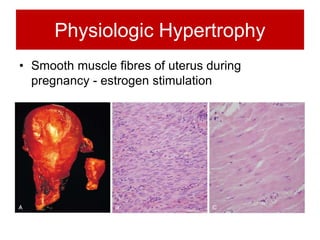
Physiologic Hypertrophy
• Smooth muscle fibres of uterus during
pregnancy - estrogen stimulation
Physiologic hyeprtrophy
• Skeletal muscle – increased work
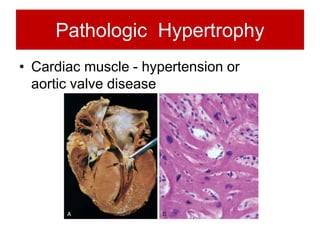
Pathologic Hypertrophy
• Cardiac muscle - hypertension or
aortic valve disease
Mechanism of hypertrophy
• Triggers
– mechanical – stretch
– trophic triggers - growth factors & adrenergic
hormones
• Transduction pathways - Induction of
genes - Synthesis of many cellular
proteins
Hypertrophy is finite
• Beyond a critical point degenerative
changes start
• Eg : heart – initial hypertrophy – followed
by heart failure
Hyperplasia
• increase in the number of cells
• increase in the size of the organ
• cell populations capable of replication
• stimuli similar to those for hypertrophy
Physiologic Hyperplasia
• Hormonal hyperplasia
– glandular epithelium of the female breast at
puberty and during pregnancy
Physiologic Hyperplasia
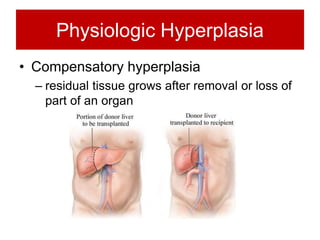
• Compensatory hyperplasia
– residual tissue grows after removal or loss of
part of an organ
Pathologic Hyperplasia
• Cause –
–excessive hormonal stimulation
–excessive growth factor stimulation
Pathologic Hyperplasia
• Endometrial hyperplasia - disturbed
balance between estrogen and
progesterone
Pathologic Hyperplasia
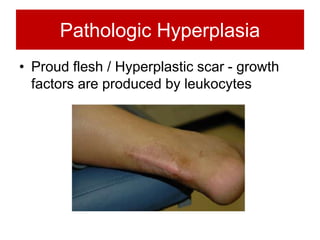
• Proud flesh / Hyperplastic scar - growth
factors are produced by leukocytes
Pathologic Hyperplasia
• Hyperplastic epithelium (warts) - viral
infections
Hyperplasia – fertile soil for cancer
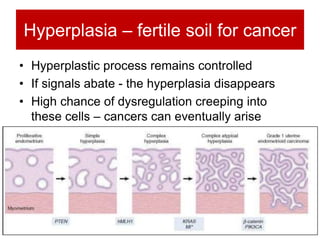
• Hyperplastic process remains controlled
• If signals abate - the hyperplasia disappears
• High chance of dysregulation creeping into
these cells – cancers can eventually arise
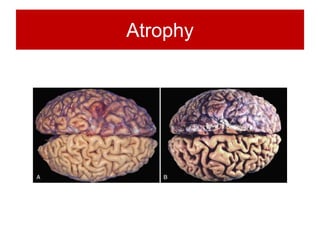
Atrophy
• Shrinkage in the size of the cell
• Loss of cell substance
• Tissue or organ diminishes in size
• Cells have diminished function – But are
not dead
Causes of atrophy
• Causes
– decreased workload
– loss of innervation
– diminished blood supply
– Inadequate nutrition
– loss of endocrine stimulation
– aging
Mechanisms of atrophy
• decreased protein synthesis - reduced
metabolic activity.
• increased protein degradation - ubiquitin-
proteasome pathway
• increased autophagy
Atrophy
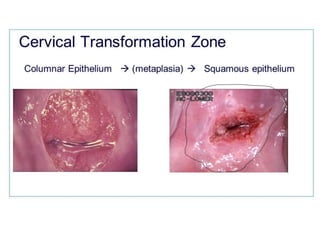
Metaplasia
• reversible change
• one adult cell type (epithelial or
mesenchymal) is replaced by another adult
cell type
• The replaced cell type better able to
withstand the adverse environment
• Reprogramming of stem cells –
transdifferentiation
• Eg:
– Epithelial metaplasia in respiratory epithelium of
habitual smokers
Metaplasia
Metaplasia – Double edged sword
• Survival advantages
• Loss of important protective mechanisms
• Persistent stimuli - predispose to
malignant transformation
Summarise
Questions ?

Cellular adaptations